Clinical remission is an emerging treatment goal in severe asthma, although real-world data on its long-term maintenance remain limited. We retrospectively evaluated 50 patients who initiated first-line biologic therapy with omalizumab, mepolizumab, or reslizumab between 2015 and 2019. Clinical remission at 12 months was defined as no moderate or severe exacerbations, an asthma control test (ACT) score of ≥20, post-bronchodilator forced expiratory volume in 1 second of ≥80% predicted, and no use of maintenance oral corticosteroid. Of these patients, 13 (26.0%) met the criteria for remission. They had significantly higher unadjusted baseline forced vital capacities (FVC; 103.6% vs. 85.7%, p=0.002) and ACT scores (17.5 vs. 11.0, p<0.001), and 6 (46.2%) maintained remission over a median follow-up of 63.0 months. Although remission was achieved in approximately one-quarter of patients, it was maintained in fewer than half. Our baseline FVC and ACT findings require confirmation in larger studies.
La remisión clínica es objetivo terapéutico emergente en el asma grave, aunque los datos del mundo real sobre su mantenimiento a largo plazo siguen siendo limitados. Evaluamos retrospectivamente a 50 pacientes que iniciaron tratamiento biológico de primera línea con omalizumab, mepolizumab o reslizumab entre 2015 y 2019. La remisión clínica a los 12 meses se definió como la ausencia de exacerbaciones moderadas o graves, una puntuación en el Asthma Control Test (ACT) ≥20, un volumen espiratorio forzado en el primer segundo posbroncodilatador ≥80% del valor predicho y la ausencia de tratamiento de mantenimiento con corticoides orales. De estos pacientes, 13 (26,0%) cumplieron los criterios de remisión. En comparación con los pacientes que no alcanzaron la remisión, presentaban una capacidad vital forzada (FVC) basal significativamente mayor (103,6 frente al 85,7%; p=0,002) y puntuaciones basales más elevadas en el ACT (17,5 frente a 11,0; p<0,001). De ellos, 6 (46,2%) mantuvieron la remisión durante un seguimiento mediano de 63,0 meses. Aunque aproximadamente una cuarta parte de los pacientes alcanzó la remisión, esta se mantuvo en menos de la mitad de los casos. Nuestros hallazgos sobre la FVC y la puntuación en el ACT al inicio del tratamiento requieren confirmación en estudios de mayor tamaño muestral.
Biologic therapies have improved the management of severe asthma by reducing exacerbations and systemic corticosteroid exposure and improving symptom control and lung function.1,2 Consequently, clinical remission has emerged as a potential treatment goal. However, its definitions and reported frequencies remain heterogeneous, particularly in retrospective real-world cohorts.3 The Spanish Consensus on Remission in Asthma (REMAS) defines clinical remission during treatment as sustained disease control, no exacerbations or need for systemic corticosteroids, preserved lung function, and a negative bronchodilator response for at least 12 months.4
In this study, we assessed the proportion of patients who met the REMAS definition of clinical remission 1 year after initiating first-line biologic therapy, explored their baseline characteristics, and evaluated the long-term maintenance of clinical remission. This study was intended as an exploratory description rather than an analysis of independent predictors or comparative effectiveness.
This single-center retrospective observational study included patients with severe uncontrolled asthma who initiated first-line biologic therapy with omalizumab, mepolizumab, or reslizumab at Gregorio Marañon General University Hospital between 2015 and 2019. Those previously treated with monoclonal antibodies or lost to follow-up during the first year of treatment were excluded.
The following data were obtained from patients’ electronic medical records at baseline and at 12 months: symptoms, smoking status, asthma control test (ACT) score, moderate and severe exacerbations, maintenance oral corticosteroid (OCS) treatment, spirometry results, serum eosinophil and immunoglobulin E (IgE) levels, and fractional exhaled nitric oxide (FeNO). Study-defined remission at 12 months was defined as no moderate or severe exacerbations, an ACT score of ≥20, post-bronchodilator forced expiratory volume in 1 second (FEV1) of ≥80% predicted, and no use of maintenance OCS at 12 months. We evaluate “study-defined remission” because a negative bronchodilator response, required by the REMAS, was not systematically available.
Patients who met the inclusion criteria were followed through 2025. Continuous variables were compared between remission and non-remission groups using Student's t-test or the Mann–Whitney U test, and categorical variables using the chi-square or Fisher's exact test. Given the small size of the cohort and remission group (n=13), no multivariable model was fitted. All comparisons are unadjusted and exploratory, and drug-specific maintenance data are descriptive.
This study was approved by the Research Ethics Committee of Gregorio Marañon General University Hospital (approval no.: 02/2026; approval date: January 19, 2026). The requirement for informed consent was waived due to the study's use of retrospective anonymized data that was analyzed in aggregate, in accordance with national regulations.
This study included 50 patients with a mean age of 52.5±13.0 years, of whom 13 (26.0%) were male, and 15 (30.0%) were active smokers. At baseline, the mean FEV1 was 75.3±19.9% predicted, the mean FVC was 90.3±17.2% predicted, and the median ACT score was 13.5 (interquartile range [IQR]: 10.0–18.0). Eighteen patients (36.0%) received maintenance OCS before starting first-line biologic therapy. Biologic therapy was omalizumab in 23 patients (46.0%), mepolizumab in 16 (32.0%), and reslizumab in 11 (22.0%).
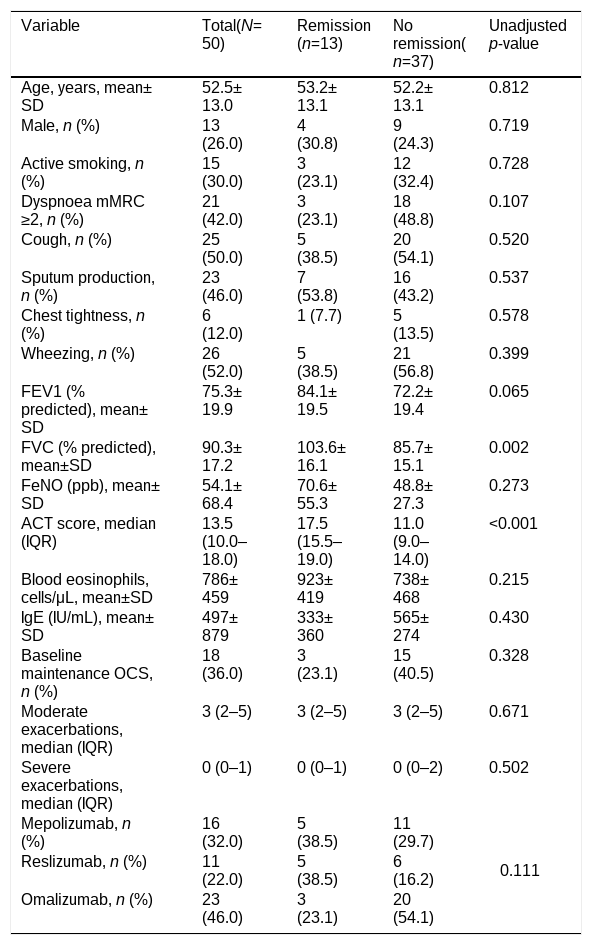
Thirteen patients (26.0%) met the study-defined remission criteria at 12 months: 5/16 patients (31.3%) on mepolizumab, 5/11 (45.5%) on reslizumab, and 3/23 (13.0%) receiving omalizumab. Baseline clinical and functional characteristics are compared between the remission and non-remission groups in Table 1. At baseline, FVC (103.6% vs. 85.7% predicted, p=0.002) and ACT scores (17.5 vs. 11.0, p<0.001) were significantly higher in the remission group than in the non-remission group, whereas FEV1 was numerically but not significantly higher (84.1% vs. 72.2%, p=0.065). No other examined variables differed significantly between groups.
Baseline clinical and functional characteristics by study-defined remission.
| Variable | Total(N=50) | Remission(n=13) | No remission(n=37) | Unadjusted p-value |
|---|---|---|---|---|
| Age, years, mean±SD | 52.5±13.0 | 53.2±13.1 | 52.2±13.1 | 0.812 |
| Male, n (%) | 13 (26.0) | 4 (30.8) | 9 (24.3) | 0.719 |
| Active smoking, n (%) | 15 (30.0) | 3 (23.1) | 12 (32.4) | 0.728 |
| Dyspnoea mMRC ≥2, n (%) | 21 (42.0) | 3 (23.1) | 18 (48.8) | 0.107 |
| Cough, n (%) | 25 (50.0) | 5 (38.5) | 20 (54.1) | 0.520 |
| Sputum production, n (%) | 23 (46.0) | 7 (53.8) | 16 (43.2) | 0.537 |
| Chest tightness, n (%) | 6 (12.0) | 1 (7.7) | 5 (13.5) | 0.578 |
| Wheezing, n (%) | 26 (52.0) | 5 (38.5) | 21 (56.8) | 0.399 |
| FEV1 (% predicted), mean±SD | 75.3±19.9 | 84.1±19.5 | 72.2±19.4 | 0.065 |
| FVC (% predicted), mean±SD | 90.3±17.2 | 103.6±16.1 | 85.7±15.1 | 0.002 |
| FeNO (ppb), mean±SD | 54.1±68.4 | 70.6±55.3 | 48.8±27.3 | 0.273 |
| ACT score, median (IQR) | 13.5 (10.0–18.0) | 17.5 (15.5–19.0) | 11.0 (9.0–14.0) | <0.001 |
| Blood eosinophils, cells/μL, mean±SD | 786±459 | 923±419 | 738±468 | 0.215 |
| IgE (IU/mL), mean±SD | 497±879 | 333±360 | 565±274 | 0.430 |
| Baseline maintenance OCS, n (%) | 18 (36.0) | 3 (23.1) | 15 (40.5) | 0.328 |
| Moderate exacerbations, median (IQR) | 3 (2–5) | 3 (2–5) | 3 (2–5) | 0.671 |
| Severe exacerbations, median (IQR) | 0 (0–1) | 0 (0–1) | 0 (0–2) | 0.502 |
| Mepolizumab, n (%) | 16 (32.0) | 5 (38.5) | 11 (29.7) | 0.111 |
| Reslizumab, n (%) | 11 (22.0) | 5 (38.5) | 6 (16.2) | |
| Omalizumab, n (%) | 23 (46.0) | 3 (23.1) | 20 (54.1) |
ACT, asthma control test; FeNO, fractional exhaled nitric oxide; FEV1, forced expiratory volume in 1 second; FVC, forced vital capacity; IQR, interquartile range; mMRC, modified Medical Research Council; OCS, oral corticosteroids; SD, standard deviation. Data on asthma duration, body mass index, nasal polyposis, atopy, and psychiatric comorbidity were unavailable.
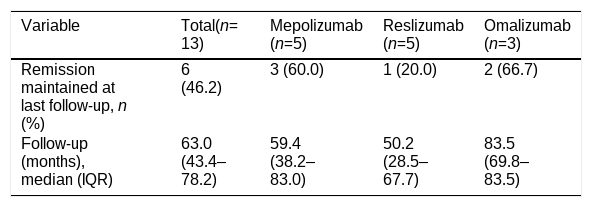
In the remission group, median follow-up was 63.0 months (IQR: 43.4–78.2), and 6 (46.2%) remained in remission at the end of follow-up. Remission maintenance by biologic therapy is summarized descriptively in Table 2.
Maintenance of study-defined remission by first-line biologic agent.
| Variable | Total(n=13) | Mepolizumab(n=5) | Reslizumab(n=5) | Omalizumab(n=3) |
|---|---|---|---|---|
| Remission maintained at last follow-up, n (%) | 6 (46.2) | 3 (60.0) | 1 (20.0) | 2 (66.7) |
| Follow-up (months), median (IQR) | 63.0 (43.4–78.2) | 59.4 (38.2–83.0) | 50.2 (28.5–67.7) | 83.5 (69.8–83.5) |
IQR, interquartile range. No inferential comparisons were performed because the subgroups were very small.
In this real-world cohort, approximately one-quarter of patients met the study definition of clinical remission after 1 year of biologic therapy. This proportion is broadly consistent with, though slightly below, pooled estimates indicating that approximately 30–38% of biologic-treated patients attain clinical remission depending on the definition applied.5 Almost half of those who met the study definition for clinical remission remained in remission over prolonged follow-up, supporting the view that remission is a dynamic rather than invariably sustained state.6,7 However, this estimate applies only to the small subgroup who achieved clinical remission at 12 months and should not be extrapolated to the entire cohort.
At baseline, ACT scores were higher in the remission group, consistent with previous cohorts in which better initial symptom control was associated with subsequent remission.5,8 However, this finding does not establish the ACT score as an independent predictor of remission. Similarly, FVC was higher in the remission group at baseline, though this finding requires particular caution. Although FEV1 showed a near-significant difference, the analysis was unadjusted, and FVC may be influenced by obesity, air trapping, smoking, and spirometric technique.9 Without lung-volume measurements or adjustment for confounding factors, our FVC finding is hypothesis-generating and should not be assigned a specific pathophysiological meaning.
Our findings cannot be compared across biologic agents because they target different phenotypes, are administered via different routes, and have very small subgroup sizes. Since detailed data on phenotype or endotype, adherence, treatment interruptions, discontinuation, and switching were not consistently available, clinical remission cannot be attributed to a specific agent, as our analysis cannot rule out differences in phenotype, exposure, or baseline severity. The EXACTO (exacerbations, ACT, systemic corticosteroids, and obstruction-FEV1) scale was not prespecified and could not be applied reliably.
However, our study had several limitations that should be acknowledged, including its retrospective single-center design, small cohort, lack of multivariable adjustment, and incomplete availability of asthma duration, body mass index, nasal polyposis, atopy, and psychiatric comorbidity. In addition, its definition of clinical remission did not include a negative bronchodilator test and therefore remains less stringent than the REMAS definition. Nevertheless, its long observation period describes maintenance of clinical remission at 12 months, an outcome less often reported than attainment at a single time point.
In conclusion, clinical remission was observed in approximately one-quarter of patients and was maintained in fewer than half of these patients during long-term follow-up. Although baseline FVC and ACT scores were higher among patients who achieved clinical remission, these unadjusted exploratory findings require confirmation in larger, phenotype-characterized cohorts using current consensus criteria.
Ethical considerationsThe authors declare that all study procedures conducted in this study were performed in accordance with the ethical standards of the relevant institutional and national research ethics committees, as well as with the principles set forth in the Declaration of Helsinki. The study was approved by the corresponding Research Ethics Committee.
Declaration of generative AI and AI-assisted technologies in the writing processArtificial intelligence tools were used exclusively for language translation and to improve the quality of the writing. The manuscript subsequently underwent manual review and editing. The authors assume full responsibility for the content.
Informed consentGiven the retrospective nature of the study, the absence of any need to contact patients for study purposes, and the use of anonymised aggregated data, a waiver of informed consent was requested to the Research Ethics Committee, which was subsequently approved.
FundingNo funding was received for this study.
Authors’ contributionsAll authors meet the authorship criteria and made substantial contributions to the conception and design of the study, data acquisition, analysis and interpretation of the data, as well as the drafting and revision of the manuscript. All authors reviewed and approved the manuscript.
Conflicts of interestThe authors declare no conflicts of interest.