The introduction of biologic therapies for chronic obstructive pulmonary disease (COPD) represents a conceptual shift in the prevention of exacerbations.1 After decades of limited therapeutic progress, targeting specific inflammatory pathways has opened the era of precision therapies in COPD. However, this therapeutic advance has shifted the main challenge from developing effective treatments to identifying the right patients. At present, candidate selection relies mainly on two clinical proxies: the presence of type 2 (T2) inflammation, largely inferred from peripheral blood eosinophil counts, and the persistence of exacerbations despite optimized triple inhaled therapy.1,2 Although these criteria have proven useful in clinical trials, they may not adequately capture the biological heterogeneity of COPD. In many respects, we have entered the era of precision therapies before achieving precision patient selection.
The indication for biologic therapies assumes that pharmacological treatment has been optimized with triple inhaled therapy.1,2 Yet an important question remains unanswered: when can triple therapy truly be considered to have failed? Clinical trials with monoclonal antibodies such as dupilumab or mepolizumab enrolled patients receiving optimized inhaled treatment who continued to experience exacerbations,3 but no operational definition of treatment failure exists, nor is there consensus on the minimum period of optimization before treatment escalation. Consequently, patients may be labelled as refractory to inhaled therapy without addressing potentially treatable traits that limit treatment response, including poor adherence, incorrect inhaler technique, active smoking, chronic bronchial infection or relevant comorbidities. In these circumstances, biologic therapy may be introduced prematurely. Conversely, it is equally plausible that a biological window of opportunity exists during which earlier intervention could modify disease progression. Although this hypothesis remains unproven, it illustrates the need to distinguish genuine biological refractoriness from remediable clinical factors before escalating treatment.
An even more fundamental issue is the assumption that exacerbations represent biologically homogeneous events. Current biologic trials have used exacerbation frequency both as an inclusion criterion and as the main outcome measure,3 despite increasing evidence that COPD exacerbations encompass distinct inflammatory and infectious endotypes.4 Eosinophilic exacerbations, characterized by increased T2 biomarkers and corticosteroid responsiveness, are likely the biological substrate most amenable to targeted therapies. In contrast, exacerbations driven predominantly by recurrent bacterial infection may benefit more from antimicrobial strategies, airway clearance or respiratory physiotherapy. Importantly, clinical trials have generally not distinguished between these biological phenotypes. As a result, reducing the overall exacerbation rate implies that all exacerbations are equally amenable to treatment, whereas only a subset may actually be driven by T2 inflammation. The current paradigm considers exacerbation frequency a surrogate of the underlying disease biology, whereas it may simply reflect the cumulative clinical expression of multiple distinct biological mechanisms.
Peripheral blood eosinophil count has become the reference biomarker for identifying T2 inflammation in COPD because it identifies patients enriched for treatment response in trials targeting the IL-5 and IL-4/13 pathways.2 However, eosinophils should probably be regarded as a surrogate marker rather than a direct measure of ongoing biological activity.5 Blood eosinophil counts are dynamic and influenced by corticosteroid exposure, smoking, infections and biological variability, while elevated values do not necessarily indicate active eosinophilic inflammation.6 Biomarkers reflecting eosinophil activation, such as eosinophil cationic protein or eosinophil-derived neurotoxin, may provide a more direct assessment, although their clinical utility remains insufficiently validated.7 Taken together, these observations reinforce the need to complement peripheral blood eosinophils with additional biomarkers for selecting candidates for biologic therapies. Despite these limitations, peripheral blood eosinophils remain the most accessible, widely available and best-validated biomarker supporting biologic treatment selection in COPD. Their limitations should therefore not diminish their current clinical value, but rather encourage the development and validation of complementary biomarkers and integrated approaches capable of refining patient selection. Rather than relying on a single biomarker, future selection of candidates for biologic therapies will probably require integrated biological signatures combining complementary sources of information. These signatures may integrate inflammatory biomarkers (including peripheral blood eosinophils, fractional exhaled nitric oxide (FeNO) and biomarkers of eosinophil activation) together with imaging characteristics, microbiological profiles and longitudinal clinical trajectories.5,7–9 Such multidimensional integration may provide a more accurate representation of the biological mechanisms underlying treatment response in individual patients and ultimately improve the selection of candidates most likely to benefit from biologic therapies. Although this approach remains largely investigational, it represents one of the most promising avenues towards genuine precision medicine in COPD.
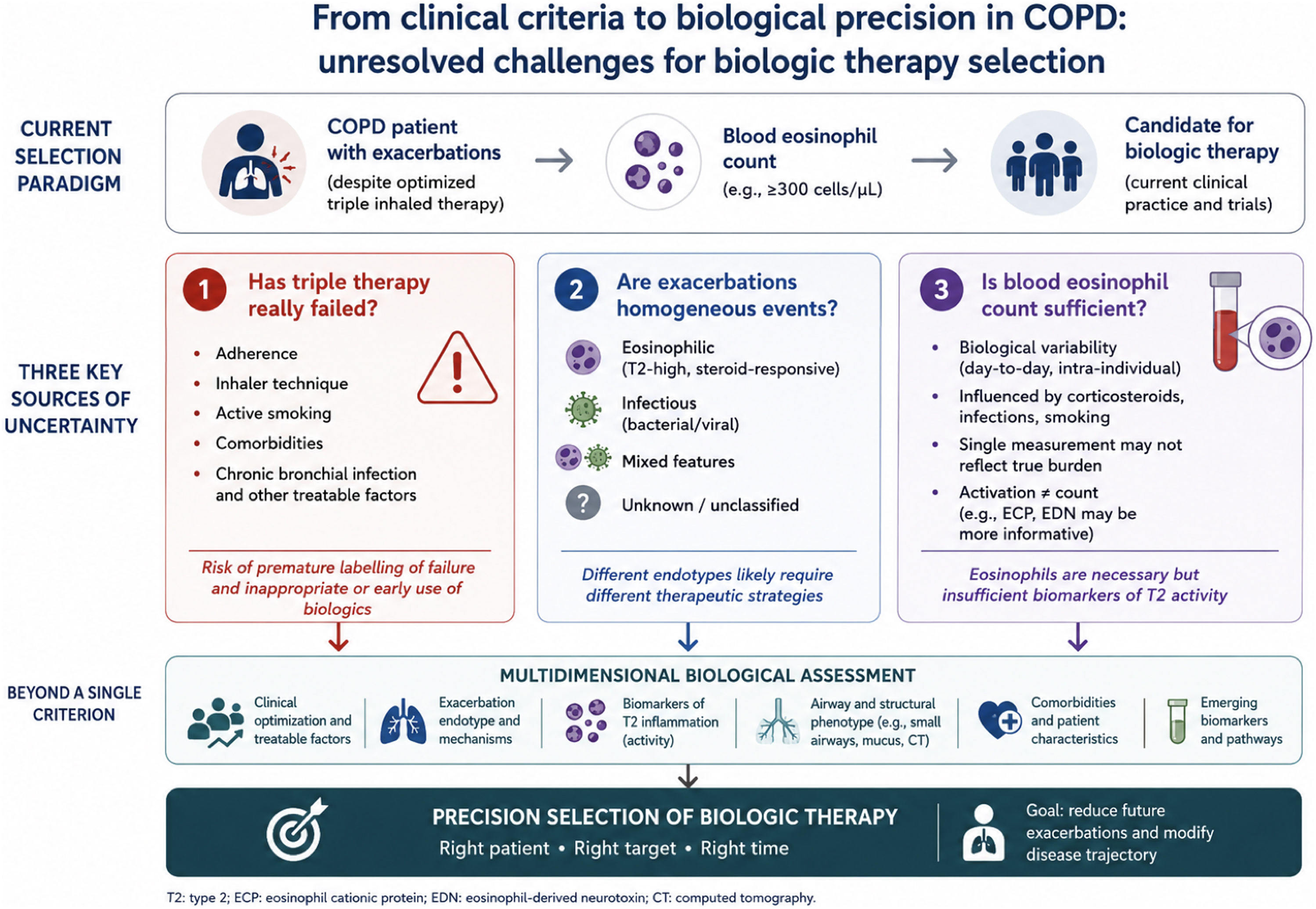
Taken together, these uncertainties (the absence of a clear definition of triple therapy failure, the assumption that all exacerbations are biologically equivalent, and the reliance on blood eosinophils as the principal biomarker) reflect the same underlying challenge (Fig. 1). Patient selection for biologic therapies continues to rely predominantly on clinical surrogates rather than direct measures of disease biology. Biologic therapies have undoubtedly transformed the therapeutic landscape of COPD, but they have also exposed the limitations of our current approach to precision medicine. The next step is not simply to identify which patients experience frequent exacerbations, but to determine which patients have biologically targetable disease and how this biological activity can be reliably identified in routine clinical practice. Moving towards integrated biological signatures, rather than relying on isolated surrogate biomarkers, may ultimately represent the transition from precision therapies to true precision medicine in COPD.

Artificial intelligence tools were used exclusively to support the editing and linguistic refinement of the manuscript and to assist in the graphical design of Fig. 1. AI tools did not influence the scientific content, data interpretation, clinical recommendations, or the conceptual content of the figure.
FundingThis manuscript did not receive any funding.
Authors’ contributionsAll authors contributed equally to this manuscript and approved the final version.
Conflicts of interestJMFG has received honoraria for speaking engagements and funding for conference attendance from Laboratories Esteve, MundiPharma, AstraZeneca, Boehringer Ingelheim, Ferrer, Menarini, Rovi, GSK, Chiesi, Novartis, and Gebro Pharma.
RG has received speaking or advisory fees, or economic aid to attend congresses from AstraZeneca, GSK, Novartis, FAES, Chiesi, Mundipharma, Menarini, TEVA, Grifols, Ferrer, Boehringer In gelheim, Rovi, and Gebro.
JMD is part of the Editorial board of Open Respiratory Archives and declares that he has remained outside the evaluation and decision-making process in relation to this article. On the other hand, he has received grants and honoraria from Abbott, AstraZeneca, BIAL, Boehringer Ingelheim, Chiesi, Ferrer, Gebro, GSK, Grifols, Janssen, Menarini, Novartis, Sanofi-Regeneron, Roche, Teva, Pfizer, and Zambon.