Listeria monocytogenes is an uncommon cause of pleural empyema, particularly in patients with rheumatoid arthritis (RA). Disease and treatment-related immunosuppression increases susceptibility to invasive listeriosis, which carries significant mortality. A 78-year-old man with seropositive RA treated with methotrexate and low-dose corticosteroids presented with fever, hypotension, pleuritic chest pain, and weakness. Laboratory tests showed leukocytosis, neutrophilia, and elevated C-reactive protein. Imaging revealed a left pleural effusion with lower-lobe collapse. Thoracentesis drained 800mL of exudative fluid, and cultures of pleural fluid and blood isolated L. monocytogenes. Cranial CT and lumbar puncture performed due to neurological symptoms were normal. High-dose ampicillin plus cotrimoxazole was administered for 7 days, followed by ampicillin monotherapy to complete a total of 14 days of antibiotic treatment, achieving progressive clinical and radiological improvement. Empyema caused by L. monocytogenes is rare and occurs mainly in immunocompromised hosts, with only isolated cases described in RA. This case underscores the need to consider Listeria infection in immunosuppressed RA patients presenting with pleural empyema.
Listeria monocytogenes es una causa infrecuente de empiema pleural, especialmente en pacientes con artritis reumatoide (AR). La inmunosupresión relacionada con la enfermedad y su tratamiento aumenta la susceptibilidad a listeriosis invasiva, con significativa mortalidad. Un varón de 78 años con AR seropositiva tratado con metotrexato y corticoides a bajas dosis presentó fiebre, hipotensión, dolor torácico pleurítico y debilidad. La analítica mostró leucocitosis, neutrofilia y proteína C reactiva elevada. La imagen reveló un derrame pleural izquierdo con colapso del lóbulo inferior. La toracocentesis drenó 800mL de líquido turbio exudativo, y los cultivos de líquido pleural y sangre aislaron Listeria monocytogenes. La tomografía craneal y la punción lumbar realizadas por síntomas neurológicos fueron normales. Se administró ampicilina a dosis altas asociada a cotrimoxazol durante 7 días, seguida de ampicilina en monoterapia hasta completar un total de 14 días de tratamiento antibiótico, con mejoría clínica y radiológica. El empiema por L. monocytogenes es excepcional y aparece sobre todo en pacientes inmunodeprimidos. Este caso destaca la necesidad de considerar Listeria en pacientes con AR inmunosuprimidos con empiema pleural.
Rheumatoid arthritis (RA) is a chronic inflammatory autoimmune disease that primarily affects the joints but may also involve extra-articular organs, including the respiratory system. The immune dysfunction associated with RA, compounded by the use of immunomodulatory drugs and biological agents, may impair cellular immunity and increase susceptibility to infection. Among the thoracic manifestations of RA, pleural effusion is the most common, although it is clinically significant in only a small proportion of cases (3.8%1). Empyema, although less frequent, is a severe complication, with a markedly higher incidence rate than in the general population (23.6 per 10,000 person-years2).
We report the case of a 78-year-old man with a history of erosive seropositive RA, polymyalgia rheumatica, and chronic ischemic heart disease who was receiving immunosuppressive therapy with methotrexate and deflazacort (6mg/day). He presented to the emergency department with fever (38°C), hypotension, generalized weakness, and pleuritic chest pain. Physical examination revealed decreased breath sounds at the left lung base. Laboratory tests showed leukocytosis (25,720cells/μL), neutrophilia (24,000cells/μL), and an elevated C-reactive protein level (14.7mg/dL). Chest radiography showed a left-sided pleural effusion. Chest computed tomography (CT) confirmed the effusion and revealed passive atelectasis with near-complete collapse of the left lower lobe (Fig. 1A). Diagnostic thoracentesis yielded 800mL of turbid pleural fluid, consistent with a complicated pleural effusion (pH 6.80, glucose<20mg/dL, total protein 3.90g/dL, LDH 3066IU/L, and 96% polymorphonuclear leukocytes). An Argyle-type chest tube was subsequently placed under ultrasound guidance. Pleural fluid culture was positive for Listeria monocytogenes, which was also isolated from peripheral blood cultures. During hospitalization, the patient developed neurological symptoms, including bradypsychia and bradylalia. Cranial CT and lumbar puncture were therefore performed, with unremarkable findings. Following the diagnosis of left-sided pleural empyema with L. monocytogenes bacteremia, targeted antibiotic therapy with ampicillin (2g every 4h) and cotrimoxazole (800/160mg every 12h) was administered for 7 days. After extrapulmonary involvement had been ruled out, ampicillin monotherapy was continued to complete a total of 14 days of treatment. The patient had a favorable clinical course, with resolution of the empyema confirmed by follow-up chest radiography at 30 days (Fig. 1B).
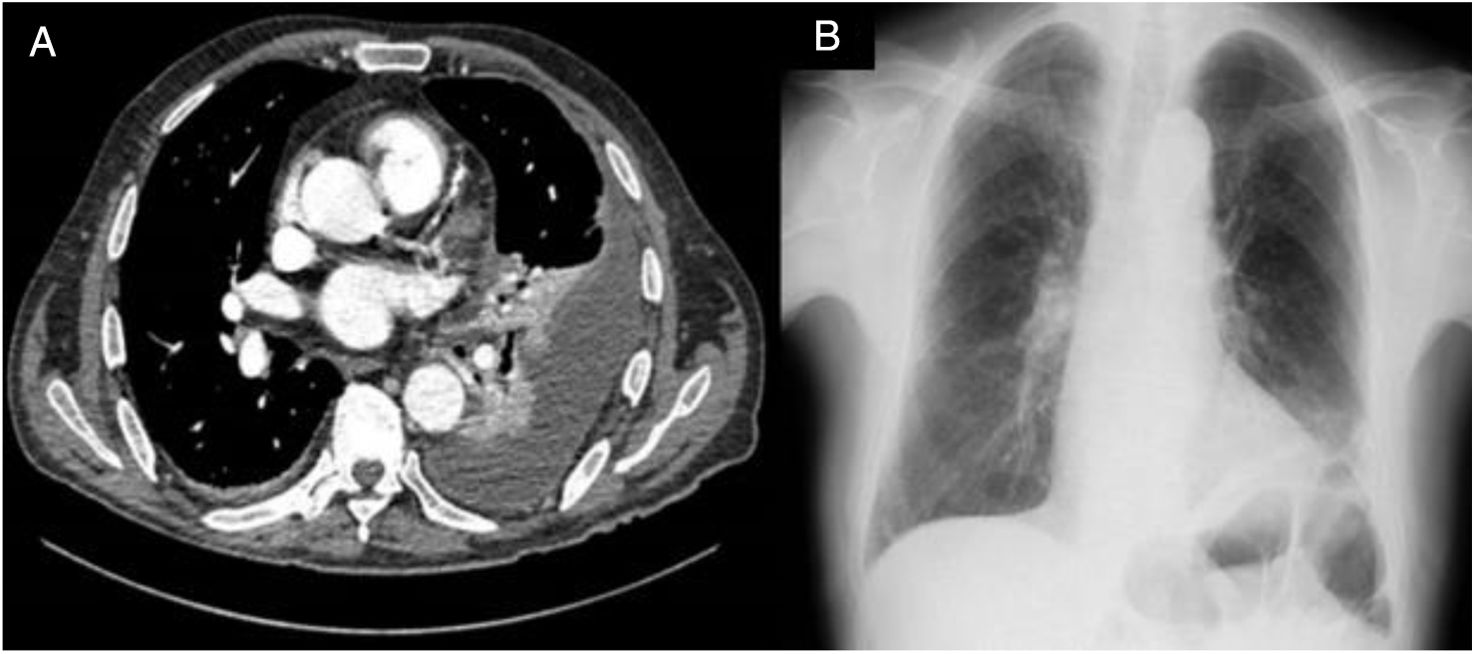
(A) Contrast-enhanced chest CT scan. Bilateral pleural effusions, predominantly on the left side, associated with compressive atelectasis and near-complete collapse of the left lower lobe (LLL). (B) Posteroanterior chest radiograph. Resolution of the left basal pleural effusion during outpatient follow-up after discharge.
L. monocytogenes is a Gram-positive intracellular bacillus with an estimated incidence of 3–6 cases per million inhabitants. It is an important pathogen in immunocompromised patients and can cause meningoencephalitis, bacteremia, septic arthritis, brain abscess, infective endocarditis, and peritonitis, with mortality rates exceeding 30% despite appropriate antibiotic treatment.3 It predominantly affects individuals with impaired cellular immunity, including pregnant women, organ transplant recipients, older adults, and patients receiving immunomodulatory or corticosteroid therapy. In most cases, infection is thought to result from the ingestion of contaminated food.4
Respiratory infections caused by L. monocytogenes are rare, severe, and associated with a high mortality rate, approximately twice that reported for bacterial pneumonia (4–18% at one month5) and comparable to that observed in severe opportunistic respiratory infections such as those caused by Legionella (35%6). The association between L. monocytogenes and pleural empyema is uncommon and has been reported primarily in immunosuppressed patients. Although the incidence of empyema in this population may be as high as 40% (5–40%7), the proportion attributable to Listeria remains very low. Its occurrence in patients with RA is even more unusual, as pleural empyema in these patients is typically polymicrobial.8 To date, no case series or epidemiological studies have quantified the prevalence of L. monocytogenes-related empyema in patients with RA, and only one published report has described this specific association.4 Despite its rarity, this clinical entity should be considered in this patient population because of its potential to cause invasive infection.
The diagnosis of listeriosis is established by isolating L. monocytogenes from normally sterile specimens, such as blood, cerebrospinal fluid, pleural fluid, or amniotic fluid. L. monocytogenes grows readily on blood agar at 35°C, exhibiting β-hemolysis after 18–24h of aerobic incubation. Gram staining may reveal Gram-positive bacilli in clinical specimens, while PCR provides a rapid method for detection.9 Nevertheless, culture remains the gold standard and confirmed the diagnosis in our patient.
The treatment of choice for most manifestations of listeriosis is high-dose ampicillin, often combined with gentamicin during the first 7–10 days of therapy. This combination is intended to provide a synergistic bactericidal effect.10 However, aminoglycosides have a narrow therapeutic index and require therapeutic drug monitoring because of their potential toxicity, which precluded the use of gentamicin in our patient. Treatment duration should be tailored to the clinical presentation: two weeks for bacteremia, three weeks for meningitis, and 4–6 weeks for brain abscess or endocarditis. Cotrimoxazole is a suitable alternative in patients with β-lactam allergy, particularly in cases involving the central nervous system, because of its excellent penetration across the blood–brain barrier.9–11 Notably, L. monocytogenes is intrinsically resistant to third-generation cephalosporins because of their poor affinity for Listeria penicillin-binding proteins; therefore, these agents should not be used for the treatment of listeriosis.11
Given the limited number of reported cases, the prognosis of L. monocytogenes pleural empyema remains uncertain. Prompt diagnosis, adequate pleural drainage, and early initiation of targeted antibiotic therapy are therefore essential to improve clinical outcomes. Awareness of this rare clinical entity may facilitate early recognition and appropriate treatment.
Ethical considerationsAccording to institutional policies, this case report did not require formal approval from an ethics committee. Written informed consent for publication was obtained from the patient. Patient confidentiality and anonymity were maintained throughout the preparation of the manuscript.
Declaration of generative AI and AI-assisted technologies in the writing processDuring the preparation of this work, the authors used artificial intelligence tools to improve the language, refine the scientific writing, and assist with the translation of the manuscript. After using these tools, the authors reviewed and edited the content as necessary and take full responsibility for the content of the publication.
Informed consentWritten informed consent was obtained from the patient for the publication of this case report and any accompanying images.
FundingThe authors declare that no funding was received for the preparation of this case report.
Authors’ contributionsAll authors made substantial contributions to the conception and design of the clinical case, data acquisition, drafting of the manuscript, critical revision of the intellectual content, and final approval of the version to be published.
Conflicts of interestFV-Á has attended and participated in activities organized or sponsored by the pharmaceutical companies Almirall, AstraZeneca, Bial, Boehringer Ingelheim, Chiesi, GlaxoSmithKline, Esteve, Ferrer, Menarini, Novartis, Mundipharma, Orion, Pfizer, Teva, and Zambon. The remaining authors declare no conflicts of interest.