


Alemtuzumab has demonstrated efficacy and safety in clinical trials for relapsing–remitting multiple sclerosis (RRMS). However, real-world patients do not always meet the strict inclusion criteria of clinical trials, making it essential to assess outcomes in clinical practice. The objective of this study was to describe the risk of infections and immunosuppression in patients with RRMS treated with alemtuzumab, over a 42-month follow-up period.
MethodsWe conducted a retrospective, open-label, multicentre study. Inclusion criteria were patients diagnosed with RRMS who received alemtuzumab between 2015 and 2024. The primary endpoint of the study was to evaluate the incidence of infections reported in patients’ medical records. The risk of immunosuppression was assessed through lymphocyte count in blood during the first month after each treatment cycle and then every 3 months until the end of follow-up.
ResultsA total of 32 patients were included. Urinary tract infections and herpes infections were the most common, generally without complications. Regarding the risk of immunosuppression, severe lymphocytopenia occurred only during the first month following each treatment cycle. Subsequently, lymphocyte counts progressively increased. No significant correlation was found between lymphocyte levels and infection risk.
ConclusionsAlemtuzumab has demonstrated a favourable safety profile with regard to the risk of infections, maintaining a controlled risk of immunosuppression, which can be managed with an effective detection and treatment protocol.
Alemtuzumab ha demostrado eficacia y seguridad en ensayos clínicos en pacientes con esclerosis múltiple remitente-recurrente (EMRR). Sin embargo, la población real no siempre cumple los estrictos criterios de inclusión de los ensayos, por lo que es importante evaluar los resultados en práctica clínica. El objetivo del estudio es describir el riesgo de infecciones e inmunosupresión en pacientes con EMRR tratados con Alemtuzumab, con un seguimiento de 42 meses.
MétodosEstudio abierto retrospectivo y multicéntrico. Los criterios de inclusión fueron: pacientes diagnosticados de EMRR que recibieron Alemtuzumab entre el 2015 y 2024. El objetivo principal del estudio fue evaluar la incidencia de infecciones reportada en la historia clínica. El riesgo de inmunosupresión se determinó mediante el recuento de linfocitos en sangre en el primer mes tras cada ciclo de tratamiento y luego cada 3 meses hasta completar el seguimiento.
ResultadosSe incluyeron un total de 32 pacientes. Durante 3,5 años de seguimiento, las infecciones tracto urinario y las herpéticas fueron las más frecuentes, habitualmente sin complicaciones asociadas. En cuanto al riesgo de inmunosupresión, según el recuento de linfocitos, únicamente aparecieron linfopenias graves durante el primer mes posterior a cada ciclo de tratamiento. Posteriormente, el recuento linfocitario fue progresivamente en ascenso. No encontramos relación entre los niveles de linfocitos y el riesgo de infecciones en pacientes con EMRR.
ConclusionesAlemtuzumab ha demostrado un perfil de seguridad favorable en cuanto al riesgo de infecciones con riesgo de inmunosupresión mantenido, que puede ser controlado con un efectivo protocolo de detección y tratamiento.
Multiple sclerosis (MS) is an autoimmune demyelinating disease that causes degeneration of the central nervous system and represents the leading cause of non-traumatic disability in young adults in the Western world.1 The worldwide prevalence of MS has increased from 2.3 million in 2013 to 2.9 million in 2023, due to, among other causes, improved diagnostic capabilities.1,2 The most prevalent clinical course of MS is the relapsing–remitting form (RRMS).3
Over the past decade, numerous disease-modifying drugs have been developed.4 They act by modulating or suppressing the immune response through several mechanisms that may increase susceptibility to infections.1 One such drug is alemtuzumab, a monoclonal antibody targeting the CD52 antigen, which is present on the surface of adaptive immune cells (B and T cells), and to a lesser extent, in innate immune cells (NK cells, monocytes, and macrophages).5 After binding to lymphocytes, it causes their antibody-dependent and complement-mediated lysis, thus inducing intense, very long-lasting and variable lymphodepletion. Although its action mechanism is not clearly established, the reduction in circulating B and T cell levels and its subsequent repopulation are believed to decrease relapses, thus slowing disease progression.6
Alemtuzumab use was approved for highly active forms of RRMS after clinical trials demonstrated its efficacy and safety.7,8 However, these types of study use strict selection criteria that limit their external validity; therefore, it is important to assess the drug's behaviour in real life. Furthermore, one of the most frequent side effects is the onset of infections, which may affect up to 70% of patients.6
The aim of this study was to determine the annual risk of infection and immunosuppression in patients with RRMS who had been treated with alemtuzumab.
Material and methodsWe conducted a retrospective multicentre study of patients diagnosed with RRMS and treated with alemtuzumab at 2 Spanish tertiary hospitals. The study period was from 2015 to 2024, with a follow-up period of 3.5 years.
No inclusion criteria were established, other than the indication described in the summary of product characteristics: patients with highly active disease despite previous treatment or those presenting a rapidly progressive course, as reflected by disabling relapses and significant radiological activity.6
The treatment schedule consisted of 2 cycles of alemtuzumab, administered intravenously at 12 mg/day for 5 consecutive days in the first year, and for 3 consecutive days at one year. All patients received premedication with corticosteroids (methylprednisolone), antihistamines (dexchlorpheniramine) and paracetamol, as well as oral prophylaxis with aciclovir for herpes virus. When necessary, patients received a third or fourth cycle of alemtuzumab for 3 consecutive days, administered at least 12 months after the previous cycle.
The main data source was patients' electronic medical records. We designed a database for the collection of demographic, clinical, and radiological variables. The main aim of the study was to assess the incidence of infections reported in patient medical records. The risk of immunosuppression was determined by blood lymphocyte count in the first month after each treatment cycle, and subsequently every 3 months until the end of the 42-month follow-up period.
The study was evaluated and approved by the drug research ethics committee of the region of Galicia (CEIm-G) on 25/04/2024, with the record code 2023/519. The study complies with the Declaration of Helsinki, and all patients signed informed consent forms before participating in the study. To guarantee patient confidentiality and anonymity, we observed the requirements of the Spanish Organic Law 3/2018 on data protection.
We performed a descriptive analysis of all variables. Statistical analysis of variables was performed using the SPSS software, version 21. We used the t-test for independent samples showing normal distribution and homoscedasticity, and the nonparametric Mann–Whitney U test for the remaining variables not showing these characteristics. The level of statistical significance was set at P < .05.
ResultsWe recruited 32 patients (71.9% women) with a mean (SD) age of 40.3 (11.0) years (range, 24–71). Mean disease duration was 12.3 (7.9) years. Some 9.4% of patients were treatment-naïve. The main reason for starting alemtuzumab treatment was failure of the previous treatment (78.1%). The median number of previously used drugs was 2.1 (range, 0–4), with fingolimod and natalizumab being the most frequently used (31.3% each). It was necessary to administer a third cycle of alemtuzumab to 5 patients (15.6%). A total of 29 patients completed the first year of treatment, 26 the second year, 19 the third year, and 17 completed the fourth year of follow-up.
During perfusion of the first cycle of alemtuzumab, 3 (9.3%) patients experienced urinary tract infections (UTIs).1 Infection was considered severe in one case, as it was associated with a generalised epileptic seizure. In the following 12 months, 7 (21.9%) patients presented with UTI and 3 (9.3%) presented with herpes zoster infections. During the second year of follow-up, 2 (8.3%) patients presented with UTI. During the third year of follow-up, one patient experienced sepsis of urinary origin that led to death. In the fourth year, one patient developed herpes zoster ophthalmicus, which was considered severe as the patient had to be hospitalised. No other type of infection was detected during the rest of the study period.
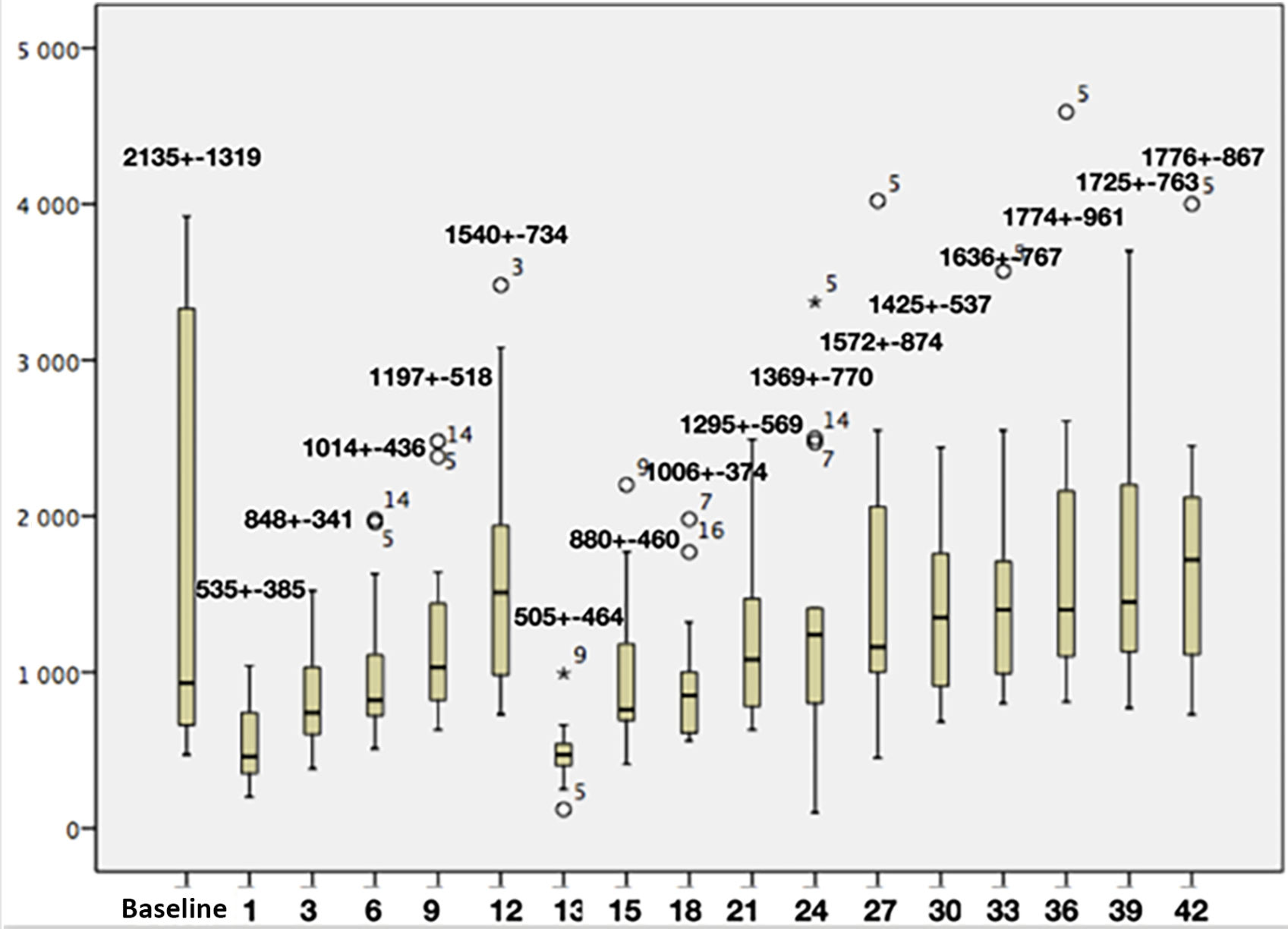
Mean baseline lymphocyte count was 2135 (1319) cells/μL. Fig. 1 describes the progression of the lymphocyte count during treatment with alemtuzumab. In the first month after treatment, lymphocyte level decreased to 535 (385) cells/μL (P < .05), subsequently increasing until reaching a level of 1540 (734) cells/μL at month 12 (P < .05). After the first month of the second cycle, it decreased again to 505 (464) cells/μL (P < .05) and progressively increased to 1369 cells/μL (770; P > .05) by month 24. Over the following months, lymphocyte count slowly increased until reaching a total of 1774 (961) cells/μL at month 36 (P > .05) and 1776 (867) cells/μL at month 42 (P > .05).

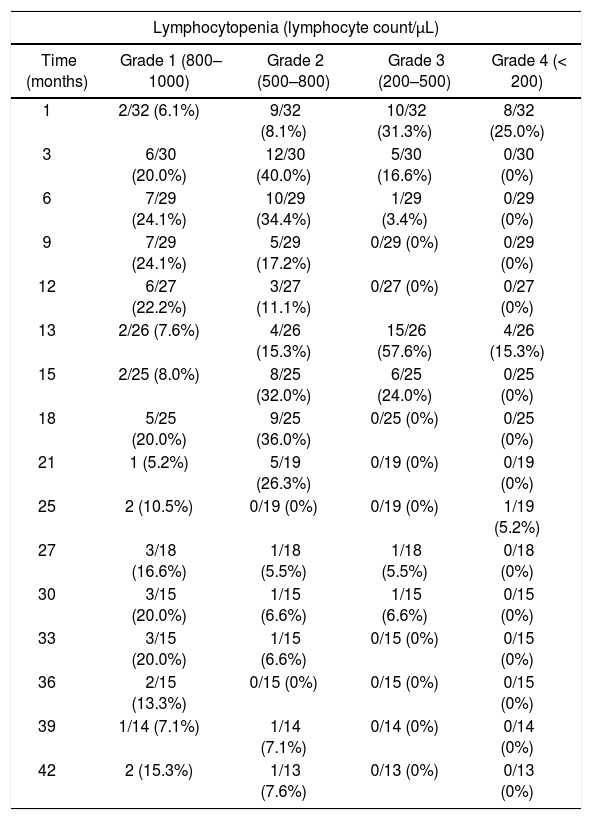
Table 1 details the time distribution of lymphocytopenia. Grade 4 lymphocytopenia (< 200 cells/μL) was identified in 8 (25.0%), 4 (15.3%), and one (5.2%) patients during the first month of the first, second, and third cycle of alemtuzumab, respectively. This adverse effect was not observed in any patient during the rest of the follow-up period. Despite these findings, we did not observe an association between lymphocyte count and the risk of infection (P > .05).
Patient distribution according to the grade of lymphocytopenia during follow-up.
| Lymphocytopenia (lymphocyte count/μL) | ||||
|---|---|---|---|---|
| Time (months) | Grade 1 (800–1000) | Grade 2 (500–800) | Grade 3 (200–500) | Grade 4 (< 200) |
| 1 | 2/32 (6.1%) | 9/32 (8.1%) | 10/32 (31.3%) | 8/32 (25.0%) |
| 3 | 6/30 (20.0%) | 12/30 (40.0%) | 5/30 (16.6%) | 0/30 (0%) |
| 6 | 7/29 (24.1%) | 10/29 (34.4%) | 1/29 (3.4%) | 0/29 (0%) |
| 9 | 7/29 (24.1%) | 5/29 (17.2%) | 0/29 (0%) | 0/29 (0%) |
| 12 | 6/27 (22.2%) | 3/27 (11.1%) | 0/27 (0%) | 0/27 (0%) |
| 13 | 2/26 (7.6%) | 4/26 (15.3%) | 15/26 (57.6%) | 4/26 (15.3%) |
| 15 | 2/25 (8.0%) | 8/25 (32.0%) | 6/25 (24.0%) | 0/25 (0%) |
| 18 | 5/25 (20.0%) | 9/25 (36.0%) | 0/25 (0%) | 0/25 (0%) |
| 21 | 1 (5.2%) | 5/19 (26.3%) | 0/19 (0%) | 0/19 (0%) |
| 25 | 2 (10.5%) | 0/19 (0%) | 0/19 (0%) | 1/19 (5.2%) |
| 27 | 3/18 (16.6%) | 1/18 (5.5%) | 1/18 (5.5%) | 0/18 (0%) |
| 30 | 3/15 (20.0%) | 1/15 (6.6%) | 1/15 (6.6%) | 0/15 (0%) |
| 33 | 3/15 (20.0%) | 1/15 (6.6%) | 0/15 (0%) | 0/15 (0%) |
| 36 | 2/15 (13.3%) | 0/15 (0%) | 0/15 (0%) | 0/15 (0%) |
| 39 | 1/14 (7.1%) | 1/14 (7.1%) | 0/14 (0%) | 0/14 (0%) |
| 42 | 2 (15.3%) | 1/13 (7.6%) | 0/13 (0%) | 0/13 (0%) |
This multicentre, retrospective study contributes real-life safety data on alemtuzumab. It analyses the risk of infection and immunosuppression in a cohort of 32 patients with RRMS, with a long follow-up period of 42 months.
The mean age of our patients (40.3 years) was higher than that reported by clinical trials (33–34.8 years). This was also the case for disease duration and the percentage of women (12.3 vs 2.1–4.5 years, and 71.9% vs 65%–66%, respectively).9,10 However, baseline characteristics are similar to those other real-life, open-label studies: mean age of 38.3 years,11 disease duration of 11.7–12.3 years,12,13 and 73.9%–74.4% women.11,14 Furthermore, as in other series, the majority of patients had previously been treated; therefore, comparatively, our sample is more representative of the population that may be found in everyday clinical practice.11,12,15
UTI and herpes virus infections were the most frequently reported in our study, typically with no associated complications. In pivotal studies, 66%–77% of patients had infections, mostly of mild or moderate intensity.9,10,16 Although this frequency is higher than that reported in our study, rates decreased over time.17 Some evidence suggests that the annual risk of severe infections is very low (< 2% in CARE-MS I and < 3% in CARE-MS II),18,19 with the most frequent being upper respiratory tract infection, UTI, and herpes simplex and zoster infection.20,21 Consistent with the results of another Spanish study, performed at Hospital de Cabueñes, UTI was the only type of infection identified in our cohort.11 Other studies of data from clinical practice report a similar incidence of infections to that observed in our cohort.12,15,22 Regarding herpes zoster virus, incidence in our sample was lower than that reported in clinical trials.9,10 This finding is explained by the fact that the summary of product characteristics for alemtuzumab recommends prophylaxis with aciclovir for at least one month after administration, as a result of a modification made in the CARE-MS studies to reduce the risk of this infection.6 We should also underscore that none of our patients developed Listeria meningitis, one of the most severe adverse reactions described in the literature.18
To assess the risk of immunosuppression, we considered the lymphocyte count in the first month after each treatment cycle, and subsequently every 3 months until the end of the follow-up period. Severe lymphocytopenia was only identified in 8 (25%), 4 (15.3%), and one (5.2%) patient after the first month of the first, second, and third cycles, respectively. No cases of grade 4 lymphocytopenia were observed in the remaining months of follow-up.
Our findings are similar to those of the CARE-MS I and II clinical trials, which reported a significant, rapid decrease in lymphocyte count after the first month of treatment: 95.3% of CD4+ and 83.7%–85.4% of CD8+ T cells.23 Furthermore, after one year of treatment, lymphocyte count is reported to remain low in 46%–70% of patients, with reconstitution (ie, lymphocyte counts >400 cells/μL) occurring at approximately 35 months.24 Similarly, a study performed in the United States observed a rapid decrease in lymphocyte count in the first month after treatment, with levels remaining low throughout the first year in 50%–75% of cases. These researchers also assessed monocyte count, detecting a decrease after the first month of treatment, although these levels quickly recovered by around the third month.15
Lastly, we observed no association between lymphocyte levels and the development of infections. The UTI observed in our patients may be associated with the risk linked to neurogenic bladder dysfunction secondary to MS, rather than with alemtuzumab treatment.25 Regarding severe herpes virus infections and lymphocytopenia, these were exceptional in our series, which would account for the lack of association observed between both parameters.
In conclusion, alemtuzumab has been shown to be safe regarding risk of infections, with UTI and herpes virus infections being the most frequent, although they typically present no associated complications. In terms of immunosuppression risk, severe lymphocytopenia only appeared during the first month immediately after each cycle of treatment, with lymphocyte count progressively increasing over the following months. We observed no association between lymphocyte levels and the risk of infections in patients with RRMS.
Ethical considerationsThe study was approved by the drug research ethics committee of the region of Galicia (CEIm-G).
FundingThis study received no funding of any kind.
The authors have no conflicts of interest to declare.


