


Anti–HMG-CoA reductase (anti-HMGCR) immune-mediated necrotising myopathy (IMNM) is an infrequent disease that is often associated with the use of statins, although it may also manifest in statin-naïve patients. It is clinically characterised by subacute proximal muscle weakness, markedly elevated creatine kinase (CK) levels, and limited response to withdrawal of the causal agent.
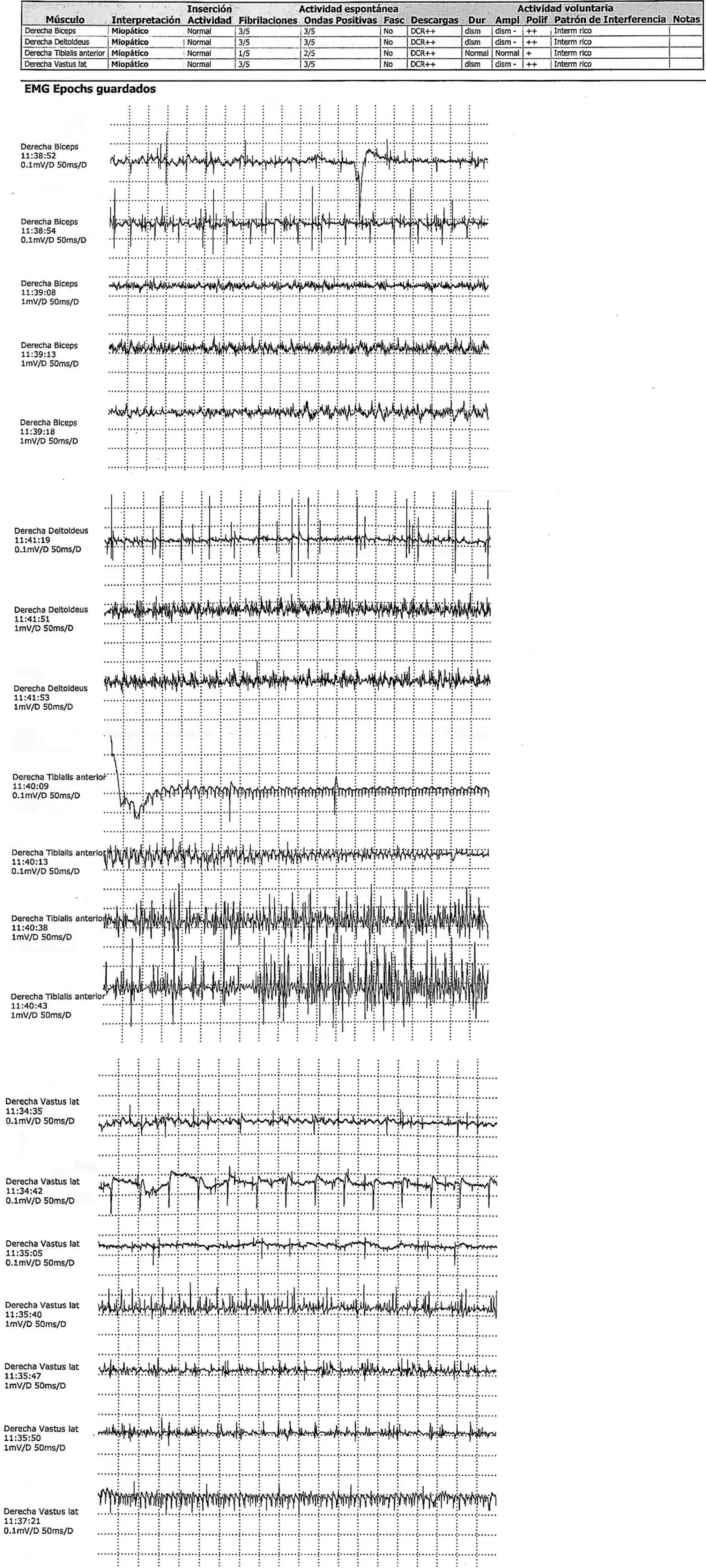
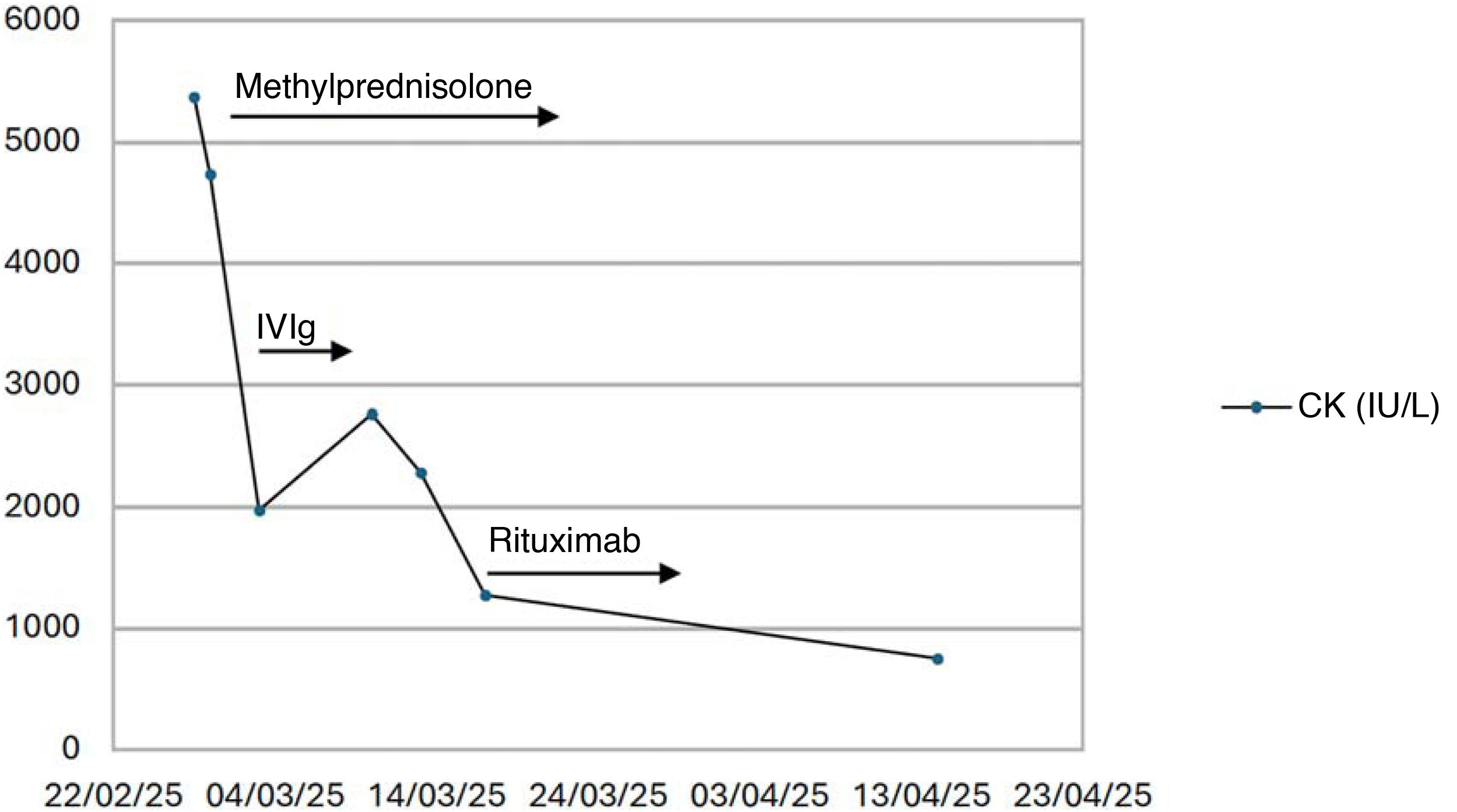
We present the case of an 80-year-old woman with history of dyslipidaemia under treatment with atorvastatin 40 mg for more than 5 years, who consulted due to 3 months’ history of progressive muscle weakness, predominantly affecting the proximal lower limbs, which caused difficulty until she was unable to leave bed. Furthermore, she presented weakness of neck muscles with inability to keep the head in position, and began to develop exertional dyspnoea. A blood analysis revealed a CK level > 5000 IU/L. Needle electromyography during voluntary muscle activation recorded readings with myopathic characteristics and early recruitment in all the muscles examined (except for the right tibialis anterior, in which only a slight increase in polyphasia was observed). At rest, we identified high-intensity inflammatory signs in the right deltoid muscle, right biceps, and right vastus lateralis, with milder signs in the right tibialis anterior. In summary, these findings suggest predominantly proximal primary muscle involvement with high-intensity inflammatory signs (Fig. 1). A muscle biopsy showed fibre necrosis with inflammatory infiltrate. An MRI of the limbs showed generalised muscle inflammation, predominantly in the thighs. The presence of anti-HMGCR antibodies was confirmed (4.69 U/mL). After discontinuing the statin, treatment was started with high-dosed corticosteroids (methylprednisolone 1000 mg/24 h, 5 doses) and intravenous immunoglobulins (IVIg, 20 g/24 h, 5 doses), achieving minimal clinical improvement; the patient was able to remain seated only with help, and her levels of muscle enzymes decreased very slightly. Subsequently, 2 doses of rituximab (1 g on days 1 and 15) were administered, achieving a progressive functional recovery and a sustained decrease in CK levels until the patient was able to walk independently, without complications (Fig. 2).


Our case reflects the usefulness of rituximab in refractory IMNM, as has been previously described, although only a few studies specifically analyse the treatment of this myopathy. Firstly, the early discontinuation of treatment with statins is essential, although some reported cases showed no association.1,2 Furthermore, the use of immunosuppressants is recommended to improve prognosis. Typical treatments include corticosteroids, IVIg, methotrexate, or mycophenolate mofetil.3–6
The proposed mechanisms for myopathy with anti-HMGCR antibodies suggest that B cells play an essential role in the production of autoantibodies.7 Therefore, B-cell depletion may be a therapeutic strategy for this condition.
Allenbach et al.8 recommend using corticosteroids associated with a second-line immunosuppressant treatment immediately after diagnosis, suggesting rituximab as a possible alternative that may be combined with methotrexate in severe cases. In this line, Gupta et al.9 published a case with favourable clinical response after failure of conventional immunosuppressants.
Similarly, Landon-Cardinal et al.10 performed a retrospective study of 9 patients who received rituximab after showing no response to a mean of 3 previous immunosuppressants. Of the total series, 3 patients showed improvements in muscle strength and in MRI radiological parameters, with decreases in CK levels. Furthermore, Ashton et al.11 used rituximab in 5 patients who showed no response to prednisolone, methotrexate, azathioprine, and IVIg, with 2 patients showing an improvement. In the series by Xiong et al.,12 including 16 patients unresponsive to corticosteroids and other immunosuppressants, 61.8% responded to rituximab. They also suggest that rituximab may be used as first-line drug.12 The systematic review by Zhen et al.13 also supports the use of rituximab: after analysing 26 studies, the authors found that 65% of patients with inflammatory myopathies respond to rituximab, with 45% showing a complete response; they reported an incidence of adverse effects of 8% and only 2% for infections.
In conclusion, rituximab is a possible therapeutic alternative in patients with anti-HMGCR IMNM who do not respond to corticosteroids and IVIg. We consider it relevant to include rituximab in early stages of treatment in refractory or severe cases.
FundingThis study has received no specific funding from any public, commercial, or non-profit organisation.
The authors have no conflicts of interest to declare.
None.


