




Spontaneous intracerebral haemorrhage (ICH) is a neurological emergency. While code stroke has improved the management of ischaemic stroke in Spain, ICH lacks a specific protocol, leading to significant variability in its treatment. The ActúA project aims to standardise ICH care through recommendations tailored to the Spanish healthcare system.
Material and methodsThe project was conducted in four phases: 1) initial recommendation proposal by a multidisciplinary scientific committee (MSC); 2) 7 regional workshops to review and assess applicability; 3) final version prepared by the MSC; and 4) final validation using the Delphi methodology. Indicators were defined to evaluate the implementation and impact of the recommendations.
ResultsThe MSC identified key areas and proposed a total of 42 recommendations (17 pre-hospital, 12 in-hospital, and 13 post-discharge). These address, among other aspects, code stroke activation, the use of validated neurological scales, the implementation of essential care bundles, and early rehabilitation. Simultaneously, 27 clinical performance indicators were established. Subsequently, 217 healthcare professionals participated in the regional workshops. Finally, 43 experts took part in the validation phase, achieving consensus on all recommendations in a single round.
ConclusionsThe ActúA project provides a comprehensive framework for standardising ICH management in Spain, based on the available evidence and the consensus of a multidisciplinary panel. The coordinated implementation of these recommendations has the potential to contribute to more consistent and structured care, laying the groundwork for the development of a future national “code ICH.”
La hemorragia intracerebral (HIC) espontánea es una emergencia neurológica, y aunque el Código Ictus ha mejorado la atención del ictus isquémico en España, la HIC carece de un protocolo específico generando variabilidad en su manejo. El proyecto ActúA busca estandarizar la atención de la HIC mediante recomendaciones adaptadas al sistema sanitario español.
Material y métodosProyecto de cuatro fases: (1) propuesta inicial recomendaciones por comité científico multidisciplinar (CCM); (2) siete talleres regionales para su revisión/aplicabilidad; (3) versión final por el CCM; y (4) validación final mediante metodología Delphi. Se definieron indicadores para evaluar la implementación y el impacto de las recomendaciones.
ResultadosEl CCM identificó las áreas clave y propuso un total de 42 recomendaciones (17 prehospitalarias, 12 intrahospitalarias y 13 poshospitalarias). Estas abordan, entre otros aspectos, la activación del Código Ictus, el uso de escalas neurológicas validadas, la implementación del conjunto de medidas esenciales/care-bundles y la rehabilitación precoz. Paralelamente, se definieron 27 indicadores de desempeño clínico. Posteriormente, 217 profesionales sanitarios participaron en los talleres regionales. Finalmente, 43 expertos participaron en la fase de validación, en la que, mediante una única ronda, se alcanzó el consenso en todas las recomendaciones.
ConclusionesEl proyecto ActúA proporciona un marco para la estandarización del manejo de la HIC en España, basado en la evidencia disponible y el consenso de un panel multidisciplinar. La implementación coordinada de estas recomendaciones tiene el potencial de contribuir a una atención más homogénea y estructurada, sentando bases para el desarrollo de un futuro Código HIC.
Stroke is a major public health problem, representing the second leading cause of death and the leading cause of disability in Europe.1 According to recent estimates, over 1.1 million Europeans present a stroke every year, with mortality rates ranging from 20% to 35%.1–4 In Spain, approximately 120 000 strokes are reported every year; the disease has a significant impact in terms of morbidity and mortality, and represents an increasing healthcare and socioeconomic burden due to population ageing.5,6 Approximately 15%-20% of all strokes are haemorrhagic, which is associated with poorer outcomes and higher mortality rates than ischaemic stroke.5,7 Spontaneous intracerebral haemorrhage (ICH) is a neurological emergency whose timely, appropriate management is essential to improve patient prognosis.8
The increasing incidence of ICH in the context of an ageing population and the widespread use of anticoagulants underscores the importance of developing effective care systems.9,10 Code stroke, which is widely implemented across Spanish hospitals, has improved the early, coordinated management of ischaemic stroke.5,11 However, while code stroke does not exclude patients with ICH, no specific protocol has been established for this condition, whose management varies between hospitals and Spanish autonomous communities.11,12 This variability underscores the need to standardise initial management and guarantee efficient referral to centres with stroke units, intensive care units, and neurosurgery teams, in addition to implementing key practices that have shown to significantly improve survival and clinical outcomes.13,14
International clinical practice guidelines (CPG), such as those published by the American Heart Association/American Stroke Association (AHA/ASA) in 2022 and by the European Stroke Organisation (ESO) in 2019, recommend key interventions for ICH management, including intensive blood pressure control, early anticoagulant reversal, and rapid stabilisation of the patient.15,16 However, the practical application of these recommendations in Spain remains limited due to the difficulty of their adaptation to our healthcare system, which diminishes the impact of the interventions on clinical outcomes.
Recent evidence has shown the effectiveness of care bundles (intensive blood pressure reduction, anticoagulant reversal, glucose control, temperature control, and neurosurgical assessment) in the management of ICH.14 The coordinated implementation of these bundled interventions significantly improves clinical outcomes as compared to the application of each intervention separately, underscoring the importance of this approach for the optimal management of these patients.14,16–19
The ActúA project is a multidisciplinary initiative designed to address the above-mentioned needs, integrating the emerging evidence and international recommendations and adapting them to the Spanish healthcare system. Its purpose is to reduce healthcare variability, to standardise initial care, and to promote efficient, coordinated management of ICH across Spain through a series of recommendations established through Delphi consensus, as well as a list of clinical performance indicators designed to evaluate the applicability of these recommendations. This study presents the practical measures established, and lists others that may assist in guiding the implementation of effective strategies for the management of these patients.
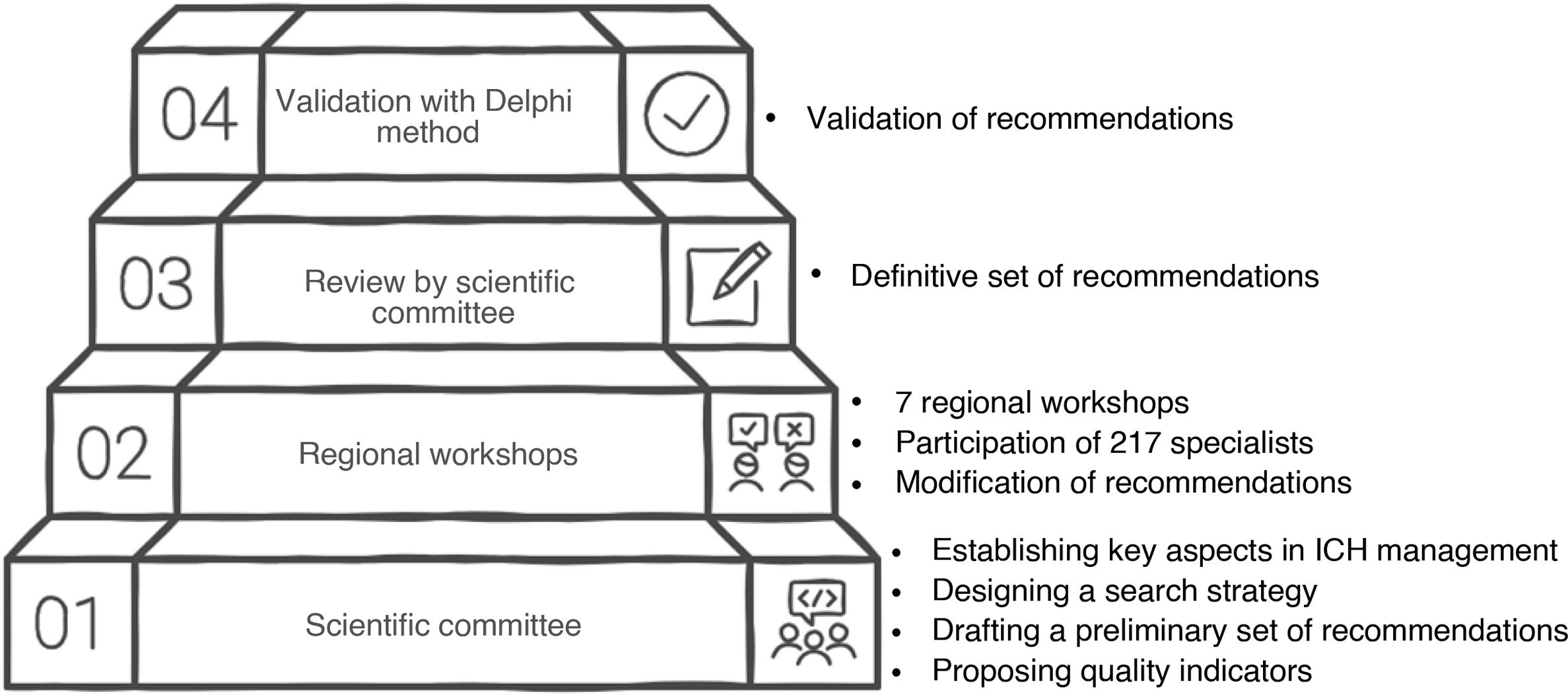
Material and methodsStudy designThe ActúA project is an initiative led by the Spanish Society of Neurology in coordination with AstraZeneca, designed to optimise the management of patients with ICH in Spain. This study has a prospective, cooperative design comprising 4 stages. The opinions of experts and healthcare professionals were gathered at regional workshops, and recommendations were subsequently validated according to the Delphi method (Fig. 1). This design aimed to minimise regional disparities in ICH management and to establish practical, evidence-based recommendations that are applicable nationwide and encompass all the specialties involved in the pre-hospital, in-hospital, and post-discharge management of patients with ICH.
- •
Stage 1: creation of a scientific committee and drafting of recommendations and quality indicators
A scientific committee was established, including 9 national experts in cerebrovascular disease, who were selected based on their clinical and research experience in neurology, intensive care medicine, pre-hospital emergency care, and hospital emergency care. The scientific committee held an initial meeting to establish the key aspects of ICH management for inclusion in the recommendations, as well as the guidelines for the literature search strategy. An initial draft of the document was subsequently created, based on an extensive review of the available literature and CPG, focusing on the specific characteristics of the Spanish healthcare system.
The literature search was conducted on PubMed using the following search strategy: spontaneous intracerebral haemorrhage: (“hemorrhagic stroke” [MeSH] OR “hemorrhagic stroke*” OR “intracerebral hemorrhagic stroke” OR “intracerebral haemorrhage”). Pre-hospital management: to include CPG and reviews on ischaemic stroke we added the terms (“ischemic stroke” OR “ischemic stroke” [MeSH]). Additional keywords were successively added to retrieve studies on particular subjects: “time,” “virtual,” “telemedicine,” “emergency,” “transport,” “code stroke.” In-hospital management: we searched for articles on ICH using the keywords specified. We also gathered data on ischaemic stroke stabilisation and management at the emergency department before diagnosis. Additional keywords were successively added to retrieve studies on particular subjects: “emergency room,” “workups,” “imaging” OR “computerized tomography” OR “magnetic resonance” OR “angio*,” “care bundle” OR “treatment combination,” “blood pressure” OR “blood pressure lowering,” “blood glucose” OR “hyperglycaemia,” “body temperature,” “anticoagulation reversal,” “complications.” Post-discharge management: given the potential overlap with some aspects of the follow-up and rehabilitation of ischaemic stroke, we added (“ischemic stroke” OR “ischemic stroke” [MeSH]) to retrieve CPG and reviews on ischaemic stroke. Additional keywords were successively added to retrieve studies on particular subjects: “secondary prevention,” “blood pressure,” “follow-up,” “rehabilitation,” “telemedicine,” “patient education,” “lifestyle,” “anticoagulation.”
An in-person meeting was subsequently held to review the available evidence, with a view to designing a preliminary set of recommendations and proposing quality indicators. Indicators were established based on the recommendations, using a structured approach and aiming to respond to the needs of different Spanish regions. The process included the identification of key areas associated with the care of patients with ICH, followed by the definition of specific metrics enabling the assessment of organisational, clinical, and outcome parameters. The indicators were categorised into 3 main groups: 1) structural indicators, designed to evaluate the availability of resources and the organisational capacity to conduct care processes; 2) process indicators, aimed at measuring the implementation and quality of care protocols; and 3) outcome indicators, designed to analyse the direct impact of interventions on patient health. Each indicator was evaluated in terms of relevance, feasibility, and utility for improving care processes in ICH.
- •
Stage 2: regional workshops
To review the proposed recommendations and their applicability in different realities and contexts of our healthcare system, 7 workshops were held in different autonomous communities between 10 October and 12 November 2024, with the participation of a total of 217 healthcare professionals from hospital and pre-hospital settings (see Supplementary material [Appendix A]). The initial draft of the recommendations was presented at each workshop, followed by a structured debate on its contents. The conclusions from each workshop were gathered with a view to refining the initial proposal. The proposed modifications for each recommendation were recorded for subsequent assessment by the scientific committee.
- •
Stage 3: review by the scientific committee
All proposed modifications and comments made during the regional workshops were analysed at a meeting of the scientific committee. A definitive version of the recommendations was established during this stage, incorporating the distinctive features identified in each region.
- •
Stage 4: validation using the Delphi method
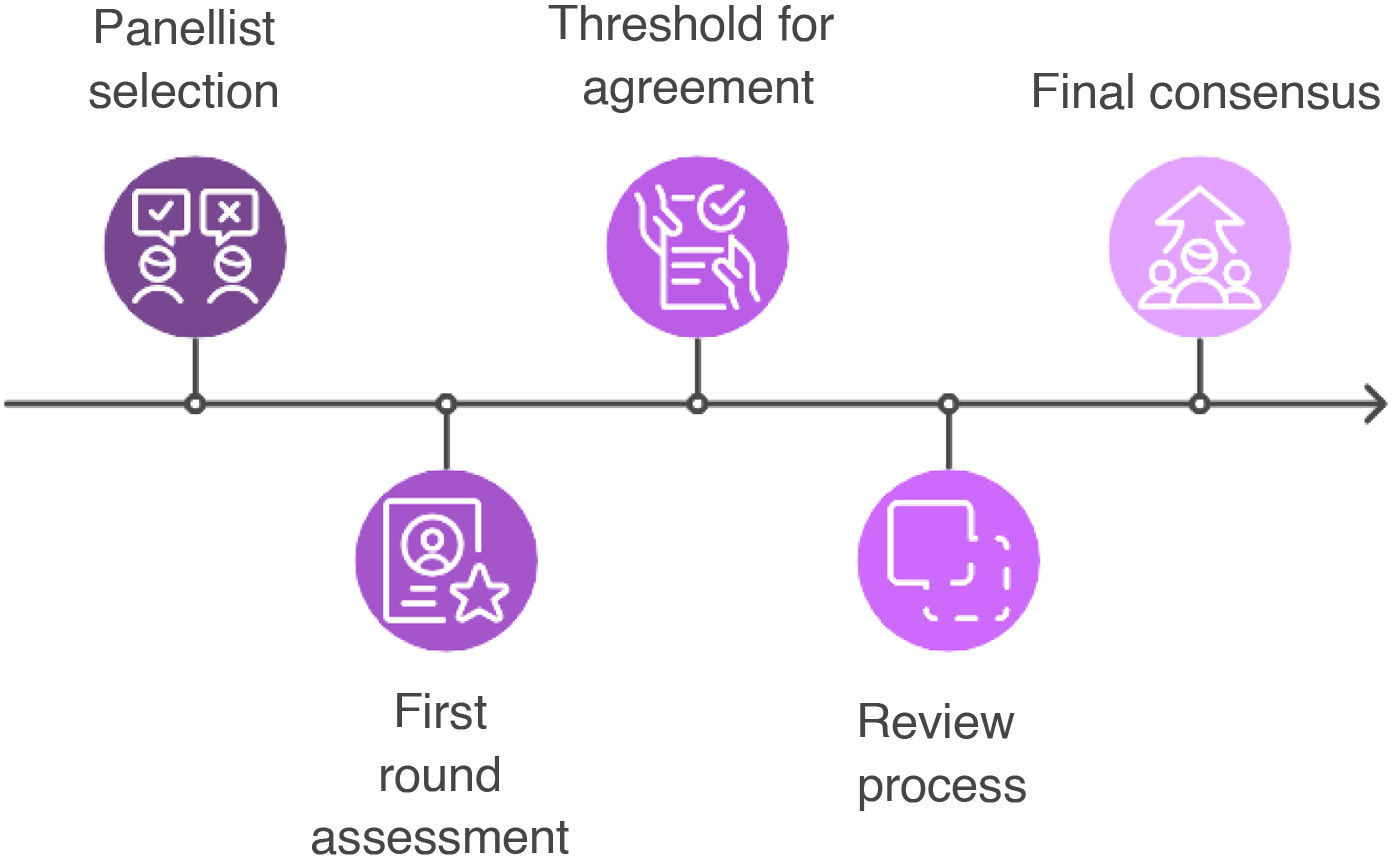
The Delphi method was used to reach a national consensus position, using a panel of 43 experts selected according to their experience with cerebrovascular disease. During the first round, participants evaluated each recommendation in terms of its relevance, applicability, and feasibility using a 9-point scale. The median score for each recommendation and the level of agreement between panellists (≥ 70%) were used to establish the degree of acceptance and agreement. Final consensus was reached in the first round (Fig. 2).
Analysis of resultsResponses to Delphi questionnaires and the results from the regional workshops were analysed with descriptive statistics. For the regional workshops, we calculated the percentages of agreement for each recommendation, establishing 70% agreement as an acceptable threshold. The analysis of Delphi consensus followed the RAND/UCLA appropriateness method20: agreement was considered to have been reached when fewer than one-third of ratings fell outside the range containing the median.
Ethical considerationsThis study is based on a technique to reach expert consensus, and did not involve patients or patient data collection. Therefore, approval by a research ethics committee or institutional review board was not necessary. All participants acted as panellists and/or authors, and contributed voluntarily to the objectives of the modified Delphi panel and to manuscript drafting. The panellists who completed the Delphi questionnaire received detailed information on the project, including its purpose and the authors’ intention to publish the results. All participants agreed to these terms, giving informed consent to participate in the study.
ResultsThe scientific committee defined 27 clinical performance indicators through qualitative consensus. Furthermore, through a qualitative Delphi consensus process, a total of 42 recommendations were formulated and voted on (17 for pre-hospital management, 12 for in-hospital management, and 13 for post-discharge management).
Pre-hospital phaseMultiple key considerations regarding the pre-hospital management of ICH were considered, including specific recommendations on code stroke activation at the regional level (such as clinical and operational criteria), and the implementation of protocols for patient management during transfer to the reference centre. We also analysed the use of validated neurological scales as essential tools for initial patient assessment. Furthermore, we included guidelines for the development of a pre-hospital care services map, with a view to optimising coordination between levels of care, and explored the use of telemedicine (“telestroke”) as a resource for remote support in the management of ICH at hospitals lacking continuous neurological care (Table 1).
Consensus statements.
| No. | Recommendation | Level of consensus and inclusion of the recommendation | |
|---|---|---|---|
| Median | Consensus | ||
| Pre-hospital phase | |||
| 1 | Code stroke is a care process involving rapid identification of acute stroke by the healthcare professionals providing the initial care, notification of emergency services, or activation of in-hospital pathways and communication between care levels. | 9 | Consensus |
| 2 | All autonomous communities must have a stroke care system in the form of a code stroke protocol for the adult population, including measures for both ischaemic and haemorrhagic strokes. | 9 | Consensus |
| 3 | All autonomous communities must have a stroke care system in the form of a code stroke protocol for the paediatric population, including measures for both ischaemic and haemorrhagic strokes. | 9 | Consensus |
| 4 | Code stroke care pathways must be based on a network or organisational model coordinating different care levels (primary care, pre-hospital emergency services, hospitals), with procedures and protocols for joint care provision. | 9 | Consensus |
| 5 | Code stroke must be activated in individuals who were previously independent for daily living activities and present acute neurological deficits of less than 24 hours’ duration. | 9 | Consensus |
| 6 | Acute neurological impairment must be suspected following sudden onset of any of the most frequent neurological symptoms of stroke, including loss of strength on one side of the body, difficulty speaking or understanding spoken language, acute vision problems, sensory deficits on one side of the body, or severe headache. | 9 | Consensus |
| 7 | The centres coordinating emergency services must have protocols for application of the main stroke screening scales in the general population, enabling healthcare professionals to recognise stroke. | 9 | Consensus |
| 8 | Medical emergency services must have resources to provide both direct (primary) and secondary (inter-hospital) transfer of patients meeting code stroke criteria to stroke centres with the most appropriate unit, as rapidly as possible. | 9 | Consensus |
| 9 | Care protocols for stroke recognition and assessment by healthcare professionals must include objective, validated assessment scales. | 9 | Consensus |
| 10 | To guarantee the homogeneity of the process of stroke identification and severity assessment, healthcare centres participating in the code stroke network must ensure continuing training of healthcare professionals, in the form of specific stroke training plans. | 9 | Consensus |
| 11 | Training for emergency services professionals must be provided to all healthcare professionals working at the coordinating centre and in basic or advanced life support teams. | 9 | Consensus |
| 12 | Each autonomous community must reach a consensus on and manage code stroke pathways to guarantee immediate patient transfer to the most appropriate centre, both in primary and in secondary transfers. | 9 | Consensus |
| 13 | Following code stroke activation, the patient must be transferred to the most appropriate centre as early as possible, given that stroke is a time-dependent emergency requiring priority response. | 9 | Consensus |
| 14 | In regions that lack stroke units due to their geographical characteristics (eg, rural areas), telestroke systems should be implemented that provide protocolised care through coordination between emergency services and the closest reference centre. | 9 | Consensus |
| 15 | Patients with suspected stroke and requiring intubation or presenting severe neurological complications must be attended and transferred by advanced life support teams to the closest hospital with an intensive care unit, for stabilisation and diagnosis following the established protocols. | 9 | Consensus |
| 16 | All hospitals participating in the code stroke network must be equipped to establish diagnosis based on CT studies, whether at reference centres or at centres with a telestroke system. | 9 | Consensus |
| 17 | The code stroke network must have an information system enabling the digital sharing of data on the pre-hospital and in-hospital phases of the care process. | 9 | Consensus |
| In-hospital phase | |||
| 18 | As part of the code stroke protocol, initial hospital care at the emergency department for patients with acute stroke requires an individualised, systematic clinical assessment (using stroke assessment scales), laboratory analyses, and neuroimaging studies, as well as early neurological evaluation (whether in-person or through teleconsultations). | 9 | Consensus |
| 19 | Initial hospital care in the context of code stroke must seek to identify ICH and determine its severity, and to guide immediate interventions, such as stabilising the patient, providing symptomatic treatment, controlling for risk factors for haematoma expansion and neurological deterioration, and ensuring continued care by a multidisciplinary team. | 9 | Consensus |
| 20 | CT is the first-line neuroimaging technique in the acute phase of stroke, and should be performed within 15 minutes of admission to the emergency department in all clinically stable code stroke patients, aiming to rapidly differentiate between ICH and ischaemic stroke. | 9 | Consensus |
| 21 | CT angiography, MR angiography, and MRI are recommended as complementary techniques for the aetiological study of ICH, particularly when a structural lesion or vascular malformation is suspected. | 9 | Consensus |
| 22 | Early assessment and treatment of patients with ICH is essential to prevent irreversible neurological damage, increase recovery rates, and improve functional prognosis. | 9 | Consensus |
| 23 | Patients with ICH should be managed by multidisciplinary teams (emergency medicine, neurology, neurosurgery, radiodiagnosis, and intensive care specialists, and nursing staff) following a systematic, protocolised strategy. | 9 | Consensus |
| 24 | Following individualised assessment, the stroke unit must ensure close neurological monitoring and implement a care bundle including intensive blood pressure control, glucose control, temperature control, early anticoagulant reversal with specific agents (when needed), neurosurgical assessment, seizure management, prevention of such complications as venous thromboembolism, and supportive care measures. | 9 | Consensus |
| 25 | Neurologically unstable patients with ICH (ie, those presenting decreased level of cornsciousness, respiratory failure, elevated intracranial pressure, need for neurosurgical management, or systemic complications) must be evaluated on a case-by-case basis by intensive care medicine specialists, particularly during the acute phase. | 9 | Consensus |
| 26 | During hospitalisation, prevention of ICH-related complications must include frequent assessment with neurological scales (GCS and NIHSS), continuous monitoring of cardiovascular parameters (blood pressure and heart rate), oxygenation and ventilation parameters, blood glucose level, body temperature, epileptic seizures, and risk of venous thromboembolism, in addition to dysphagia screening and assessment. | 9 | Consensus |
| 27 | A neuroimaging study must be performed to evaluate treatment response and any emerging complications, preferentially within the first 24 hours after hospital admission. | 9 | Consensus |
| 28 | Experts recommend systematic assessment of the need for integrative neurorehabilitation (including the neuropsychological and social domains) and continued care strategies enabling early functional, family, and social reintegration at discharge. | 9 | Consensus |
| 29 | The need for rehabilitation treatment should be assessed as early as possible following patient stabilisation, ideally from 24 hours after stroke, when the patient’s clinical status allows this. | 9 | Consensus |
| Post-discharge phase | |||
| 30 | Integrated clinical assessment should be performed immediately after clinical stabilisation, considering the patient’s functional, cognitive, and emotional status. | 9 | Consensus |
| 31 | Specialised neurorehabilitation must be started during hospitalisation and continued after discharge, either at an outpatient centre or at home, depending on patient progression. | 9 | Consensus |
| 32 | Early supported discharge should be promoted in patients with mild or moderate disability, reducing the length of hospital stays and improving health outcomes. | 9 | Consensus |
| 33 | ICH telerehabilitation programmes should be developed, particularly for patients with mobility problems or who live in rural areas, which would improve access, participation, and adherence to rehabilitation. | 9 | Consensus |
| 34 | Healthy lifestyle is recommended, including healthy diet, reduction of salt and alcohol intake, regular exercise, smoking cessation, and control of arterial blood pressure; this may significantly reduce the risk of ICH recurrence and improve overall vascular health. | 9 | Consensus |
| 35 | To prevent recurrence in patients with spontaneous ICH, blood pressure should be strictly monitored and controlled, aiming to maintain values below 130/80 mm Hg in the long term. | 9 | Consensus |
| 36 | Reintroduction of oral anticoagulation should be considered in patients with history of atrial fibrillation and other vascular risk factors, but requires careful risk-benefit assessment. | 9 | Consensus |
| 37 | Prevention of venous thromboembolism must be started at admission, with intermittent pneumatic compression systems; at 1-4 days after symptom onset, it may be continued with lowmolecular-weight heparin prophylaxis in patients presenting clinical stability and no rebleeding. | 9 | Consensus |
| 38 | High-risk factors for ICH and ischaemic stroke should be identified to prevent recurrences. | 9 | Consensus |
| 39 | Left atrial appendage closure should be considered in patients with history of atrial fibrillation and high risk of ischaemic stroke and brain haemorrhage with long-term contraindication for anticoagulation. | 9 | Consensus |
| 40 | In patients with an indication for continuous antiplatelet therapy, resuming this treatment is considered reasonable. | 9 | Consensus |
| 41 | Early onset of statin treatment following ICH may be beneficial for survival while decreasing ICH recurrence in patients with dyslipidaemia. | 8 | Consensus |
| 42 | Education and active participation of patients and their families are essential for effective stroke management and follow-up. Patients and their relatives must understand and support the treatment plan. | 9 | Consensus |
CT: computed tomography; GCS: Glasgow Coma Scale; ICH: intracerebral haemorrhage; NIHSS: National Institutes of Health Stroke Scale.
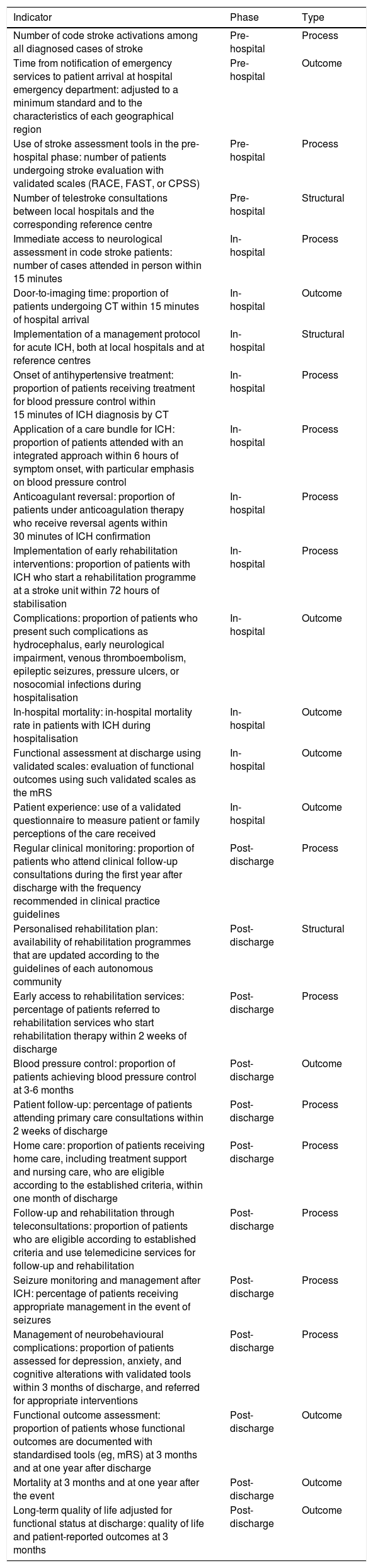
During this phase, we defined 4 key clinical performance indicators in order to objectively measure the quality of pre-hospital care and guide future interventions aiming to improve outcomes in this population (Table 2). These indicators include the number of code stroke activations, frequency of use of validated neurological assessment tools, emergency services transfer times, and number of telestroke consultations between local hospitals and the corresponding reference centre.
Clinical performance indicators.
| Indicator | Phase | Type |
|---|---|---|
| Number of code stroke activations among all diagnosed cases of stroke | Pre-hospital | Process |
| Time from notification of emergency services to patient arrival at hospital emergency department: adjusted to a minimum standard and to the characteristics of each geographical region | Pre-hospital | Outcome |
| Use of stroke assessment tools in the pre-hospital phase: number of patients undergoing stroke evaluation with validated scales (RACE, FAST, or CPSS) | Pre-hospital | Process |
| Number of telestroke consultations between local hospitals and the corresponding reference centre | Pre-hospital | Structural |
| Immediate access to neurological assessment in code stroke patients: number of cases attended in person within 15 minutes | In-hospital | Process |
| Door-to-imaging time: proportion of patients undergoing CT within 15 minutes of hospital arrival | In-hospital | Outcome |
| Implementation of a management protocol for acute ICH, both at local hospitals and at reference centres | In-hospital | Structural |
| Onset of antihypertensive treatment: proportion of patients receiving treatment for blood pressure control within 15 minutes of ICH diagnosis by CT | In-hospital | Process |
| Application of a care bundle for ICH: proportion of patients attended with an integrated approach within 6 hours of symptom onset, with particular emphasis on blood pressure control | In-hospital | Process |
| Anticoagulant reversal: proportion of patients under anticoagulation therapy who receive reversal agents within 30 minutes of ICH confirmation | In-hospital | Process |
| Implementation of early rehabilitation interventions: proportion of patients with ICH who start a rehabilitation programme at a stroke unit within 72 hours of stabilisation | In-hospital | Process |
| Complications: proportion of patients who present such complications as hydrocephalus, early neurological impairment, venous thromboembolism, epileptic seizures, pressure ulcers, or nosocomial infections during hospitalisation | In-hospital | Outcome |
| In-hospital mortality: in-hospital mortality rate in patients with ICH during hospitalisation | In-hospital | Outcome |
| Functional assessment at discharge using validated scales: evaluation of functional outcomes using such validated scales as the mRS | In-hospital | Outcome |
| Patient experience: use of a validated questionnaire to measure patient or family perceptions of the care received | In-hospital | Outcome |
| Regular clinical monitoring: proportion of patients who attend clinical follow-up consultations during the first year after discharge with the frequency recommended in clinical practice guidelines | Post-discharge | Process |
| Personalised rehabilitation plan: availability of rehabilitation programmes that are updated according to the guidelines of each autonomous community | Post-discharge | Structural |
| Early access to rehabilitation services: percentage of patients referred to rehabilitation services who start rehabilitation therapy within 2 weeks of discharge | Post-discharge | Process |
| Blood pressure control: proportion of patients achieving blood pressure control at 3-6 months | Post-discharge | Outcome |
| Patient follow-up: percentage of patients attending primary care consultations within 2 weeks of discharge | Post-discharge | Process |
| Home care: proportion of patients receiving home care, including treatment support and nursing care, who are eligible according to the established criteria, within one month of discharge | Post-discharge | Process |
| Follow-up and rehabilitation through teleconsultations: proportion of patients who are eligible according to established criteria and use telemedicine services for follow-up and rehabilitation | Post-discharge | Process |
| Seizure monitoring and management after ICH: percentage of patients receiving appropriate management in the event of seizures | Post-discharge | Process |
| Management of neurobehavioural complications: proportion of patients assessed for depression, anxiety, and cognitive alterations with validated tools within 3 months of discharge, and referred for appropriate interventions | Post-discharge | Process |
| Functional outcome assessment: proportion of patients whose functional outcomes are documented with standardised tools (eg, mRS) at 3 months and at one year after discharge | Post-discharge | Outcome |
| Mortality at 3 months and at one year after the event | Post-discharge | Outcome |
| Long-term quality of life adjusted for functional status at discharge: quality of life and patient-reported outcomes at 3 months | Post-discharge | Outcome |
CPSS: Cincinnati Prehospital Stroke Scale; CT: computed tomography; FAST: Face, Arms, Speech, Time scale; ICH: intracerebral haemorrhage; mRS: modified Rankin Scale; RACE: Rapid Arterial Occlusion Evaluation.
We identified and analysed the key recommendations for optimising the care of patients with spontaneous ICH at the emergency department. These include initial stabilisation of the patient and the use of standardised imaging protocols, with CT being regarded as an essential tool for early diagnosis. We also evaluated integrated treatment strategies encompassing such essential measures as intensive blood pressure control, early anticoagulant reversal, and improved access to neurosurgery when deemed necessary. Furthermore, we reviewed the guidelines for referral to the stroke unit, intensive care unit, and neurosurgery department, as well as guidelines for hospital discharge (Table 1).
The 11 in-hospital management indicators aim to measure the efficiency and quality of care, evaluating time from admission to neuroimaging and to treatment onset, the degree of implementation of in-hospital management protocols, the incidence of complications, and in-hospital mortality. We also incorporated metrics associated with patient experience and functional assessment at discharge using validated scales, with a view to providing an integrated view of the impact of these interventions (Table 2).
Post-discharge phaseWe evaluated recommendations focusing on patient management and treatment after hospital discharge, including strategies focused on rehabilitation, aligned with the National Stroke Plan, as well as secondary prevention measures aimed at reducing the risk of recurrent events (Table 1).
Furthermore, we analysed the guidelines on the follow-up of such key clinical performance indicators as mortality, hospital readmission rates, and functional prognosis. The 12 indicators proposed by the expert panel aim to measure the effectiveness of post-discharge interventions and to identify areas for improvement in the integrated care of patients with ICH (Table 2).
DiscussionThe ActúA project applied a multidisciplinary Delphi methodology to gather the perspectives of experts from different medical specialties involved in the management of patients with ICH. The diversity of knowledge and variety of approaches have resulted in an integrated, practical set of recommendations for optimising ICH management in all Spanish regions, including “code ICH.”21
Early identification of stroke is crucial to ensuring timely, effective management, initiating the optimal chain of care to ensure that patients are attended as quickly as possible.5 Code stroke activation by the emergency services attending the patient is an essential step in this process, as it enables immediate coordination between different care levels, whether in person or through teleconsultations.5,22 This organised flow not only enables rapid patient transfer to the most appropriate centre but also ensures early implementation of critical interventions.11 Furthermore, specific, continued training of healthcare professionals participating in this care pathway is essential to improve the early diagnosis of stroke using specific scales, especially in cases with more subtle presentations, which increases the likelihood of treatment effectiveness and better outcomes.23–28
Differences in neurological care between regions represent a significant public healthcare problem.29 These recommendations aim to minimise inequalities between autonomous communities, providing a solid basis and a series of clinical performance indicators that can be adapted to each setting, improving clinical outcomes.30 However, in the case of large autonomous communities, inter-regional agreements are required to ensure that patients are transferred to the closest stroke unit regardless of the autonomous community where it is located. Regions that lack stroke units due to their geographical characteristics should implement protocolised, coordinated telephone-based support between emergency services and the closest reference centre to ensure equity of care quality.5,31
The type of centre where patients with suspected severe or haemorrhagic stroke should be transferred continues to be a subject of debate. CPG recommend direct transfer to reference stroke centres if distance allows it, especially when neurosurgery or endovascular treatment is needed. However, prioritising transfer to the closest stroke centre enables earlier management and prevents critical delays in initial stabilisation.5,16,32–35 A secondary analysis of the RACECAT randomised clinical trial showed that bypassing the closest stroke centre in patients with a final diagnosis of ICH decreases the likelihood of functional independence at 90 days.36 This underscores the need to develop strategies to prioritise rapid access to initial care and patient transfer to centres equipped with specialised resources for the management of severe complications, optimising continuity of care.
On the other hand, the time elapsed until a treatment decision is made has a crucial impact on clinical outcomes. Early assessment and treatment are essential to minimise the risk of irreversible neurological damage, increase recovery rates, and improve functional prognosis.16,37 In this context, care bundles (blood pressure reduction, anticoagulant reversal, glucose control, temperature control, and neurosurgical assessment) represent a key tool to achieve positive outcomes in patients with acute ICH, in terms of survival and functional prognosis.14,38 These measures systematically address the most relevant aspects of the clinical management of ICH, and must be coordinated by stroke units in stable patients and by the intensive care unit in neurologically unstable patients.13,17,39 Specifically in this approach, rapid reduction of systolic blood pressure to a level below 140 mm Hg within 60 minutes is one of the most important interventions in the initial stage.8,14,40,41 This approach has been shown to effectively reduce haematoma expansion, limit early neurological impairment, and significantly improve functional outcomes at 90 days.16,37 On the other hand, immediate anticoagulant withdrawal (in patients receiving vitamin K antagonists, factor Xa inhibitors, dabigatran, or heparin) and rapid reversal with specific treatments minimise the risk of haematoma expansion and prevent further brain damage.15,16,32,42–44 These observations underscore the need to implement care protocols that prioritise rapid decision-making and early management as integral aspects of ICH treatment. Efficient coordination between different care levels and multidisciplinary teams is essential to promptly accomplishing these objectives.
In the medium and long term, strict blood pressure monitoring following discharge is essential to prevent spontaneous ICH recurrence.5,16,45–47 Maintaining blood pressure values below 130/80 mm Hg is associated with a significant decrease in the risk of further haemorrhages and a significant improvement in overall vascular health.5,16 This approach is particularly important in patients with poorly controlled hypertension, one of the main risk factors for recurrent ICH.48 Furthermore, the reintroduction of oral anticoagulation in patients with atrial fibrillation and other thromboembolic risk factors is a controversial issue that requires careful risk-benefit assessment.49 Although anticoagulation may be necessary to prevent thromboembolic events, its reintroduction in patients with history of ICH should be assessed on a case-by-case basis, considering clinical stability, haematoma localisation, and risk of haemorrhage recurrence.45,49 This balance between preventing thromboembolic events and minimising the risk of recurrent haemorrhage is essential for clinical decision-making. Therefore, the standardisation of these practices, based on the available evidence and CPG, must be prioritised for a more efficient and uniform management of this complex condition.
In parallel, rehabilitation treatment should be started as early as possible, although not within the first 24 hours after stroke. It should ideally be started during the acute care stage, aiming to maximise functional recovery, when the patient’s clinical status allows it.5,16,34,47 Likewise, the provision of continued care after hospital discharge is pivotal due to its demonstrated positive impact on prognosis.50–52 However, rehabilitation and/or telerehabilitation continue to be insufficient, given the large number of patients, the limited availability of resources, and geographical barriers, among other factors.
ConclusionsThe recommendations presented in this document aim to establish a solid foundation for the assessment and management of spontaneous ICH. These guidelines seek not only to standardise care provision but also to promote the implementation of evidence-based strategies that significantly improve clinical and functional outcomes; for this reason, we present a series of key clinical performance indicators that may be used to evaluate the implementation of the strategies proposed. The success of code stroke in improving management times and clinical outcomes in patients with ischaemic stroke should serve as a model for the development of an equally robust and coordinated protocol for ICH. This integrated approach, which includes coordination between different care levels and participation of multidisciplinary teams, may help to close the gap in ICH management, promoting a more equitable, rapid, and efficient response to the needs of this vulnerable patient population. These recommendations, although aspirational in some cases, must be viewed as a starting point toward a structural change, enabling the consolidation of care excellence for patients with ICH.
FundingEditorial assistance from Medical Statistics Consulting, S. L. was financed by AstraZeneca Farmaceutica Spain.
The authors have no conflicts of interest to declare.
The authors thank Miriam Ejarque, PhD, Blanca Piedrafita, PhD, and Javier Arranz-Nicolás, PhD, of Medical Statistics Consulting, S.L., for their assistance in compiling the authors’ contributions and in the drafting and editing of the manuscript in accordance with the Good Publication Practice guidelines.
The following is Supplementary data to this article:



