



The Simplified Evaluation of Disorders of Consciousness scale (SECONDs) has been proposed as a brief and efficient tool for the accurate diagnosis of patients with prolonged disorders of consciousness (DoC). Previous validation studies have only compared its total score with that of the Coma Recovery Scale-Revised (CRS-R). Our objective was to validate the Spanish-language version of the SECONDs, including its additional index, and to compare it with other scales such as the Disability Rating Scale (DRS).
Materials and methodsThirty-two patients with prolonged DoC were included. Each patient was assessed using the CRS-R, DRS, and SECONDs on 2 consecutive days. The SECONDs was translated into Spanish following the methodology proposed by Beaton et al. (2000). Diagnostic agreement (weighted kappa coefficient) and inter-scale correlations (Spearman coefficient) were analysed.
ResultsThe SECONDs showed excellent agreement with the CRS-R (κ = 0.81-0.83) and high intra- and inter-rater reliability (κ = 0.70-0.77). Administration time was significantly shorter than that of the CRS-R (7.2 [1.4] vs 16.6 [2.4] minutes; P < .001). Correlation with the DRS was moderate (r = –0.5 to –0.64).
ConclusionsThe SECONDs is a valid, reliable, and rapid tool for assessing patients with DoC in Spanish-speaking populations. Although it is not a replacement for the CRS-R, its brevity makes it ideal for use in critical care settings or as an initial screening instrument, optimising resources and clinical time.
LaEvaluación Simplificada de los Trastornos de la Conciencia (SECONDs), se ha propuesto como una escala breve y eficiente para el diagnóstico preciso de los pacientes en estados alterados de la conciencia (EAC). Los estudios de validación previos solo han incluido la comparación de su puntuación total con la de la Escala de Recuperación del Coma Revisada (CRS-R). Nuestro objetivo es validar la versión en castellano de la SECONDs, incluyendo su índice adicional, y su comparación con otras escalas como la Escala de Valoración de la iscapacidad (DRS).
Material y métodoSe incluyeron 32 pacientes con EAC prolongado. Cada paciente fue evaluado con la CRS-R, la DRS y la SECONDs en dos días consecutivos. La SECONDs se tradujo al castellano siguiendo la metodología de Beaton et al. (2000). Se analizó la concordancia diagnóstica (coeficiente kappa ponderado) y la correlación entre escalas (coeficiente de Spearman).
ResultadosLa SECONDs mostró una concordancia casi perfecta con la CRS-R (κ = 0.81−0.83) y una alta fiabilidad intra e interevaluador (κ = 0.70−0.77). El tiempo de administración fue significativamente menor que el de la CRS-R (7.2 ± 1.4 vs. 16.6 ± 2.4 minutos; p < 0.001). La correlación con la DRS fue moderada (r = -0.5 a -0.64).
ConclusionesLa SECONDs es una herramienta válida, fiable y rápida para evaluar a pacientes con EAC en población hispanohablante. Aunque no reemplaza a la CRS-R, su brevedad la hace ideal para uso en unidades de cuidados críticos o como herramienta de cribado inicial, optimizando recursos y tiempo en la práctica clínica.
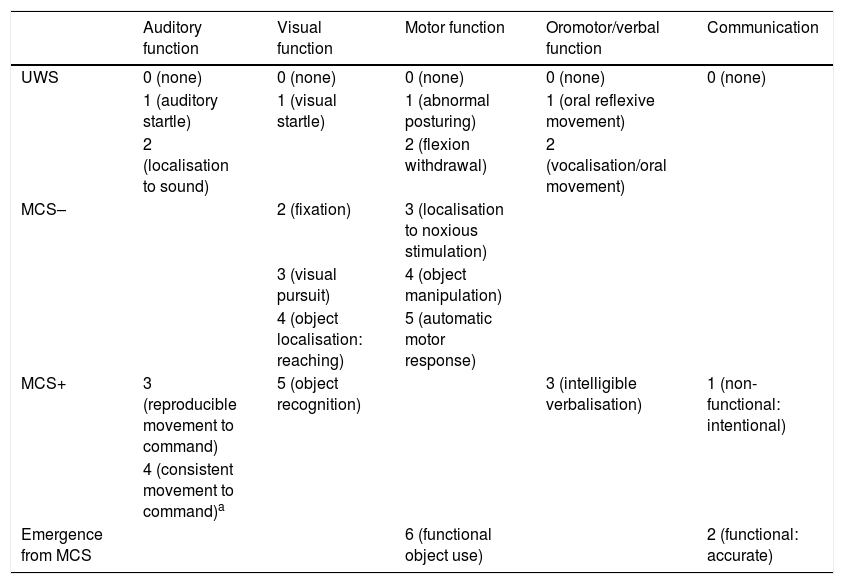
Precise diagnosis of disorders of consciousness (DoC) is essential, as the disorders grouped under this term differ greatly in terms of prognosis and treatment response.1,2 Beyond the 28 days that mark the threshold for DoC to be considered prolonged, clinical progression differs considerably in terms of morbidity and mortality: patients showing some sign of interaction with the environment, a condition known since 2004 as minimally conscious state (MCS),3 present more favourable outcomes than those without this interaction, a condition called vegetative state or, more recently, unresponsive wakefulness syndrome (UWS).4 Furthermore, patients in MCS and presenting a way of communicating (considered to be in MCS+) appear to present more favourable progression than those without communication (MCS–).5 Differences in the clinical response observable at the bedside in these 3 patient groups appear to reflect the extent of loss of cortico-thalamo-cortical connectivity due to the initial brain damage (Table 1).6 This would also explain the greater response to treatment, whether pharmacological or with neurostimulation and/or neuromodulation techniques, in those patients in whom the neurobiological substrate is partially preserved after the injury, and therefore susceptible to recovery to a greater or lesser extent.7
Diagnostic scores for the different subscales of the Coma Recovery Scale-Revised.
| Auditory function | Visual function | Motor function | Oromotor/verbal function | Communication | |
|---|---|---|---|---|---|
| UWS | 0 (none) | 0 (none) | 0 (none) | 0 (none) | 0 (none) |
| 1 (auditory startle) | 1 (visual startle) | 1 (abnormal posturing) | 1 (oral reflexive movement) | ||
| 2 (localisation to sound) | 2 (flexion withdrawal) | 2 (vocalisation/oral movement) | |||
| MCS– | 2 (fixation) | 3 (localisation to noxious stimulation) | |||
| 3 (visual pursuit) | 4 (object manipulation) | ||||
| 4 (object localisation: reaching) | 5 (automatic motor response) | ||||
| MCS+ | 3 (reproducible movement to command) | 5 (object recognition) | 3 (intelligible verbalisation) | 1 (non-functional: intentional) | |
| 4 (consistent movement to command)a | |||||
| Emergence from MCS | 6 (functional object use) | 2 (functional: accurate) |
MCS–: minimally conscious state minus; MCS+: minimally conscious state plus; UWS: unresponsive wakefulness syndrome.
Although the majority of management guidelines for DoC propose a multimodal approach to diagnosis, including functional neuroimaging and neurophysiological studies, among others,1,2 accessing these tests is often difficult at many centres, and their interpretation requires experience and processing time that is often not available. Although they have been shown to increase diagnostic sensitivity and specificity at the group level, additional studies are still necessary at the individual level to assist in interpreting the value of the results in the clinical context of each patient.8 Therefore, the diagnosis of these states remains fundamentally clinical in many institutions.9 Unfortunately, the use of clinical scales alone is associated with a very high percentage of diagnostic errors, particularly when standardised scales are not used or when administration of scales is not repeated over time with a view to detecting potentially infrequent clinical signs.10 The Coma Recovery Scale-Revised (CRS-R)11 is considered the scale of choice for this evaluation; however, its administration requires considerable time and a certain degree of experience and expertise. Furthermore, as the percentage of diagnostic errors decreases with repeated administration, it must be administered a minimum of 5 times over 10 days before diagnosis can be established, resulting in a considerable increase in the time needed to reach an exact diagnosis.12 The Simplified Evaluation of Consciousness Disorders scale (SECONDs) was recently proposed as a simplified scale, as it includes only 8 scored items and an additional index score ranging from 0 to 100; it presents all the advantages of the CRS-R, with a much shorter administration time.13 To date, the scale has been validated in French, English, Chinese, and recently an Italian-language version, with good results.13,14 However, published validation studies of the scale do not include other functional assessment scales frequently used in this population, such as the Disability Rating Scale (DRS)15; furthermore, only the latest study, conducted in an Italian population, reports results for the additional index score.16 The present study reports the cross-cultural adaptation and validation of the Spanish-language version of the scale in a sample of patients with prolonged DoC. In addition to the 8 scored items of the SECONDs, we also report the additional index score, comparing results against both the CRS-R, as in previous studies, and the DRS.
Material and methodsParticipantsAll patients with DoC, except those in coma, and admitted consecutively between February 2022 and February 2024 to 3 centres belonging to a dedicated rehabilitation hospital network for patients with severe brain injury, were considered eligible for study inclusion. Inclusion criteria were: presence of a severe acquired brain injury; presenting DoC (except coma) considered to be prolonged (≥ 28 days since injury); age 18 years or older; absence of prior history of neurological or psychiatric disorders; and being clinically stable. Each patient was assessed by 3 different examiners with experience in the clinical evaluation of this type of patients. Therefore, assessments were performed by a total of 9 examiners across the 3 participating centres.
The study was approved by the ethics committee of the reference hospital (record no. P11_24-102023), and written informed consent was obtained from the legal representatives of all patients prior to data collection.
MaterialSimplified Evaluation of Consciousness DisordersThe SECONDs is a clinical tool that was designed and validated for the differential diagnosis of patients with DoC in a short space of time (approximately 10 minutes), based on responses that can be observed at the bedside. The scale includes 6 obligatory items (observation, command-following, visual pursuit, visual fixation, oriented behaviours, and arousal) and 2 conditional items (pain localisation and communication).17 The final score corresponds to that of the highest-scored item. The score ranges from 0 to 8 points, and corresponds to a specific diagnosis, as follows: 8 points: emergence from the MCS; 6-7 points: MCS+; 2-5 points: MCS–; 1 point: UWS; 0 points: coma. It is essential that the scale be administered according to the instructions in the manual (Appendix 1), in order to ensure that results are replicable. For example, it is important to observe the prescribed timing and to administer each element in the order established on the scoring sheet.
The SECONDs was translated from French to Spanish according to the method proposed by Beaton et al.18 Two bilingual translators with expertise in Spanish and French independently translated the scale from French to Spanish. The 2 versions were compared by a member of the research team, resulting in a first draft of the Spanish-language adaptation. This version was back-translated to French by 2 experts in that language; then, the research team, alongside the translators, compared both versions and confirmed that there were no disparities between the 2. The Spanish-language adaptation of the scale was administered by 3 researchers to an initial sample of 5 patients to test the viability of the translation. The score sheet resulting from the Spanish-language adaptation of the scale is included in the Supplementary Material (Appendix 1).
Coma Recovery Scale-RevisedThe CRS-R is considered the standard instrument for assessing patients with severe brain injuries and presenting prolonged DoC. This scale, with a validated Spanish-language version,19 includes 23 items distributed across 6 subscales that assess the level of response in different domains: auditory function (4 items), visual function (5 items), motor function (6 items), oromotor/verbal function (3 items), communication (2 items), and arousal (2 items). The items of each subscale are ordered hierarchically and evaluated from greater to lesser levels of complexity, until a positive score is reached that characterises the level of consciousness (Table 1). The lowest scores for each subscale correspond to reflex responses, and the highest scores reflect activities that hypothetically imply cortical activity. Scores are standardised, and based on the presence (one point) or absence (zero points) of pre-defined behavioural responses to a specific sensory stimulus. The administration and scoring of the CRS-R incorporate the current diagnostic criteria for vegetative state/UWS, MCS, and emergence from MCS, although we must bear in mind that the global score is not able to distinguish between these 2 entities; rather, diagnosis must be based on the presence of specific items that define the transition from one state to another.
Disability Rating ScaleThe DRS takes into account aspects related both to deficits and to disability, according to the World Health Organization’s International Classification of Functioning, Disability, and Health. It assesses 8 items, divided into 4 categories. The awareness category includes 3 items (eye opening, communication ability, and motor response); the cognitive ability category evaluates patients’ ability to perform 3 basic tasks (feeding, toileting, and grooming); the third assesses dependence on others; and the fourth assesses employability, defined as the ability to perform work activity. Each item is scored on a scale with a minimum score of 0 (all items) and a maximum of 3 points (first and second categories) or 5 points (third and fourth categories), and total score ranges from 0 to 29, with higher scores indicating more severe involvement.
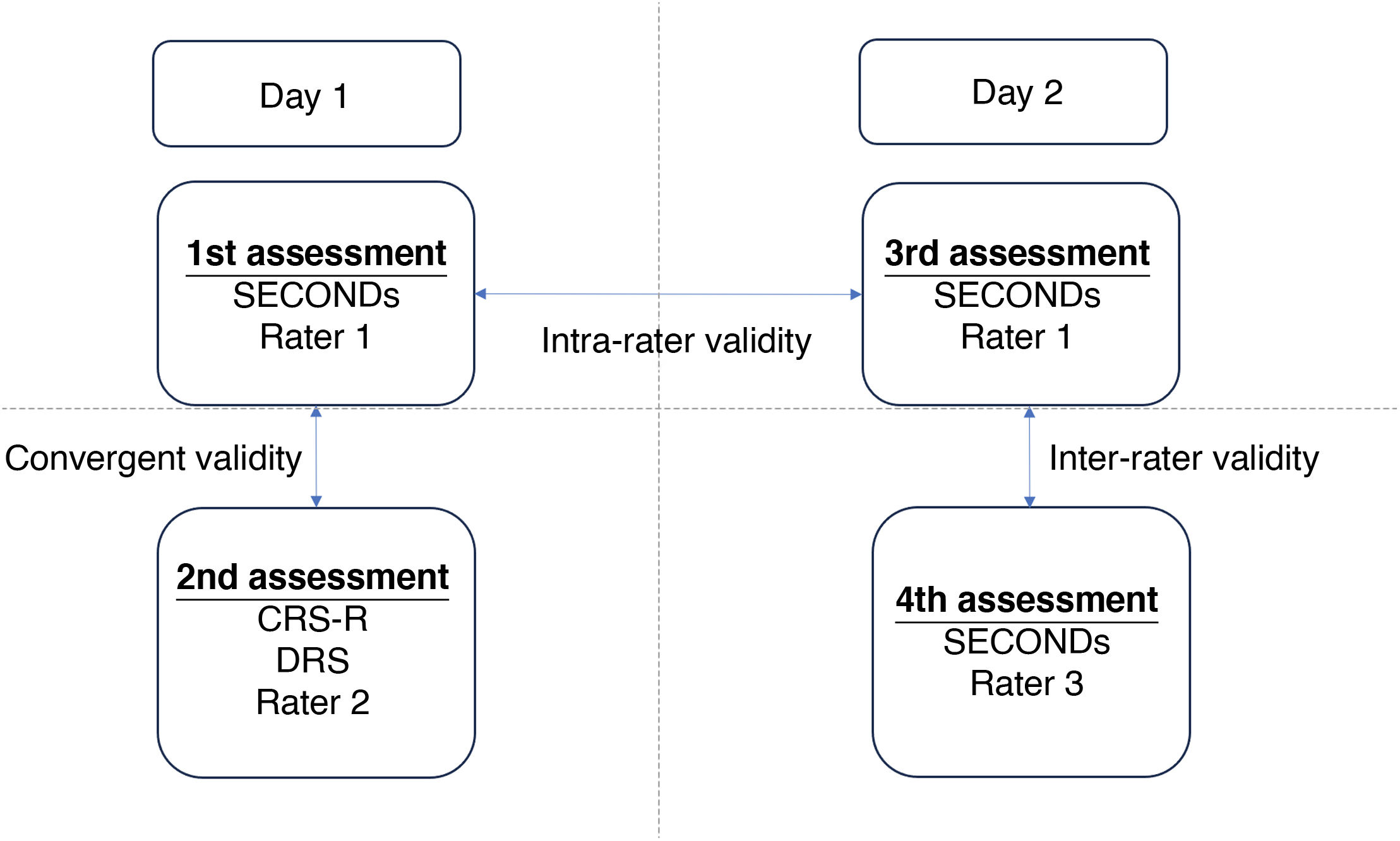
ProcedureAll patients were assessed on 4 occasions over 2 consecutive days, in accordance with the protocol established in the validation study by the authors of the original scale. On the first day, the CRS-R or DRS and the SECONDs were administered to determine convergent validity, defined as the concordance between the scores on 2 scales. A rest period of 45-60 minutes between evaluations was established to limit fluctuations in the ability to respond and to avoid fatigue. The following day, the SECONDs was administered twice (testing intra- and inter-rater reliability), with the same time interval established between the 2 assessments. The order of evaluations (CRS-R/DRS and SECONDs) and the order of the 2 days (CRS-R/SECONDs and SECONDs/SECONDs) was randomised. Three examiners were randomly assigned to the 4 assessments (Fig. 1). The administration time for each assessment was recorded. Examiners were blinded to patients’ medical diagnoses, medical records, and the results of the other assessments.
Statistical analysis
Descriptive statistics were used to evaluate patient characteristics. Quantitative variables are expressed as mean and standard deviation (SD), and qualitative variables are expressed as percentages. Differences in the administration times between the SECONDs and the CRS-R were evaluated with the Mann-Whitney U test. Results with P-values < .05 were considered statistically significant.
Convergent validity, including the scores in the 2 scales administered on the same day and between the CRS-R and the highest SECONDs score, as well as intra- and inter-rater reliability, were calculated using Fleiss weighted kappa coefficients (κ). Kappa values < 0 were classified as “poor agreement,” 0-0.2 as “mild agreement,” 0.21-0.4 as “acceptable agreement,” 0.41-0.6 as “moderate agreement,” 0.61-0.8 as “substantial agreement,” 0.81−0.99 as “near-perfect agreement,” and 1 as “perfect agreement.” The initial analysis of the results considered the 3 main diagnostic entities (UWS, MCS, and emergence from MCS), and a second analysis also considered the subdivision of MCS into MCS+ and MCS–. Finally, the Spearman correlation coefficient (r) was used to compare total CRS-R and DRS scores with SECONDs scores, and to compare SECONDs scores from the 2 assessments performed on the same day.
ResultsA total of 35 patients meeting the inclusion criteria were admitted to our institution. Two were transferred to another centre, and one was clinically unstable at admission and died within a period of weeks; thus, the final sample included a total of 32 patients (8 women and 24 men) with a mean (SD) age of 40 (17.6) years. Patients were consecutively attended at a specialised neurorehabilitation department for a mean of 95.2 (33.89) days after brain injury (traumatic in 21 cases, intracerebral haemorrhage in 4, and anoxic in 7).
The mean administration time (minutes) was significantly shorter for the SECONDs than for the CRS-R (7.2 [1.4] vs 16.6 [2.4]; P < .001).
According to CRS-R results, our sample included 10 patients with UWS, 13 in MCS–, 7 in MCS+, and 2 who had emerged from MCS. According to SECONDs scores from assessments performed the same day, a total of 12 patients had UWS, 11 were in MCS–, 8 were in MCS+, and one had emerged from MCS; according to the best SECONDs score, 11 had UWS, 12 were in MCS–, 5 were in MCS+, and 4 had emerged from MCS.
When only the 3 main diagnostic entities (UWS, MCS, and emergence from MCS) were considered, we observed near-perfect agreement between the CRS-R and the SECONDs performed the same day (κ = 0.81; 29/32; 90.6%) and between the CRS-R and the best SECONDs score (κ = 0.83). Both intra- and inter-rater reliability showed substantial agreement (κ = 0.77 and κ = 0.70, respectively).
When the extended diagnostic classification (UWS, MCS–, MCS+, and emergence from MCS) was considered, we observed substantial agreement between the CRS-R and the SECONDs performed the same day (κ = 0.77; 27/32; 87.5%) and between CRS-R and the best SECONDs score (κ = 0.77). Intra- and inter-rater reliability remained substantial (κ = 0.77 and κ = 0.77, respectively).
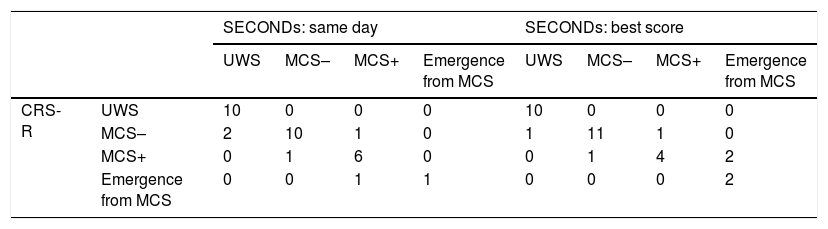
Table 2 presents the number of discrepancies in the diagnoses established with the SECONDs and the CRS-R, with the diagnostic distinction between MCS– and MCS+ being taken into account. When analysing scores from the SECONDs assessment performed on the same day as the CRS-R, diagnoses differed in 5 of the 32 initial patients (15.6%). Overall, diagnosis based on the SECONDs was more favourable than that based on the CRS-R in only one case, whereas the latter diagnosis was more favourable in 4 cases. The case in which diagnosis based on the SECONDs was more favourable was due to the detection of “command-following” with this scale only, with the patient therefore being diagnosed with MCS+. In another patient, the item “reproducible movement to command” was only detected with the CRS-R, and not the SECONDs. In 2 patients in whom visual pursuit was detected with the CRS-R (MCS–), this was not detected with the SECONDs; therefore, they were classified as having UWS according to the latter scale. One patient who displayed functional object use (denoting emergence from MCS) in the CRS-R assessment could not be diagnosed with the SECONDs, as this scale does not include this item.
Discrepancies in diagnoses established with the Simplified Evaluation of Consciousness Disorders scale and with the Coma Recovery Scale-Revised.
| SECONDs: same day | SECONDs: best score | ||||||||
|---|---|---|---|---|---|---|---|---|---|
| UWS | MCS– | MCS+ | Emergence from MCS | UWS | MCS– | MCS+ | Emergence from MCS | ||
| CRS-R | UWS | 10 | 0 | 0 | 0 | 10 | 0 | 0 | 0 |
| MCS– | 2 | 10 | 1 | 0 | 1 | 11 | 1 | 0 | |
| MCS+ | 0 | 1 | 6 | 0 | 0 | 1 | 4 | 2 | |
| Emergence from MCS | 0 | 0 | 1 | 1 | 0 | 0 | 0 | 2 | |
CRS-R: Coma Recovery Scale-Revised; MCS–: minimally conscious state minus; MCS+: minimally conscious state plus; SECONDs: Simplified Evaluation of Consciousness Disorders scale; UWS: unresponsive wakefulness syndrome.
Comparison of diagnoses made using the CRS-R and the best SECONDs score also detected discrepancies in 5 of the 32 initial patients. In this case, 3 patients presented more favourable diagnoses with the SECONDs than with the CRS-R, with the CRS-R diagnosis being more favourable in the other 2. When the best SECONDs score was considered, all patients diagnosed with UWS with the CRS-R were identified with the SECONDs, whereas 2 patients diagnosed with MCS+ using the CRS-R were classified as emergence from MCS according to the best SECONDs score.
Finally, the total CRS-R score was correlated both with the score from the SECONDs assessment performed by the same examiner on the same day (r = 0.84; P < .001) and with the additional index score (r = 0.89; P < .001). Likewise, total CRS-R score was correlated with the best of the 3 SECONDs scores recorded (r = 0.84; P < .001). Finally, DRS score was correlated with the SECONDs total score and additional index score for assessments performed on the same day (r = –0.5 and r = –0.64, respectively; P < .01 for both comparisons) and with the best of the 3 SECONDs scores recorded (r = –0.5; P < .01).
DiscussionOur results confirm the usefulness of the SECONDs as a diagnostic tool for patients with prolonged DoC, and expand its application to the Spanish-speaking population. The excellent convergent validity with the CRS-R, as well as the excellent intra- and inter-rater agreement, are consistent with reports from previous validation studies.13,14,16,17 Furthermore, our results contribute an excellent correlation between the SECONDs additional index and the CRS-R, as well as acceptable correlation with the DRS, supporting the scale’s diagnostic validity in this population.
One of the main advantages of the SECONDs is its short administration time. The items of the CRS-R exhaustively evaluate multiple domains (auditory, visual, motor, and verbal function, communication, and arousal), and as a result the scale may take 20-40 minutes to administer, depending on the status of the patient. The SECONDs, on the other hand, is designed to be more agile, enabling assessment of the patient’s response in different sensory modalities in a much shorter time. The CRS-R administration times recorded in our study are consistent with those described in the technical documents for the instrument; for the SECONDs, they were slightly shorter than those described previously. Due to the time saving, the scale is particularly attractive for use in critical care units or for rapid screening, where due to time limitations and high patient numbers, or because the severity of the situation prevents prolonged suspension of sedation, it is important to quickly reach an accurate diagnosis.20
The development of the SECONDs drew on data from previous studies analysing which CRS-R items are the most frequent in different clinical states, and which determine changes in the patient’s clinical situation. As a result, the SECONDs is both faster and simpler to administer than the CRS-R, which requires detailed knowledge of its scoring system and protocols; as a result, the SECONDs is more accessible for a broader range of healthcare professionals.
With respect to convergent validity, our results are consistent with those of previous studies reporting substantial to near-perfect agreement. The original study in French reported a κ coefficient of 0.79 for agreement on the same day, and 0.84-0.85 for comparison with the best SECONDs score.13 Similarly, the Spanish-language adaptation described here presented excellent convergent validity (κ = 0.81-0.83), supporting the capacity of the SECONDs to reflect the CRS-R diagnostic classification in the Spanish-speaking population. The Chinese-language adaptation also showed substantial convergent validity (mean κ = 0.62, increasing to 0.69-0.72 when the best score was considered)14; this suggests good diagnostic alignment, despite cultural and linguistic differences. Finally, the Italian-language adaptation reported substantial to near-perfect agreement (κ = 0.772-1.000),16 further supporting the convergent validity of the SECONDs. In addition to agreement regarding the diagnostic classification, strong, significant correlations are reported between scores on the SECONDs (including the additional index, in the Italian- and Spanish-language adaptations) and the CRS-R, supporting the scale’s concurrent validity.
Intra-rater reliability, which evaluates the consistency of scores obtained by the same rater in different administrations, was consistently high. Our data demonstrated substantial reliability (κ = 0.77), though slightly lower than the values reported in the French- (κ = 0.91),13 Chinese- (κ = 0.90-0.91),14 and Italian-language adaptations (κ = 0.951-0.968).16 These results show that the SECONDs enables stable, consistent assessment by the same examiner over time. Studies also show considerable agreement in the evaluation of inter-rater reliability. Our results show substantial inter-rater reliability (κ = 0.70), similar to that described for the Chinese-language adaptation (κ = 0.76),14 whereas the original study (κ = 0.82-0.85)13 and the validation of the Italian-language study (κ = 0.928-0.936)16 showed near-perfect agreement. The high inter-rater reliability suggests that the SECONDs is a robust tool whose administration is not significantly influenced by the rater; this is crucial to its implementation in clinical practice and multicentre studies.
As in previous studies, the main differences in the evaluation of these patients with both scales seem to result from differences in the visual pursuit and command-following items, as well as the lack of the functional object use item in the SECONDs. The description of visual pursuit seems to be more demanding in the SECONDs, as visual movement must persist for at least 2 seconds. On the other hand, the command-following item in the SECONDs appears to be less demanding, as only 2 out of 3 commands must be correctly performed, whereas the CRS-R requires patients to perform 3 out of 4 commands. Of all these differences, the greater difficulty of detecting visual pursuit on this scale is perhaps the most relevant consideration, as this sign is the one that most frequently determines the change in diagnosis from UWS to MCS, with the ensuing consequences for prognosis and therapy.21,22
No other study to date has compared the SECONDs with other scales besides the CRS-R. Whereas both the SECONDs and the CRS-R are intended to assess objective clinical or behavioural deficits after the application of different stimuli, the DRS includes aspects of global and integrated functional status, which may explain the lower convergent validity observed for this scale. Furthermore, as the elements of the SECONDs were extracted from the CRS-R, it should be unsurprising that stronger correlations should be observed with that scale than with the DRS. In this regard, Estraneo et al.23 described a similar correlation between the CRS-R and the DRS to that observed in our study, in a sample of patients with different aetiologies and disease durations.
It is important when interpreting our results to take into account the limitations of the sample, which included a small number of patients with prolonged DoC of different aetiologies. Unlike previous studies, ours had a particular focus on the differential diagnosis of patients with UWS and MCS, and therefore excluded patients in coma. Finally, no previous validation study of the SECONDs was performed during the acute phase or in emergency departments; therefore, caution should be exercised when extrapolating the results obtained to date to these populations.
Generally, the results show that the SECONDs presents robust psychometric properties in different languages and cultural contexts, reinforcing its value as an efficient tool for evaluating disorders of consciousness. The validity and reliability data of the Spanish-language translation reported here support its use in this population, particularly in the light of its high level of diagnostic accuracy and its short administration time. It should be stressed that the SECONDs is not a replacement for the CRS-R; rather, both tools can complement one another according to the context, situation, or objectives of the assessment. Although the SECONDs presents clear advantages, we should underscore that it does not provide the same level of detail as the CRS-R. In general terms, the SECONDs may be used as an initial screening tool to identify the residual capacity for sensory response, before performing a more comprehensive evaluation with the CRS-R, which would enable optimal use of the available resources and time.
FundingThis study was partially funded by the European Union’s Horizon Europe programme (Marie Skłodowska-Curie Actions, Staff Exchange, Grant Agreement ID: 101131344) and the Regional Ministry for Innovation, Universities, Science, and the Digital Society of the regional government of the Valencian Community (CIDEXG/2022/15).
The authors have no conflicts of interest to declare.
The following is Supplementary data to this article:



