


Sex differences in clinical presentation of ATTR-CA have been described, although published information is scarce. We aimed to compare baseline characteristics and outcomes between women and men with ATTR-CA.
MethodsWe evaluated all patients with ATTR-CA included in the Galician registry of cardiac amyloidosis (AMIGAL) between January 1st, 2018 and September 30th, 2023.
ResultsWe included 385 patients with ATTR-CA - 95 women (24.7%) and 290 men (75.3%), with a median age of 82.5 years. Female sex presented more frequently NYHA class ≥ III (36.8% vs. 25.2%, P = .028) and had higher LVEF (56.0% vs. 52.6%, P = .003) and indexed left ventricular maximum thickness (10.2 mm/m2 vs. 9.2 mm/m2, P = .001). Women received more thiazide diuretics (18.9% vs. 10.3%, P = .028) and less SGLT2i (15.8% vs. 27.2%, P = .024) and tafamidis (15.8% vs. 26.6%, P = .033). Incidence of HF hospitalizations was lower in female sex (IR 167.39 vs. 245.61, P = .033). There was no differences in mean survival, which was 4.1 years in both sexes.
ConclusionsWomen with AC-ATTR presented with worse functional class, higher LVEF and higher left ventricular thicknesses than men. Female patients received less frequently SGLT2i and tafamidis, and were admitted to hospital for HF less frequently compared to male patients, while survival was similar.
Se han descrito diferencias entre ambos sexos en la presentación clínica de la AC-ATTR, aunque la información publicada es escasa. Nos propusimos comparar las características basales y la aparición de eventos entre mujeres y hombres con AC-ATTR.
MétodosSe evaluaron todos los pacientes con AC-ATTR incluidos en el registro de amiloidosis cardiaca de Galicia (AMIGAL) entre el 1 de enero de 2018 y el 30 de septiembre de 2023.
ResultadosSe incluyeron 385 pacientes con AC-ATTR, 95 mujeres (24,7%) y 290 hombres (75,3%), con una edad mediana de 82,5 años. El sexo femenino presentó con más frecuencia una clase funcional NYHA ≥ III (36,8% frente a 25,2%; p = 0,028), tuvo una FEVI más elevada (56,0% frente a 52,6%; p = 0,003) y grosores máximos indexados del ventrículo izquierdo mayores (10,2 mm/m2 frente a 9,2 mm/m2; p = 0,001). Las mujeres recibieron más diuréticos tiazídicos (18,9% frente a 10,3%; p = 0,028) y menos iSGLT2 (15,8% frente a 27,2%; p = 0,024) y tafamidis (15,8% frente a 26,6%; p = 0,033). La incidencia de hospitalizaciones por insuficiencia cardiaca fue menor en el sexo femenino (tasa de incidencia 167,39 frente a 245,61; p = 0,033). No hubo diferencias en la supervivencia media, que fue en ambos sexos de 4,1 años.
ConclusionesLas mujeres con AC-ATTR se caracterizaron por presentar peor clase funcional, FEVI más elevada y mayor engrosamiento ventricular izquierdo que los hombres. Las pacientes de sexo femenino recibieron con menos frecuencia iSGLT2 y tafamidis e ingresaron con menos frecuencia por IC en comparación con los de sexo masculino, mientras que la supervivencia fue similar.
Transthyretin amyloidosis (ATTR)1 is a systemic disease caused by deposits of the transthyretin protein building up in extracellular organ spaces, altering the organ’s structure and function. There are two subtypes of this disease: a hereditary or variant form (ATTRh) caused by one of more than 120 pathogenic variants identified in the transthyretin gene; and a non-hereditary or wild-type form (ATTRwt) caused by a poorly understood ageing-associated mechanism. Although ATTR can affect the peripheral nervous system, the musculoskeletal system, or the digestive system, the most frequently affected organ is the heart, which determines patient’ prognosis.2,3 Despite therapeutic breakthroughs in recent years that include the availability in daily clinical practice of a specific drug with a favourable impact on the prognosis of patients with transthyretin cardiac amyloidosis (ATTR-CM),4 it still remains a disease associated with high morbidity, mainly due to hospital admissions for heart failure (HF),5,6 and mortality.
Information obtained from various ATTR-CM patient registries has shown that both subtypes, although more markedly wtATTR-CM, affect women less frequently than men.7–12 Furthermore, recent research indicates that, similar to that observed in other cardiovascular diseases, there are notable differences in the clinical presentation and prognosis of this disease between the two sexes, although the evidence is scarce and contradictory.13 Without a doubt, it is essential to further our knowledge in this area in order to correct a potential imbalance that may be observed in the healthcare provided to women with ATTR-CM. We therefore set out to compare the baseline characteristics and the occurrence of clinical episodes between both sexes in a prospective, multicentre cohort of patients with ATTR-CM.
MethodsStudy descriptionThis study used the cohort of patients with ATTR-CM included in the Galician Cardiac Amyloidosis Registry (AMIGAL) between 1 January 2018 and 30 September 2023. This is an observational, prospective, multicentre registry of patients diagnosed with CM in Galicia, which began on 1 January 2018 and is still active today.
The protocol for this registry, developed in accordance with the Declaration of Helsinki, was approved by the Galician Research Ethics Committee and published previously.12 In summary, the diagnosis of ATTR-CM is based on the combination of a 3,3-diphosphono-1,2-propanedicarboxylic acid bone scintigraphy with a myocardial uptake grade ≥ 2 and the demonstrated absence of monoclonal gammopathy confirmed by serum free light chains and serum and urine immunofixation. If abnormal results are obtained in haematological tests, histological confirmation of myocardial amyloid deposits by transthyretin is required to make the diagnosis of the disease. Finally, a genetic study is recommended to assess the existence of pathogenic variants in the transthyretin gene. Each participant must sign a specific informed consent form before being included in the registry.
Data collection and follow-upThis study has used the information in the AMIGAL registry's electronic database, which includes baseline clinical characteristics, the occurrence of various clinical events (hospital admissions, A&E visits, arrhythmic episodes, syncope, pacemaker implantation, ischaemic heart disease, cerebrovascular disease, and venous or arterial embolic events), and the mortality of all patients. Follow-up continued until the date of a heart transplant, the date of death, or 31 December 2023.
Statistical analysisCategorical variables are presented as proportions and continuous variables as medians (interquartile range), given their lack of normality. Categorical variables were compared using the χ2 test, the median value of continuous variables using the Wilcoxon test, and episode incidence rates using the rate ratio. Survival curves were constructed using the Kaplan-Meier method and compared using the logarithmic rank test. Statistical analysis was performed using SPSS 25 and EPIDAT 4.2 for Mac.
ResultsPatientsBetween 1 January 2018 and 30 September 2023, 385 patients with ATTR-CM were included: 330 (85.7%) wtATTR-CM; 11 (2.9%) with hATTR-CM and 44 (11.4%) of unknown subtype, as no genetic study had been performed. Of the total, 95 (24.7%) were women and 290 (75.3%) were men. No significant differences were observed between the two sexes in the median age at the time of inclusion (82.6 years for women versus 82.3 years for men, P = .330) or in the distribution of disease subtypes: 79 (83.2%) were women and 251 (86.6%) were men with wtATTR-CM (P = .265). There were also no significant differences in the clinical presentation of ATTR-CM, the most common form in both sexes being HF, or in the prevalence of diagnoses prior to ATTR-CM.
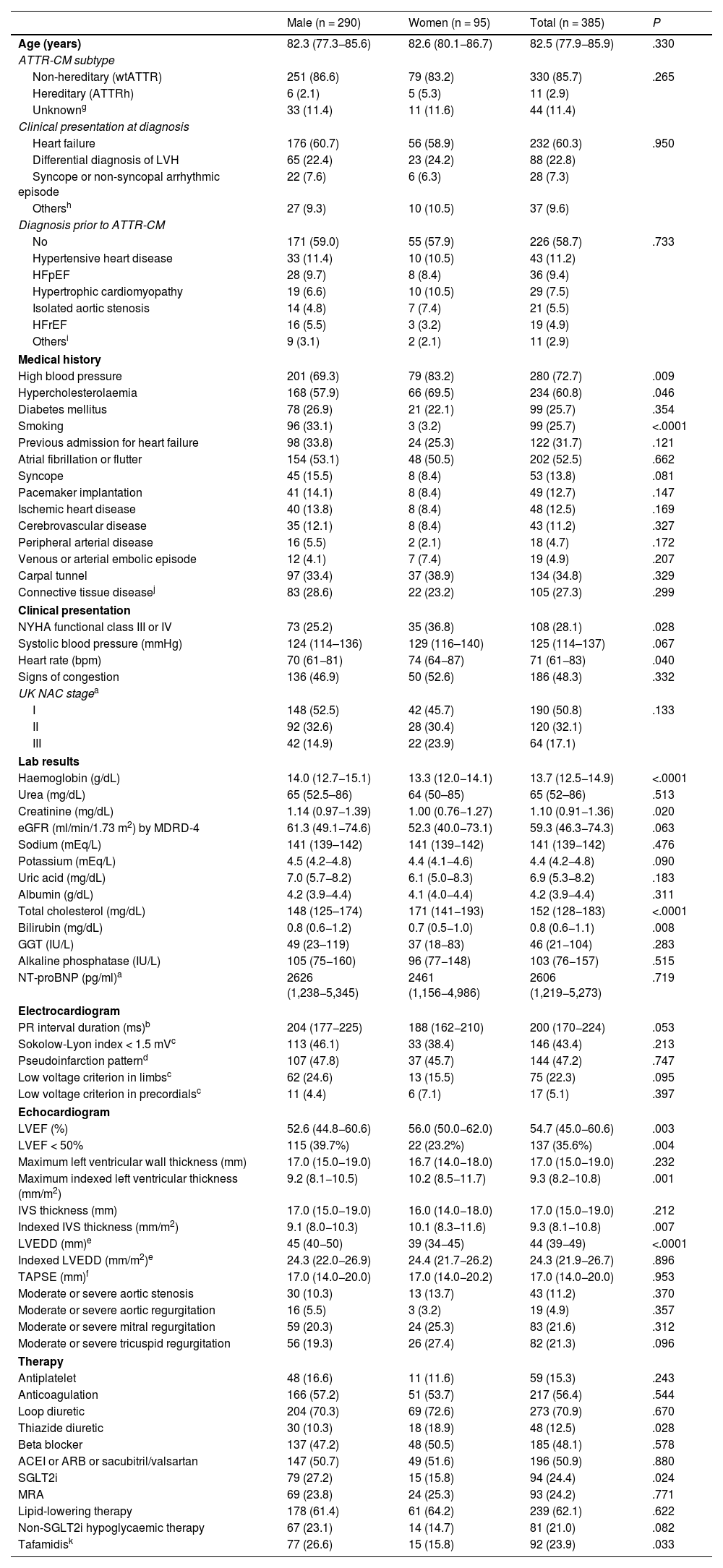
Baseline clinical characteristicsThe baseline clinical characteristics of patients at the time of inclusion in the registry are shown in Table 1.
Baseline clinical characteristics of patients at the time of inclusion in the registry according to sex.
| Male (n = 290) | Women (n = 95) | Total (n = 385) | P | |
|---|---|---|---|---|
| Age (years) | 82.3 (77.3−85.6) | 82.6 (80.1−86.7) | 82.5 (77.9−85.9) | .330 |
| ATTR-CM subtype | ||||
| Non-hereditary (wtATTR) | 251 (86.6) | 79 (83.2) | 330 (85.7) | .265 |
| Hereditary (ATTRh) | 6 (2.1) | 5 (5.3) | 11 (2.9) | |
| Unknowng | 33 (11.4) | 11 (11.6) | 44 (11.4) | |
| Clinical presentation at diagnosis | ||||
| Heart failure | 176 (60.7) | 56 (58.9) | 232 (60.3) | .950 |
| Differential diagnosis of LVH | 65 (22.4) | 23 (24.2) | 88 (22.8) | |
| Syncope or non-syncopal arrhythmic episode | 22 (7.6) | 6 (6.3) | 28 (7.3) | |
| Othersh | 27 (9.3) | 10 (10.5) | 37 (9.6) | |
| Diagnosis prior to ATTR-CM | ||||
| No | 171 (59.0) | 55 (57.9) | 226 (58.7) | .733 |
| Hypertensive heart disease | 33 (11.4) | 10 (10.5) | 43 (11.2) | |
| HFpEF | 28 (9.7) | 8 (8.4) | 36 (9.4) | |
| Hypertrophic cardiomyopathy | 19 (6.6) | 10 (10.5) | 29 (7.5) | |
| Isolated aortic stenosis | 14 (4.8) | 7 (7.4) | 21 (5.5) | |
| HFrEF | 16 (5.5) | 3 (3.2) | 19 (4.9) | |
| Othersi | 9 (3.1) | 2 (2.1) | 11 (2.9) | |
| Medical history | ||||
| High blood pressure | 201 (69.3) | 79 (83.2) | 280 (72.7) | .009 |
| Hypercholesterolaemia | 168 (57.9) | 66 (69.5) | 234 (60.8) | .046 |
| Diabetes mellitus | 78 (26.9) | 21 (22.1) | 99 (25.7) | .354 |
| Smoking | 96 (33.1) | 3 (3.2) | 99 (25.7) | <.0001 |
| Previous admission for heart failure | 98 (33.8) | 24 (25.3) | 122 (31.7) | .121 |
| Atrial fibrillation or flutter | 154 (53.1) | 48 (50.5) | 202 (52.5) | .662 |
| Syncope | 45 (15.5) | 8 (8.4) | 53 (13.8) | .081 |
| Pacemaker implantation | 41 (14.1) | 8 (8.4) | 49 (12.7) | .147 |
| Ischemic heart disease | 40 (13.8) | 8 (8.4) | 48 (12.5) | .169 |
| Cerebrovascular disease | 35 (12.1) | 8 (8.4) | 43 (11.2) | .327 |
| Peripheral arterial disease | 16 (5.5) | 2 (2.1) | 18 (4.7) | .172 |
| Venous or arterial embolic episode | 12 (4.1) | 7 (7.4) | 19 (4.9) | .207 |
| Carpal tunnel | 97 (33.4) | 37 (38.9) | 134 (34.8) | .329 |
| Connective tissue diseasej | 83 (28.6) | 22 (23.2) | 105 (27.3) | .299 |
| Clinical presentation | ||||
| NYHA functional class III or IV | 73 (25.2) | 35 (36.8) | 108 (28.1) | .028 |
| Systolic blood pressure (mmHg) | 124 (114–136) | 129 (116–140) | 125 (114–137) | .067 |
| Heart rate (bpm) | 70 (61−81) | 74 (64−87) | 71 (61−83) | .040 |
| Signs of congestion | 136 (46.9) | 50 (52.6) | 186 (48.3) | .332 |
| UK NAC stagea | ||||
| I | 148 (52.5) | 42 (45.7) | 190 (50.8) | .133 |
| II | 92 (32.6) | 28 (30.4) | 120 (32.1) | |
| III | 42 (14.9) | 22 (23.9) | 64 (17.1) | |
| Lab results | ||||
| Haemoglobin (g/dL) | 14.0 (12.7−15.1) | 13.3 (12.0−14.1) | 13.7 (12.5−14.9) | <.0001 |
| Urea (mg/dL) | 65 (52.5–86) | 64 (50–85) | 65 (52–86) | .513 |
| Creatinine (mg/dL) | 1.14 (0.97−1.39) | 1.00 (0.76−1.27) | 1.10 (0.91−1.36) | .020 |
| eGFR (ml/min/1.73 m2) by MDRD-4 | 61.3 (49.1−74.6) | 52.3 (40.0−73.1) | 59.3 (46.3−74.3) | .063 |
| Sodium (mEq/L) | 141 (139–142) | 141 (139−142) | 141 (139−142) | .476 |
| Potassium (mEq/L) | 4.5 (4.2−4.8) | 4.4 (4.1−4.6) | 4.4 (4.2−4.8) | .090 |
| Uric acid (mg/dL) | 7.0 (5.7−8.2) | 6.1 (5.0−8.3) | 6.9 (5.3−8.2) | .183 |
| Albumin (g/dL) | 4.2 (3.9−4.4) | 4.1 (4.0−4.4) | 4.2 (3.9−4.4) | .311 |
| Total cholesterol (mg/dL) | 148 (125–174) | 171 (141−193) | 152 (128−183) | <.0001 |
| Bilirubin (mg/dL) | 0.8 (0.6−1.2) | 0.7 (0.5−1.0) | 0.8 (0.6−1.1) | .008 |
| GGT (IU/L) | 49 (23–119) | 37 (18−83) | 46 (21−104) | .283 |
| Alkaline phosphatase (IU/L) | 105 (75−160) | 96 (77−148) | 103 (76−157) | .515 |
| NT-proBNP (pg/ml)a | 2626 (1,238−5,345) | 2461 (1,156−4,986) | 2606 (1,219−5,273) | .719 |
| Electrocardiogram | ||||
| PR interval duration (ms)b | 204 (177−225) | 188 (162−210) | 200 (170−224) | .053 |
| Sokolow-Lyon index < 1.5 mVc | 113 (46.1) | 33 (38.4) | 146 (43.4) | .213 |
| Pseudoinfarction patternd | 107 (47.8) | 37 (45.7) | 144 (47.2) | .747 |
| Low voltage criterion in limbsc | 62 (24.6) | 13 (15.5) | 75 (22.3) | .095 |
| Low voltage criterion in precordialsc | 11 (4.4) | 6 (7.1) | 17 (5.1) | .397 |
| Echocardiogram | ||||
| LVEF (%) | 52.6 (44.8−60.6) | 56.0 (50.0−62.0) | 54.7 (45.0−60.6) | .003 |
| LVEF < 50% | 115 (39.7%) | 22 (23.2%) | 137 (35.6%) | .004 |
| Maximum left ventricular wall thickness (mm) | 17.0 (15.0−19.0) | 16.7 (14.0−18.0) | 17.0 (15.0−19.0) | .232 |
| Maximum indexed left ventricular thickness (mm/m2) | 9.2 (8.1−10.5) | 10.2 (8.5−11.7) | 9.3 (8.2−10.8) | .001 |
| IVS thickness (mm) | 17.0 (15.0−19.0) | 16.0 (14.0−18.0) | 17.0 (15.0−19.0) | .212 |
| Indexed IVS thickness (mm/m2) | 9.1 (8.0−10.3) | 10.1 (8.3−11.6) | 9.3 (8.1−10.8) | .007 |
| LVEDD (mm)e | 45 (40−50) | 39 (34−45) | 44 (39−49) | <.0001 |
| Indexed LVEDD (mm/m2)e | 24.3 (22.0−26.9) | 24.4 (21.7−26.2) | 24.3 (21.9−26.7) | .896 |
| TAPSE (mm)f | 17.0 (14.0−20.0) | 17.0 (14.0−20.2) | 17.0 (14.0−20.0) | .953 |
| Moderate or severe aortic stenosis | 30 (10.3) | 13 (13.7) | 43 (11.2) | .370 |
| Moderate or severe aortic regurgitation | 16 (5.5) | 3 (3.2) | 19 (4.9) | .357 |
| Moderate or severe mitral regurgitation | 59 (20.3) | 24 (25.3) | 83 (21.6) | .312 |
| Moderate or severe tricuspid regurgitation | 56 (19.3) | 26 (27.4) | 82 (21.3) | .096 |
| Therapy | ||||
| Antiplatelet | 48 (16.6) | 11 (11.6) | 59 (15.3) | .243 |
| Anticoagulation | 166 (57.2) | 51 (53.7) | 217 (56.4) | .544 |
| Loop diuretic | 204 (70.3) | 69 (72.6) | 273 (70.9) | .670 |
| Thiazide diuretic | 30 (10.3) | 18 (18.9) | 48 (12.5) | .028 |
| Beta blocker | 137 (47.2) | 48 (50.5) | 185 (48.1) | .578 |
| ACEI or ARB or sacubitril/valsartan | 147 (50.7) | 49 (51.6) | 196 (50.9) | .880 |
| SGLT2i | 79 (27.2) | 15 (15.8) | 94 (24.4) | .024 |
| MRA | 69 (23.8) | 24 (25.3) | 93 (24.2) | .771 |
| Lipid-lowering therapy | 178 (61.4) | 61 (64.2) | 239 (62.1) | .622 |
| Non-SGLT2i hypoglycaemic therapy | 67 (23.1) | 14 (14.7) | 81 (21.0) | .082 |
| Tafamidisk | 77 (26.6) | 15 (15.8) | 92 (23.9) | .033 |
ACEI: angiotensin-converting enzyme inhibitor; ARB: angiotensin receptor blocker; ATTR-CM: transthyretin cardiac amyloidosis; eGFR: estimated glomerular filtration rate; HFpEF: heart failure with preserved ejection fraction; HFrEF: heart failure with reduced ejection fraction; hATTR-CM: variant or hereditary transthyretin cardiac amyloidosis; IVS: interventricular septum; LVEDD: left ventricular end-diastolic diameter; LVEF: left ventricular ejection fraction; LVH: left ventricular hypertrophy; MRA: mineralocorticoid receptor antagonists; NYHA: New York Heart Association; SGLT2i: sodium-glucose cotransporter 2 inhibitors; TAPSE: tricuspid annulus plane systolic excursion; UK NAC: United Kingdom National Amyloidosis Centre; wtATTR-CM: wild-type or non-hereditary transthyretin cardiac amyloidosis.
Data are presented as n (%) and median (interquartile range).
Calculations based on n = 385 except:
Includes: chest pain, electrocardiographic abnormalities in asymptomatic patients, diagnosis in the context of an aetiological study of stroke or peripheral neuropathy, and incidental diagnosis.
Includes: ischaemic heart disease, ischaemic-hypertensive heart disease, and idiopathic restrictive cardiomyopathy.
Women had a higher prevalence of a previous history of high blood pressure (83.2% vs. 69.3%; P = .009) and hypercholesterolaemia (69.5% vs. 57.9%; P = .046) compared to men, while a history of smoking was more common among men (33.1% vs. 3.2%; P < .0001).
A significantly higher percentage of women were in New York Heart Association (NYHA) functional class III or IV (36.8% vs. 25.2%; P = .028). However, no differences were observed in the United Kingdom National Amyloidosis Centre (UK NAC) stage of patients of both sexes at the time of inclusion.
With regard to laboratory results, it should be noted that women had lower median haemoglobin and bilirubin values (13.3 g/dL vs. 14.0 g/dL; P < .0001 and 0. 7 mg/dl vs. 0. 8 mg/dL; P = .008, respectively) and higher total cholesterol values (171 mg/dL versus 148 mg/dL; P < .0001) than in men. No differences were observed between the two sexes in plasma NT-proBNP values.
None of the electrocardiographic parameters evaluated were more frequent in one sex than the other. With regard to transthoracic echocardiogram, women were characterised by a higher median left ventricular ejection fraction (LVEF) (56.0% vs. 52.6%; P = .003), a lower prevalence of LVEF < 50% (23.2% vs. 39.7%; P = .004), and a narrower left ventricular end-diastolic diameter (LVEDD) (39 mm vs. 45 mm; P < .0001), although when these measurements were indexed by body surface area, no statistically significant differences in left ventricular size were observed. In contrast, although the absolute values for maximum left ventricular thickness and interventricular septal thickness did not differ between the two sexes, measurements indexed by body surface area showed that women had significantly greater left ventricular thickening than men (10.2 mm/m2 versus 9.2 mm/m2; P = .001 and 10.1 mm/m2 versus 9.1 mm/m2; P = .007, respectively).
Finally, women were more likely to receive thiazide diuretics (18.9% vs. 10.3%; P = .028) and, to a lesser extent, sodium-glucose cotransporter 2 inhibitors (SGLT2 inhibitors) (15.8% vs. 27.2%; P = .024) and tafamidis (15.8% vs. 26.6%; P = .033) than men.
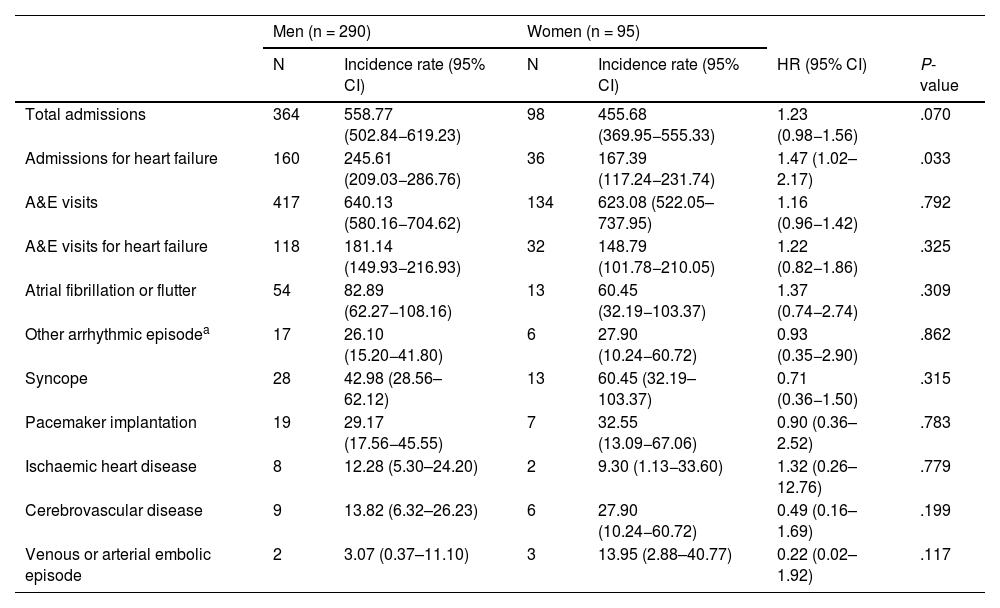
Clinical episodes and survivalDuring a median follow-up of 685 days (interquartile range 365–1228 days), there were a total of 462 hospitalisations (196; 42.4%) for HF and 551 A&E visits (150; 27.2%) for HF. A lower incidence rate of hospital admissions for HF was observed in women (167.39 vs. 245.61 admissions per 1000 patient-years; P = .033). There were no differences between the sexes in the occurrence of other clinical episodes, the incidence rates of which can be found in Table 2.
Comparison between both sexes of the incidence rates of various clinical episodes during follow-up.
| Men (n = 290) | Women (n = 95) | |||||
|---|---|---|---|---|---|---|
| N | Incidence rate (95% CI) | N | Incidence rate (95% CI) | HR (95% CI) | P-value | |
| Total admissions | 364 | 558.77 (502.84−619.23) | 98 | 455.68 (369.95−555.33) | 1.23 (0.98−1.56) | .070 |
| Admissions for heart failure | 160 | 245.61 (209.03−286.76) | 36 | 167.39 (117.24−231.74) | 1.47 (1.02–2.17) | .033 |
| A&E visits | 417 | 640.13 (580.16−704.62) | 134 | 623.08 (522.05–737.95) | 1.16 (0.96−1.42) | .792 |
| A&E visits for heart failure | 118 | 181.14 (149.93−216.93) | 32 | 148.79 (101.78−210.05) | 1.22 (0.82−1.86) | .325 |
| Atrial fibrillation or flutter | 54 | 82.89 (62.27−108.16) | 13 | 60.45 (32.19−103.37) | 1.37 (0.74−2.74) | .309 |
| Other arrhythmic episodea | 17 | 26.10 (15.20−41.80) | 6 | 27.90 (10.24−60.72) | 0.93 (0.35−2.90) | .862 |
| Syncope | 28 | 42.98 (28.56–62.12) | 13 | 60.45 (32.19–103.37) | 0.71 (0.36−1.50) | .315 |
| Pacemaker implantation | 19 | 29.17 (17.56−45.55) | 7 | 32.55 (13.09−67.06) | 0.90 (0.36–2.52) | .783 |
| Ischaemic heart disease | 8 | 12.28 (5.30–24.20) | 2 | 9.30 (1.13−33.60) | 1.32 (0.26–12.76) | .779 |
| Cerebrovascular disease | 9 | 13.82 (6.32–26.23) | 6 | 27.90 (10.24−60.72) | 0.49 (0.16–1.69) | .199 |
| Venous or arterial embolic episode | 2 | 3.07 (0.37–11.10) | 3 | 13.95 (2.88–40.77) | 0.22 (0.02–1.92) | .117 |
Incidence rates are presented as the number of admissions per 1000 patient-years.
HR: hazard ratio; 95% CI: 95 per cent confidence interval.
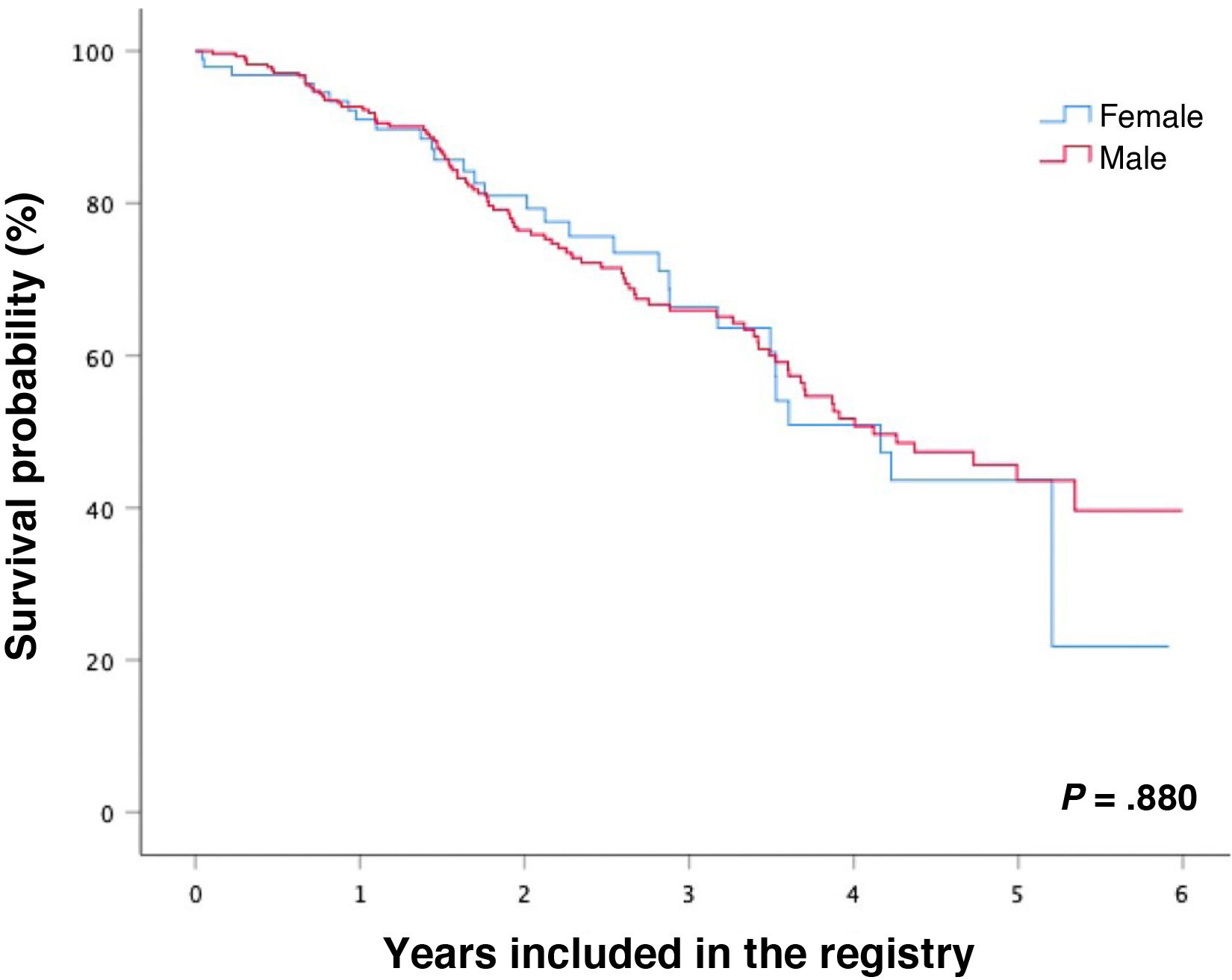
During follow-up, no women and 2 (0.7%) men received a heart transplant, and 121 (31.4%) patients died: 30 (31.6%) women and 91 (31.4%) men. The cause of death was cardiovascular in 79 (65.3%), (17 [56.7%] women and 62 [68.1%] men; P = .275). No significant difference was observed in survival when comparing the survival curves for both sexes (P = .880); in both women and men, the mean survival from inclusion in the registry was 4.1 years (Fig. 1).
Discussion
In this paper we provide a detailed descriptive analysis of a cohort of patients with ATTR-CM, mainly of the wtATTR-CM subtype, belonging to a real-world, prospective, multicentre registry, comparing them according to sex. The main findings were a higher prevalence of men and the presentation of women with a more advanced NYHA functional class, higher LVEF values, and greater left ventricular thickening. Female patients received SGLT2i and tafamidis treatment less frequently and were admitted less often for HF. There were no differences in survival between the two sexes.
Traditionally, ATTR-CM was considered a disease that almost exclusively affected men, given the results of some studies in which up to 98% of patients were male.9,14 Subsequent published ATTR-CM patients series showed that women accounted for between 20% and 28% of the total cohorts.10–12 The figure observed in our study (25% women) is consistent with these findings and is likely to be close to the reality in our setting. These results continue to demonstrate the greater contribution of men to the diagnosis of this disease, which could have various explanations. For example in regards to the observation that ATTR-CM affects males more than females, it could be theorised that the cardioprotective effect of oestrogens may be responsible for the lower incidence of this disease in women.15,16 Another idea is that the use of the same criteria in both sexes to establish suspicion of ATTR-CM may lead to its underdiagnosis in females.17 The European position on the diagnosis and treatment of cardiac amyloidosis2 recommends screening for the disease in all patients with suggestive clinical data (red flag) and a left ventricular wall thickness ≥ 12 mm. Given that women usually have a smaller body surface area, it is likely that the use of indexed values for this parameter would be more appropriate, thereby increasing the number of diagnoses among women. Finally, another factor that may contribute to the finding of a lower proportion of women with ATTR-CM is their greater difficulty in accessing the resources offered by the healthcare system, a fact that has been well demonstrated in other scenarios such as ischaemic heart disease or HF.18,19
Some studies indicate that women with ATTR-CM are older than men at the time of diagnosis10,20,21 and inclusion in registries.16,22 Although there is no clear explanation for this, it has been suggested that it could be due to a less aggressive and later onset profile in females. Another plausible explanation for this finding could be the tendency to think that this disease occurs less frequently in women due to the ingrained concept that ATTR-CM affects almost exclusively men. This leads to a greater delay in diagnosis in females. In our study and in the one published by Ochi et al.,23 we did not observe any differences between the two sexes in terms of age at presentation, with a median of 82 years. This may be due to the participation of researchers who are particularly sensitive to the detection of ATTR-CM and who consider its diagnosis in both women and men. The high median age could be explained by the ageing population that characterises our autonomous community.
In our study, we observed that the percentage of women in NYHA functional class ≥ III was higher than that of men. However, we did not observe differences between the two sexes with regard to other parameters suggestive of an advanced stage of the disease, such as the UK NAC stage, prevalence of signs of congestion, plasma NT-proBNP value, or the prescription of loop diuretics. Previous research in HF-patient populations also found that females tend to present with more severe symptoms than males, without objective data indicating more severe disease.18,24 It is believed that this discrepancy could be due to the fact that the symptoms derived from the disease are compounded by greater emotional and physical stress, mainly due to greater family burdens in the case of women.
As observed in other publications,13 women in our population were characterised by a higher LVEF value than men: the percentage of female patients with an LVEF < 50% was lower than that of male patients. If we consider the pathophysiology of ATTR-CM, characterised by an initial interstitial deposit of amyloid material leading to thickening of the ventricular walls followed by myocyte necrosis, the onset of fibrosis and a reduction in LVEF, this finding could indicate, as other authors conclude,10 that women showed symptoms at an earlier stage of the disease. However, this reasoning would not be consistent with another echocardiographic finding in our study: the presence of a higher indexed left ventricular thickness in women compared to men, which is a finding also previously reported by Patel et al.22 Although this could be due to a higher prevalence of high blood pressure in females, it could also be argued that it is secondary to greater amyloid deposition, due to women being at a more advanced stage of the disease. Taking into account both opposing results and the previously discussed evidence of similar values in both sexes for different parameters related to the degree of disease involvement, we consider that the echocardiographic findings observed are not related to women being at a different stage of disease progression than men and that it may simply be due to a tendency to present different phenotypes.
In addition to the greater use of thiazide diuretics in the female patient group, probably because women had a higher prevalence of high blood pressure, we observed differences between the two sexes in regard to the prescription of SGLT2i and tafamidis. As for SGLT2i, its greater use in men was probably due to the higher prevalence of reduced LVEF observed in this group and the publication of clinical trials demonstrating its benefit in HF with reduced LVEF.25,26 With regard to tafamidis, its lower prescription rate in females was possibly related to the fact that most of the patients included in this study received the drug as part of the extension phase of the ATTR-ACT study27 and the well-documented underrepresentation of women in the clinical trials.28,29 In any case, these results corroborate published data showing that women with cardiovascular disease continue to receive the recommended therapies less frequently than men,30,31 with ATTR-CM being no exception.
Finally, it should be noted that we only observed differences between the two sexes with regard to the occurrence of a single clinical episode: hospital admissions for HF. In this case, female patients had a lower incidence rate than male patients. This finding is consistent with the results obtained in sub-analyses of clinical trials conducted in populations with HF, which repeatedly show a lower incidence of hospitalisations in women.32 It is argued that this may be due to some of the factors mentioned above, such as the fact that women experience more social stressors, which may make it difficult for them to be available for hospitalisation (e.g., family responsibilities that prevent them from leaving their homes), or the greater obstacles women face in accessing the resources offered by the healthcare system compared to men.
In our study, as in others previously published,13 survival rates for women and men were similar, with an average of 4.1 years.
Our study has some limitations that are worth mentioning. Firstly, it is an observational study of a cohort of patients in real life, so there may be certain biases in terms of information, selection or confusion. Furthermore, we were unable to establish the ATTR-CM subtype in 11% of patients, because no genetic study had been performed, and pathogenic variants in the transthyretin gene were identified in only 3% of the cohort. Although it would have been of great interest, the small number of patients with hATTR-CM prevented us from carrying out a specific analysis of this subtype of the disease, and the results and conclusions of this study must be interpreted in the context of a population mainly with wtATTR-CM. Finally, although its multicentre nature gives it a certain degree of validity for extrapolating the results to other populations, it also implies the possible existence of heterogeneity in the clinical management of patients by the participating researchers, which could contribute to the differences observed.
ConclusionsA quarter of the patients with ATTR-CM in this study were women. Female patients were characterised by a higher prevalence of high blood pressure and hypercholesterolaemia. In addition, women reported poorer functional class and presented with higher LVEF values and greater left ventricular thickening. Finally, female patients were less likely to receive treatment with SGLT2i and tafimidis, were less likely to be admitted for HF, and had similar survival rates to male patients.
FundingThe AMIGAL registry has been funded through a competitive grant from the Sociedade Galega de Cardioloxía (SOGACAR) and an independent research grant from Pfizer (ID 54963821). Currently, the AMIGAL registry is funded through funds provided by the Centre for Biomedical Research in Cardiovascular Diseases (CIBER-CV). In addition, author D.E.V. receives funding from the Carlos III Health Institute (JR24/00059).
G.B.C. and M.G.C.L. have received funding for travel to conferences and fees for presentations from Pfizer. E.B.C. has received fees for presentations from Pfizer. Six researchers in this study (D.E.V., G.B.C., I.G.O., A.V.R., M.G.C.L. and E.B.C.) are members of the Biomedical Research Network Centre for Cardiovascular Diseases (CIBER-CV).


