




Chronic thromboembolic pulmonary hypertension (CTEPH) is a complication of pulmonary embolism and a major cause of chronic pulmonary hypertension leading to right heart failure and death. While pulmonary endarterectomy is the treatment of choice, some patients might benefit from medical therapy or balloon pulmonary angioplasty. Sex differences in outcomes of these therapies are not well characterized.
Material and methodsWe conducted a systematic review and meta-analysis to investigate sex differences in outcomes of various therapies for CTEPH. We searched MEDLINE, PubMed, Embase, CINAHL and the Cochrane Library databases between January 1, 2010 and April 30, 2021, published in English. We pooled incidence estimates using random-effects meta-analyses. We evaluated heterogeneity using the I2 statistic. We assessed publication bias using Begg's and Egger's tests. This study is registered in PROSPERO, CRD42021268504.
ResultsA total of 19 studies met the eligibility criteria, but only 3 trials provided separate outcomes for women and men. Two studies evaluated the efficacy of BPA, and one study evaluated the efficacy of riociguat (129 patients). Overall, 57.3% of patients were women and 62.6% were in functional class III. Mean time of follow-up was 55.5 (SD 26.1) weeks. Women showed a significantly better response in cardiac index (mean difference [MD], 0.10L/min/m2; 95% confidence interval [CI], 0.04–0.16; I2=0%; P=0.001). Alternatively, the reduction of pulmonary vascular resistances was significantly higher for men than for women (MD, 161.17dynscm−5; 95% CI, 67.99–254.35; I2=0%; P=0.0007).
ConclusionsWomen and men might show different hemodynamic responses to riociguat or BPA for CTEPH.
La hipertensión pulmonar tromboembólica crónica (HPTEC) es una patología grave que puede conducir a insuficiencia cardiaca derecha y muerte. La endarterectomía pulmonar es el tratamiento de elección, pero algunos pacientes pueden beneficiarse de medicamentos o de angioplastia pulmonar con balón (APB). No se ha valorado la diferencia en respuesta a las terapias por sexos, por lo que es el objetivo de este estudio.
Material y métodosSe realizó una revisión sistemática y un metaanálisis para investigar las diferencias entre hombres y mujeres en los resultados de diversas terapias para la HPTEC. Se buscaron en las bases de datos Medline, PubMed, Embase, CINAHL y Cochrane entre el 1 de enero de 2010 y el 30 de abril de 2021, artículos publicados en inglés. Este estudio se encuentra registrado en PROSPERO, CRD42021268504.
ResultadosSe encontraron un total de 19 estudios que cumplían con los criterios de elegibilidad, de los cuales tres proporcionaron los datos segregados. Dos estudios evaluaron la eficacia de la APB y uno evaluó la eficacia de Riociguat (129 pacientes). 57,3% de los pacientes eran mujeres y el 62,6% se encontraban en clase funcional III. El tiempo medio de seguimiento fue de 55,5 semanas (DE 26,1). Las mujeres mostraron una respuesta significativamente mejor en el índice cardiaco (diferencia media [DM] 0,10 L/min/m2; IC 95%, 0,04-0,16; 120%; p=0,001). Por otro lado, la reducción de las resistencias vasculares pulmonares fue significativamente mayor en los hombres que en las mujeres (DM, 161,17 dyn/sec/cm2; IC 95%, 67,99-254,35; F=0%; p=0,0007).
ConclusionesLos resultados de este estudio sugieren que existen diferencias entre mujeres y hombres en la respuesta a APB y Riociguat para la HPTEC.
Pulmonary hypertension (PH) is characterized by remodeling of pulmonary vasculature and rise of pulmonary resistance that leads to remodeling and hypertrophy of right ventricle.1 Chronic thromboembolic pulmonary hypertension (CTEPH) is a life-threatening disease of obstructive pulmonary artery remodeling resulting from chronic thromboembolic material in pulmonary arteries and vasculopathy in the distal vessels, which causes elevated pulmonary vascular resistance, progressive pulmonary hypertension, and right ventricular dysfunction.2 The recent published clinical guidelines endorsed by ESC/ERS, place CTEPH is in the group 4 of PH, labeled as PH associated with pulmonary artery obstructions.3 CTEPH has been reported with a cumulative incidence between 0.1% and 9.1% within the first 2 years after a symptomatic pulmonary embolism (PE) event4 but still, a significant number of cases may originate from asymptomatic venous thromboembolic event (VTE).5 It has been described an equally prevalence between women and men.6
Therapeutic anticoagulation is recommended for patients with CTEPH for lifelong, as recurrent pulmonary thrombo-embolism accompanied by insufficient clot resolution are key pathophysiological features of this disease.3 Surgical pulmonary endarterectomy (PEA) is the treatment of choice, and it should be offered to all eligible patients with CTEPH.7–9 PEA can normalize pulmonary hemodynamics and increase functional capacity.10 The surgical technique consists of a complete bilateral endarterectomy of the pulmonary arteries (PAs) down to segmental and subsegmental levels. In centers with experience the peri-operative mortality rates <2.5%11 and post-operative PH is observed in approximately 25%, with excellent survive in long-term (averaging 90% in 3 years).12
CTEPH has a microvascular component that explains the persistent PH after PEA, and it has emerged two approved therapies. Riociguat, a soluble guanylate cyclase stimulator, has demonstrated in inoperable CTEPH or those with persistent/recurrent PH after PEA improved in 6 minutes walking distance (6MWD) and reduced pulmonary vascular resistance (PVR) by 31% compared to placebo.13 Treprostinil sub-cutaneous (s.c.), an analog of prostacyclin, similarly demonstrated improvement in 6MWD.14 Other therapies have been used off-label but has no evidence in randomize clinical trials (RCTs).
Balloon pulmonary angioplasty (BPA) has surged as an alternative treatment option in selected patients with inoperable CTEPH or persistent/recurrent PH after PEA. It consists in an endovascular procedure to widen narrowed or obstructed pulmonary arteries.15 Several RCTs demonstrated improvements in hemodynamics (lowering PVR), improvement in right heart function, and exercise capacity.15,16
However, a comparative efficacy of the treatment in men and women has not been carried out until now. The objective of our systematic review and meta-analysis was to compare the efficacy of PEA, BPA, riociguat and treprostinil between men and woman assessing hemodynamics, clinical and laboratory outcomes.
Material and methodsStudy objectivesThe primary objective of our systematic review and meta-analysis was compare the efficacy of PEA, BPA, rocioguat and teprostinil between woman and men assessed by an improvement pulmonary vascular resistance (PVR). Secondary objectives were improvements in exercise capacity appraised with 6-min walk distance, functional class, cardiac biomarkers as NT-proBNP and BNP, cardiac index (CI) and mean pulmonary arterial pressure (mPAP).
Search strategyThe systematic review protocol was registered in the International Prospective Register of Systematic Reviews (PROSPERO) database (CRD42021268504).
We conducted independent systematic searches of the MEDLINE (using the Ovid platform), PubMed, Embase, CINAHL (using the Ovid platform), and the Cochrane Library databases for eligible articles published between January 1, 2010, and April 30, 2021. Full articles of all potentially appropriate abstracts were reviewed. Searches were performed using the following strategy: chronic thromboembolic pulmonary hypertension OR thromboembolic pulmonary hypertension cteph AND pulmonary thromboendarterectomy OR balloon pulmonary angioplasty OR riociguat OR Treprostinil, including articles in English. The systematic review was completed by a manual search of the literature.
Study selectionTwo investigators (A.T. and A.G.-S.) independently assessed identified articles to determine study eligibility. Based on title and abstract review, the reviewers excluded non-relevant studies. For relevant studies, the reviewers independently carried out data extraction using a pre-piloted, standardized form. Consensus or discussion with a third reviewer (D.J.) resolved eligibility and data extraction discrepancies or uncertainties.
Data extraction and quality assessmentFor each study, two investigators (A.T. and A.G.-S.) extracted data on the baseline characteristics of the patients, and changes from baseline for each group. In the absence of information on events in each group, the corresponding author was contacted to obtain it. Discrepancies were resolved with the help of a third investigator (D.J.). The quality in prognosis studies (QUIPS) tool was used to assess the quality of the studies chosen.17
Statistical analysisThe meta-analysis was performed according to the Preferred Reporting Items for Systematic Reviews and Meta-Analyses (PRISMA) recommendations.18 The Review Manager (RevMan) 5.4.1 software (Cochrane Collaboration, Copenhagen), which offers open-source statistical packages for meta-analysis, was used for data analysis. For primary analyses, continuous data will be pooled to estimate weighted mean differences with 95% confidence intervals (CIs) using a random-effects model with inverse variance weighting. In cases where only medians and interquartile ranges were reported, means and standard deviations (SDs) will be approximated using the method described in the Cochrane Handbook Statistical heterogeneity between groups will be measured using the Cochran's Q statistic and the Higgins I2 statistic. The heterogeneity of the original studies was assessed using the I2 statistic. We used Begg's test to determine publication bias. In all analyses, the significance levels were bilateral and considered significant with a P<0.05.
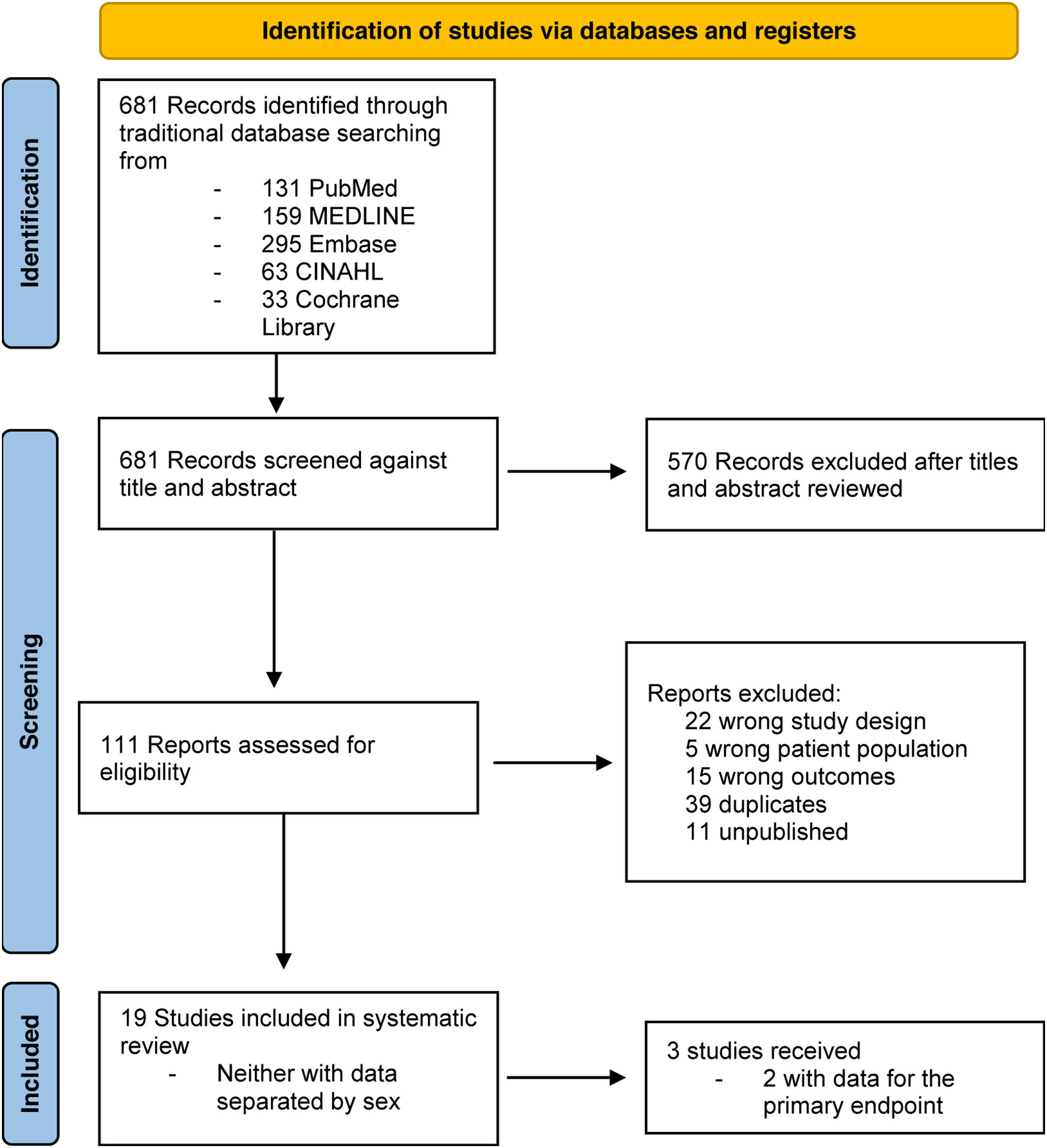
ResultsStudy identification and selectionStudy selection process has been shown in flow diagram in Fig. 1. We identified 681 studies of PEA, BPA, riociguat, and Treprostinil s.c. once duplicate studies were excluded. Of these, 570 studies were excluded after titles and abstracts were screened for the selection criteria. One hundred eleven reports were assessed for eligibility, then we excluded conference abstracts, reviews, case reports, animal trials, letters, and other unrelated topics. The Begg's test did not evidence publication bias. We eventually included 19 studies in the final analysis. Neither of the studies reported the results according to sex, so we ask the corresponding authors for the data. Only three authors reply to the data request.16,19,20
Characteristics and quality of included studies
Characteristic of patients in the included trials have been presented in Table 1. Two studies evaluated the efficacy of BPA, and one study evaluated the efficacy of riociguat (129 patients). Overall, 57.3% of patients were women and 62.6% were in functional class III. Most patients were in functional class II/III. Mean time of follow-up was 55.5 (SD 26.1) weeks.
Characteristics of included studies.
| First author | Year | Country | Study design | Treatment | No. patients | Proportions of female (%) | Mean PVR (dynscm−5) SD | Mean PAPm (mmHg) SD | Mean cardiac index (Lmin−1m−2) SD | Mean 6MWD (m) SD | Mean NT-proBNP/BNP (pg/ml) SD | NYHA/WHO functional class (%) | Mean/longest follow-up (weeks) SD |
|---|---|---|---|---|---|---|---|---|---|---|---|---|---|
| Mizoguchi16 | 2012 | Japan | Prospective study | BPA | 68 | 78.0 | 942±367 | 45.4±9.6 | 2.2±0.7 | 296±108 | – | I: 0.0II: 0.0III: 72.00IV: 28.0 | 38.4±38.4 |
| Andreassen19 | 2013 | Norway | Observational study | BPA | 20 | 50.0 | – | 33.0±10 | 2.8±1.9 | – | NT-proBNP 90±119 | I: 0.0II: 15.0III: 70.0IV: 15.0 | 51±30 |
| Halank20 | 2017 | Germany | Prospective study | Riociguat | 41 | 44.0 | – | – | – | 447.6±187 | – | I: 2.0II: 51.0III: 46.0IV: 0.0 | 77±10 |
Analyzing the data provided, it was shown that the response in the PVR was in favor of men against women, with an inverse variance (IV) of 161.17 (67.99, 254.35, I2=0%, P=0.0007) (Fig. 2), this data was extracted from two studies that involved BPA.
Exercise capacity
For the capacity for exercise measure with the 6MWD it shown an IV 19.8 (−23.38, 62.97, I2=80%, P=0.37) (Fig. 3) and showed a signal to have a better response to treatments in men.
Hemodynamics parameters
In regard of the other hemodynamics parameters (PAPm and CI), we obtain a response in favor of response to treatment for women in CI (IV −0.10 (−0.16, −0.04), I2=0%, P=0.001) but show no difference according to sex in the response in PAPm (IV 1.50 (−0.32, 3.32), I2=89%, P=0.11) but showing certain better effectiveness for men (Figs. 4 and 5). All this data was collected from two studies involving the BPA.
Biomarkers and functional class

It was shown no difference in the response of serum biomarkers (such as BNP and NT-proBNP) regarding to sex (IV 31.97 (−250.50, 314.45), I2=83%, P=0.82) (supplemental Fig. 1), involving the data provided from BPA. The change in the functional class (demonstrating an improvement from baseline to a better class) shown a OR of 0.44 (0.14, 1.43), I2=40%, P=0.17, providing a signal of better response in women (supplemental Fig. 2), involving data from the two therapies (BPA and riociguat).
DiscussionOur study provides some information about the effect of the treatments available for the treatment of the CTEPH and the difference in the effect according to sex. The reduction in PVR is more noticeable in men and there is also some favorable effect in the PAPm and 6MWD from the data collected. In regard of the women, shown evidence of better response in the CI and probably in functional class representing maybe a different pathway to make improvements with the medical and interventional therapies. This data might show different response to treatments, that can be explained for adaptation of men and women, that has not been established before, and can explain differences in survival, according to the severity of the disease.
Previous studies have shown a difference in hemodynamics characteristics of men and women who have CTEPH. Yang et al.21 demonstrated that women have a better compliance of the pulmonary vascular demonstrated by a higher response to acute vasodilator test in the PVR (ΔPVR/PVR), however our data do not evidence a better response in PVR (in women) as in CI and functional class, but we have to take on account that the data provided only has the efficacy of two therapies (BPA and riociguat) and only one analysis take the three.
The PVR is one of the most important outcomes that we take account after diagnosed and treat a patient with CTEPH and has implications in the prognostic and the treatment options in some centers with expertise. Some data demonstrated a higher PVR in women with CTEPH, that can predict a worse response for PVR against men.6,22
Besides the response of PVR, there is evidence that women have a better long-term survival compared to men and has been seen in previous registries publications by Barco et al.6 and Cruz-Utrilla et al.22 In than same direction, for PAH, it has been demonstrated that women maybe have better adaptive remodeling of the RV in response to increased afterload.23 Even further, some data describes that women undergo less surgical treatment (PEA) due to evidence of more distal disease.6,22 This confusion of survival but less invasive procedures (PEA) can maybe evidence better response to other treatment options, such as riociguat or BPA, that perhaps are used more in this group.
LimitationsThis study has several limitations. Firstly, we do not have the data for several studies, to complete the comparison in the respond to the treatment and maybe have better conclusions. Secondly, we only compared two therapies and maybe the results reflect the efficacy of each one instead of the effectiveness for men and women, even further, maybe we are only comparing the efficacy of BPA between men and women. However, there are evidence of survival differences between men and women, that this study may bring some light. Thirdly, the sample size differs in the different treatment options. Therefore, our conclusions should be taken with caution since there are no randomized controlled trials comparing the efficacy of treatment options between men and women.
ConclusionsAmong patients with CTEPH, women and men might show different hemodynamic responses to riociguat and BPA for CTEPH. Women response better in hemodynamics and maybe clinical outcomes, compared to men, but them, have a better response in vascular resistance.
Ethical considerationswe do not obtain written informed consent, because of the nature or the study.
FundingThis research did not receive any specific grant from funding agencies in the public, commercial, or not-for-profit sectors.
Authors’ contributionsTenes had full access to all the data in the study and take responsibility for the integrity of the data and the accuracy of the data analysis.
Concept and design: Tenes, García-Sanchez, Jiménez.
Acquisition, analysis, or interpretation of data; statistical analysis: Tenes, García-Sanchez.
Drafting of the manuscript: Tenes, García-Sanchez, Jiménez.
Critical revision of the manuscript for important intellectual content: Tenes, García-Sanchez, Pintado-Cort, González, Briceño, Duran, Morillo, Jiménez.
Study supervision: Jiménez.
Conflict of interestA.T. has served as an advisor or consultant for Janssen.
A.G.-S., B.P.-C., S.G., W.B., D.D., and R.M. have nothing to disclose.
D.J. has served as an advisor or consultant for Pfizer, MSD, Sanofi.
The following are the supplementary data to this article:



