




Platforms are typically associated with digital infrastructures, algorithmic mediation, and large-scale network effects. Yet many organizations create platform value without relying on digital intermediation, raising the question of how non-digital platforms evolve over time. This study examines the 25-year evolution of the Digital Innovation Observatories,11 For the review team, the authors have anonymized the case to preserve confidentiality and ensure the rigor of the double-blind review procedure. As explained in the methodology, all the authors hold roles within the studied organization, which could otherwise compromise the anonymity of the authorship. At the end of the review process, the organization’s name and the interviewees’ names will be disclosed.
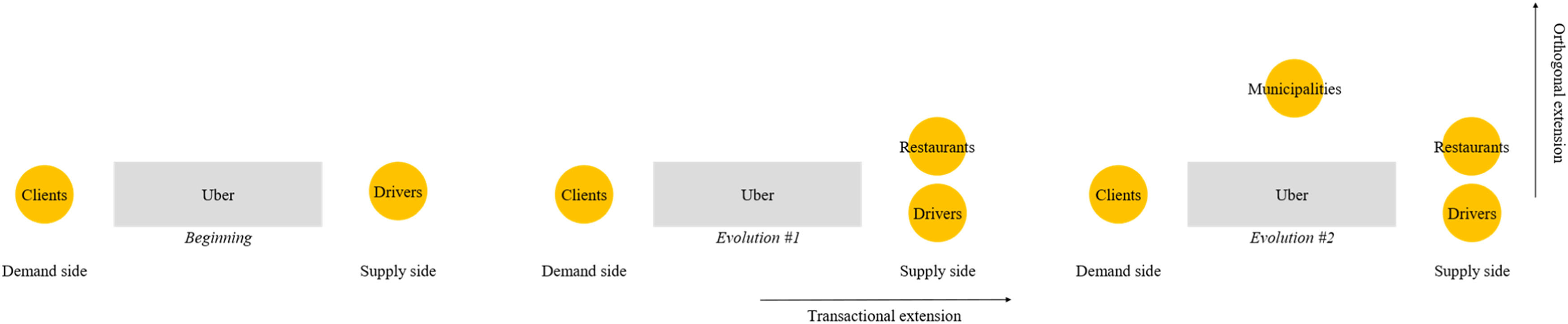
Platforms create value by connecting distinct user groups through multi-sided infrastructures that scale faster than linear value chains (Gawer, 2014; Täuscher & Laudien, 2018). Their strength lies in large networks that enable expansion across domains (Chen et al., 2022), and in their ability to create value through asset exchanges – particularly via knowledge sharing (Han, 2025). Almost always, platforms are driven by the generativity and combinatorial nature of digital technologies (Yoo et al., 2010), which support modular architectures that attract diverse customers and enable network scaling (Varga et al., 2023). This modularity is further enabled by identifying and sharing idle assets, resources not yet adopted but potentially valuable for attracting specific user groups (Trabucchi et al., 2021), such as what Uber did with mobility data gathered through ride sharing and offered to municipalities (for further details, refer to Fig. 1).

While these dynamics are typically associated with digital business models (de Reuver et al., 2018; Hunt et al., 2025), they are not exclusive to digital infrastructures. Non-digital platforms (Perez Mengual et al., 2024), such as science parks and accelerators, also connect multiple customer sides (e.g., startups and firms), facilitating knowledge exchange (Primario et al., 2024), usually through co-location (Doloreux et al., 2024). Although often overlooked, scholars have shown that physical spaces or organizational layers can substitute digital intermediation (Staykova & Damsgaard, 2015). In these cases, the centrality of co-location challenges traditional views of how to leverage network effects to foster value creation (Bibeau et al., 2024) and scale it over time (Shankar & Clausen, 2020).
Given the network’s limited reach, non-digital platforms prioritize the quality of interactions over global spread (Gadola et al., 2026), creating long-term value through meaningful connections and knowledge sharing (Han, 2025). Although the platform literature posits that diverse mechanisms of knowledge sharing can support platform evolution (Albats et al., 2025), it offers little clarity on how these mechanisms are adopted by non-digital platforms to scale. Understanding this point can clarify how locally operating organizations achieve network scalability (Shankar & Clausen, 2020) and inform strategies not only to foster asset adoption but also to operate effectively within limited user networks. Therefore, this study addresses the question:
“How do non-digital platforms evolve?”
To address this gap, this study adopts a single-case study of the 25-year evolution of the Digital Innovation Observatories at Politecnico di Milano, a non-digital platform that supports B2B interactions (Springer et al., 2025) and knowledge exchange between the demand and supply sides of various digital technologies in Italy. The study traces the Observatories’ evolution across three phases – launch, consolidation, and maturity – and two units of analysis – the single Observatory and the organizational portfolio of the Digital Innovation Observatories.
Findings show that the organization scales by launching more than 50 Observatories and by identifying and adopting a repeatable, successful format. This generates a compound network structure balancing local relationships with scalability, enabling synergistic value creation. Knowledge from user interactions fuels horizontal replication and vertical expansion. This evolution is supported by an internal organizational structure that facilitates the sharing of activity-based knowledge to improve Observatories’ activities and content-based knowledge to enhance the value they offer to their communities. The Digital Innovation Observatories, thus, achieve an efficient resource-sharing structure and internal platform-based collaboration, driven by idle knowledge sharing.
This study presents four main contributions. First, it expands the current understanding of platform evolution based on network scalability and side attraction through existing customers (Chen et al., 2022; Trabucchi et al., 2017). Non-digital platforms introduce an evolution path based on horizontal duplication and vertical expansion. The former preserves the pursuit of network scale (Shankar & Clausen, 2020) while privileging interaction quality, guiding scalability through a compound structure. This broadens the effects of limited network externalities (Karhu et al., 2024), which influence new customer onboarding given the symbolic value of being part of the community. Vertical evolution shows how orthogonal platforms (Filistrucchi et al., 2014) enable local transformation and include the digital layer also in non-digital platforms.
Second, we stress the pivotal role of a “format” in ensuring sustainable evolution by leveraging knowledge as an idle asset. This broadens the current, limited understanding of the platform gemini (Trabucchi & Buganza, 2022a) and reframes platform modularity (Gawer, 2014; Trabucchi & Magistretti, 2020) through a standardized structure, thereby reducing launch costs and time. Since evolution is based on knowledge exploitation, learning economies (Arrow, 1962; Teece, 2007) best suit non-digital evolution, compared to traditional scale economies (Gawer, 2014).
Third, we anchor horizontal and vertical evolution paths in knowledge as the key idle asset (Trabucchi et al., 2021), clarifying its role as content- and activity-based to make evolution sustainable and aligned to customer needs. Knowledge, as an idle asset, broadens current platform studies on knowledge adoption for value creation (Albats et al., 2025) by uniquely considering its role in format design and efficiency.
Fourth, we highlight individual proactivity as a lever for transformation (Paniccia et al., 2024), thereby broadening the current human role in platform thinking (Trabucchi & Buganza, 2022b). The organizational structure that collects and shares knowledge expands current understanding of internal platform structures for collaboration (Gadola et al., 2026; Rohn et al., 2021) and non-digital platforms (Perez Mengual et al., 2024).
The Digital Innovation Observatories’ evolution and its configurations provide a framework for sustaining long-term value in non-digital platforms. Our insights guide strategic planning and internal restructuring. The paper reviews platform literature, then details the case of Digital Innovation Observatories, and concludes by discussing the empirical insights in light of existing theory to advance the current debate.
Literature reviewThe three platform pillars defining platform characteristicsPlatforms, particularly transactional ones, are built on three pillars (Evans, 2003) grounded in the characteristics of multi-sided markets (Rochet & Tirole, 2003). These pillars identify platform mechanisms serving as a framework for guiding value creation (Trabucchi & Buganza, 2026), and are significantly enhanced by the presence of a digital infrastructure.
The first pillar highlights that platforms comprise at least two customer sides, each with a distinct value proposition (Muzellec et al., 2015). Platforms create value by fulfilling the demand side's needs with the supply side's offer (Hagiu & Wright, 2015). Thus, platforms must onboard both sides simultaneously to overcome the so-called “chicken and egg paradox” (Caillaud & Jullien, 2003), thereby attracting users on one side (e.g., travelers, demand side on Airbnb) even when the other side (e.g., host, supply side on Airbnb) are limited or still absent. Sides’ interdependence makes the launch a critical phase in the platform life cycle, heavily influencing its success (Yoffie et al., 2019).
The second pillar is that platforms substantially leverage network externalities (Katz & Shapiro, 1985). As one side grows, the other benefits, and vice versa, driving platform scaling to increase value creation (Evans, 2003). Network externalities are often supported by pricing strategies that attract one side through free or subsidized access to a customer base that would otherwise be hard to reach (Eisenmann et al., 2006). Digital infrastructure enables this scalability, allowing near-zero marginal cost to add new users globally (Rifkin, 2014).
The third pillar reflects platforms’ role in reducing market frictions, lowering search and transaction costs, and facilitating interactions (Chen et al., 2022; Rochet & Tirole, 2003). Trust-enhancing mechanisms via transparency strengthen matchmaking (Hagiu & Wright, 2015), whose effectiveness depends on the relevance of reduced externalities (Evans & Schmalensee, 2016) and on data-driven customer insights to offer a suitable match (Amit & Han, 2017).
These pillars underpin platform evolution. As digital technologies amplify their effects (de Reuver et al., 2018), platforms have become closely associated with digital infrastructures (Hunt et al., 2025). This reinforces the view of platforms as inherently digital and links their evolution to digital scalability, often overlooking geographical embeddedness (Rohn et al., 2021) and discussing it only in mainstream cases such as Uber and Airbnb, focusing on their effects rather than on it as an influencing feature.
The pivotal role of idle assets and knowledge in platform evolutionPlatform evolution is driven by the pursuit of network scalability (Eisenmann et al., 2006) and by the generativity enabled by digital technologies to offer new services or solutions to existing customer groups (Yoo et al., 2010). The literature recognizes multiple scaling strategies (e.g., Stummer et al., 2018) to expand the current customer base, all linked to the modular expansion path of adding new user groups to broaden the network (Varga et al., 2023).
The literature recognizes two main trajectories based on platform modularity (Facin et al., 2016). First, horizontal extension leverages cross-side externalities by adding new customer sides along the transaction line (Varga et al., 2023). Second, vertical expansion leverages unilateral externalities by introducing sides that benefit from assets generated by already-onboarded user groups (Filistrucchi et al., 2014). Typical of orthogonal platforms, customer attraction depends on one side’s size and does not interfere with the current service provided (Trabucchi & Buganza, 2020). Uber exemplifies both paths, evolving from drivers and riders to restaurants and later municipalities through data monetization, as shown in Fig. 1.
These two trajectories are not mutually exclusive and rely on identifying and sharing idle assets, meaning underutilized resources held by users or the platform that have a potential value to be exploited (Trabucchi et al., 2021). Uber, for instance, leverages drivers’ time and vehicles, customer demand for food delivery, and mobility data for research purposes. Knowledge, networks, relationships, data, or physical resources represent various idle assets that platforms matchmake with new users interested in acquiring or sharing them to generate value (Facin et al., 2016).
Beyond these trajectories, platforms may also adopt a platform gemini approach (Trabucchi & Buganza, 2022a), which entails leveraging existing sides to launch new platforms to address emerging network needs that cannot be met by the current structure. A typical example is Amazon launching Prime Video while already having end users and video producers on board in the main marketplace. Although it has received limited attention in the literature, this strategy involves expanding both the demand- and supply-side networks by creating a new platform that shares nothing with the original platform other than a smaller share of its network, abandoning the extension based on network externalities.
Overall, platform evolution depends on modularity, which enables extensions by leveraging already onboarded customers or assets (Gawer, 2021). When physical assets are involved, variety is critical, as the breadth of options, such as on Airbnb or Vinted, increases the likelihood of a suitable match (Trabucchi & Buganza, 2022b). For intangible assets, such as knowledge, the influence of breadth can vary. Value depends on codification and accessibility (Curtis & Mont, 2020) and on users’ ability and propensity to leverage it (Huang et al., 2018), such as on TripAdvisor or in knowledge-sharing platforms within organizations. The literature shows how this codified knowledge can inform platform extension strategies by identifying new knowledge to share (Albats et al., 2025) and facilitating customer attraction (Cutolo & Kenney, 2021), thereby enabling the sharing of well-defined knowledge. As platforms are adopted within organizations (McIntyre et al., 2021) to promote innovation through a “platform thinking” (Trabucchi & Buganza, 2022b) mindset, which means leveraging the three pillars to scout and launch innovations, with knowledge as a source of evolution and extension currently lacks a comprehensive understanding.
However, in the context of knowledge sharing within organizations, other streams of literature highlight various knowledge typologies that can be shared to promote long-term value creation and organizational evolution. For instance, when knowledge is considered tacit and sticky, it can create unexpected opportunities for innovation, yet it requires a suitable setting for its collection and sharing, based on proximity to gather others’ experience (Dyer & Nobeoka, 2000). For sharing tacit knowledge, the literature relies on a combination of social interactions, proximity, and organizational support represented by the concept of “ba,” where insights are transformed into actionable knowledge (Nonaka et al., 2000). This mechanism theoretically aligns with the co-creation role of platforms (McIntyre et al., 2021), but it lacks a proper representation, given the centrality of digital platforms that abandon the relational and serendipitous role of value sharing. In this view, the literature highlights the need to better understand the role of other factors in platform scalability, such as organizational learning and employees’ entrepreneurial roles (Nagy et al., 2025), to provide a better fit for diverse platform adoption, even without the digital infrastructure, and where knowledge plays a central role.
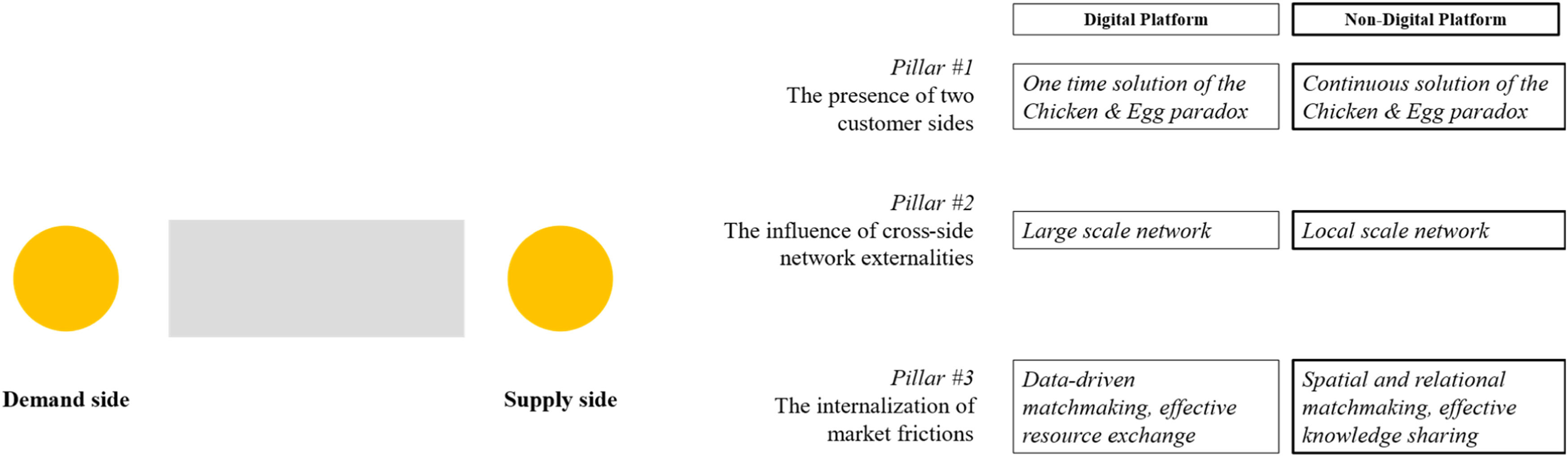
Non-digital platform characteristics and different evolution pathsAlthough platform characteristics are often linked to digital technologies (de Reuver et al., 2018; Täuscher & Laudien, 2018), their mechanisms extend beyond digital contexts. The intermediation role of platforms is also evident in cases overlooked in the literature, such as coworking spaces, airports and incubators, which operate as non-digital platforms because the value they create does not depend on digital layers. This socio-technical view (Schreieck et al., 2022) expands the current understanding of platforms by considering factors that can modify established dynamics and value-creation mechanisms, as summarized in Fig. 2.

Non-digital platforms connect distinct customer sides that often participate temporarily (Lamine et al., 2018). For instance, startups in incubators engage with peers or mentors only for a limited time (Primario et al., 2024). This alters how incubators can leverage network effects. A key feature of non-digital platforms is co-location, which limits scale but ensures manageable and meaningful interactions (Pinarello et al., 2026). Local networks create challenges for scalability and financial sustainability, with uncertainty about whether to attain network spread and why (Shankar & Clausen, 2020), often requiring external support. However, proximity enhances trust and the quality of interaction (Messeni Petruzzelli et al., 2009), fostering knowledge sharing and cross-pollination of ideas, which benefits co-located users by enabling tacit and explicit knowledge exchange (Primario et al., 2024).
This non-digital perspective strengthens understanding of how platforms create value within organizations (Gadola et al., 2026) through collaboration and knowledge sharing (Kopplin, 2021). Proximity and the space for interaction act as catalysts for experimentation (Björklund et al., 2019), with the interaction space functioning as a “third space” that enables trust and knowledge exchange (Oksanen & Ståhle, 2013). The absence of digital mediation shifts attention to individual proactiveness and physical space as drivers of interaction, challenging the current platform’s view of matchmaking. This connects the platforms’ value to the literature on intra-organizational collaboration and knowledge sharing (e.g., Dyer & Nobeoka, 2000), in which non-digital platforms emphasize individual proactivity and the role of physical space as a catalyst for interaction.
Existing platform theories remain anchored to digital scalability (Varga et al., 2023) and to modularity in their structure (Trabucchi et al., 2017), implicitly assuming algorithmic mediation and marginal-cost scalability. While prior studies have examined the importance of local embeddedness (Zander et al., 2025) and knowledge sharing with organizational reconfiguration (Nagy et al., 2025), the implications are often tied to digital platforms and do not explain how these mechanisms enable scaling without digital infrastructure.
Although the literature recognizes the tension between local embeddedness and network scale (Shankar & Clausen, 2020), it does not clarify which mechanisms enable sustainable expansion, thereby demanding further understanding to overcome current failures (Hansson et al., 2005). Non-digital platforms leverage knowledge sharing to empower participants and extend their local reach (Han, 2025), yet the mechanisms that support this process remain unclear. Similarly, generativity may emerge from individual knowledge exploration (Zander et al., 2025), but its impact is often limited to individuals rather than organizations.
While collaboration and knowledge sharing are central to the evolution of non-digital platforms (Kopplin, 2021; Perez Mengual et al., 2024), the absence of a digital layer raises questions about how scalability is achieved. Current literature does not explain how knowledge becomes an organizationally scalable idle asset. Therefore, although knowledge is widely recognized as central to organizational evolution (e.g., Nagy et al., 2025; Paniccia et al., 2024), this research calls for a deeper understanding of its role in the evolution of non-digital platforms and the identification of mechanisms that substitute for digital generativity in non-digital contexts. This also contributes to understanding how platforms enhance local, social and economic value (Doloreux et al., 2024).
MethodologyThis research adopts a single-case study methodology and examines an extreme case that can well explain the evolution dynamics of non-digital platforms (Siggelkow, 2007). The study is based on the Digital Innovation Observatories, an applied research center in Italy that orchestrates firms and start-ups and interacts with public administrations to generate actionable knowledge on digital technologies. A single case enables an in-depth understanding of a phenomenon with unique characteristics (Siggelkow, 2007) through extensive data collection (Langley & Abdallah, 2011), offering deeper insight into the context under analysis (Eisenhardt & Graebner, 2007). The single-case design best suits comparisons across life cycle phases, which are difficult in multiple-case designs (Goffin et al., 2019), and is thus particularly well-suited to capture organizational evolution (Yin, 2018). For these reasons, this study collects data in a longitudinal retrospective approach (Langley & Abdallah, 2011), tracing assets, organizational dynamics, and strategic choices over time. This approach is aligned with previous studies on platform evolution (e.g., Chen & Cui, 2022; Varga et al., 2023).
The research setting: the case of the Digital Innovation ObservatoriesThe Digital Innovation Observatories represent a unique non-digital platform (Siggelkow, 2007). Founded in 1999 to explore the adoption of digital technologies, they connect two main user groups: technology providers – seeking visibility, market orientation, and feedback – and technology adopters – seeking to understand emerging opportunities. As part of Politecnico di Milano, the Observatories benefit from research credibility, visibility, and dedicated spaces for interaction. Their goal is to connect organizations with complementary perspectives and foster dialogue that generates actionable knowledge. The Digital Innovation Observatories have divided its community into topic-based Observatories that meet at periodic face-to-face events averaging 60 participants, with larger events reaching 150 participants from more than100 companies, ensuring manageable networks coordinated by a small central team.
Over the past 25 years, the Digital Innovation Observatories have expanded to include more than 50 Observatories and a website (Osservatori.net) for knowledge dissemination. Each Observatory conducts annual thematic research, operating as a semi-autonomous unit led by scientific directors and research teams. Its operations are typically renewed unless a decision to discontinue is made. The directors also contribute to the organizational infrastructure and strategic development of each Observatory. This broad thematic coverage sustains ongoing interest and generates impact for participating organizations and public institutions. In the first 10 years, the Digital Innovation Observatories launched 14 Observatories. This number increased to 36 in 2020 and 52 in 2025. To sustain this growth, the organization expanded beyond the initial group of founders, reaching around 25 people after the first decade. Over the following 10 years, the workforce grew to approximately 120 members, including staff, researchers, and scientific directors, and exceeded 200 by 2025. Regarding participation in the events, in 2010 there were approximately 13,500 attendees (representing nearly 300 supporting organizations), which grew to 53,000 in 2025 (almost 640 organizations). Moreover, between 2018 and 2023, the Digital Innovation Observatories collaborated with 10 Italian Ministries and organized over 230 public events to disseminate their work.
Data collectionThe unit of analysis is the entire organization, capturing its evolution and asset configuration. Data collection combined organization-level insights with in-depth analysis of individual Observatories. Data were gathered through semi-structured interviews and secondary sources. This enables a combination of retrospective and real-time data collection (Pettigrew, 1990) to create an in-depth understanding (Langley & Abdallah, 2011).
Informants were selected through theoretical sampling to capture variation across core aspects in the literature that influence the understanding of platform evolution. They provide three main perspectives, stopping at saturation without the emergence of new constructs (Eisenhardt & Graebner, 2007). First, an understanding of the vision for launching the platform (Yoffie et al., 2019) and the identification of customers’ value proposition to secure their onboarding (Muzellec et al., 2015). Second, the mechanisms to overcome the “chicken and egg” paradox (Caillaud & Jullien, 2003). Third, the mechanisms to sustain platform operations and its evolution (Trabucchi & Buganza, 2020). The sample included founders, long-tenured members, strategic roles, and experienced scientific directors to ensure a comprehensive view of the mechanisms of evolution.
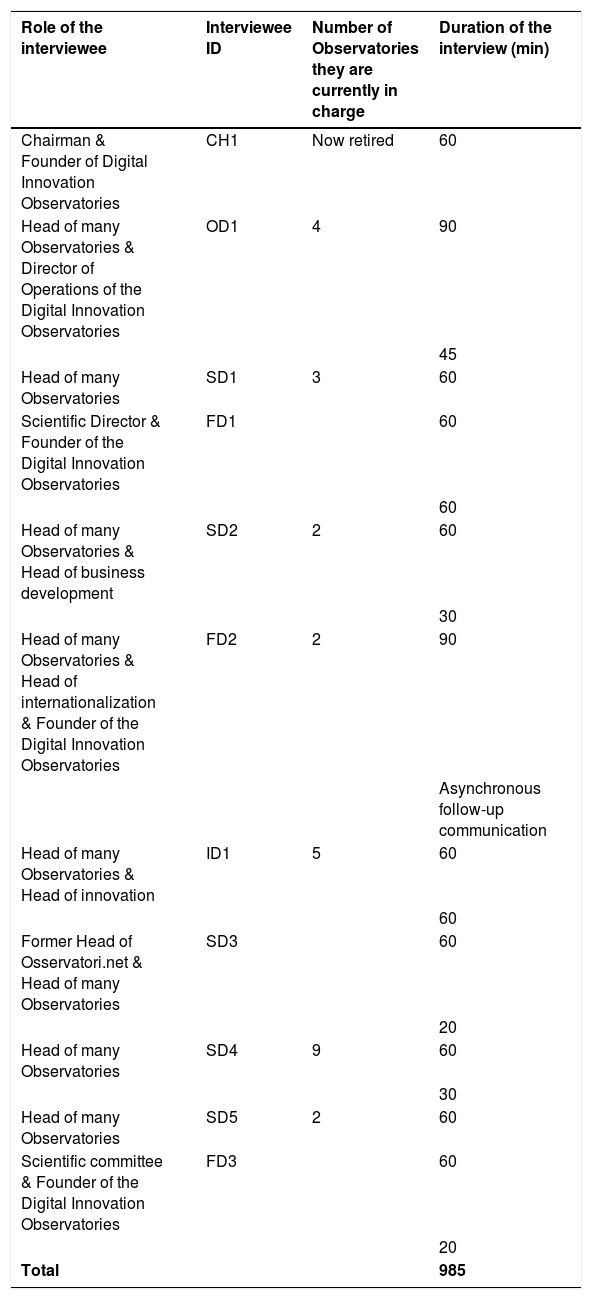
Primary data were collected through 19 interviews, digitally recorded, and conducted both in person and remotely. Almost every informant has been interviewed twice, as detailed in Table 1. A preliminary call defined the informant pool, which was later validated through referrals (Robinson, 2014), with suggested names cross-checked to mitigate selection bias. The list of informants was compiled to provide a comprehensive understanding of the Digital Innovation Observatories’ evolutionary path. It includes founders who launched the organization, people who worked since the early development and witnessed different evolutionary phases. Each informant was asked to suggest names that might help in identifying additional perspectives. Suggested names were evaluated against the theoretical sampling criteria, prioritizing those able to contribute meaningful insights. To avoid homogeneous viewpoints, we ensured variation in tenure, role, and organizational responsibility, including both individuals managing multiple Observatories and those responsible for a single large-scale one. Most informants had experienced all three phases of the platform’s evolution, enabling a comprehensive understanding of its development. Finally, interview data were triangulated with secondary sources (internal documents) tracking the organization’s strategic evolution over time.
details about interviews conducted and sample structure.
Two interview protocols were used: one focused on the early stages to understand its foundations, and the other on current activities and evolutionary trajectories. Protocols were adapted to informants’ backgrounds. Secondary sources (internal documents and online materials) supported triangulation (Miles & Huberman, 1984) and informed coding.
Given the relevance of organizational dynamics and human actions, findings primarily rely on interviews that captured tacit knowledge difficult to obtain from secondary data (Johannisson, 2011). All authors are affiliated with the organization, with different levels of seniority and roles. This engagement provided an in-depth understanding of the context and supported reflection on data collection, with a structured reframing of the insights achieved (Elias et al., 2022). However, authors with greater involvement in the organization played a less central role in data analysis and paper development, and differences in seniority and engagement contributed to the reliability of the data analysis.
Data analysisData were analyzed using axial coding, which unified codes explaining categories’ properties and their relations (Saldaña, 2013). The process was inductive and iterative, aimed at identifying patterns in evolution strategies (Eisenhardt, 1989; Yin, 2018). First, concepts were coded regardless of temporal reference to identify recurring patterns. Second, codes were grouped by life cycle phases (launch, consolidation, and maturity). Third, these groupings were iteratively matched and refined as the interviews continued. Fourth, a second axial coding distinguished between units of evolution: single Observatory and the portfolio of the Digital Innovation Observatories (the overall organizational level).
This process produced a matrix coding tree (Burton & Galvin, 2019), as shown in Table 2, organizing codes across dimensions. The matrix supports visualization of code distribution and aggregation (Cloutier & Ravasi, 2021). To enhance transparency, the matrix coding tree has been enriched with the citation counts for each category, not as a statistical measure but as an indicator of pattern salience (Klag & Langley, 2013), consistent with prior studies (e.g., Hoorani et al., 2019). Given the authors' connection to the studied organization, the first coding procedure was performed by less-embedded authors, allowing codes to emerge inductively from the data before being aggregated into life cycle phases. More embedded authors, among whom was one of the first founders of the Digital Innovation Observatories, were involved in subsequent rounds to clarify contextual details, verify the historical plausibility of the interpretations, and support triangulation with secondary sources, without imposing predefined categories on the coding structure.
Matrix coding tree.
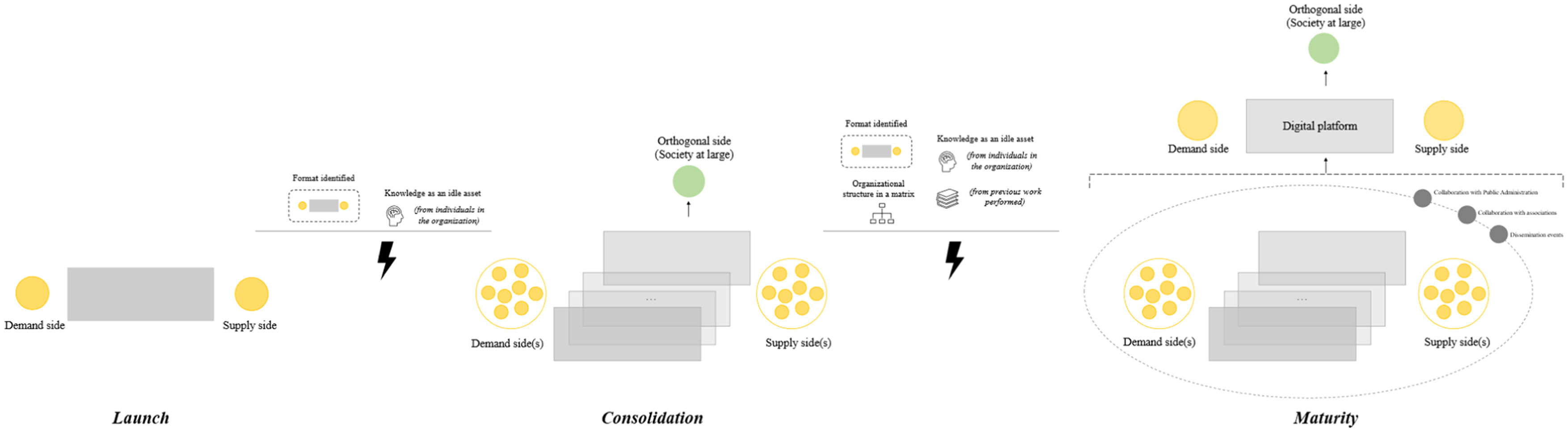
The Digital Innovation Observatories evolved through three macro phases: launch, consolidation, and maturity, at both the single Observatory level and the overall Digital Innovation Observatories portfolio. Across phases, it combined multiple platform typologies, shifting from a two-sided to a hybrid, multisided structure. Changes in format, organizational structure, and expansion strategies drove these transitions. Considering numerical values, the first phase ended after 10 years of operation, with 14 opened Observatories and approximately 25 workers. The consolidation phase witnessed the expansion of the Digital Innovation Observatories, reaching after 20 years of operation (10 years after the launch phase), 36 opened Observatories and approximately 120 workers, entering the maturity phase, which is still ongoing.
The platform launch phaseThe single Observatory: the experimentation of interaction mechanismsThe first Observatory was launched as a result of researchers’ entrepreneurial effort to support the Italian market with “A proper representation of the role of technologies that was missing back in those days” (CH1). Initially the Observatory focused on e-commerce and B2C markets, revolved around a single annual dissemination event summarizing a year of interviews with organizations into a public report funded by one sponsor: “The first Observatory was born without being a platform; it was simply a research study funded by a consulting firm, but it sparked very strong interest from what we call the targets of this research.” (FD3)
This event supported Italian industry representatives in tackling technological transformation, where participating in this event signaled innovation efforts and visibility: “A key element of the value proposition for partners and sponsors was gaining exposure to potential clients [of the participating organizations], a positioning that establishes the company as a cultural leader on the topic.” (SD1)
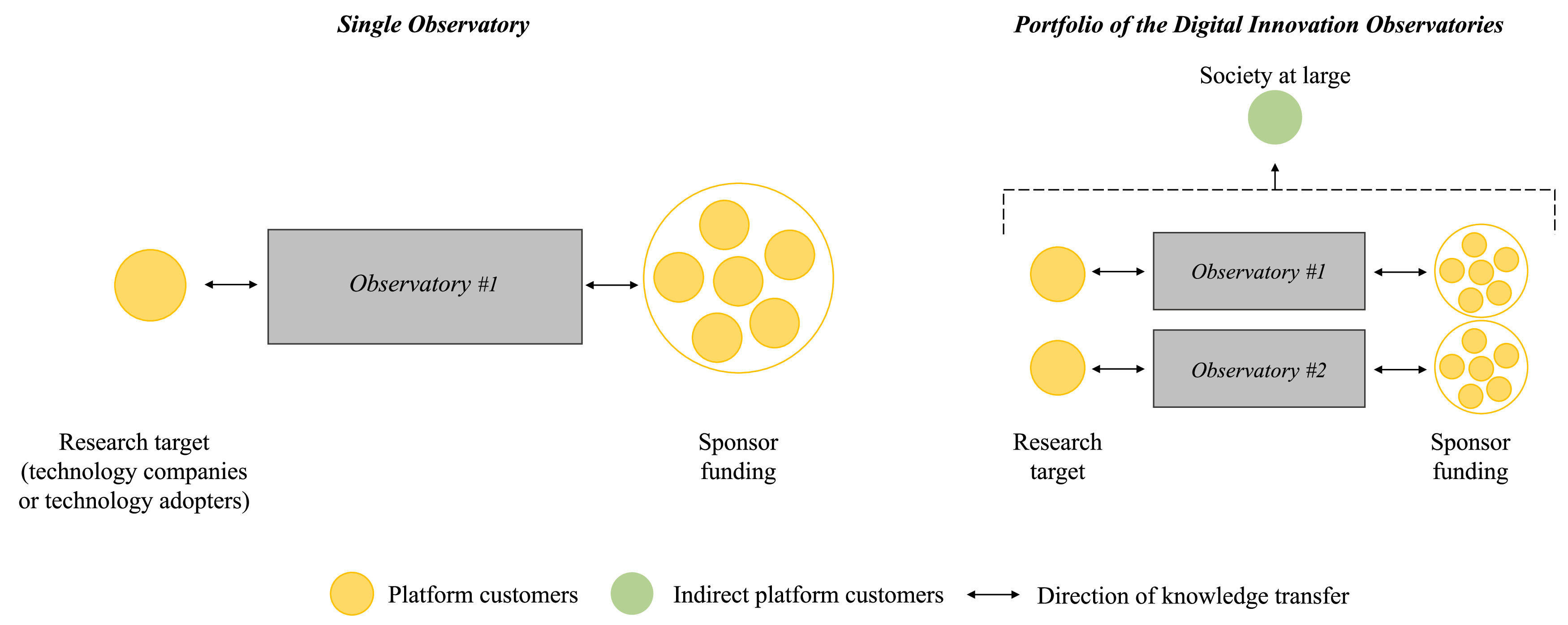
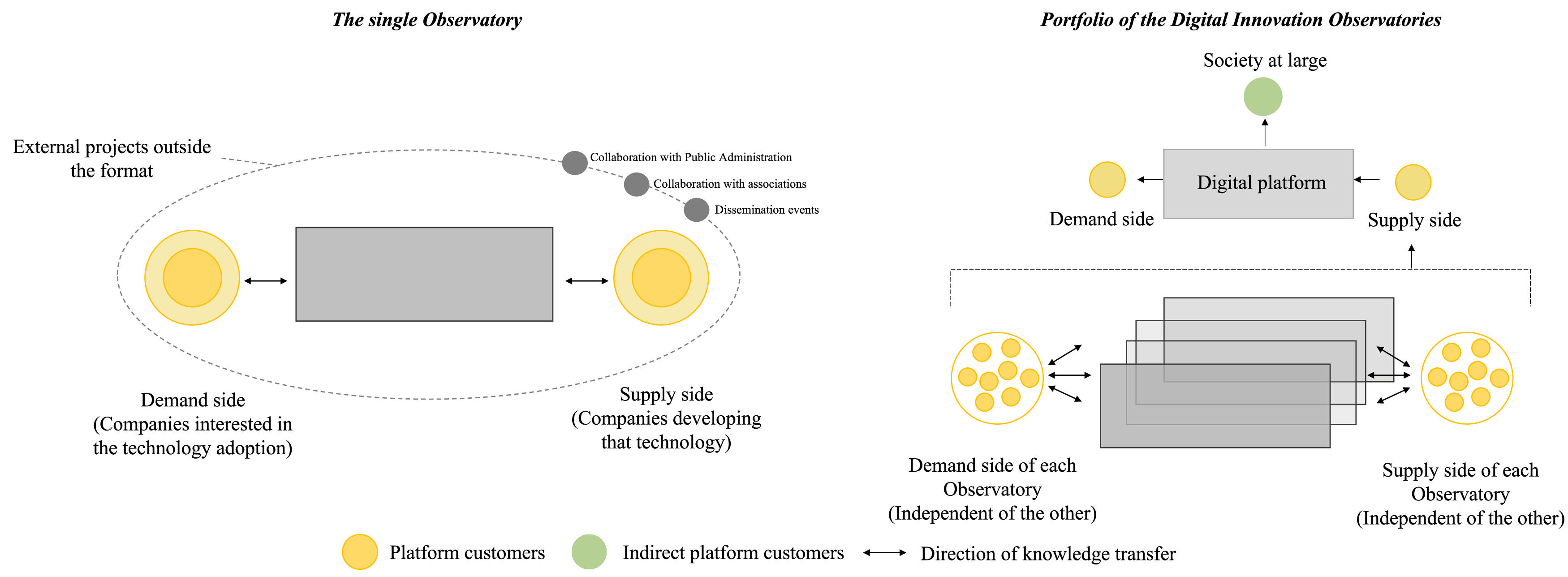
After the first event, the founders recognized that “you could not do research earmarked by one sponsor, but you had to have a lot of them making contributions small enough to be irrelevant from the point of view of conditioning the research.” (FD3) Thus, it shifted from a single sponsor to multiple contributors, enhancing credibility and engagement. As shown in Fig. 3, the Digital Innovation Observatories diversified their user base: some stakeholders co-defined research, others contributed data, and others participated as observers. How the Digital Innovation Observatories collected the findings seeded the opportunity for a platform-based structure. This structure acknowledges the creation of a solution in which knowledge collected from multiple actors on a specific technology was synthesized and redistributed to a broader audience seeking hard-to-find information.
The portfolio of Digital Innovation Observatories: the entrepreneurial spirit of opening a new Observatory
An entrepreneurial mindset drove rapid replication into adjacent technological domains, guided by the directors’ interest to apply their knowledge in a field where they saw an increasing market demand: “The e-commerce Observatory created the B2B Observatory, which looked more at supply-purchase processes. Differently, other Observatories, under another founder, were focused on internal processes, like the HR and intranet area. These represented the macro areas from which we then duplicated new Observatories.” (ID1)
The creation of an initial, smaller portfolio of diverse Observatories, as shown in Fig. 3, was enabled by an informal, flexible organizational structure. Sharing best practices and new market trends was eased by working in the same space, creating cross-fertilization of ideas among research teams and allowing them to embrace a shared culture of innovation: “We used to tell the desk neighbor about that innovation and what had been done […], we had, somewhat by affinity or theme or friendship, a continuous contamination that happened over coffee and brought innovation.” (ID1)
New Observatories and dissemination events advanced the initial mission of promoting transformation across firms and institutions, by disseminating competencies to address the emerging digital transformation trend “Strong is also an advocacy goal toward policy to generate institutional, regulatory changes. So less of an ‘observer’ and more of a community that generates and sustains change through development.” (FD3)
The platform consolidation phaseThe single Observatory: the creation of a formatOver time, the Digital Innovation Observatories consolidated their structure by onboarding heterogeneous participants, including competitors, within the same community, to enhance community value by sharing knowledge: “It was a progressive construction of tools consistent with the understanding of what could be the strengths of the Digital Innovation Observatories, including continuity, perseverance, consistency, and attention to the periodicity of the community that was being generated.” (FD1)
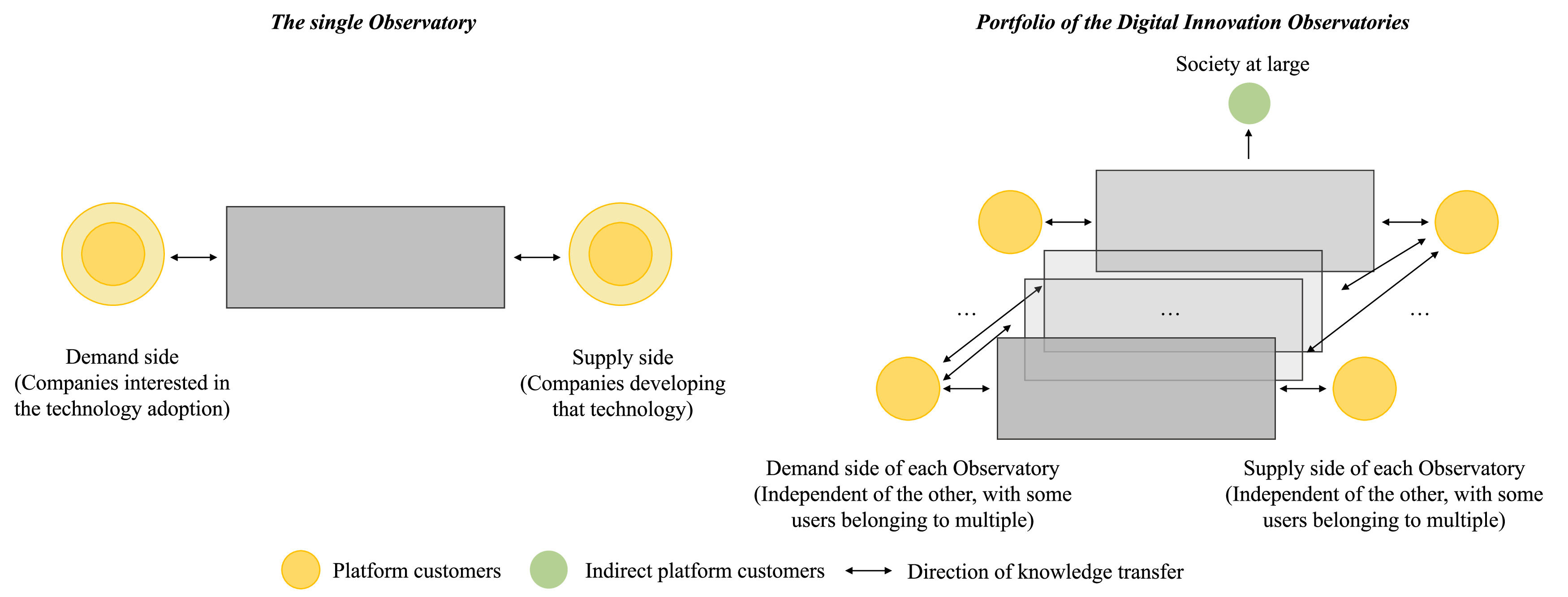
To sustain a periodic events structure over time, the organization identified the “Observatory format” as a shared structure for organizing activities within the Observatory life cycle and its composition, as shown in Fig. 4. The format is structured annually, with a kick-off meeting and four to six intermediate events organized as workshops or dissemination sessions for a dedicated community, and concludes with a final event open to the public. The format guides the Observatory structure, with two distinct user groups. One group is represented by organizations seeking insights about the impact and adoption of leading-edge technologies. The other group comprises organizations that produce or have already adopted that technology, seeking insights into market orientation, visibility and user feedback to inform adoption. As these groups derive value from participating in community events, the number of users on both sides grows, and the value of participating on both sides increases as well. At the center, the Digital Innovation Observatories envisioned the research team, which operated as a catalyst for side interactions, engaging with the community, and facilitating suitable matches during events: “At a certain point, the Observatory becomes a matching platform. On one side, there are market operators [the technology producer], who are often not in competition with each other but rather in a relationship of complementarity in promoting or generating a phenomenon. On the other side, there is the audience in need [of knowledge], contributing through their participation. And then there is us, the researchers, acting as catalysts of this process, who see in the community the advantage of data collection.” (FD3)

Each Observatory has an annual research cycle focused on a specific technological theme. Topic renewal serves to maintain participant retention, ensuring continuity while attracting new members. With the final conference, the community is free to decide whether to stay on board for the new edition or leave. Usually, a consistent share of participants remains on board, ensuring continuity over time and signaling the value of being part of that community. Some Observatories also leveraged their communities to identify urgent topics to address in the next cycle.
The format derives its main value from standardizing moments of community interaction, in which participants can share opinions and viewpoints on the chosen topic. The insights shared enabled the research team to gather unique data to present at the final event and gave community members multiple perspectives and visibility into other experts' perspectives on urgent topics. For this reason, as the community is established, the members are also encouraged to invite prospects, leveraging the Observatory as a venue for discovering new business opportunities: “Partners are often asked to invite whomever they want from outside the community. So they get visibility and offer access to an exclusive community. At the same time, for the Observatory, this new participant, unknown before, is a prospective customer that we can try to retain and keep inside the community.” (OD1)
During the consolidation phase, multiple Observatories were operating, increasing the number of topics covered. For this reason, when scientific directors had the opportunity to launch a new Observatory, they were encouraged to experiment with market interest in existing communities of other Observatories with aligned content themes. In this way, they were encouraged to experiment with new topics and formats, treating some of their events as low-risk sandboxes for idea testing before committing resources to launching the format into a new field: “One example is the Digital Identity Observatory, which started from two other Observatories already operating, since, in both communities, several people were talking about digital identity. It had started as a shared workshop, and now it is an Observatory on its own.” (SD5)
The identification of a format supported a horizontal extension into new areas, as one of the researchers said: “In some cases, it was also easy to build, because with skills already available, you would create a new case, gather new resources. […] Easily, I started a new Observatory because I knew the model and the new area.” (FD2).
As shown in Fig. 4 the format standardization reduced the effort to organize Observatory activities and became a standard practice to be adopted to launch new ones. The format outlined a set of steps that relied on a proven approach to community collaboration and community creation, with the research team customizing only the topics to be discussed. Moreover, the presence of other Observatories facilitated the duplication, since their existing communities offered a set of companies to propose for participation or to test market interest: “From a certain point on, we realized that one of the most common ways for new Observatories to emerge was precisely through gemini from existing Observatories.” (FD1)
The individual entrepreneurial culture continued to drive expansion, with scientific directors acting as key catalysts driven by external market demands and internal competencies, indeed: “Our strongest asset is that we are a platform that works on people and people who feel like entrepreneurs of their own piece.” (OD1).
To launch multiple initiatives efficiently, the Digital Innovation Observatories adopted an internal functional matrix structure to centralize back-end services, such as administration, event logistics, and communication, while preserving Observatory autonomy: “We needed to structure ourselves. We had grown to a point where a structured organization was needed to ensure alignment and keep everybody going in the same direction. It made everyone part of the system […] it safeguarded autonomy but brought out good practices that became standards and created the structural organizational composition with vertical matrix functions.” (OD1).
The matrix structure aimed to support innovation habits by establishing a shared language, creating horizontal ties, and granting equal access to best practices and knowledge. The diverse functions that nurture cross-Observatory connections and create egalitarian access to knowledge and innovation opportunities, even in smaller Observatories. The ease of sharing established a shared identity across the Digital Innovation Observatories, nurturing the feeling of “Lifting the boat all together.” (FD3).
Periodic meetings and retreats were established to favor collaboration and generate relational bonds among researchers, reinforcing cohesion, through “We met [with other colleagues]-not just your team-during the outdoors and meetings that we used to have two or three times a year, or the vespertines, where we were all together.” (SD2) Yet, standardization and scale could limit the original innovative momentum and serendipitous proximity-based knowledge exchange, with the risk of generating siloed structures that may undermine these dynamics: “This process standardization has been very strong in creating efficiency. However, it has somewhat repelled innovation over the years and limited the innovative spirit.” (ID1)
Eventually, the consolidation phase generated a horizontally replicated structure composed of 36 (almost identical) Observatories that differ by community topic, each hosting its own demand and supply sides, including approximately 510 partner companies with a network spread of almost 45,000 participants at the events. This expansion path positioned the Digital Innovation Observatories as a reference point for policymakers, given their pervasiveness across several areas and their capacity to promote local transformation. “If I take our Observatory as an example, perhaps one of the greatest impacts we have had over time has been our influence on the introduction of mandatory electronic invoicing. Through the Observatory, we made a significant contribution to the development of estimation models for calculating the benefits of electronic invoicing, in collaboration with the Italian Revenue Agency (Agenzia delle Entrate).” (SD1)
In the maturity phase, the format was fully codified, standardizing best practices, resources, and the event typologies needed for each life cycle stage, formalized in a document with all the steps required to implement the format. At the same time, continuous innovation remained essential to sustain engagement, leveraging loyal members to attract new participants. Yet, innovation remained essential to sustain community engagement. Scientific directors constantly tested new ideas to nurture interest in the community and gave value to those interaction moments, also leveraging the loyalty of long-standing members to expand the Observatory's visibility among new members: “Now that the Observatory is consolidated, a partner company is saying to its suppliers “I'm there, it's a valuable context, why don't you get on board too?” It brought us other companies that paid the fee because of the user satisfaction who was satisfied with the offer and brought in their suppliers" (SD2)
In this way, the format enables the launch of more than 50 Observatories that cover almost all areas of the digital and innovation fields. This network of independent yet loosely connected platforms serves as a resource for scientific directors to promote cross-Observatories collaboration and offer new insights to their communities.
To expand opportunities, cases introduced complementary projects beyond the yearly cycle, deepening knowledge and engaging new actors. As shown in Fig. 5, some Observatories added a set of collaborations to their two-sided structure that offer opportunities to explore idle knowledge with new actors. These projects contributed to strengthening the connection with the Italian and European institutions: "There is a selection of which organizations to engage with for new projects, [chosen among those who] do not display an opportunistic attitude. So, for example, projects with institutions or on certain topic, such as about data center, where we collected a set of data and involved all the players who are investing in that technology by offering our super partes view of the topic " (SD4)

The maturity phase consolidated the horizontal extension and added vertical growth, as represented in Fig. 5. The format was replicated also across thematic fields, loosely tied to digital solutions, such as Digital and Sustainability. Over time, the portfolio has opened or closed new Observatories in response to market opportunities and community interest, reaching the number of 50 Observatories. This portfolio has generated, in the past 25 years, a significant amount of field-specific knowledge, represented by publicly available reports and internal documents for the community, which the Observatory has no value in sharing twice with its community, but maintains a value for the market. This content-specific, codified knowledge launched the Osservatori.net webpage, a digital on-demand platform aggregating years of research for a broader audience, representing a vertical expansion. The platform targets many organizations that had no opportunity to participate in the yearly event but were interested in comprehending better current trends: “The online part could not exist without the offline part because it benefits from all the assets created by the offline one. They are inseparable. Over time, the online platform has allowed the development of assets, contacts, and visibility, which has allowed an integration of resources that support the Observatory’s research. It served as an asset enhancement, allowed investments to be made, and activated a virtuous circle of mutual enhancement.” (SD3)
Osservatori.net played a dual role: the possibility to capitalize on idle knowledge, identifying peculiar customer engagement mechanisms and an arena for strategic experimentation that eased cross-fertilization: "Osservatori.net in some ways has a glue function, as it is the project that unites [all the Observatories] communities and that allows that community to be exposed to other Observatories, through cross-fertilization" (OD1).
From an organizational viewpoint, the matrix structure expanded with new functions, such as the Innovation units and the Center for Digital Envisioning. They repurposed internal knowledge to create synergies, fostered top-down dissemination, and dismantled operational silos: "The goal is to enhance what is already there. We [the Innovation unit] select interesting things and then check whether they can be included within the activities we do. We involve a good number of representatives from various Observatories, so that we understand if these innovations can be interesting across them. […] that's what the research and development function is for, to figure out how to improve processes and introduce innovations that are cross-cutting" (ID1).
Knowledge sharing among Observatories became an internal, informal platform architecture enabling reuse of best practices (of activity- and topic-related knowledge). This reinforced an open-innovation culture of learning economies and underpinned a spirit of innovation and entrepreneurship, with the idea of nurturing a “greater culture and awareness that enrich ourselves, but also give everyone the opportunity to do so. From there, we included it in the strategic plan as one of the organization’s directions for development. That emerged in a bottom-up impetus” (OD1).
To overcome fragmentation, the Digital Innovation Observatories also worked to co-create a shared semantic repository of definitions and cross-Observatory trends to smooth alignment. To manage the large number of Observatories in the portfolio, a strategic vision with a medium-to long-term horizon was set to guide individual entrepreneurship. Periodic, collegial meetings with scientific directors steered this process, taking into account the existing portfolio, internal capabilities, and market trends before approving new initiatives. The large portfolio ensured a comprehensive support to local institutions, combining research and project activities that amplified community contributions to European, national, and regional bodies: "The role of the Digital Innovation Observatories now aims to be even more impactful on policy-making. For example, in recent years, several Observatories have had much more dialogue with institutions. To support the policymakers’ analysis with data and point some industrial policies in the right direction." (OD1).
Overall, the maturity phase consolidated how the Digital Innovation Observatories have gradually developed their platform structure, expanding from a two-sided to a hybrid multisided one. Knowledge drove this evolution: first as a format enabling replication, then as a core asset exchanged within communities, and finally as a resource enabling digital expansion.
DiscussionThe life cycle of the Digital Innovation Observatories offers a comprehensive picture of how non-digital platforms evolve through a modular structure in horizontal and vertical trajectories. The findings highlight knowledge identification and adoption, an effective organizational infrastructure, and individual proactivity as pivotal factors, each discussed in the following paragraphs.
The non-digital platform evolutionThe Digital Innovation Observatories present an ongoing evolution based on identifying their minimum “unit of analysis,” serving as a foundational structure for platform expansion. This minimum set of mechanisms is exemplified by the design of a transactional platform (Evans, 2003; Rochet & Tirole, 2003), in which face-to-face interactions and local community dependence categorize the Digital Innovation Observatories as a non-digital platform (Perez Mengual et al., 2024). Cross-side network externalities are in place (Katz & Shapiro, 1985) by easing access to otherwise unreachable individuals and knowledge. Face-to-face interactions create a neutral third space, incorporating the concept of “ba”, meant as a safe space for trust formation and serendipitous value discovery (Oksanen & Ståhle, 2013), which acts as a driver for platform evolution. Non-digital platforms, thus, serve to share unexpected knowledge, highlighting how the search for genuine connections (Berdicchia et al., 2023) drives evolution.
Recognizing the value of a repeatable format guides an effective non-digital evolution path that relies on its iterative adoption, thereby standardizing a process to accelerate customer onboarding and offering an alternative way to address the “chicken and egg” paradox (Caillaud & Jullien, 2003). Similar to digital platforms, the evolution path creates a multi-sided platform that onboards new customers along the transaction line (Hagiu & Wright, 2015; Trabucchi & Buganza, 2022b), however, new users are not onboarded to interact with existing ones. Unlike digital platforms, which exploit large user bases (Trabucchi et al., 2017; Varga et al., 2023), non-digital platforms leverage aggregated niche communities to demonstrate their value and serve as testing grounds for identifying market needs. At the same time, when the central organization is unable to value communities’ accumulated knowledge and translate insights across domains, horizontal growth may increase the number of local communities without producing cumulative learning at the portfolio level. The evolution of non-digital platforms, therefore, depends not only on launching additional initiatives, but also on preserving knowledge circulation across them to create a scalable platform portfolio.
This horizontal duplication aligns with the theoretical view of platform gemini (Trabucchi & Buganza, 2022a), but it assumes a central role as the primary mechanism for non-digital platform expansion, as discussed in Section 5.2. Unlike digital platforms, on non-digital ones, the creation of an internal organizational structure that guides this horizontal extension and format duplication is crucial. This expands the role of the organizational infrastructure in promoting evolution (Nagy et al., 2025) and shows that knowledge drives evolution not through sharing (Albats et al., 2025) but through gathering and internal adoption.
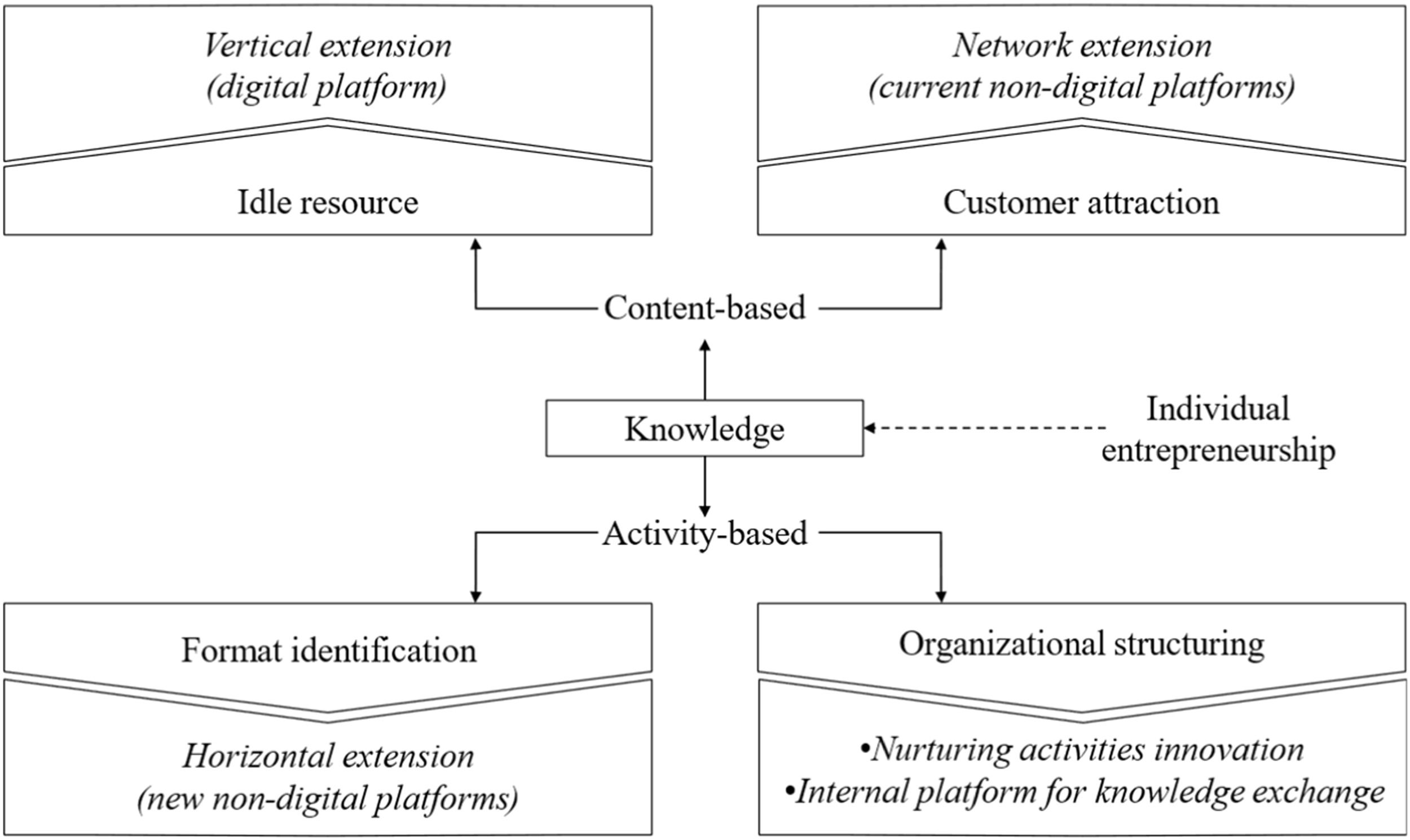
In the maturity phase, non-digital platforms can also evolve into a hybrid orthogonal platform (Filistrucchi et al., 2014; Trabucchi et al., 2017). Aligned with client-as-a-source logic (Trabucchi et al., 2017), a vertical direction is introduced that leverages the Digital Innovation Observatories’ knowledge as an idle asset to create Osservatori.net digital platform. In line with unilateral externalities (Filistrucchi et al., 2014), the size of Osservatori.net does not affect the activities of the Digital Innovation Observatories, whereas the latter's growth provides updated materials. The value of vertical evolution stems from recognizing knowledge as an idle asset (Trabucchi et al., 2021) that can be offered to new customers. Orthogonal expansion offers the opportunity to integrate non-digital platforms with digital layers, choosing digital when large network effects are sought (Eisenmann et al., 2006), and is fully aligned with the platform thinking mindset (Trabucchi & Buganza, 2022b). Moreover, the vertical expansion of the Digital Innovation Observatories creates the opportunity to pursue a digital expansion and broader network reach to respond to Feser's (2023) requests to uncover mechanisms to enhance local value creation. Platform mechanisms represent a valuable option for maximizing the use of available assets and fostering local value creation (Doloreux et al., 2024). Findings indicate that the orthogonal customer group of non-digital platforms can be treated as a separate transactional platform rather than a single customer group, opening the way to new dynamics. The evolution of the non-digital platform structure and the triggers that drive it are shown in Fig. 6.
Platform gemini and format creation
The evolution and the launch of more than 50 similar platform-based initiatives broaden the role of the platform gemini (Trabucchi & Buganza, 2022a), a mechanism already studied in the platform literature but underexplored. The literature presents it as a way to resolve existing network tensions and secure suitable interactions among customers by launching a new platform. In non-digital platforms, instead, platform gemini takes on a different meaning and strategic role. First, it becomes the primary mechanism for expansion by ensuring continuous local and content fit (Feser, 2023) through a format that facilitates its iterative adoption and creates a multi-sided platform that repeatedly identifies new demand and supply sides, maintaining central local connections. Second, identifying new fields in which it could be duplicated becomes a strategic path to achieve network scalability across multiple topic-specific platforms. In this way, launching a new platform addresses the need to cope with network expansion and local connections (Shankar & Clausen, 2020).
Horizontal extension through platform gemini centers platform value creation on the quality of interactions, enabled by deep knowledge of users, rather than from the quantity of network connections. This supports the ongoing debate about the value of limited network externalities (e.g., Karhu et al., 2024; Springer et al., 2025), offering a mechanism to leverage them despite size constraints. For each new platform, network growth is sought, where, given the relevance of the interactions created in the community, users can be empowered to act as ambassadors in a recommendation system (Raj, 2024), a strategic move particularly suitable given the network composition. Given the challenges of launching platforms with mismatched market readiness (Yoffie et al., 2019), the availability of other networks for pre-testing new platform ideas offers a unique opportunity to leverage the compound network structure.
As presented earlier, an effective platform gemini is based on identifying a replicable format, as represented in the consolidation phase. This research defines the format as a codified set of rules that govern customer interactions, platform structure, and its life cycle, enabling replication across diverse domains. Knowledge accumulated over time about customer preferences and successful internal initiatives shapes the format, which rethinks knowledge as an idle asset (Trabucchi et al., 2021) to generate value within the organization and promote transformation. This broadens the scope of knowledge collection and adoption (Paniccia et al., 2024), thereby creating a standardized infrastructure to guide platform evolution. In this view, learning economies (Arrow, 1962; Teece, 2007) drive non-digital evolution by enabling knowledge replication, rather than through traditional network scaling (Gawer, 2014). For non-digital platforms in knowledge-intensive fields – such as coworking spaces or science parks – format design and adoption guide platform scaling and efficiency. This becomes a preferable strategy for expansion for organizations that rely on network value, but they are not globally scalable. This study shows that the efficiency of horizontal duplication depends on the density of specific knowledge in that local area (understood as the availability of relevant actors and a recognized need for interaction around a shared topic). Yet, when knowledge availability is scarce, this study identifies pre-testing and partial format adaptation as a means to maintain the relevance of network effects and efforts undertaken while broadening organizational boundaries.
The centrality of format adoption reinterprets platform modularity (Gawer, 2014; Meyer & Lehnerd, 1997), giving new meaning to adding sides at minimal cost (Williamson, 1981) and enabling platform expansion (Varga et al., 2023). The format modularity represents a codified interaction architecture that structures platform engagement through standardized temporal, relational, and governance mechanisms, enabling replication across domains. This modularity operates in two directions. First, in each platform, by adding new mechanisms based on the community’s needs, represented by a set of pre-tested mechanisms. In this way, the central team can focus its efforts on innovating only some activities to keep community interest high. Second, within the portfolio of platforms, the format ensures replicability, supporting the organizational portfolio’s expansion.
As the non-digital expansion path splits governance and orchestration efforts between the overarching central platform (the Digital Innovation Observatories) and the thematic platform (the Observatory), the format broadens the central platform's ability to orchestrate and govern this structure (Kretschmer et al., 2022) by giving it the freedom to innovate while centralizing standard activities. This also affects the platform generativity, digitally studied through a modular architecture (Yoo et al., 2010), which, in non-digital platforms, emerges through the individual (human) reflection and a set of mechanisms that the non-digital platform can adopt to create valuable customer interactions.
Knowledge as an idle assetIn the evolution of the Digital Innovation Observatories, knowledge plays a central role. It is identified, adopted and continuously developed to sustain the organizational expansion through format definition and replication. This view aligns with the perspective of digital platforms, in which knowledge is treated as an idle asset that guides expansion to attract new users (Trabucchi et al., 2021) or the launch of new solutions (Kenney et al., 2021; Trabucchi & Magistretti, 2020). However, on non-digital platforms, both activities require launching a new platform.
This study finds that different types of knowledge contribute to these goals. Activity-based knowledge, focused on procedural and codified knowledge, serves the organizational structure and supports the format creation. Content-based knowledge, focused on topic-specific knowledge, instead, aims to support customer matchmaking and influence their value capture. This extends knowledge adoption beyond sharing mechanisms, which is relevant for platform evolution (Albats et al., 2025), and highlights the typology that sustains this path.
Activity-based knowledge contributes to platform literature by capturing internal best practices to design the format through which non-digital platforms operate and scale horizontally. Codifying it into a format shows how platforms manage knowledge to support path development (Garud et al., 2010), reinterpreting digital generativity (Yoo et al., 2010) and modularity (Gawer, 2014) through effective sharing. As the Digital Innovation Observatories did, it means formalizing guidelines in documents to launch the platform, including all the steps to be followed. To ensure effectiveness, the organization acts as an internal knowledge broker, offering an alternative to relying solely on team connections or on external facilitators (Feser, 2023; Pinarello et al., 2026). As the organizational infrastructure operates as the central platform provider, individuals play a central role in collecting, codifying, and repurposing knowledge. On this internal platform, researchers across non-digital platforms can act on both the demand and supply sides, depending on their needs. This extends the platform’s role as an orchestrator of assets (McIntyre et al., 2021) and generator of new opportunities (Springer et al., 2025; Thomas & Tee, 2022), with knowledge sharing driven more by face-to-face interaction (Perez Mengual et al., 2024) and entrepreneurial initiative than by algorithms. Using knowledge management to design an effective format represents a new direction for non-digital platforms to empower user engagement, even in niche areas (Han, 2025).
Content-based knowledge, by contrast, concerns idle knowledge generated during interactions in each thematic non-digital platform. This is the knowledge that gives value to customers and, through the relational nature of matchmaking, extends Huang et al.'s (2018) view by linking the evolution path to relational connections among platform customers beyond knowledge collection. Content-based knowledge, thus, represents how non-digital platforms empower individuals (Han, 2025) through face-to-face interactions, thereby strengthening the role of co-location and local connection. This links knowledge-sharing practices (Nonaka et al., 2000) to platform evolution (Trabucchi et al., 2017; Varga et al., 2023), demonstrating how such practices can form the modular infrastructure that enables platforms to evolve while remaining aligned with user needs. The knowledge collected also enables the launch of non-platform projects with private and public partners, embracing a platform-thinking mindset (Trabucchi & Buganza, 2022b), and is always on the lookout for new customers interested in adopting this knowledge. As a result, platform mechanisms operate as engines to enhance the public good and limit the institutional void (Lashitew et al., 2022) through ongoing local dissemination. Fig. 7 illustrates the overall influence of knowledge on the evolution of non-digital platforms.
The human role and the organizational infrastructure
The studied evolutionary path presents the organizational infrastructure as pivotal in ensuring the launch of more than fifty non-digital Observatories platforms through effective knowledge management. This broadens the limited attention given to the organizational layer in the digital platforms literature (e.g., Altman & Tushman, 2017; Varga et al., 2023). In contrast, the case of the Digital Innovation Observatories highlights both individual agency (Huang et al., 2017) and a structured organizational infrastructure as essential.
Individual entrepreneurship (Garud et al., 2010) drives platform expansion by sensing and combining market opportunities with reflexive actions, envisioning short- and long-term community needs, and orchestrating onboarded resources. Individual reflexivity is essential for determining which knowledge to use, reinforcing the idea that organizational evolution is rooted in the purposeful adoption of knowledge (Paniccia et al., 2024). The entrepreneurial effort guides both the launch phase and the design of platform dynamics. Recognizing and empowering this role helps address common failures in network and resource orchestration on non-digital platforms (Hansson et al., 2005; Heshmati & Shafiee, 2021). Envisioning new opportunities in existing knowledge strengthens the literature's view of the platform-thinking mindset (Trabucchi & Buganza, 2022b), in which individuals deploy platform mechanisms as strategies to create new value by connecting interested users.
However, achieving non-digital platform evolution through individual entrepreneurship requires a formalized organizational infrastructure and supportive innovation culture, aspects that digital cases have overlooked. The Digital Innovation Observatories present how the founders' strategic vision and cognitive framework shape platform interactions, while shared culture ensures alignment. The internal matrix enables efficient service delivery (Chen & Cui, 2022) and resource governance (Hunt et al., 2025) and also functions as a knowledge broker. In this view, organizational learning (Nagy et al., 2025) is central to supporting platform evolution, framed as an organizational infrastructure that collects idle knowledge and shares it with the appropriate teams.
Although non-digital platforms require minimal investment in complementary infrastructure to enable customer connections (Staykova & Damsgaard, 2015), an organizational layer that facilitates asset sharing and avoids redundant activities can be decisive. This enhances the asset-light business model of platforms (Gawer, 2014) and shows that non-digital platforms require additional support through a defined format and organizational infrastructure, thereby reducing inefficiencies, promoting ongoing innovation, and enabling flexible experimentation. This ties platform generativity (Han, 2025; Thomas & Tee, 2022) to both the organizational layer (a broker of knowledge and an enabler of innovation) and individual agency (enabled by the freedom to experiment).
ConclusionThis research contributes to understanding how non-digital platforms evolve, guided by knowledge adoption and individual proactivity, thereby addressing the search for mechanisms to overcome their long-term failures (Heshmati & Shafiee, 2021; Hansson et al., 2005).
Theoretical contributionsThis research contributes to the platform literature in four ways discussing how non-digital platforms evolve.
First, it expands the current view of platform evolution (Chen et al., 2022; Trabucchi et al., 2017), which is conventionally anchored in network scalability and expansion (Varga et al., 2023). Non-digital platforms enable evolution through format identification and replication in adjacent areas, ensuring community fit and interaction quality. This view offers a new understanding of network scalability (Varga et al., 2023), achieved by creating a compound structure formed by summing several local, independent networks. Non-digital platforms demonstrate that network scale remains sought (Shankar & Clausen, 2020), but with varying intensity and reach. As non-digital platforms expand their networks, the existing customer base is used to gauge interest in the idea rather than to facilitate onboarding new customers (Trabucchi & Buganza, 2020). While remaining relevant, local face-to-face interactions focus on the quality of connections (Karhu et al., 2024), ensuring knowledge sharing among onboarded users.
This expansion path assigns a new role to platform gemini (Trabucchi & Buganza, 2022a), serving as the mechanism for horizontal extension. To ensure efficient platform replication, knowledge organization and formalization guide the design of a format that facilitates platform launch, overcoming challenges reported in the literature (Yoffie et al., 2019) and avoiding the continuous redesign of interaction mechanisms. The format rethinks digital platform modularity (Gawer, 2014) and generativity (Yoo et al., 2010) by combining individual proactivity and organizational knowledge management. This evolutionary path becomes possible given the centrality of learning economies (Arrow, 1962; Teece, 2007), which inform the design of formats and user interactions, rather than conventional platform scale economies (Gawer, 2014).
Second, this study shows that non-digital platforms can also attain the multi-sided structure of digital platforms (Trabucchi & Buganza, 2022b) through their evolution by combining physical and digital interaction media. Like digital platforms, the non-digital ones can pursue an orthogonal evolution (Filistrucchi et al., 2014), launching a digital platform to repurpose idle knowledge already shared with the local community. By pursuing a client-as-a-source logic (Filistrucchi et al., 2014; Trabucchi & Buganza, 2020), non-digital platforms give a new meaning to the client role by adopting orthogonal mechanisms to launch a new transactional platform, leveraging the format and digital scalability according to the asset and mechanisms sought.
Third, knowledge management emerges as the key driver of this evolution path, conceived as an idle asset (Trabucchi et al., 2021) embedded in both content and activities. Beyond being the value exchanged among customers, non-digital platforms also highlight their transformative role within the organization by ensuring flexibility, modularity, and efficiency. Individual proactivity in adopting knowledge at the right time is fundamental (Paniccia et al., 2024), placing those who operate in these organizations at the center, defining new opportunities for customers and themselves, and continuously interacting with colleagues. As knowledge is highly dependent on who exchanges it, to be leveraged for the evolution of non-digital platforms, it is crucial to invest in internal infrastructure that enables systematic knowledge collection and sharing. This shows how transactional platform mechanisms may also be applied internally, contributing to an emerging research stream (Rohn et al., 2021), to secure knowledge flows and collective support for platform growth. As the non-digital platform provider also assumes the role of knowledge collector and orchestrator (Kretschmer et al., 2022), this extends the current understanding of how knowledge creates value on platforms beyond matchmaking (Albats et al., 2025) and serves as a driver of organizational innovation.
Fourth, this research presents the central role of the organizational infrastructure, which serves as a knowledge broker and facilitates experimentation. Creating a formalized organizational structure also supports platform generativity (Thomas & Tee, 2022) that eases the sharing of knowledge and best practices, achieved through human agency (Huang et al., 2017). This expands the current limited role of the organizational infrastructure in platform literature (Altman & Tushman, 2017), highlighting its managerial role in promoting collaboration while balancing centralization and flexibility within organizational structures. Platform mechanisms can be adopted internally within organizations (Rohn et al., 2021) to serve as knowledge-brokering functions (Feser, 2023), ensuring alignment and a sense of belonging through mutual collaboration.
In conclusion, this study broadens how platforms can evolve, reconfiguring platform mechanisms in a non-digital setting through format identification and knowledge mobilization. Learning the evolution path also broadens the understanding of non-digital platform dynamics (Perez Mengual et al., 2024; Primario et al., 2024), highlighting the central role of the organizational team in understanding user needs and facilitating meaningful connections through co‑located presence. While not the core focus, this study strengthens the organizational role as a matchmaker, replacing digital algorithms (Amit & Han, 2017; Evans & Schmalensee, 2016) with sensemaking. Human centricity broadens how individuals embrace the Platform Thinking mindset (Trabucchi & Buganza, 2022b), which is connected here to individual entrepreneurship (Garud et al., 2010) in identifying quiescent market needs and leveraging idle assets. The evolution of non-digital platforms thus places human interactions and an innovative mindset at the center, offering a modular structure that suits local needs while securing long-term success.
Contributions for PractitionersThis study aims to support managers of non-digital platforms by offering a strategic, step-by-step path for evolutionary growth. The first step is to analyze internal activities to determine whether a standard format can be defined that would also be valuable in adjacent areas. This approach helps build a competitive advantage by leveraging unique user interactions and improving efficiency by avoiding redundant efforts, such as duplicating early-stage investments in defining activities and user engagement models. Once identified, the format will serve as the basic infrastructure for designing the new platform's dynamics. Being sufficiently generalizable in format to support managers in pursuing multiple platform launches based on market interest and the topics to be shared.
The central role of the organizational layer informs managers that an efficient internal organization that stores and shares knowledge is the key to sustaining long-term value and promoting continuous innovation. The organizational infrastructure can reduce pressure on each replicated platform while also maintaining a “neutral” role in assessing the value of the available knowledge.
The relevance of a shared culture in pursuing innovation, the consciousness of collaboration, and knowledge sharing suggest that individuals are those who secure this evolutionary path. Those who work within the organization represent the platform mechanism, as they operate to matchmake external customers and recognize the value of internal knowledge. This role as a promoter of platform-based mechanisms drives constant innovation in the value shared, reduces redundancy and resource waste, and ensures modular expansion of recombination mechanisms.
As non-digital platform managers rely on individual effort in knowledge sharing and a modular expansion strategy based on repurposing extant knowledge, they can achieve a broader local transformation by consciously adopting these mechanisms. Individuals can also adopt the idle asset to rethink their current knowledge and undertake initiatives that are not based on platform dynamics, which can eventually generate new knowledge to support the local community or the overall organization. Awareness of these interdependencies and distinct dynamics helps build collaborative strategies grounded in shared value creation, such as those with governments and associations. An area of attention for managers during horizontal replication is assessing whether the target field offers a good spread of specific knowledge, which might ease format adoption. As discussed, the format serves as a basic infrastructure that managers can adapt to the community’s needs, considering changes in knowledge availability and individual participation that can drive its adaptation.
As non-digital platforms rely on a limited set of investments in digital technologies, this study presents how managers should design an infrastructure that nurtures and is nurtured to create new knowledge, even adopting the digital dimension when relevant to expand its impact.
Limitations and future researchThis study is not without limitations, primarily due to its reliance on a single case study (Siggelkow, 2007), which limits the generalizability of the findings. While multiple data sources and perspectives were employed to mitigate this, future studies could adopt a multiple-case study design to test and extend the observed horizontal and vertical evolution dynamics on non-digital platforms. This research positions knowledge as an idle asset central to platform growth. This might link the generalizability of this study to knowledge-intensive non-digital platforms, such as science parks, innovation hubs, or business incubators, and is less applicable to platforms primarily focused on the exchange of tangible assets or loosely organized community initiatives. For this reason, future studies benefit from exploring the evolution of other non-digital platforms to understand how horizontal and vertical paths are adopted. In addition, this case study suggests that evolution through format duplication is contingent on the existence of fertile ground in the new field of adoption. More specifically, horizontal replication is more likely to succeed when the adjacent field exhibits sufficient knowledge density, identifiable actors, and the platform provider’s ability to attract relevant knowledge holders to the community. This may pose a limitation for non-digital platforms operating in domains where field-specific knowledge is scarce or scattered, as such conditions may undermine the effectiveness of format duplication. Future studies should therefore specify and operationalize how format characteristics are influenced when the organization has to adapt them to external conditions, such as due to limited knowledge density. Moreover, this study is based within an Italian institutional setting, characterized by strong advocacy for local transformation and public-private collaboration. Future research should examine whether the Italian setting or the relationship with a university influences the evolutionary path, and whether similar mechanisms emerge in contexts with different institutional configurations.
Future research could examine how format-driven horizontal extension operates in platforms where spatial dynamics and tangible asset sharing play a greater role, such as festivals, local markets, or nonprofits, to inquire into how local connections influence this expansion. It could also investigate the combined impact of physical and digital space, given that this study is among the first to address non-digital evolution while incorporating digital components. Further work could explore mutual influences between digital and non-digital platforms, contributing to the expanding spectrum of platform business models emerging in new sectors and to the implications of these hybrid models for policymaking and interactions.
Additionally, findings suggest that platform dynamics can operate internally within organizations to support knowledge sharing. This opens the door to future research on how platform mechanisms are adopted as internal processes in non-digital contexts. Finally, future studies should consider the broader impact of non-digital platform evolution, particularly the horizontal and hybrid expansion phases, on policy-making and other institutional stakeholders, which this study only partially addressed.
Ethics approval and consentThe authors confirm that this research was conducted ethically and in compliance with all applicable standards for research integrity. Informed consent was obtained where necessary.
FundingNo funding was received for conducting this study and assisting with the preparation of this manuscript.
CRediT authorship contribution statementSilvia Gadola: Writing – review & editing, Writing – original draft, Visualization, Validation, Methodology, Investigation, Formal analysis, Data curation, Conceptualization. Daniel Trabucchi: Writing – review & editing, Validation, Supervision, Conceptualization. Tommaso Buganza: Writing – review & editing, Validation, Supervision, Conceptualization. Luca Gastaldi: Writing – review & editing, Validation, Supervision, Conceptualization. Alessandro Perego: Writing – review & editing, Validation, Supervision, Conceptualization.
The authors have no relevant financial or non-financial interests to disclose.
The authors have no competing interests to declare that are relevant to the content of this article.
For the review team, the authors have anonymized the case to preserve confidentiality and ensure the rigor of the double-blind review procedure. As explained in the methodology, all the authors hold roles within the studied organization, which could otherwise compromise the anonymity of the authorship. At the end of the review process, the organization’s name and the interviewees’ names will be disclosed.

