




Entrepreneurship represents a pivotal pathway for transforming knowledge into innovation and economic value; however, the factors underlying this process remain a “black box”. Drawing on the Cognition, Capability, and Commitment (3C) framework, this study employs a data-driven machine learning approach—specifically, a decision tree algorithm—to systematically identify the potential predictors of Total Early-stage Entrepreneurial Activity (TEA). Using primary data from more than 70,000 individuals in the 2020 Global Entrepreneurship Monitor (GEM), supplemented with 2021 data for robustness checks, the results suggest that various forms of entrepreneurial cognition, such as necessity-driven motivations, family tradition, and perceptions of opportunity scarcity, emerge as prominent potential predictors. In contrast, capability-related variables exhibit comparatively lower predictive weights. These findings may advance theoretical understanding of entrepreneurial patterns and offer potential actionable implications for policymakers seeking to foster entrepreneurship. Moreover, they highlight the utility of machine learning in uncovering complex, non-linear interactions between motivational and contextual factors, thereby providing complementary exploratory insights beyond conventional GEM-based analyses.
In the context of rapid global economic restructuring and continuous technological advancement, Entrepreneurial Activity (EA) is widely recognized as a catalyst for innovation, job creation, and sustained economic growth (Avelar et al., 2024; Li et al., 2024; Uriarte et al., 2025). The urgency of understanding the factors underlying new venture creation has intensified, particularly in the aftermath of the 2020 global events, which underscored the relevance of entrepreneurship in economic recovery and adaptation (Ratten, 2023). Consequently, identifying the predictors of individual entrepreneurial intent and action has become a central concern in both academic research and policy discourse.
Over the past five decades, entrepreneurship research has expanded substantially, evolving from personality-centered approaches to more complex, multi-dimensional configurational perspectives on entrepreneurial behavior (Bacq et al., 2025). The Total Early-stage Entrepreneurial Activity (TEA) index developed by the Global Entrepreneurship Monitor (GEM) has become a cornerstone for cross-national assessments of entrepreneurial dynamics (Kuratko & Covin, 2025; Piñeiro-Chousa et al., 2025a; Vargas-Zeledon & Lee, 2024). Prior studies have examined a variety of potential predictors, including perceived entrepreneurial skills, fear of failure, opportunity perception, and institutional support (Audretsch et al., 2024; Schade & Schuhmacher, 2022). However, most existing research relies on linear regression or variance-based techniques, which may be limited in capturing potential non-linear interactions and interdependent effects among individual, institutional, and motivational factors (Braunerhjelm, 2022). Consequently, the underlying patterns through which cognitive, capability, and commitment-related factors may be associated with TEA remain insufficiently theorized.
To address these gaps, this study adopts the Cognition, Capability, and Commitment (3C) framework as an integrative analytical lens that informs the behavioral and cognitive traditions of entrepreneurship research (Carsrud & Brännback, 2011; Krueger, 2007; Mitchell et al., 2002). The framework comprises three dimensions: Cognition, reflecting motivational and perceptual factors such as opportunity recognition, personal aspiration, and family tradition; Capability, encompassing physical and psychological abilities required to achieve outcomes; and Commitment, denoting the willingness to persist, assume risk, and translate intentions into sustained entrepreneurial behavior. In this model, cognition, capability, and commitment function as mutually reinforcing conditions. Rather than assuming a simple hierarchical flow, the 3C framework emphasizes that cognitive processes are embedded within and shaped by the individual’s capability and commitment levels. This perspective aligns with the configurational interpretation, suggesting that the pathway to TEA may be shaped by the non-linear interplay of these three pillars (Graham & Bonner, 2022; Piñeiro-Chousa et al., 2025b).
Drawing on individual-level GEM data from 2020 and 2021, this study empirically examines the hierarchical importance and interaction patterns of TEA. The 2020 dataset—collected during the COVID-19 pandemic—captures the crisis phase of entrepreneurship, while the 2021 dataset represents the early recovery period and is used to examine the robustness of findings. Data were collected from over 70,000 respondents across 77 countries, offering broad coverage and cross-cultural comparability.
This study addresses the following three core research questions:
RQ1 Within the 3C framework, which factors are more frequently identified as relevant predictors of TEA?
RQ2 How do cognition-, capability-, and commitment-related factors interact in non-linear and interdependent ways to be associated with early-stage entrepreneurial activity?
RQ3 How does the relative importance of cognition, capability, and commitment factors vary between the pandemic and post-pandemic contexts?
By integrating a classical theoretical perspective with cutting-edge methodological tools, this study contributes to entrepreneurship research in three key areas: it enriches the theoretical framework for offering potential perspectives on entrepreneurial behavior, advances methodological innovation in the analysis of complex variables, and offers potential insights for policymakers and entrepreneurship educators.
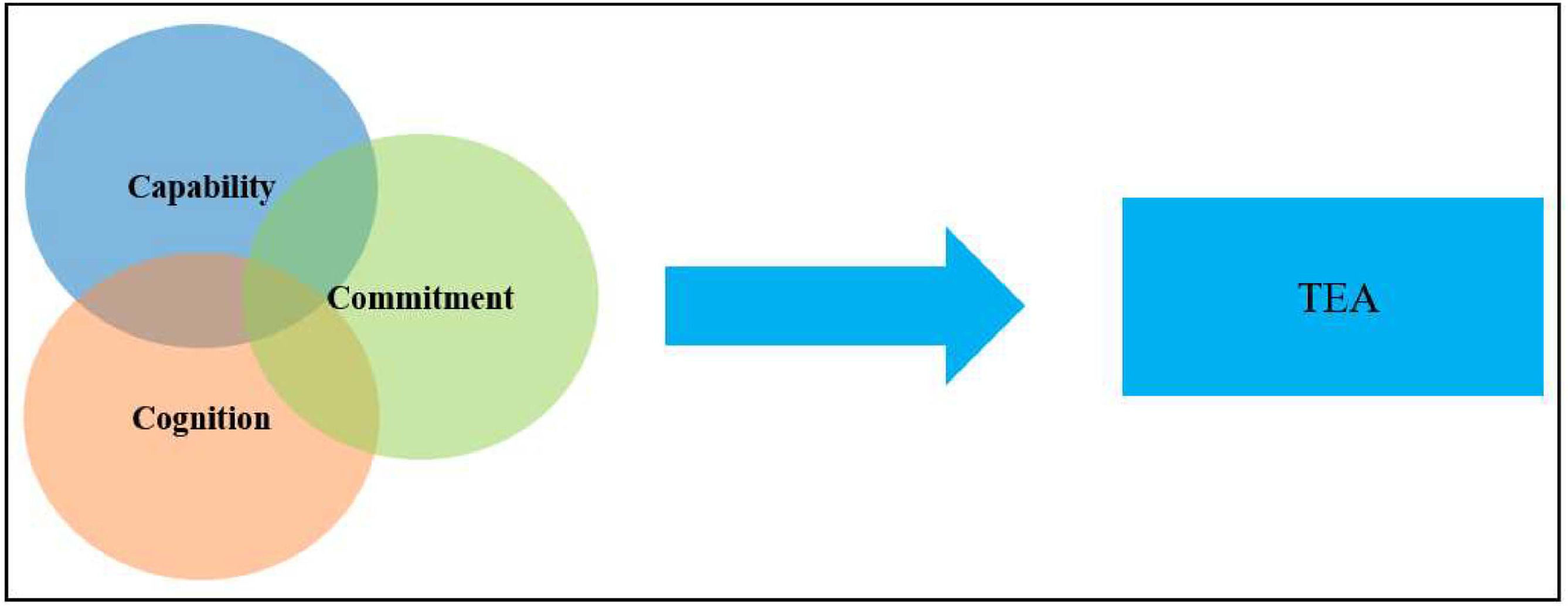
Literature review and research frameworkThe 3C framework (cognition, capability, commitment)To capture the multi-dimensional nature of early-stage entrepreneurial activity (TEA), this study proposes the 3C framework (see Fig. 1), integrating three interrelated configurational dimensions—cognition, capability, and commitment—that correspond to distinct psychological, skill-based, and behavioral domains. Drawing on entrepreneurial cognition theory (Krueger, 2007; Mitchell et al., 2002), psychological capital (Welter & Scrimpshire, 2021), and entrepreneurial intention models (Maheshwari et al., 2023), the framework is both theoretically grounded and empirically aligned with the variables measured in this study.
Cognition, Capability, and Commitment (3C) framework.
Cognition refers to the mental frameworks and thought processes through which individuals recognize, interpret, and evaluate the prospects of initiating and sustaining a new venture. It encompasses both intrinsic motives (e.g., creating an impact) and extrinsic motives (e.g., financial security), as well as symbolic factors such as social status (Carsrud & Brännback, 2011).
Capability is defined as the physical and psychological abilities required to achieve desired outcomes (Li et al., 2019). Individual abilities have been shown to strongly predict individual performance (Schmidt & Hunter, 1998). Theoretically, the capability component is grounded in both human capital theory and psychology research (Gerhart, 2007). Capability is conceptualized as personal resources that individuals have readily, requiring no substantial additional costs or effort (Hendriks & Stokmans, 2020).
Commitment, in an entrepreneurial context, can be defined as a psychological state that characterizes an individual’s bond with a venture and shapes the decision to persist over time. Adapting the framework of Meyer and Allen (1991), this state reflects a founder’s desire (affective commitment), perceived need (continuance commitment), and/or sense of obligation (normative commitment) to maintain the course of action.
By articulating these three interdependent constructs, the 3C framework provides a richer lens to examine how individuals may process information, mobilize resources, and maintain motivation in pursuing entrepreneurial activity.
The 3C framework in the entrepreneurship research contextBased on the GEM dataset, we operationalize the 3C framework using validated indicators across three dimensions—cognition, capability, and commitment—which together are associated with individuals’ propensity to engage in early-stage entrepreneurial activity. Below, we elaborate on each component in turn, integrating relevant theoretical and empirical evidence to clarify their role in predicting TEA.
Cognition and EntrepreneurshipEntrepreneurial cognition spans a continuum from necessity-based motives (e.g., earning a living) to commitment-based motives (e.g., creating wealth or making a difference). While earlier GEM studies treated these motives as a strict dichotomy (O’Donnell et al., 2024), recent research highlights their overlap and context-dependence (Carsrud & Brännback, 2011). Rather than viewing these motives merely as predefined variables, prior scholarship conceptualizes them as cognitive factors that shape how individuals interpret opportunities under different economic and institutional conditions. In addition, societal norms—such as perceiving entrepreneurship as a good career, granting high status to entrepreneurs, and ensuring media visibility—act as extrinsic symbolic reinforcers that inform psychological commitment through social learning mechanisms (De Clercq et al., 2008; Urbano & Alvarez, 2014). These normative perceptions have been widely recognized as informal institutional forces that guide entrepreneurial desirability and expectations, situating our use of GEM indicators within an established theoretical tradition.
Taken together, existing literature suggests that cognition is not merely a set of isolated motivations and perceptions but a broader evaluative system through which potential entrepreneurs make sense of risks, rewards, and social expectations.
Motivations. Entrepreneurial motivations are more complex than the binary opportunity–necessity framework used in early GEM studies suggests. Opportunity-driven entrepreneurs typically have alternative employment options but choose entrepreneurship in pursuit of potential income gains (Sautet, 2013). In economically challenging environments, opportunity-based entrepreneurship is often associated with a decline, while necessity-based entrepreneurship may rise as it becomes the only viable career path (Núñez & Morales-Alonso, 2024). Despite ongoing debate, many scholars continue to employ the GEM’s binary classification to study entrepreneurial motivations (Huang et al., 2023). Prior research has extensively examined these push–pull mechanisms, including necessity motives driven by economic constraints and pull motives related to wealth creation, independence, or family tradition. This body of literature provides a mature foundation for understanding why individuals engage in entrepreneurship, but it has largely focused on motivational typologies rather than on how their relative salience shifts across different macroeconomic conditions. Our study therefore contributes by comparing the salience of these motivational factors before and after the COVID-19 shock, allowing us to observe how contextual disruptions reshape the opportunity–necessity balance in ways underexplored in prior work.
Skills perception. Skills perception refers to an individual’s confidence in their entrepreneurial abilities and is widely recognized as a key predictor of entrepreneurial behavior (Bosma & Schutjens, 2011). Individuals with higher perceived competence are better equipped to manage uncertainty and overcome challenges, which strengthens psychological resilience. They are also more likely to anticipate higher returns from entrepreneurial activities and to reframe obstacles as opportunities (Chen et al., 2025). Such cognitive self-assessments inform behavioral intentions: the more capable individuals feel, the more likely they are to pursue entrepreneurship as a viable career path (Brush et al., 2017). In line with the broader entrepreneurship literature, perceived skills therefore represent a central mechanism linking cognition to capability-based action, rather than merely a survey item.
Fear of failure. Fear of failure, originally conceptualized in psychology as an avoidance motivation, emphasizes the tendency to evade failure rather than pursue success in achievement contexts (Cacciotti et al., 2016). It involves anticipating negative consequences such as shame, reduced self-evaluation, future uncertainty, and loss of social approval (Shahid et al., 2024). In entrepreneurship, fear of failure manifests as concerns about economic loss, diminished social evaluation, or damage to interpersonal relationships (Boudreaux et al., 2019; Simon et al., 2000). This anticipation can inhibit entrepreneurial intentions, particularly in cultures that place high value on reputation and “face” (Cacciotti & Hayton, 2015). Recent cross-national studies show that the effect of fear of failure varies by institutional conditions, underscoring its role as a context-sensitive barrier within the capability spectrum.
Opportunity perception. Opportunity perception is central to entrepreneurship, as the process inherently involves identifying, evaluating, and acting upon opportunities to create value. Individuals who perceive viable entrepreneurial opportunities are more likely to engage in proactive behaviors, including information search, resource mobilization, and risk assessment (Neill et al., 2017). This perception is shaped by personal experience, prior knowledge, and contextual awareness, serving as a critical trigger for entrepreneurial intention and action (Gundry & Welsch, 2001; Huang et al., 2025a). Understanding opportunity perception is therefore essential for explaining why some individuals are more inclined to pursue entrepreneurial paths than others.
Social norms. Social norms—customs, cultural values, and codes of conduct—are informal institutions that operate through unwritten rules rather than formal legal structures. Compared with formal institutions, these norms often exert a stronger influence on behavior (Huang et al., 2025b; North, 1990). They shape the resources available to potential entrepreneurs and help them mobilize financial, technological, and human capital (Aldrich & Fiol, 1994). Three specific social perceptions are particularly relevant: viewing entrepreneurship as a good career choice, according high social status to entrepreneurs, and providing favorable media coverage (Urbano & Alvarez, 2014). Positive career perceptions are linked to early-stage entrepreneurship (Hindle & Klyver, 2007). When entrepreneurs enjoy high social status, they become more salient role models, increasing the likelihood that others will emulate their decisions. Similarly, extensive media coverage of new ventures can significantly boost entrepreneurial activity (De Clercq et al., 2008; Urbano & Alvarez, 2014). These findings collectively illustrate how social norms shape entrepreneurial cognition by signaling societal endorsement, thereby reinforcing opportunity recognition and perceived legitimacy.
By integrating these insights, this subsection moves beyond variable description to clarify the conceptual foundations through which cognitive factors relate to early-stage entrepreneurial activity.
Capability and EntrepreneurshipEntrepreneurial capability is a multifaceted construct, reflecting a specific form of human capital that encompasses both objective skills and subjective perceptions. This capital is accumulated through various channels, from formal training and prior start-up experience to informal ‘learning by doing’ within intrapreneurial roles (González-López et al., 2021). From a human capital perspective, the level of this accumulated stock of knowledge and skills is a critical predictor of entrepreneurial performance and venture success. As Boyles (2012) argues, a deficiency in this capital can hinder the development of new businesses, whereas strategic investments in strengthening it are linked to increased entrepreneurial activity. This developmental aspect is particularly salient for entrepreneurs from challenging backgrounds, such as refugees. For this group, the process of acquiring or adapting their human capital to a new entrepreneurial landscape is often a central challenge (Yakushko et al., 2008). The following subsection outlines the specific competencies, or forms of human capital, relevant in this context.
Innovative. The link between innovation and entrepreneurship has long been acknowledged (Lee et al., 2004). While early scholars treated innovative ability and entrepreneurial ability as distinct (Gilad, 1984), contemporary research recognizes considerable overlap. Innovation—whether technological, scientific, or artistic—supports entrepreneurship by creating new opportunities, driving economic growth, and generating employment (Baumol, 2002). As a result, innovation-related perceptions have increasingly been integrated into capability frameworks as indicators of opportunity discovery and proactive entrepreneurial behavior.
Autonomous start-up. Autonomous start-up refers to the independent initiation of a new business, either alone or with partners, outside of one’s primary employment. This variable captures the behavioral phase of entrepreneurship, translating intention into concrete action such as self-employment or market offerings. Prior research identifies autonomous start-ups as a critical milestone in the entrepreneurial process, where intentions are converted into tangible ventures (Shane, 2003). Recent studies emphasize that autonomy in business creation is closely linked to intrinsic motivation, decision-making control, and the shaping of strategic direction (Murnieks et al., 2020). Early-stage autonomous ventures also serve as important drivers of innovation and job creation, particularly in dynamic or uncertain environments (Cieślik et al., 2025). Thus, prior autonomous activity can be interpreted as both a consequence and a further enhancer of entrepreneurial capability.
Job involves business start-up. Intrapreneurial activity—engaging in new product development, market entry initiatives, or innovation tasks within an existing job—has been widely examined as an organizational pathway through which individuals accumulate entrepreneurial experience. A substantial body of research further shows that intrapreneurs benefit from the support of their organizations when developing new ideas, allowing them to access resources, legitimacy, and internal networks that facilitate experimentation and innovation (Kuratko et al., 2014). This organizational backing reduces personal risk and makes intrapreneurship an effective mechanism for generating new products, business models, or venture initiatives that remain linked to the parent organization. Unlike autonomous start-ups, this captures intrapreneurial activity within organizational settings. Machine learning analyses suggest that this factor has lower predictive power than intrinsic motivational factors, consistent with evidence that externally facilitated entrepreneurial pathways are less decisive than internal motivations (e.g., survival needs or social legacy). Nevertheless, existing studies indicate that intrapreneurship strengthens opportunity recognition, strategic decision-making, and problem-solving skills, thereby contributing to the development of entrepreneurial human capital that may later support autonomous venture creation.
Commitment and EntrepreneurshipMoving beyond mere intention, entrepreneurial commitment represents a crucial psychological state that binds an individual to the sustained pursuit of a venture. Scholars argue that commitment exerts a more direct and powerful influence on entrepreneurial outcomes than intention alone (Erikson, 2012; Parente & Feola, 2013). This commitment is not a fleeting state but is forged through substantial investments of personal resources, including time, effort, and emotional and financial capital (Parente & Feola, 2013). It is characterized by deep psychological involvement, a strong attachment to the venture, and a persistent drive for its success (Meyer & Herscovitch, 2001; Robert & Vandenberghe, 2021).
Ease of starting a business. The ease of starting a business reflects the regulatory and institutional environment in which entrepreneurs operate. Empirical studies consistently show that entrepreneurial activity is higher in economies with fewer regulations and lower barriers to entry (Hong & Sullivan, 2007), and this factor exerts a stronger influence on overall entrepreneurial activity than most other variables (Stenholm et al., 2013).
Rarely opportunities. The “rarely opportunities” variable captures individuals’ perception of limited favorable conditions for starting a business in their local context. Derived from the GEM indicator of perceived opportunities (reverse-coded), higher values indicate a greater perception of scarcity. Prior research demonstrates that perceived scarcity negatively affects early-stage entrepreneurial activity and shapes intentions across diverse economic contexts (López-Muñoz et al., 2023).
Proactivity. Proactivity refers to individuals’ initiative to effect change in their environment. Highly proactive individuals demonstrate persistence, seek closure, and adapt successfully to emerging challenges (Crant, 2000). In contrast, low proactivity reinforces defensive strategies, limiting growth aspirations and reducing engagement in innovative activities (Lumpkin & Dess, 2001). Empirical evidence identifies low proactivity as a core psychological and contextual barrier to opportunity-oriented entrepreneurship (Mainela et al., 2014).
By integrating these indicators within the 3C Framework, this study aims to explore not only who becomes an entrepreneur, but also how and under what configurational conditions individuals engage in entrepreneurial activity.
MethodSamples and variablesThe data for this study originate from the Adult Population Survey (APS) conducted annually by the Global Entrepreneurship Monitor (GEM). The GEM APS is one of the most authoritative and widely utilized data sources in cross-national entrepreneurship research. The measurement items within the survey have been extensively validated and widely used in top-tier entrepreneurship research, which supports their reliability and construct validity for the purposes of this study (Estrin et al., 2016; Stenholm et al., 2013). With respect to data collection, the GEM consortium employs a rigorous and harmonized methodological approach to ensure cross-national methodological consistency. Although overall project coordination is managed by a central team, data collection is implemented by national teams within each participating economy. These national teams utilize standardized questionnaires and strict sampling protocols—typically multi-stage stratified probability sampling—to secure a nationally representative sample of at least 2,000 adults aged 18 to 64 in each country (Reynolds et al., 2005). This standardized process is intended to minimize response bias and facilitates robust cross-country comparisons. For the purpose of this study, we utilize the datasets compiled during the 2020 and 2021 survey cycles.
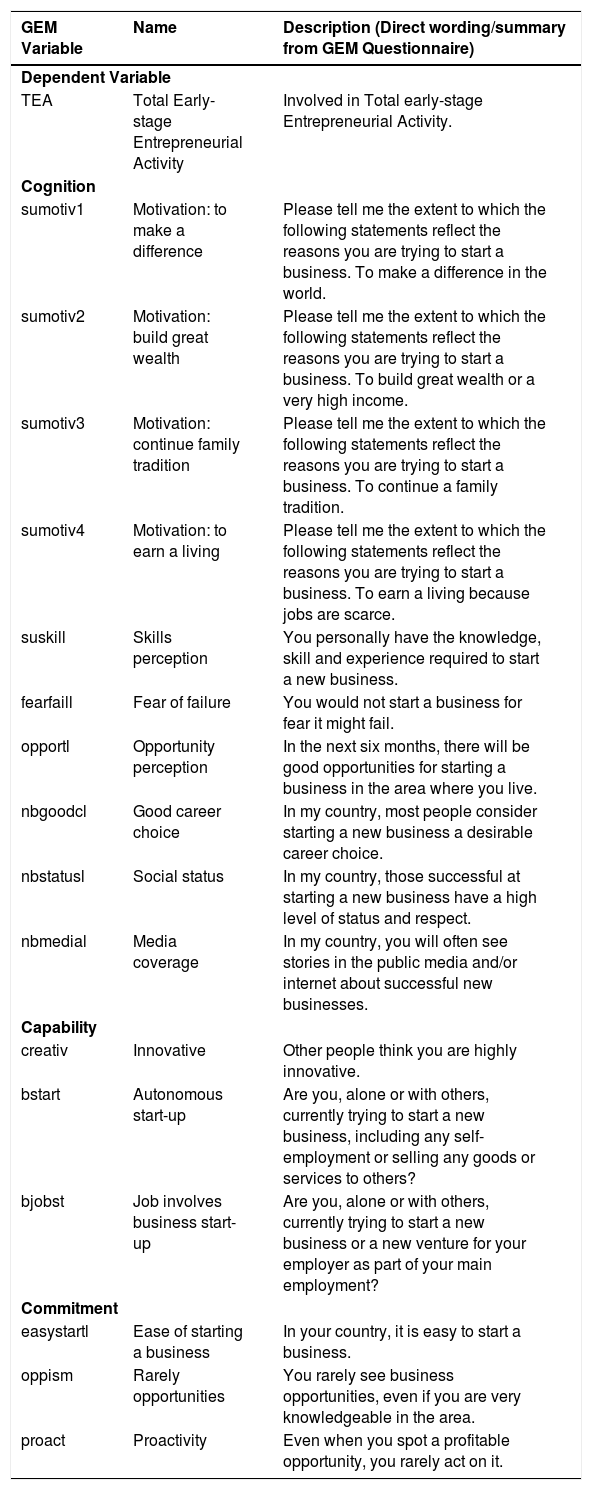
Our analytical sample comprises responses from more than 70,000 individual observations in 2020 and over 60,000 observations in 2021. While 2020 data provide the main basis of analysis, the 2021 data—the latest release available at the time of this research—are employed as a validation sample to assess the robustness and temporal generalizability of the findings. This is particularly important given the exceptional context of the COVID-19 pandemic in 2020 (Piñeiro-Chousa et al., 2023), which may have informed entrepreneurial behavior. Table 1 provides a detailed overview of the variables used in the analysis.
List of variables.
This study uses TEA as the dependent variable to represent the extent of early-stage entrepreneurial activity, drawing on relevant prior studies (McMullen et al., 2008; Parker, 2009; Stenholm et al., 2013; Yoon et al., 2018). TEA, sourced from GEM, measures whether individuals aged 18–64 are actively involved in starting or owning a new business that is less than 42 months old.. It includes nascent businesses (up to three months) and new businesses (between 3 and 42 months), operationalized as a binary indicator (0 = no, 1 = yes). TEA captures entrepreneurial activities regardless of form, entry mode, or motivation, thereby capturing the prevalence of early-stage entrepreneurial engagement in the adult population.
Independent variablesThe independent variables are all measured at the individual level, encompassing variables related to cognition, capability, and commitment. Cognition-related factors include the motivation to start a business across four main categories: to make a difference in the world; to build great wealth or a very high income; to continue a family tradition; or to earn a living because jobs are scarce. Other cognition-related factors include skills perception, fear of failure, opportunity perception, good career choice, social status, and media coverage. Capability-related factors include perceived innovativeness, autonomous start-up experience, and whether one’s job involves business start-up activities. Commitment-related factors include ease of starting a business, rarely opportunities, and proactivity.
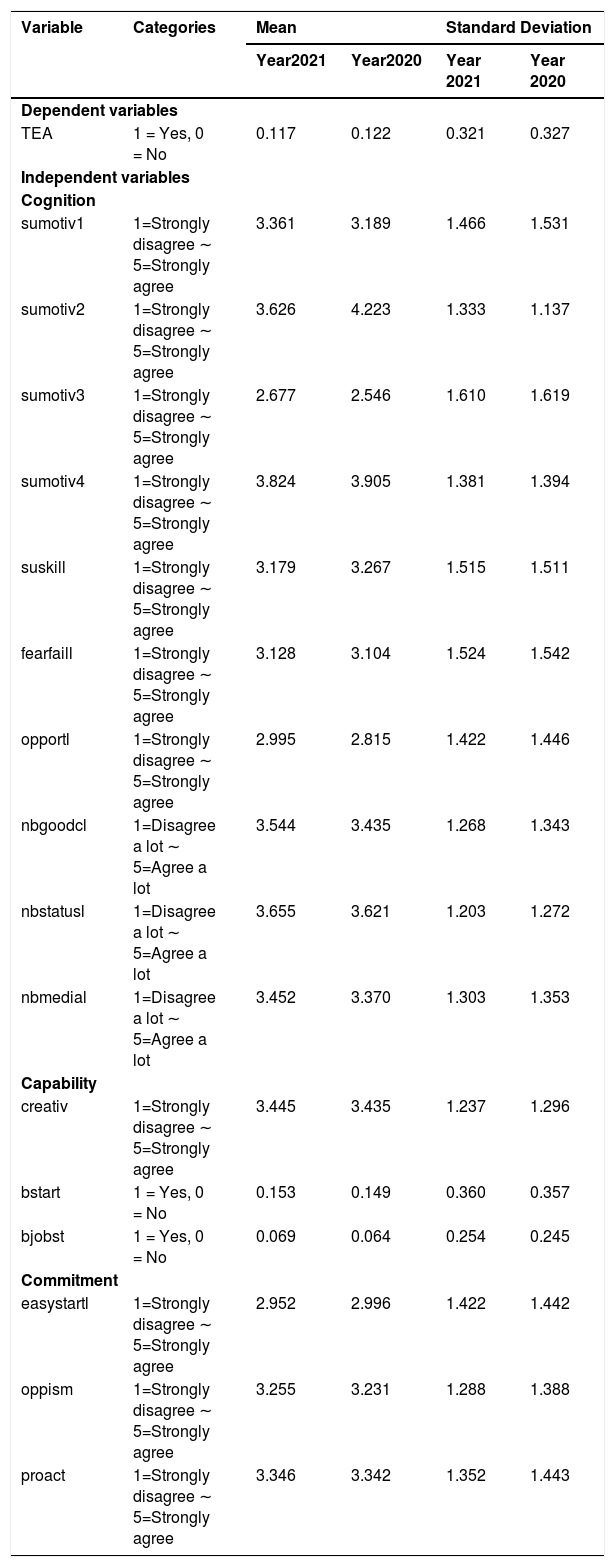
Descriptive statistics for variablesThe descriptive statistics presented in Table 2 reveal several key characteristics of the sample. The mean values of the dependent variable (TEA) were 0.122 in 2020 and 0.117 in 2021, indicating that approximately 12% of the respondents were engaged in early-stage entrepreneurial activity, a figure consistent with GEM’s global averages. For the independent variables, respondents generally reported moderate levels of skills perception (mean around 3.2) and fear of failure (mean around 3.1). Among the cognitive factors, necessity-based motivation (“to earn a living”, sumotiv4, mean around 3.9) and wealth creation (“build great wealth”, sumotiv2, mean around 3.6-4.2) scored relatively high, highlighting the dual importance of push and pull factors. Commitment-related variables, such as ease of starting a business (easystartl, mean around 3.0) and rarely opportunities (oppism, mean aroud 3.2), hovered around the midpoint of the scale, suggesting a mixed but not overwhelmingly positive entrepreneurial environment as perceived by the respondents. These descriptive statistics provide essential context for interpreting the subsequent machine learning–based predictive analyses.
Descriptive statistics.
This study adopts a data-driven approach by employing supervised machine learning techniques to model the factors influencing TEA. Complementing traditional econometric methods, machine learning enables the exploration of complex, non-linear patterns within large-scale datasets (Lin & Liu, 2025).
Machine learning algorithms are typically classified into supervised and unsupervised learning. Supervised learning uses labeled data to establish predictive relationships between inputs and outcomes, making it particularly suited for our research objective. In contrast, unsupervised learning focuses on identifying hidden structures or groupings without predefined targets. Given our objective of predicting TEA based on observed individual-level variables, supervised learning was deemed appropriate.
The supervised learning workflow generally involves four main steps: identifying relevant features, splitting the dataset into training and test sets, training the algorithm and evaluating its predictive performance, and finally, interpreting the model outputs (Kuhn & Johnson, 2013). Each step will be discussed in the subsequent sections, with particular attention to how machine learning enhances model interpretability and explanatory insight in entrepreneurship research.
Machine learning algorithms and model trainingData are usually randomly divided into the training set and the test set. In this study, 80% of the data were used to train the machine learning model, and the remaining 20% were used to test the performance of the model. This split not only ensures a sufficient volume of data for model training, but also allows for an objective evaluation of predictive performance. Using the test set to evaluate the accuracy of the model enables us to assess the performance of the model more objectively.
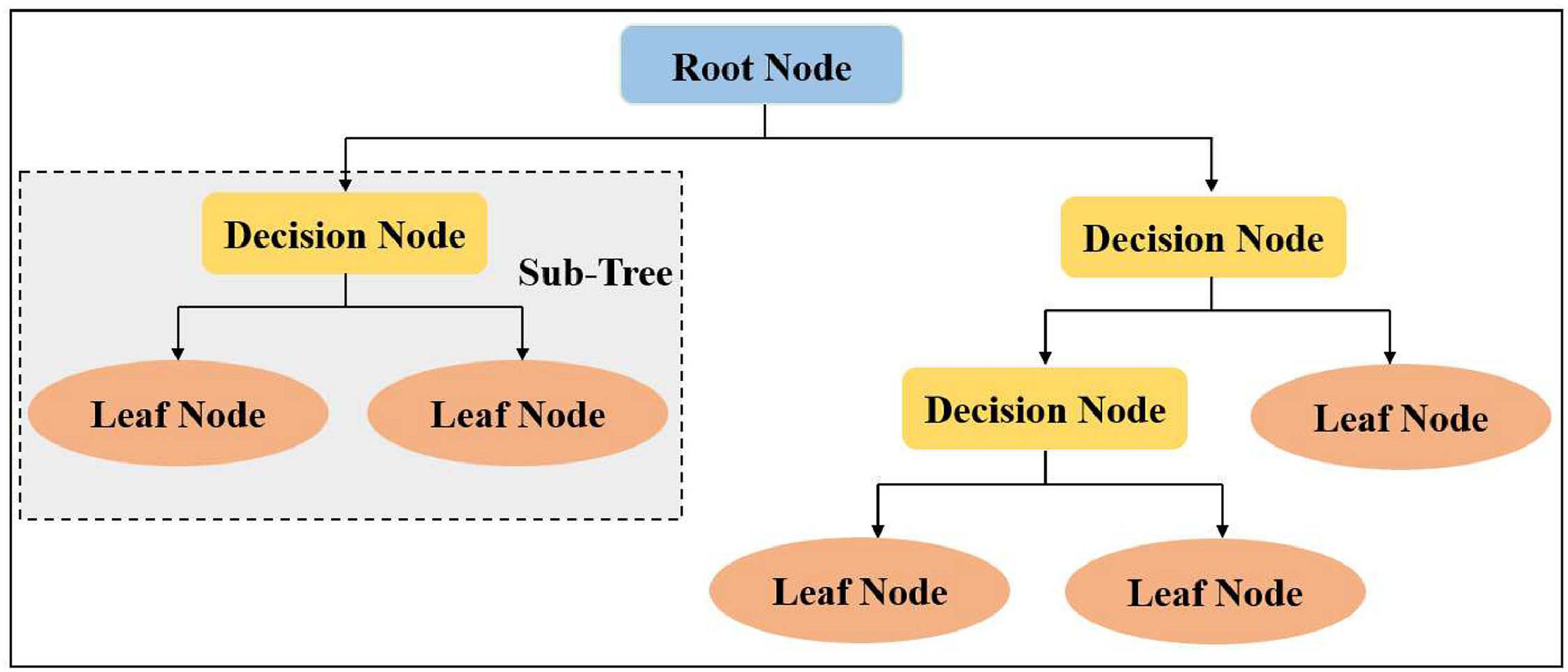
In this study, the decision tree algorithm (see Fig. 2 for a schematic representation) is used to construct the model. Decision trees are a widely used and well-established class of machine learning methods, with different types such as iterative dichotomies 3 (ID3), classification and regression tree (CART), CHi-squared automatic interaction detector (CHAID), multivariate adaptive regression splines (MARS), among others. Decision trees have been applied in a range of scenarios across a wide range of applications, including medical diagnosis(Zou et al., 2018), text classification (Taloba & Ismail, 2019), mobile user profiling (Sarker et al., 2019), and image classification (Batitis et al., 2020; Pathan et al., 2020), amongst others.
Specifically, we utilize the recursive partitioning algorithm, which is implemented through the “rpart” package (Therneau & Atkinson, 1997) and facilitated by the “caret” package (Kuhn, 2008), and is trained and evaluated using R version 3.4.2 (Comprehensive R Archive Network) (Team, 2017), as detailed by Therneau and Atkinson (1997). The construction of the decision tree starts from the root node that contains all the observations. This algorithm determines the variables that best divide the data into two subgroups or child nodes to maximize the purity of the nodes. This process is recursively applied to each subgroup until they reach the minimum size or their purity can no longer be further improved. At each node, the data is partitioned based on the predictor variable, which optimizes the quality of the split and enhances the homogeneity of the subgroup compared with the parent group. The importance of variables is evaluated by the Gini index, which favors splits that produce purer child nodes. Tenfold cross-validation is used to estimate misclassification and prevent overfitting, with balanced accuracy as the training metric. Decision trees are pruned by removing nodes and branches that are not necessary, and are guided by complexity parameters that maximize balanced accuracy.
Parameter tuningMachine learning algorithms often require parameter tuning to optimize model performance. For recursive partitioning, we tune the complexity parameter, which controls the size of the tree by specifying the minimum improvement required for subsequent splits. To estimate optimal parameters from the data, a 10-fold cross-validation procedure with five replicates was employed in this study (Kuhn & Johnson, 2013). We tested a lattice of plausible tuning parameters on the training data to determine the parameters that produced the most accurate model. To tune the parameters, the training data were divided into ten parts, and each model was built using the data from the nine parts and tested using the omitted part. The predictive accuracy associated with each candidate parameter was evaluated. This procedure was repeated five times to ensure robustness. This procedure identifies the parameter configuration that yields the highest predictive accuracy.
Evaluating and interpreting the modelTo evaluate the model’s predictive performance, we utilized six key metrics: accuracy, precision, recall, F1 score, the area under the curve of the receiver operating characteristic (AUC-ROC), and Kappa. Accuracy reflects the overall proportion of correct predictions (Chen et al., 2025). Precision measures the proportion of true positives among all observations predicted to engage in entrepreneurial activity, while recall indicates the proportion of true positives among all actual entrepreneurship cases (Chen et al., 2025). The F1 score balances precision and recall. AUC-ROC evaluates the model’s ability to distinguish between classes across different thresholds (Bradley, 1997; Burez & Van den Poel, 2009), and Kappa adjusts for chance agreement, providing a more reliable measure under conditions of class imbalance (Chen et al., 2025). For model interpretation, variable importance scores and tree structure visualization are employed. Variable importance is calculated based on the reduction in the loss function from splits and surrogate splits (Thereneau & Atkinson, 2015).
ResultsModel evaluationTable 3 summarizes the predictive performance of the decision tree models for 2020 and 2021. The results suggest relatively stable yet somewhat heterogeneous performance across years. In 2020, the model achieved an accuracy of 0.906 and an AUC of 0.696, indicating a moderate level of discriminative performance (Hosmer & Lemeshow, 2000). In 2021, the accuracy remained relatively high at 0.836, although the AUC declined to 0.614, suggesting comparatively weaker discrimination in that year.
Kappa values were relatively low (0.117 in 2020; 0.081 in 2021), partly attributable to the highly imbalanced distribution of TEA cases in the sample. Nonetheless, recall values were high (0.946 in 2020; 0.862 in 2021), indicating that the model effectively identified individuals engaged in entrepreneurship. Precision also remained consistently high (0.955 and 0.962, respectively), resulting in F1 scores of 0.950 and 0.909. The balance between recall and precision underscores the model’s ability to identify entrepreneurial activity with both high coverage and precision.
Although performance declined slightly in 2021, the overall consistency across years demonstrates the robustness of the approach.
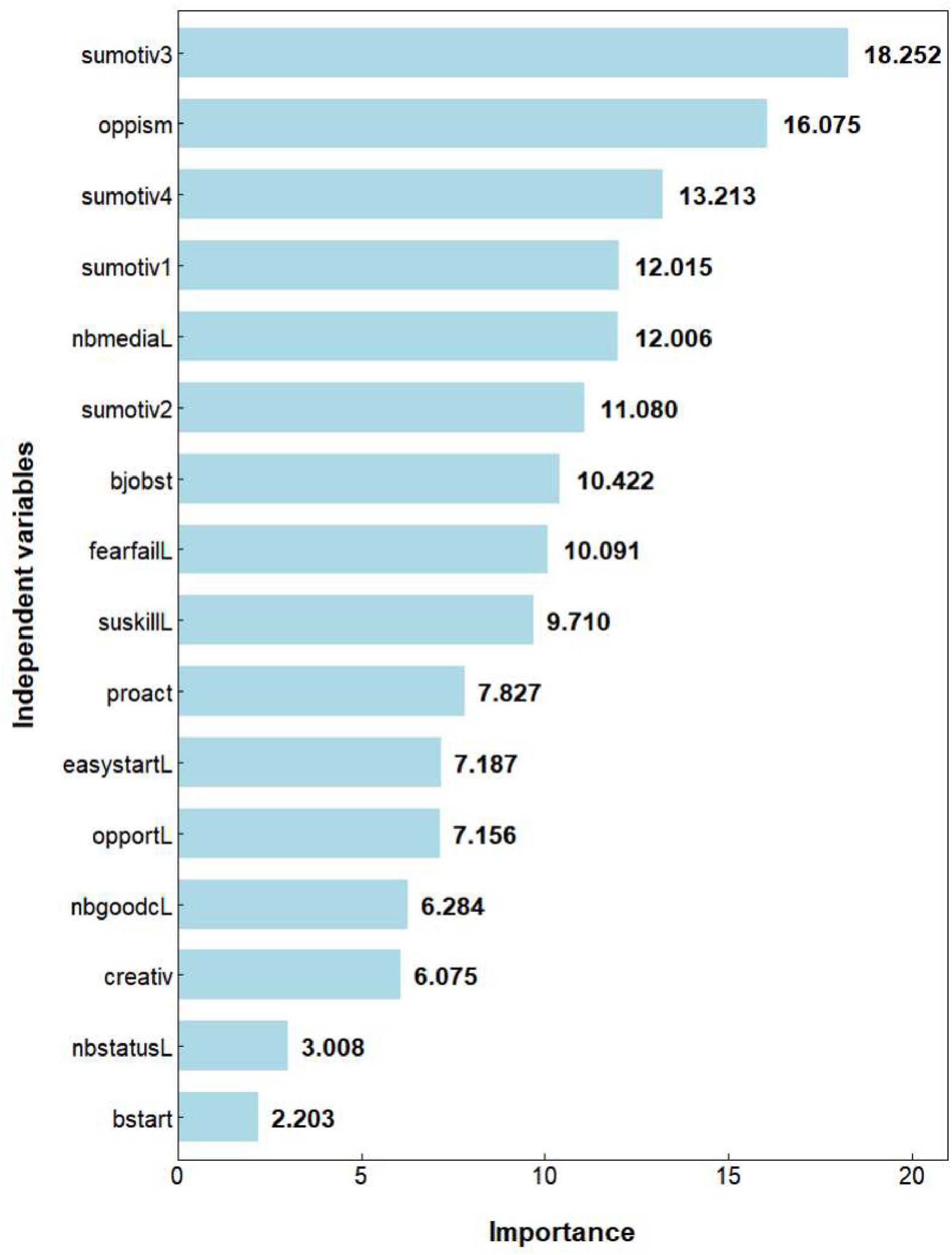
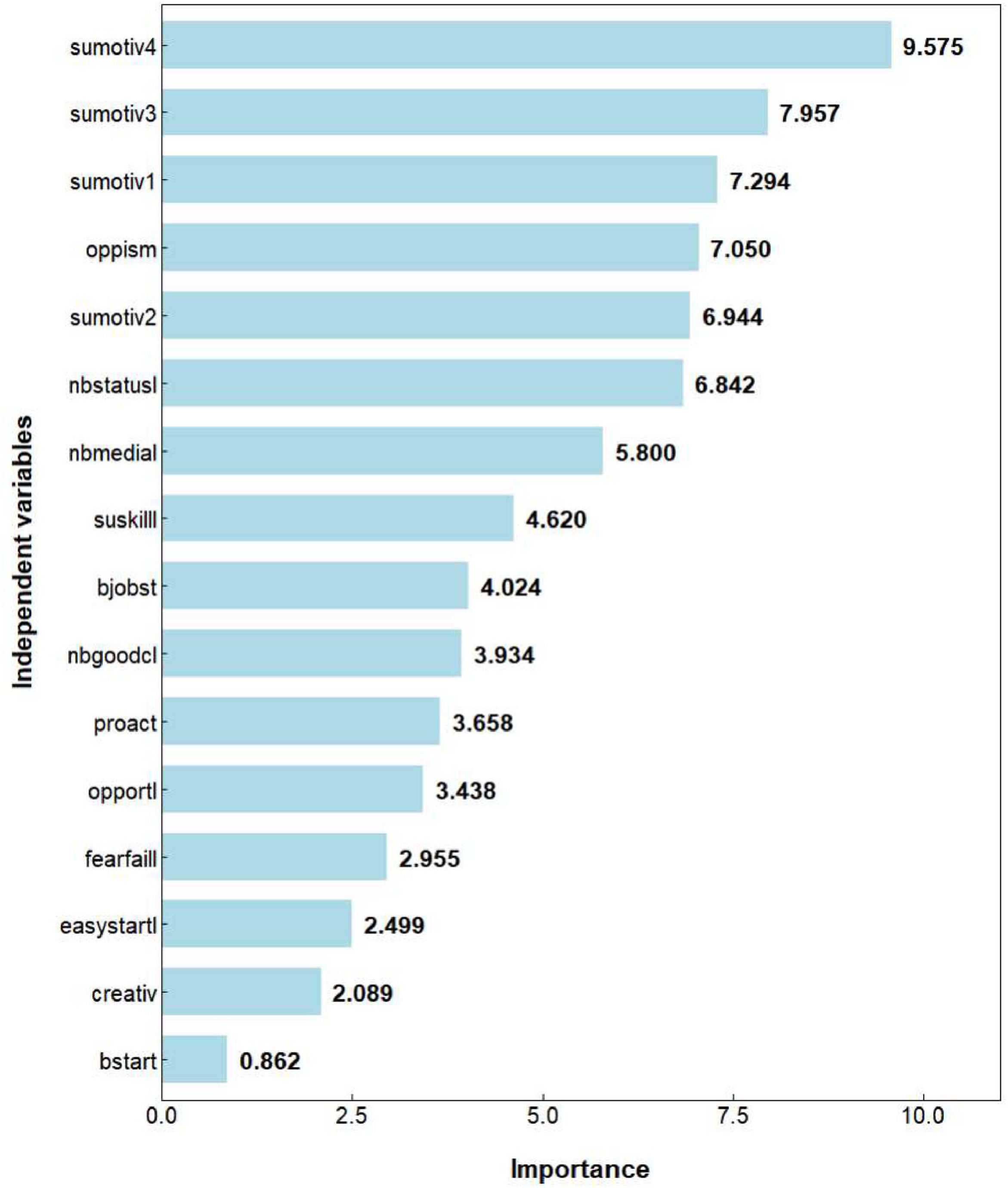
Variable importanceVariable importance analysis, conducted for both 2020 and 2021, suggests a potential consistency in the key predictors of TEA. As shown in Figs. 3 and 4, cognition-related variables—particularly motivations to earn a living due to job scarcity (sumotiv4), continue a family tradition (sumotiv3), and make a difference (sumotiv1)—consistently emerge as significant predictors across both years. The perception of rare opportunities (oppism) and the motivation to build great wealth (sumotiv2) also rank highly.
This salience of cognition-related variables is consistent with the centrality of entrepreneurial motivation and opportunity perception within the 3C framework. It indicates that individual-level cognitive factors—rather than purely capability or contextual factors—exhibit a comparatively stronger association with early-stage entrepreneurial engagement, even under the disruptive context of the COVID-19 pandemic. The pandemic appears to have intensified potential motivational disparities (e.g., necessity-driven vs. opportunity-driven entrepreneurship), thereby highlighting the salience of personal perceptions and aspirations.
Apart from job involves business start-up (bjobst) and skills perception (suskill), other capability-related variables contribute relatively little to the model, although they are retained by the decision tree algorithm during training. This stability across two distinct temporal contexts is consistent with the observed association of cognitive factors in predicting entrepreneurial activity and supports the generalizability of the 3C framework.
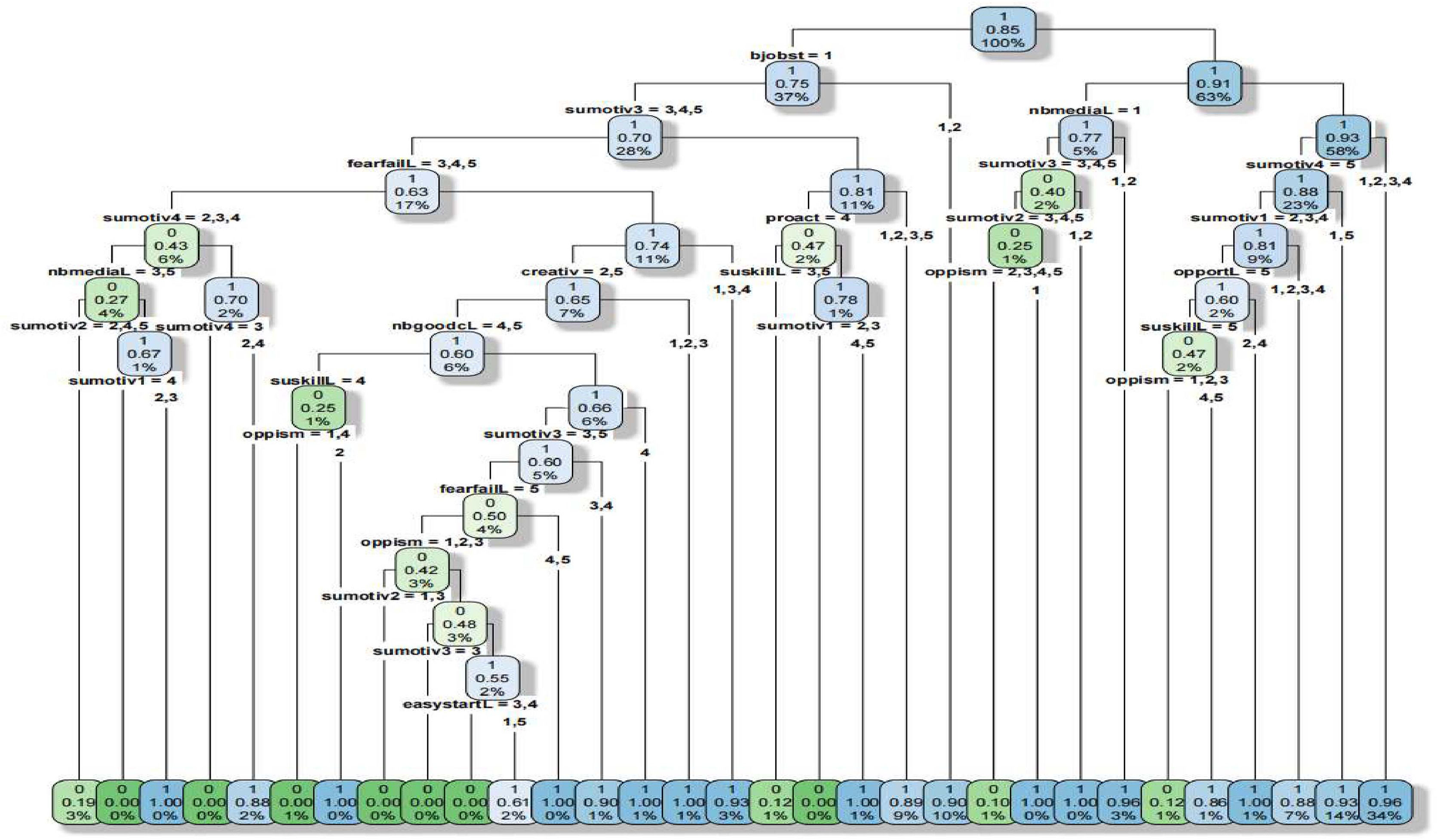
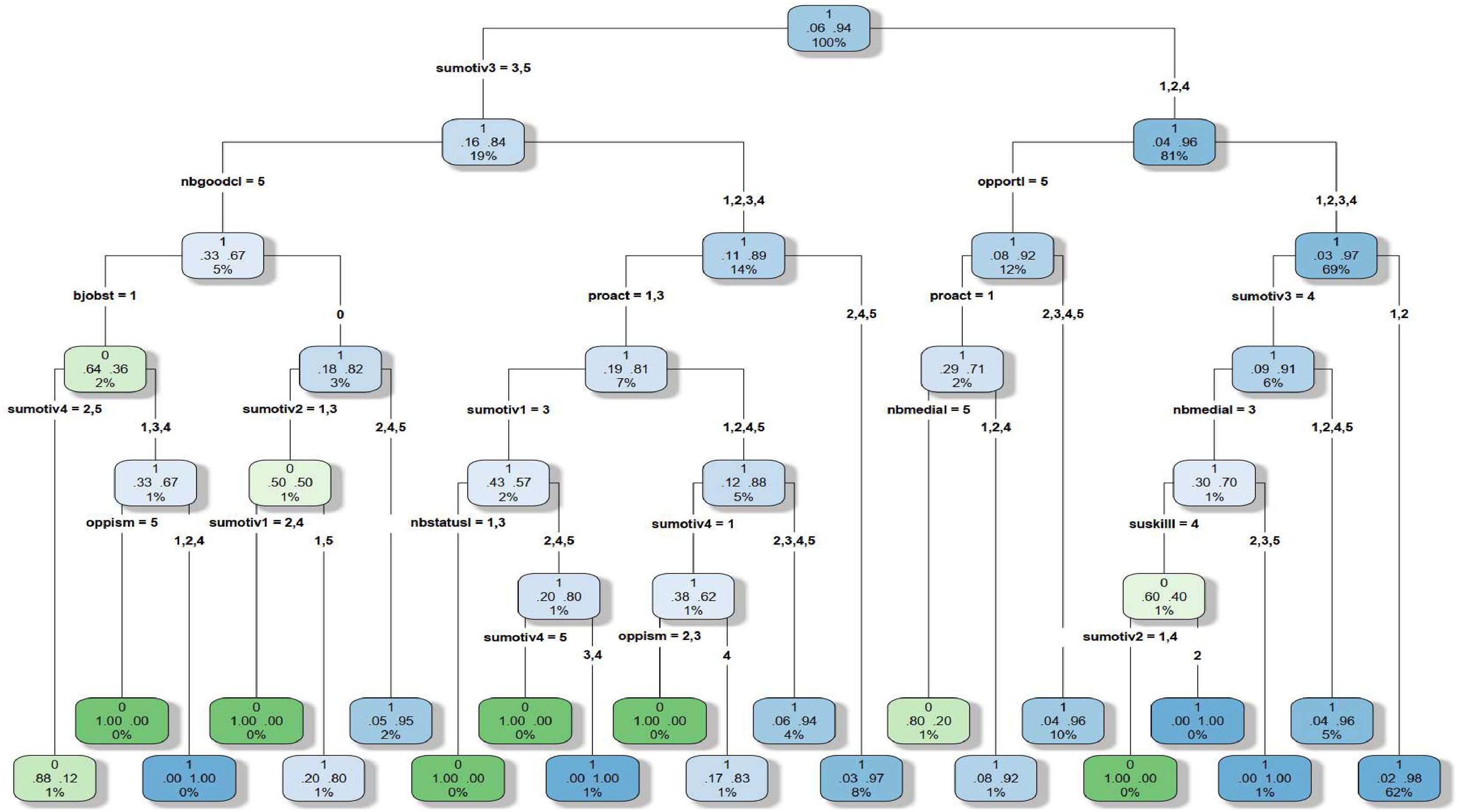
Profiling entrepreneurship using the tree structureThe decision tree models developed under the 3C framework provide detailed and interpretable insights into the predictors of TEA for the years 2020 and 2021. The pruned tree structures, visualized in Fig. 5 (2021) and Fig. 6 (2020), reveal both consistent patterns and important temporal variations in how cognitive, capability, and commitment factors may interact to be associated with entrepreneurial engagement.
Decision tree structure for 2021As shown in Fig. 5, the decision tree for 2021 is primarily informed by the context of the entrepreneurial effort, with the root split associated with the variable job involves business start-up (bjobst). This variable distinguishes whether an individual is trying to start a new venture as part of their main employment. The model shows that individuals who are not starting a venture for their employer (indicating independent entrepreneurship) have a significantly higher propensity for TEA. Within this large group of independent entrepreneurs, media coverage (nbmedial) about successful new businesses emerges as a critical secondary factor, where high exposure is associated with the highest likelihood of TEA. In the smaller branch representing individuals engaged in intrapreneurship (starting a venture for their employer), the motivation: continue family tradition (sumotiv3) becomes an important differentiator. The model also highlights interactions among additional predictors in subsequent splits, such as motivation: to earn a living (sumotiv4) because jobs are scarce, and a low fear of failure (fearfaill), which further refines the observed prediction.
Decision tree structure for 2020As shown in Fig. 6, and in contrast to the 2021 structure, the 2020 decision tree is initially split by the cognitive factor of motivation: continue family tradition (sumotiv3). This reflects the salient influence of family-oriented motivations during the pandemic period, as individuals with stronger familial motivations were identified as being more likely to engage in entrepreneurial activities. Subsequent splits reveal that among those driven by family tradition, the opportunity perception (opportl) in their area acts as a significant reinforcing factor. For individuals with weaker traditional motivation, the perception that starting a business is a good career choice (nbgoodcl) in their country is the most prominent secondary predictor. Furthermore, proactivity (proact), measured as the tendency to proactively act on opportunities, functions as a key factor throughout the tree, suggesting that a proactive mindset was associated with higher levels of entrepreneurial engagement during the unique circumstances of 2020.
Consistency and variation across yearsThe comparative analysis of both decision trees reveals that while cognitive and commitment variables are consistently important, their hierarchical structure and influence varied noticeably between 2020 and 2021. The most striking difference is the change in the root variable. In 2020, the primary associated factor was a cognitive “pull” motivation (sumotiv3). In 2021, the main predictor shifted to a potential contextual factor: whether the entrepreneurial activity was independent or part of an existing job (bjobst). Given the anomalous global context of the pandemic, this shift should not be interpreted as a structural “temporal evolution”, but rather as an indicator of the high context-sensitivity of entrepreneurial pathways. This suggests that during the initial shock phase of 2020, intrinsic motivations were more salient, whereas in the “new normal” of 2021, employment context became the primary determinant of entrepreneurial engagement. Factors like media influence (nbmedial) and opportunity perception (opportl, nbgoodcl) are crucial in both years, but their roles and positions within the hierarchy vary, with media prominence at the top level in 2021 and opportunity perception more influential at the secondary level in 2020. These structural differences underscore the context-sensitive nature of entrepreneurial pathways and are consistent with the validity of the 3C framework. While our method reveals these interesting patterns, we acknowledge that these patterns alone cannot definitively capture behavioral changes or temporal variance in entrepreneurship. Instead, the observed variations highlight the need for adaptive policy interventions responsive to evolving economic conditions.
Discussion and conclusionsThis study employed a machine learning approach, grounded in the 3C framework, to explore potential predictors of entrepreneurial activity using large-scale GEM data from the unique context of 2020 and 2021. Our analysis reveals hierarchical, configurational, and context-sensitive patterns among entrepreneurial factors. In the following sections, we discuss the theoretical and practical implications of our findings, acknowledge the study’s limitations, and propose avenues for future research.
Theoretical contributions of the resultsThis study seeks to make several theoretical contributions to the entrepreneurship literature by developing and empirically validating the 3C framework. Our findings not only identify variables frequently associated with early-stage entrepreneurship but also, through a machine learning approach, point toward the complex, configurational, and context-dependent nature of their interplay.
First, our study contributes to ongoing discussions on the antecedents of entrepreneurial action by highlighting the stronger predictive role of cognitive factors relative to perceived capability. While classic theories like the Theory of Planned Behavior (TPB; Ajzen, 1991) and the Entrepreneurial Event Model (EEM; Shapero & Sokol, 1982) emphasize the central role of attitudes and perceptions, the relative importance of different cognitive and capability-related factors remains debated. Our variable importance analysis consistently shows that cognitive factors—specifically motivations such as continuing a family tradition (sumotiv3) and earning a living (sumotiv4)—are more frequently identified by the model as relevant predictors of TEA than capability-related factors like job involves business start-up (bjobst). This finding does not dismiss the importance of capability, which is often cited as a robust predictor of entrepreneurial intentions (e.g., Chen et al., 1998; Zhao et al., 2005). Instead, it refines our understanding by suggesting that capability may be a necessary but not sufficient condition. Its influence appears to be associated with cognitive interpretations and motivational factors. In other words, possessing the skills exhibited a weaker association with entrepreneurial action than the cognitive frame—the “why”—that is linked to entrepreneurial activity. This shifts the theoretical focus from merely “can I do it?” (capability) to “why should I do it?” (cognition).
Second, by empirically validating the 3C framework, we offer a potentially integrative lens that may bridge disparate theoretical streams in entrepreneurship research. Previous studies often examine entrepreneurial predictors in isolation—separately focusing on cognition (Mitchell et al., 2002), human capital and resource-based views (capability), or intention and opportunity-based models (commitment) (Shane & Venkataraman, 2000). The 3C framework synthesizes these elements into a cohesive, psychologically grounded model. Our analysis suggests that it is the configurational interrelationship between cognition, capability, and commitment that is associated with distinct patterns of entrepreneurial engagement. By identifying these synergistic intersections, we move beyond symmetric, additive models to illustrate potential complex pathways to entrepreneurship. This provides an empirical anchor for a more holistic understanding, showing how, for example, commitment-related factors such as perception of rare opportunities (oppism) and proactivity (proact) are not merely independent predictors but may reflect the outcomes of complex individual commitment processes, as suggested by Krueger (2007). This integrative view suggests a more nuanced alternative to simpler, more linear models of entrepreneurial behavior.
Third, and perhaps most significantly, our research moves beyond symmetric, additive models to suggest the potential configurational and context-dependent pathways to entrepreneurship. Traditional regression-based analyses often assume that variables have a consistent, independent effect on the outcome. Our decision tree analysis suggests a more complex scenario, lending support to the calls for configurational theorizing in entrepreneurship research (e.g., Woodside, 2013; Graham & Bonner, 2022). We uncover multiple, heterogeneous configurational recipes for TEA. For instance, the striking difference in the decision tree structures between 2020 and 2021 is consistent with this context-sensitivity.
In 2020, amidst the high uncertainty of the COVID-19 pandemic, the most frequently selected splitting variable was associated with an internal, cognitive “pull” motivation: continuing a family tradition (sumotiv3). For those with this motivation, opportunity perception (opportl) emerged as a relevant associated factor. This is consistent with research suggesting that under extreme uncertainty, entrepreneurs may rely more on stable, internal heuristics and trusted traditions rather than volatile external signals (Townsend et al., 2018). The proactivity (proact) also showed high salience, indicating that in a crisis, a person’s intrinsic drive to act appeared particularly salient.
In 2021, as the economic environment began to stabilize, the main predictor shifted to a potential contextual factor: whether the entrepreneurial activity was independent or part of an existing job (bjobst). This may suggest a potential move from “why” to “how” entrepreneurship is pursued. For independent entrepreneurs, external validation through media coverage (nbmedial) emerged as a relevant differentiating factor. This temporal shift shows alignment with the principles of Effectuation theory (Sarasvathy, 2001), where entrepreneurs may adapt their pathways based on changing means and environmental contingencies. Our findings provide large-scale empirical evidence for these dynamic, adaptive pathways, suggesting that there is no single “recipe” for entrepreneurship; rather, the key ingredients and their importance may change with the context.
Methodological contributionsThis study seeks to offer a methodological contribution by illustrating how machine learning, specifically the decision tree algorithm, can serve as a powerful tool for theory-building in entrepreneurship research, moving beyond its common application as a purely predictive instrument.
First, we provide a framework for analyzing complex, configurational phenomena often missed by traditional regression methods. Entrepreneurship literature increasingly recognizes that the path to venture creation is not linear or additive; rather, it results from complex interactions among variables (Douglas et al., 2020). Traditional methods may struggle with this reality, as they rely on assumptions of linearity and multicollinearity, and typically report “net effects” that may mask underlying heterogeneity. In contrast, our application of decision trees provides an intuitive, non-parametric approach to point toward potential asymmetric and configurational predictive pathways. By visualizing the tree structure, we can directly observe how different combinations of cognitive, capability, and commitment factors relate to entrepreneurship, thus providing a methodological response to the call for more configurational theorizing (Woodside, 2013).
However, in adopting this approach, we acknowledge a critical trade-off between interpretability and predictive accuracy. Although ensemble methods like Random Forests or Extreme Gradient Boosting (XGBoost) may yield higher accuracy, they function as “black boxes,” limiting theoretical interpretability. Given that our research objective was not merely to predict who becomes an entrepreneur but to understand the heterogeneous pathways of how they become one, we deliberately chose the single decision tree. This choice prioritizes theoretical transparency and interpretability over marginal gains in predictive power, a trade-off essential for studies aiming at theory development rather than pure prediction.
Furthermore, we address the inherent limitations of decision trees, particularly their susceptibility to overfitting and instability, where small changes in data can lead to different tree structures. To ensure the robustness and temporal generalizability of our findings, we implemented a multi-step two-pronged strategy. First, within each model, we employed k-fold cross-validation for parameter tuning and used a separate hold-out test set to prevent overfitting and provide an honest assessment of predictive performance. Second, and more importantly, we replicated our entire analysis across two distinct and temporally separate datasets (2020 and 2021). The results of this replication suggest that while the specific pathways (i.e., the tree structures) showed alignment with the unique contexts of each year, the hierarchical importance of the core constructs remained stable (e.g., cognition consistently outweighed capability). This lends support to the robustness of the observed associations within our framework and methodological approach, with the capacity to capture both stable, underlying principles of entrepreneurship and their context-dependent manifestations. This approach thus offers a template for using replication not just to validate a model, but to test its temporal generalizability in a dynamic field like entrepreneurship.
Practical implicationsOur findings suggest several potential implications for policymakers and practitioners seeking to foster entrepreneurial activity. We offer these with the caveat that they are derived from associational patterns, not definitive evidence of causality.
First, the apparent prominence of motivational and cognitive factors suggests that policy interventions could be diversified beyond a singular focus on skills training. While capability development is important, our results indicate that cultivating entrepreneurial motivations may be associated with a greater impact. Policymakers may benefit from designing targeted support mechanisms. For example, programs focused on family business succession planning and modernization could target individuals whose profiles are associated with tradition (sumotiv3), while rapid-response grants and accessible upskilling programs could be directed at necessity-driven entrepreneurs (sumotiv4).
Second, the heterogeneity of entrepreneurial pathways suggests that support systems may benefit from being tailored rather than standardized. Practitioners, such as those managing incubators and accelerators, can use these insights to move away from a one-size-fits-all curriculum. For instance, an entrepreneur motivated by making a difference (sumotiv1) may require mentoring focused on impact measurement and sustainable business models, whereas one motivated by building great wealth (sumotiv2) might benefit more from guidance on venture capital and scaling strategies. Our findings provide a data-driven rationale for a segmented, profile-based approach to entrepreneurial support.
Third, the significance of contextual factors like media coverage (nbmedial) and the perception of entrepreneurship as a good career choice (nbgoodcl) highlights the importance of shaping the broader entrepreneurial ecosystem. This suggests that policymakers and community leaders may consider investing in public narratives that celebrate diverse entrepreneurial role models and frame entrepreneurship as a viable and respected career path, thereby reinforcing positive social norms.
Limitations and future researchWe recognize several limitations in our study, each of which presents a clear opportunity for future research.
First, our analysis is based on data from 2020 and 2021, the years defined by the COVID-19 pandemic. This is a significant contextual limitation. The global economic shock, shifts in labor markets, and widespread uncertainty likely informed entrepreneurial motivations and opportunities in unique ways. The observed differences between the 2020 and 2021 decision trees may reflect this volatile context rather than a stable, long-term trend, highlighting the limited interpretability of this temporal validation. Therefore, our findings should be considered indicative, rather than definitive evidence of stable entrepreneurial factors. Future research should therefore apply our 3C framework and machine learning approach to pre- and post-pandemic GEM data to test the temporal generalizability of these configurational pathways.
Second, our study relies on cross-sectional data, which limits our ability to establish definitive causal links. While we identify strong predictive relationships, we cannot definitively establish the directional flow of these associations. For example, does opportunity perception drive entrepreneurial entry, or does the act of starting a business heighten one’s perception of opportunities? Future studies using longitudinal or panel data are needed to disentangle these temporal dynamics and track the evolution of entrepreneurial predictors over time.
Third, by pooling data across 77 countries, our model does not account for national institutional heterogeneity. The formal and informal institutions that shape a country’s entrepreneurial ecosystem—such as regulatory quality, access to finance, and cultural values—are known to be powerful moderators of entrepreneurial activity (Audretsch et al., 2024). Future research could build on our work by employing multi-level models to examine how these country-level factors interact with the individual-level ones identified in our 3C framework.
Finally, our study is based on a single machine learning algorithm. As noted, decision trees have limitations, including potential instability, which can affect the replicability of the exact tree structures. Future methodological advancements could apply ensemble methods (e.g., Random Forests, XGBoost) to validate variable importance and interaction stability in the dataset. These techniques, as demonstrated by Chen et al. (2025), can confirm the robustness of our variable importance findings and potentially reveal even more stable and predictive interaction patterns, further enhancing the rigor and relevance of our model.
FundingThis work was supported by the Ministry of Education’s Major Project for Research in Philosophy and Social Sciences on “Research on Comprehensively Improving the Quality of Talent Cultivation under New Circumstances” [grant number 23JZD045].
CRediT authorship contribution statementYangjie Huang: Writing – review & editing, Writing – original draft, Supervision, Project administration, Funding acquisition. Yajing Bu: Writing – review & editing. Lina Wei: Investigation, Conceptualization. Xuebo Zhu: Writing – review & editing. Lingling Xu: Writing – original draft, Data curation.
The authors declare no competing interests.
Thank you to the editors and anonymous reviewers for their valuable feedback. Xuebo Zhu and Lingling Xu are co-corresponding authors. This work was also supported by the National Natural Science Foundation of China for Young Scholars [grant number 62407002].

