



In high-complexity innovation, the rhythm gap between slow technology validation (technology readiness level [TRL] linear advancement) and fast market validation (minimum viable product [MVP]/minimum viable experiment [MVE] rapid iteration) is often the primary cause of the ‘valley of death’. However, the institutional explanation for how this gap can be bridged organisationally remains limited. Considering the unique dual-node verification system of the Blue Bay Science and Technology Innovation Platform, this study conducted embedded comparative case studies on four projects with different complexities, revealing a reconfigurable verification rhythm mechanism for coupling technical and commercial validation. TRL and MVP/MVE can be integrated into a dynamic two-loop coupling structure. Such integration is achieved by forward-leaning commercial validation for early requirement convergence, backward-leaning technical validation for small-scale controllable testing and platform-based ‘rhythm choreography’ to coordinate the two originally separate verification cycles. This structure can yield demand-led, bi-directional-interactive or technology-led pathways under different industrial complexities. This study provides a new institutional explanation for the valley of death and proposes principles for verification arrangements suitable for industries with high complexity and strong regulation using rhythm as the analysis unit. These contributions offer operational governance implications for incubators, science and technology innovation platforms and innovation policies. Results orchestrate TRL and MVP/MVE into a co-performing verification cycle, challenging the traditional perception of them as independent paths.
Despite increasing investment in scientific research, digital infrastructure, and innovative resources in the digital intelligence era, transitioning from laboratory to real-world applications remains a challenge for scientific and technological achievements. Particularly in complex industries such as healthcare and core technologies, the ‘valley of death’ has not significantly narrowed (Everts & Drew, 2024; Gbadegeshin et al., 2022). Several research-based technologies are feasible under laboratory conditions but cannot form sustainable business models in clinical processes, payment systems and complex usage environments, exposing deep flaws in the existing achievement transformation system regarding its ‘verification structure’ (Baldwin et al., 2024; Freisinger & McCarthy, 2024). Recent studies on the valley of death have further explored the survival and leapfrogging mechanisms of entrepreneurship from perspectives such as open innovation strategy and collaborative networks. However, these studies focus on resources, networks and governance structures, without addressing the internal verification rhythm mechanism (Navarro-Castillo et al., 2024; Everts & Drew, 2024; Gbadegeshin et al., 2022). Consequently, the crucial mechanism of innovation failure is not a singular technology or market misjudgement but a systematic misalignment between the technology and market sides in verification logic and advancement rhythm (Trump et al., 2025; Lewis et al., 2024).
Existing studies primarily understand early verification via two verifiability logics: first is the technology verification logic represented by the technology readiness level (TRL), which emphasises linear progress through pre-defined stages and evidence chain accumulation to assess technological reliability (Mankins, 2009; Héder, 2017). Second, business verification logic is represented by lean and digital entrepreneurships, involving rapid hypothesis testing and validated learning through minimum viable products and experiments (MVPs and MVEs) to examine the desirability of value propositions and business models (Blank & Dorf, 2012; Ries, 2011; McGrath, 2024). Recent research has conceptualised Lean Startup as a tension field between theoretical claims and specific practices, framing MVP as a theoretical vehicle that carries several implicit assumptions (Stevenson et al., 2024). Simultaneously, some scholars define the lean entrepreneurship process as a structured experimental cycle akin to scientific methods, emphasising uncertainty reduction through hypothesis, testing and feedback (Felin et al., 2024; Camuffo et al., 2020). The technology verification logic underscores linearity, steady state and controllability, whereas business verification logic emphasises iteration, speed and contextualisation—altogether constituting two verifiable paradigms marked by significant mutual tension.
This tension is particularly pronounced in high-complexity industries such as healthcare, advanced core technologies and medical equipment. Technology verification is constrained by experimental cycles, safety assessments and regulatory rhythms, yielding relatively slow and steady progress. In contrast, commercial validation depends on high-frequency user feedback and contextualised experimentation, yielding a remarkably faster pace of adjustment (Salvador-Carulla et al., 2024; Everts & Drew, 2024). When the technology side emphasises controllability and safety thresholds and the market side emphasises desirability and user acceptance, the two pathways struggle to align naturally concerning evidence type, resource allocation and temporal rhythm. Recent studies have summarised this ‘technology too slow, market too fast’ tension as ‘tempo misalignment’ and identified it as a key mechanism perpetuating the ‘valley of death’, rather than a simple lack of resources or market failure (Gbadegeshin et al., 2022; Baldwin et al., 2024; Freisinger & McCarthy, 2024). However, details on how rhythm misalignment accumulates and solidifies as a structural obstacle in the micro-verification process remain limited.
Therefore, incubators and accelerators are widely regarded as key organisational forms for bridging the ‘valley of death’. Research primarily analyses their functions concerning resource provision, network building and project screening, emphasising their roles as ‘resource integrators’ and ‘signal amplifiers’ (Hausberg & Korreck, 2020). More recent research underscores the ‘professional judgement’ and ‘intermediary expertise’ accumulated by accelerators within entrepreneurial ecosystems, which shape the experimental trajectories of early projects through coaching and institutional design (Goswami et al., 2018; Navarro-Castillo et al., 2024). Concurrently, emerging research views professional incubation platforms as ‘collaborators’ and ‘sorters’ of multi-party knowledge, emphasising their roles in validation counselling, experimental design and knowledge flow (Mungila Hillemane et al., 2019; Shi & Chen, 2022). Nonetheless, we lack a systematic explanation of how these platforms internally coordinate technology and business validation from the ‘how verification rhythms are organised and coupled’ viewpoint, especially in high-complexity, strongly regulated industries (Tucci et al., 2025).
Based on the previous discussion of ‘tempo misalignment’, this study defines this long-accumulated and solidified temporal misalignment as ‘rhythm fault’. Adopting this as the core perspective shifts the focus from ‘whether to verify’ to ‘how, in what order and rhythm’. Within the domain of Blue Bay Science and Technology Innovation Platform, emphasising medical health and intelligent core technologies, an embedded process-tracing and cross-case pattern-matching design (single incubator * multi-project * multi-industry complexity) was employed to describe the interaction path between technology and business validations in real incubation situations. Considering the literature on technology and business validations (TRL and MVP/MVE logics, respectively) in Section 2, this study proposes a technology–business coupling mechanism of ‘business validation forward, technology validation backward, parallel iteration’. Within the intermediary structure of the incubation platform (coaches, tools, resources, capital), rhythm synchronisation is achieved through information flow, shared decision-making nodes and recursive feedback loops. Therefore, this study links ‘rhythm logic’ with specific mechanism elements, deepening the discussion on tempo misalignment within research on achievement transformation and verification mechanisms. Furthermore, this study engages with the latest research on Lean Startup, entrepreneurial experimentation and the valley of death (Navarro-Castillo et al., 2024; Stevenson et al., 2024; Felin et al., 2024; Camuffo et al., 2020), offering a structured and actionable framework for orchestrating verification rhythms in high-complexity industry incubation and acceleration practices. Section 2 reviews relevant theory and literature. Section 3 introduces the research design and methods. Section 4 presents multiple case results. Finally, Section 5 discusses theoretical and practical implications.
Theoretical frameworkLinear maturity logic and its limitations in technology validationTraditionally, TRL is the core of the technology validation system, depicting the staged, tabular path of technology from concept validation to application potential and providing a quantifiable evidence chain for R&D investment decisions and technology risk management (Mankins, 2009; Héder, 2017). In complex contexts such as healthcare and implementation science, tools such as TRL-i introduce dimensions of context-user capability-institutional constraints to enhance contextual fit (Salvador-Carulla et al., 2024). However, the foundation of TRL on assumptions of linearity and steady-state exposes three limitations in high-complexity, strongly regulated industries.
First, early verification is primarily conducted in laboratory and simulation scenarios, creating situational quarantine from real workflows and payment systems, making it challenging to promptly feed demand-related evidence back into technical design (Olechowski et al., 2020).
Second, the experimental cycle, safety assessment and compliance review collectively shape a relatively rigid promotion rhythm, struggling to respond to rapid changes in external demand signals (Koo & Jeong, 2024; Trump et al., 2025).
Third, TRL focuses on technical feasibility, with limited involvement in the desirability of the value proposition and the viability of the business model (Trump et al., 2025).
Therefore, relying solely on the linear maturity logic of TRL cannot adequately support the dynamic coupling between technology and market, necessitating integration with market- and user-facing verification logic.
Iterative experimental logic and cognitive boundaries of mvp/mve in commercial validationContrary to the linear advancement of TRL, the core logic of commercial verification is iterative experimentation and validated learning. Lean entrepreneurship emphasises focusing on key assumptions at minimum cost through MVPs and MVEs, continuously correcting value propositions and business models through multiple trials and errors (Blank & Dorf, 2012; Ries, 2011; McGrath, 2024). This logic accelerates opportunity assessment and path adjustment in academic makerspaces, entrepreneurial training and intra-firm innovation (Fitzgerald et al., 2010; Block et al., 2025; Battaglia et al., 2024).
Theoretically, Stevenson et al. (2024) systematised MVP as a theory-laden artefact, in which the core is validating implicit theories about users, scenarios and value propositions (Felin & Zenger, 2017), rather than merely producing early product prototypes with minimal investment. Zott and Amit (2024) placed Lean Startup within a broad framework of business model innovation, noting that MVP/MVE experimentation is a path choice among multiple value propositions, revenue structures and cost structures. Furthermore, Camuffo et al. (2020) and Felin et al. (2024) regarded Lean Startup as a scientific experimental method in entrepreneurship, emphasising systematic uncertainty reduction through hypothesis, test and feedback loops, making verification and experimental rhythms conceptually equivalent.
However, in high-complexity industries such as healthcare and core technologies, the rapid experimental logic of MVP/MVE faces critical situational constraints. Regulation and ethics limit acceptable trial formats, key user groups present entry barriers, single trials are costly and lengthy, and feedback is of low frequency and highly contextualised (Everts & Drew, 2024; von Hippel & Kaulartz, 2021). Therefore, commercial verification cannot maintain high-density iterations, critically weakening its accelerated learning advantage.
Furthermore, business validation is deeply shaped by the cognitive logic of entrepreneurs. Yang et al. (2019) demonstrated that a team logic of switching between ‘search’ and ‘execution’ affects the focus, pace and ‘sufficient validation’ criteria of MVP design. Alvarez et al. (2024), comparing the creation theory and Lean Startup, noted that the entrepreneurial process partially aligns more closely with the creation logic of ‘create first, then explain’ than hypothesis-testing-based verification logic. Therefore, MVP acts more as a creative vehicle for continuously rewriting opportunity boundaries than a strict testing tool, implying that different teams may exhibit systematic differences in verification rhythm and path selection even when using the same MVP/MVE tool, providing a cognitive basis for the later comparison of different coupling paths from S1 to S4.
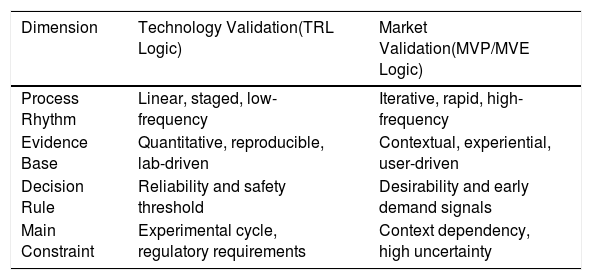
In conclusion, the two verification logics exhibit sharp contrasts in the core dimensions. TRL focuses on low-frequency, linear, staged propulsion with reliability and safety thresholds. MVP/MVE focuses on iterative, rapid, high-frequency testing centred on desirability and early demand signals (Mankins, 2009; Blank & Dorf, 2012; Ries, 2011). Comparatively, Table 1 summarises and analyses the dimensions concerning process rhythm, evidence base, decision rules and main constraints.
Comparison of dimensions between technology validation (TRL Logic) and market validation (MVP/MVE Logic).
Source: Adapted from Mankins (2009); Héder (2017); Blank and Dorf (2012); Ries (2011); Everts and Drew (2024).
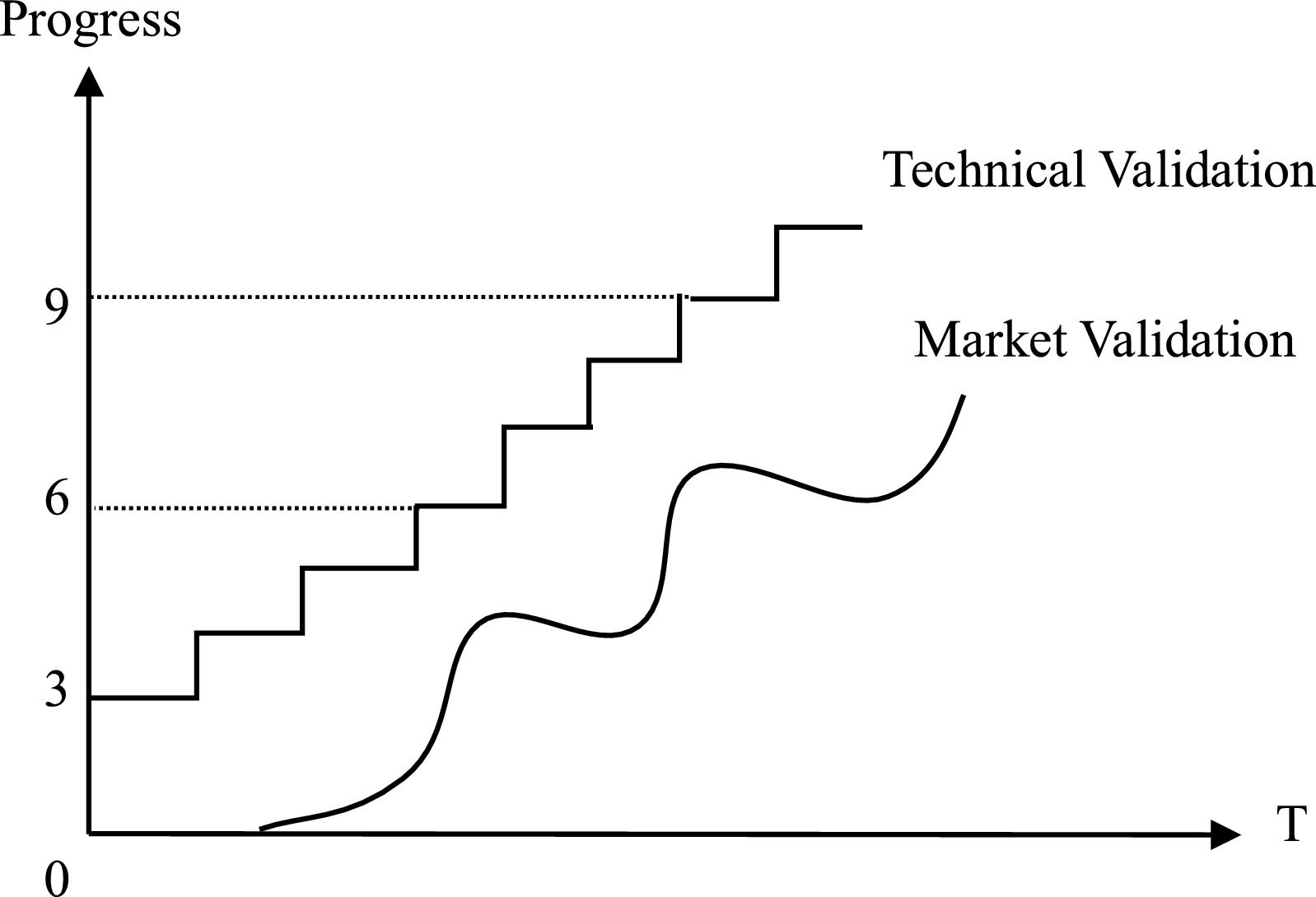
Temporally, Lean Startup literature views MVP/MVE experiments as an accelerated learning mechanism, emphasising that ‘whoever learns faster gains an advantage’ (McGrath, 2024; Felin et al., 2024; Stevenson et al., 2024). Ideally, commercial validation can quickly update user and market understandings through high-frequency experiments. However, this rapid experimental rhythm often conflicts with the technical rhythm constrained by experimental cycles and compliance reviews in highly complex, strongly regulated industries. Although the technology side is building its evidence chain, the market side generates path selection pressure. Fig. 1 illustrates the timeline of the structural misalignment between technology and market validations. technology validation advances stepwise, whereas commercial verification follows a fluctuating iterative rhythm. The two curves seldom coincide at key nodes, forming the tempo misalignment described in the literature (Fig. 1).

We define this temporal dislocation, accumulated over the long term between technological and commercial cycles and difficult to resolve through single coordination attempts, as a ‘rhythm fault’. The mechanism can be summarised as follows: (1) systematic dislocation of technology advancement and market feedback on the time axis makes it difficult for key verification activities to connect within the same time window. (2) Evidence types based on different collection methods and interpretation frameworks struggle to flow smoothly between the two cycles, affecting the common judgement basis. (3) Technology and business each form decision nodes along their internal rhythms but lack common shared nodes (Freisinger & McCarthy, 2024; Baldwin et al., 2024). This leads to a typical valley of death in resource allocation and path selection across the time dimension.
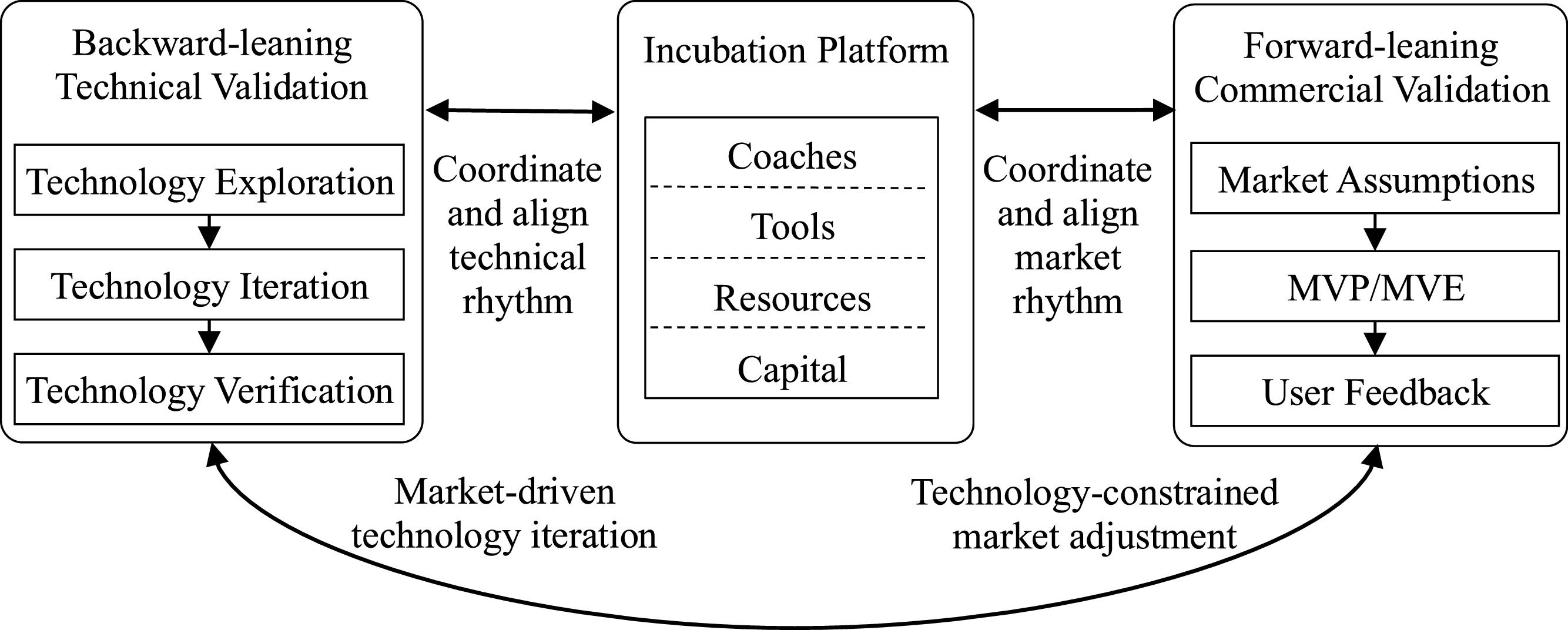
Therefore, this study focuses on how rhythm is organised and coupled. Integrating relevant literature, we consider information flow, shared decision nodes and recursive feedback loops as three key elements of the technology-business coupling mechanism (Carlile, 2004; Gbadegeshin et al., 2022; Tucci et al., 2025). Innovation intermediaries play a pivotal role in constructing cross-boundary information flows and coordinating shared nodes (Feser, 2023; Noviaristanti et al., 2023). The operational mechanisms of innovation intermediaries constitute a critical research focus in open innovation studies. Recent studies further emphasise that innovation ecosystems increasingly rely on peer innovation and collaborative orchestration mechanisms to balance competition and cooperation among technology ventures (Ogink et al., 2023; Primario et al., 2024). This collaborative orchestration logic provides an important contextual foundation for understanding how dual-node incubation systems coordinate technology-business validation rhythms. This study constructs a framework for the technology–business coupling verification mechanism. Through intermediary devices such as coaches, tools, resources and capital, user language is translated into technical requirements and technical constraints are pre-embedded into business assumptions, reconstructing cross-boundary information flow. Meanwhile, the originally parallel TRL and MVP/MVE cycles are anchored together at critical moments through shared decision points such as demand convergence, technical constraint and economic nodes. Finally, the two loops with different rhythms are gradually compressed into a double-loop structure of ‘business verification forward, technology verification backward, parallel iteration’ via two feedback loops: market-driven technology iteration and technology-constraint-driven market adjustment (Fig. 2).

In the subsequent case study, we take the Blue Bay dual-node incubation system as the experimental object to examine how this framework is organised and implemented in specific projects, and to compare the evolution of coupling paths (S1-S4) under different industrial complexities: demand-led, technology-constrained, and technology-led.
Research design and methodologyResearch orientation and overall logicThis study adopts an embedded comparative case study and abductive process study approach (Eisenhardt & Graebner, 2007; Yin, 2018; Tavory & Timmermans, 2014). Moreover, this study focuses on the mechanism of rhythm coupling between technology and commercial validations within the incubation platform. Following the logic of an iterative cycle between data, theory and mechanism, the theoretical chain centred on rhythm fault, coupling structure and platform intermediation was gradually refined through continuous dialogue between literature and field materials.
Aligning with research viewing entrepreneurial decision-making as systematic experimentation (Camuffo et al., 2020; Felin et al., 2024), this study considers the MVP/MVE trials along with TRL progression within the Blue Bay platform as a set of embedded natural experiments. In platform practice, the research team designed, intervened, observed and provided feedback across multiple cycles. The team participated in verification scheme design and rhythm adjustment and abductively traced key events and anomalous cases to identify how the platform restructured technical and commercial verification rhythms. Methodologically, this study combines participatory research and design experiments (Van de Ven, 2007; Bansal et al., 2018). The research team embedded multiple identities—incubation coaches and reflective observers—into practice to enhance mechanism identification validity.
Object of studyThis study focuses on the medical health and intelligent core technology incubation ecosystem of the Blue Bay Science and Technology Group. The ecosystem relies on drug process development, compliance testing and healthcare technology verification, reflecting safety- and reliability-oriented technical logics. Additionally, the ecosystem is oriented towards the health service and smart device market, emphasising MVP/MVE, user feedback and scenario iteration, reflecting demand–desirability-oriented business logic and forming a typical dual-node technology–market verification system.
Blue Bay has clear structural boundaries within this dual-node validation system. Lanxianzhi HealthTech, as the market verification node, designs and executes MVP/MVE tests and collects user and payment signals. CDMO PharmaTech, as the technology validation node, handles process development and safety and stability validation. Lanxianzhi HealthTech and CDMO PharmaTech are organisationally independent but form a dual-fulcrum structure of business and technology verification nodes within the incubation ecology, providing an ideal subject for observing technology–market rhythm tension and coupling mechanisms.
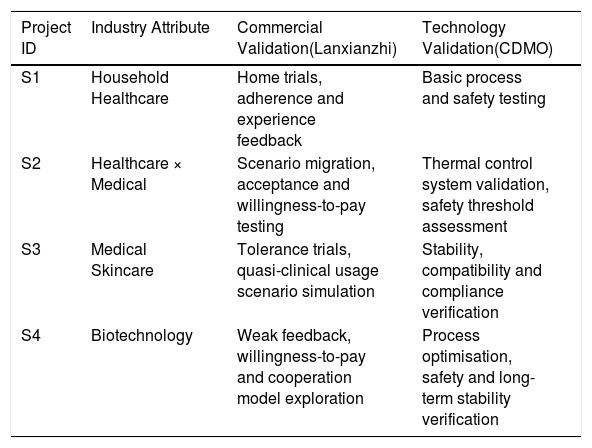
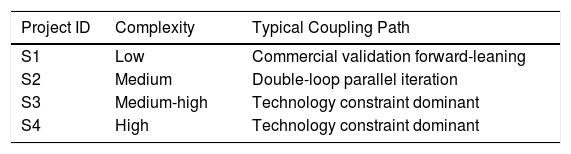
Sample casesUnder this incubation system and platform mechanism, this study selects four representative projects from S1 to S4 as analysis samples to construct gradients of regulatory density, technical threshold and situational complexity (Table 2). All four projects involve joint participation by Lanxianzhi and CDMO and have progressed from early conception to verification iteration through the key stage, ensuring comparability.
Four representative projects (S1-S4) within the blue bay science and technology platform’s ‘Dual-Node verification system’.
Negative Oxygen Ion Health Device (S1): A low-complexity household healthcare scenario for observing the commercial verification forward-leaning path.
Moxibustion Robot (S2): A cross-project between healthcare and medicine for identifying the rhythm relationship of double-loop parallel iteration.
Medical Facial Mask (S3): A medium-high complexity medical skincare project that underscores the feedback loop from technical constraints to market adjustment.
Cancer Early Screening Agent (S4): A high-complexity biotechnology project for analysing rhythm alignment challenges under weak feedback plus technology validation delay.
The four projects share platform rules, coaching teams and verification tools but reside in different industrial complexity zones, forming a natural situational contrast conducive to observing various technology–business coupling paths under different conditions within the same system.
Data sources and embedded processesTo re-construct the rhythm dislocation and re-coupling process between technology and business validations across time, the research team continuously gathered multi-source data in 2025, forming 62 evidence sets, including semi-structured interviews, documentation and participatory observation records.
Semi-structured interviews: Interviewees included entrepreneurs, Lanxianzhi operation/incubation coaches, CDMO process/R&D personnel and key users/cooperative hospitals. Focus areas were rhythm trigger points, feedback paths and decision-making logic. Total interview duration was approximately 32 h.
Documentation: Process logs, validation reports, market validation records, iMA platform validation flows, project weekly reports and external review materials were collated to demarcate key events, parameter changes and decision nodes.
Participatory observation: The research team participated in market validation activities and CDMO process meetings as coaches and judges, recording cross-team disputes, hypothesis backtracking and rhythm adjustment actions and forming meeting minutes and reflective memos.
Therefore, embedded process tracing reconstructed the key event sequence along rhythm dislocation, signal transmission, feedback reinforcement/weakening and rhythm realignment. This identified which information was amplified or weakened at which node, promoting or delaying rhythm coupling. This process-tracing method, focusing on key events and temporal sequence, is compatible with the research logic viewing entrepreneurial activities as a series of testable experiments (Camuffo et al., 2020; Felin et al., 2024) and identifying the shift and coupling mechanism of verification rhythm in natural situations.
Analysis strategy and reliability controlData were analysed using a combined strategy of cross-case pattern matching and structured situational testing. Following the approaches of Eisenhardt (1989) and Yin (2018))), the researchers compared similarities and differences among the S1 to S4 cases in terms of verification rhythm, trigger nodes, signal logic and feedback paths, and ultimately identified three typical coupling paths: commercial validation-forward-leaning, double-loop parallel iteration, and technology-constraint dominant. Following the research logic of Tucci et al. (2025), the four projects were further treated as natural situational variants to explore how rhythm conflict, feedback delay and technical constraints shape different coupling trajectories. Through this iterative comparative process, the rhythm coupling mechanism of the Blue Bay incubation platform was progressively refined.
Research findingsBased on embedded process tracing of four representative projects (S1-S4) under the Blue Bay dual-node verification system, this study identified three representative technology–business rhythm coupling paths: commercial validation forward-leaning, double-loop parallel iteration and technology-constraint dominant. These findings confirm the viewpoint of technology–market mutual construction within a co-evolution framework (Garud & Karnøe, 2003; Nambisan et al., 2017) and reveal the key roles of the cognitive stance of the founding team and the mediation of the coaching team in TRL-MVP/MVE rhythm synergy.
Coupling paths are closely related to industrial complexityUnder identical platform rules and tools, S1-S4 demonstrate three typical coupling paths evolving with increasing industrial complexity.
Commercial validation forward-leaning type (S1: negative oxygen ion health device)In low-complexity, weakly regulated scenarios, Lanxianzhi could considerably pre-perform MVP/MVE tests, rapidly converging high-priority requirements through home trials and experience feedback. CDMO conducted small-scale, safety-focused TRL tests. This path closely aligns with the emphasis of Lean Startup on ‘value proposition first, then technology deepening’ (Ries, 2011) and Stevenson et al.’s (2024) proposition defining MVP as ‘verifying value proposition assumptions at the lowest cost’. From a business model perspective, the platform discarded low-value assumptions through experiments, echoing Zott and Amit’s (2024) analysis of early business model experiments.
Double-Loop parallel iteration type (S2: moxibustion robot)In this moderate-complexity healthcare–medicine crossover project, technology and market exhibited certain rigidity. The market side required confirming feasible scenarios quickly, whereas the technical side needed to ensure thermal control and safety met thresholds. In S2, two loops advanced in parallel under coaching team coordination: one testing scenario acceptance and willingness-to-pay, the other iterating key technical parameters. Essentially, MVP/MVE experiments were conducted simultaneously on the technology and business model paths, forming a typical ‘technology–market co-evolution alignment’ model (Teece, 2018). This co-evolution alignment model provides a mechanistic explanation at the rhythmic and organisational levels for the claim of the Lean Startup literature that ‘whoever learns faster has an advantage’ (McGrath, 2024; Felin et al., 2024).
Technology-Constraint dominant type (S3 and S4: medium-high/high complexity projects)In S3 (Medical Facial Mask), technical risks identified in stability and compatibility tests directly forced the business team to shift from generalised medical skincare to specific departments and user groups, forming a recursive loop of technical constraints → market adjustment. This path strongly aligns with the ‘technology-constrained pivot’ discussed by Bohnsack et al. (2014), in which business model evolution is always subject to key technology boundaries. In S4 (cancer early screening agent), TRL activities under high-regulation, high-risk conditions became the decisive bottleneck. Commercial validation can provide directional information, struggling to drive high-frequency iteration, exhibiting a typical delayed structure of technical validation. This delayed structure is consistent with Pisano’s (2006) findings on ‘technology-oriented path locking’ in biotechnology and echoes Navarro-Castillo et al.’s (2024) conclusions on the persistence of the valley of death in high-tech contexts.
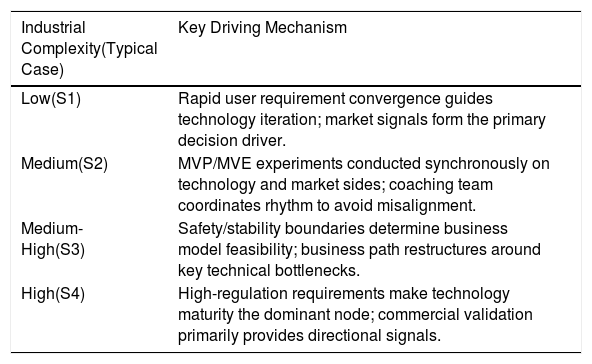
From S1 to S4, technology-business coupling does not reflect a formally synchronised process but a dynamic coordination under different combinations of market, technical and regulatory constraints. In low-complexity scenarios (S1), commercial validation dominates the rhythm through intensive user feedback and rapid requirement convergence, while technical validation remains relatively lightweight and adaptive, with technical nodes conducting delayed, miniaturised TRL tests around validated requirements. In medium-complexity scenarios (S2), the dual nodes form a double-loop parallel iteration through shared decision nodes and high-frequency coordination, enabling technology and market learning to evolve simultaneously while avoiding path deviation from one-sided pulling. In medium-high and high-complexity scenarios (S3 and S4), technical constraints and regulatory thresholds increasingly shape the feasible boundary of business experimentation, leading to constrained pivoting and progressive verification. Table 3 summarises the relationship among industrial complexity, coupling paths and key driving mechanisms.
Overall, the dual-node verification system resembles a dynamic equilibrium structure under shifting constraints rather than a static symmetric arrangement. This finding provides procedural support for the proposed rhythm coupling framework and further explains how different industrial complexities produce distinct technology-business verification trajectories, contributing to the understanding of the valley of death mechanism and technology–market co-evolution.
Founding team’s cognitive stance determines the coupling mechanism’s starting pointComparing S1-S4 denoted that the basic stance of the founding team on what to verify first and at what pace is the starting point for whether technology and business verifications can couple. In S1, the team embraced the logic of demand-first, then technology-deepening from the outset, constantly adjusting the product concept around Lanxianzhi’s multi-round MVP/MVE tests, allowing user experience and willingness-to-pay to inform TRL priorities. Conversely, the S4 team long insisted on completing technology before marketisation. The first two rounds of commercial validation narrowly explored willingness-to-pay and cooperation models, making it difficult to provide real-scene feedback for the technical route and forming a clear early-stage rhythm fault. This difference aligns with recent Lean Startup and entrepreneurial cognition research. Studies on entrepreneurial improvisation further suggest that new ventures often learn through real-time adjustment and situated experimentation rather than through fully pre-defined execution routines (Wu et al., 2023). Yang et al. (2019) noted that a team’s switching logic between search/execution remarkably affects MVP design and experimental rhythm; Alvarez et al. (2024) further distinguished the creation theory from Lean Startup, arguing that partial entrepreneurship aligns more with the ‘create first, then explain’ logic. Avoiding early requirement validation or reducing MVP/MVE to a one-way technology demonstration can lead to team imbalance between search and execution, delaying or distorting opportunity development (Yang et al., 2019; Alvarez et al., 2024; Blank & Dorf, 2012; Bingham & Eisenhardt, 2011).
Coaching team as the key intermediary for dual-node system operationIn multi-agent collaborative environments, crossing knowledge boundaries is often more critical than adding resources (Carlile, 2004; Majchrzak et al., 2012). The mediating role of the Blue Bay coaching team as knowledge translator and rhythm coordinator manifests in three primary aspects.
Cross-Node translationIn S2 and S3, the coaching team translated market language (compliance, comfort, willingness-to-pay) into technical parameters (temperature thresholds, formula stability) and embedded key technical constraints into scenario selection and business assumptions, solidifying scattered feedback into testable experimental variables.
Rhythm coordinationIn S2, weekly sync meetings and periodic co-judgement meetings maintained weak synchronisation between market and technology validations, engaging both cycles around the same decision nodes (e.g. scenario convergence and safety threshold) to avoid one-sided pulling.
Conflict mediation and re-theorisationIn S4, by comparing rhythm data and path samples from S1 and S2, the coaching team urged the founding team to accept a hybrid logic of staged market verification introduction under technical constraints, redefining MVP from demonstration to a theoretical vehicle carrying implicit assumptions. This completed the theorisation → operationalisation → experimental design closed-loop system (Stevenson et al., 2024; Felin & Zenger, 2017; Camuffo et al., 2020).
Therefore, the coaching team is not a peripheral service but a key operational intermediary for the dual-node system. The team crosses technology–market knowledge boundaries while establishing operational trade-offs between creation logic and Lean Startup verification logic through rhythm coordination and conflict mediation (Alvarez et al., 2024; Yang et al., 2019).
DiscussionFrom the tempo misalignment viewpoint, this study re-examines the dilemma of transforming scientific and technological achievements in high-complexity industries and illustrates how TRL and MVP/MVE logic misalignment in the time dimension is re-arranged under platform and coaching mechanisms. This chapter discusses four aspects: the institutional explanation of the valley of death, institutional role of the dual-node system, mediating role of the coaching team and contribution of multi-path coupling to co-evolution and Lean Startup literature.
Institutional interpretation of the valley of deathMost existing valley of death studies explain how achievements are stuck between technology and business from resource gaps, institutional gaps or collaborative network perspectives (Everts & Drew, 2024; Gbadegeshin et al., 2022), focusing on overcoming dilemmas through open innovation and collaborative combinations (Navarro-Castillo et al., 2024). Herein, even with relatively sufficient resources and partnerships, systematic misalignment between technical and commercial validation in experimental rhythm can constitute the valley of death. In the Blue Bay field, TRL advances along a linear, low-frequency, steady-state path (Mankins, 2009; Héder, 2017), whereas MVP/MVE features iterative, high-frequency, contextualised trials (Ries, 2011; McGrath, 2024). From an entrepreneurial scientific methods perspective, TRL and MVP/MVE are essentially two structured experimental streams (Camuffo et al., 2020; Felin et al., 2024). If the underlying assumptions and propulsion rhythms of TRL and MVP/MVE are misaligned, learning faster does not necessarily translate to crossing the valley of death. S4 demonstrates that even continuous TRL improvement in highly regulated biotechnology projects may evolve into what Pisano (2006) terms pseudo-maturity, exacerbating rather than alleviating the valley of death without synchronous calibration with real-scenario needs.
Rhythm-Centred mediating mechanismRecent incubator and accelerator research has gradually shifted from viewing them as resource pools to innovation intermediaries, emphasising their expertise logic in project screening and experimental path shaping (Hausberg & Korreck, 2020; Goswami et al., 2018; Navarro-Castillo et al., 2024). The Blue Bay dual-node verification system demonstrates a rhythm-centred mediating mechanism. Recent digital business model innovation research also highlights that platform capability increasingly functions as an enabling infrastructure for entrepreneurial coordination, experimentation and adaptive business model development (Wang & Thai, 2026). In the Blue Bay case, the platform not only provides resources but also actively orchestrates the interaction rhythm between technical and commercial validation. The Blue Bay dual-node verification system demonstrates a rhythm-centred mediating mechanism. Lanxianzhi generates high-frequency, contextual market feedback through MVP/MVE tests; CDMO upholds relatively steady TRL progression around process, safety and stability. Although organisationally separate, Lanxianzhi and CDMO are systemically re-anchored through unified project rhythm, co-judgement nodes and coaching mechanisms, transforming latent rhythm conflict into a governable organisational challenge. This triangular structure of market node, technology node and coaching team echoes Tucci et al.’s (2025) analysis of multi-node verification structures while extending accelerator literature from resources and signals to the arrangement and alignment of verification rhythms (Goswami et al., 2018).
Role of the coaching team in science and technology innovation platformsThe Blue Bay case demonstrates that the coaching team is the key operational intermediary for the dual-node system, in addition to a soft service. The latest Lean Startup research views MVP as a theoretical vehicle for implicit theory (Stevenson et al., 2024) and entrepreneurial practice as testable experiments (Camuffo et al., 2020; Felin et al., 2024). Within this framework, the coaching team helps the team complete the theorisation → operationalisation → experimental design closed loop by translating user language into engineering parameters and rewriting technical constraints into testable business assumptions, improving MVP/MVE experimental quality. Meanwhile, entrepreneurial cognition research notes that a team’s switching logic between search/execution can profoundly affect verification rhythm (Yang et al., 2019) and different teams’ choices between creation logic and Lean Startup verification logic can lead to path divergence (Alvarez et al., 2024). The S1-S4 samples demonstrate that the coaching team can ease tension between technical completeness and market urgency through rhythm coordination and conflict mediation, helping the founding team form an operational compromise between the two logics.
Multi-Path coupling complements co-evolution and lean startup literatureCross-case comparison shows that within the same platform system, the key driving mechanisms behind technology–business coupling exhibit regular patterns as industrial complexity increases (Table 4). In low-complexity projects, commercial validation leans forward, user requirements converge quickly and technology is guided towards delayed iteration, aligning more with the advocated ‘value proposition first, technology deepening later’ view of Lean Startup (Ries, 2011; Stevenson et al., 2024). In medium-complexity projects, MVP/MVE experiments are simultaneously conducted on technology and business model paths, with the coach team acting as experiment arranger and offering a mechanistic explanation at the rhythm and organisational level for ‘whoever learns faster has more advantages’ (McGrath, 2024; Felin et al., 2024; Teece, 2018). In medium-high and high-complexity projects, technical constraints and regulatory barriers substantially tighten the feasible space and business model evolution is more reflected in ‘shifts constrained by technical boundaries’ (Bohnsack et al., 2014; Pisano, 2006).
Key driving mechanisms under different industrial complexities.
Note: Cases are based on the actual incubation process of the Blue Bay Science and Technology Innovation Platform.
Therefore, within the technology–market co-evolution framework (Garud & Karnøe, 2003; Nambisan et al., 2017) and business model-Lean Startup interaction research (Zott & Amit, 2024), this study provides a meso‑level picture of coupling paths in different contexts using ‘rhythm structure’, offering an empirical basis for constructing a contextualised rhythm matching theory.
ConclusionConsidering tempo misalignment as the breakthrough point and based on embedded business experiments within the dual-node verification system of Blue Bay Science and Technology Innovation Platform, this study uncovers the systematic misalignment between technology (linear steady-state rhythm based on TRL) and business (iterative rhythm based on MVP/MVE) verifications in high-complexity industries. The platform, acting as a rhythm arranger, enables small-scale controllable testing and identifies different technology–business coupling paths under varying industrial complexities.
Theoretical contributionsThis study transforms the view of technology and business validations from binary opposition to rhythmic coupling. First, this study introduces ‘rhythm fault’ into the valley of death research, noting that even with adequate resources and governance, mismatches between TRL and MVP/MVE in rhythm and hypothesis propulsion can form the valley of death, shifting the research focus from resource constraints to the key mechanism variable of verification rhythm (Navarro-Castillo et al., 2024). Second, this study treats TRL and MVP/MVE as two structured experimental streams, integrating the scientific experimental logic of Lean Startup (Camuffo et al., 2020; Felin et al., 2024; Stevenson et al., 2024) into a unified rhythmic framework. Notably, commercial verification forward-leaning, technology validation backward-leaning and platform rhythm choreography can re-construct the two verification flows from parallel advancement to a dynamically coupled double-loop verification structure. Third, this study depicts coupling paths (demand-led, bidirectional-interactive, technology-constrained, technology-led) that evolve with industrial complexity using rhythm structure, providing a more structured meso‑mechanism for technology–market co-evolution (Garud & Karnøe, 2003; Nambisan et al., 2017) and business model–innovation interaction research (Zott & Amit, 2024). Fourth, this study incorporates tempo into knowledge boundary theory (Carlile, 2004), proposing ‘rhythm orchestration’. This emphasises that incubation platforms promote synchronisation and resonance of knowledge flows at different speeds at key nodes by adjusting verification rhythm and feedback cycles, thereby structuring the interaction among individuals, organisational processes, and cross-boundary routines within dual-node verification systems (Felin et al., 2012). This mechanism complements existing research on knowledge boundaries and knowledge orchestration, providing a new theoretical basis for understanding knowledge integration in complex innovation systems.
Practical implicationsThis study offers three implications for incubators, science and technology innovation platforms, and policymakers.
Shift from one-size-fits-all to situational rhythm design in technical and commercial validationCross-case analysis shows that within the Blue Bay platform, technology–business rhythm coupling is not a single path but switches among four structures with industrial complexity. Low-complexity projects lean forward in commercial validation, medium-complexity projects employ double-loop parallel iteration, medium-high-complexity projects follow technology-constraint → market adjustment and high-complexity projects tend towards technology validation delay. These paths collectively denote that leadership in pace depends on technical and regulatory constraints, not a single method choice. Therefore, entrepreneurs should design verification priorities based on industrial complexity. Low-complexity projects can moderately prioritise commercial validation to reduce ineffective R&D through early demand convergence, whereas high-complexity projects must replace one-way rapid testing with constrained market steering guided by technical and regulatory constraints.
Science and technology innovation platform as a rhythm arranger, in addition to resource providerOrganisationally, Blue Bay makes rhythm conflict explicit through its dual-node system (market node: Lanxianzhi; technology node: CDMO) and realises knowledge translation, rhythm coordination and conflict mediation through the coaching team. Compared with studies viewing accelerators as resource pools or signal amplifiers (Goswami et al., 2018), this study underscores the institutional role of the rhythm arranger—using structured nodes and co-judgement mechanisms to anchor originally parallel TRL and MVP/MVE cycles at key temporal points. The rhythm arrangement via dual nodes and coaching team represents a successful attempt by the Blue Bay platform. Science and technology innovation platforms should actively manage the progression rhythm of technology and market cycles through dual-node structures, co-judgement nodes and coaching mechanisms.
Research limitations and future directionsBased on a single platform and limited representative projects, this study primarily focuses on high-complexity industries such as healthcare and intelligent core technologies. However, the external validity and complexity characterisation remain limited. Furthermore, this study primarily relies on qualitative data and does not systematically examine the long-term performance differences of different rhythm paths. Future research should test the universality and boundary conditions of the rhythm coupling mechanism across different innovation ecosystems through cross-platform comparison and econometric modelling. Another promising direction is to explore how to embed rhythm management into science and technology policy and platform operational practice.
CRediT authorship contribution statementMinju Chen: Writing – original draft, Visualization, Validation, Project administration, Funding acquisition, Formal analysis. Chengbin Wang: Writing – review & editing, Validation, Software, Data curation, Conceptualization.

