



Firms achieve sustainable innovation and performance by using their green and digital capabilities. Using dynamic capabilities and knowledge-based perspectives, this study puts forth a conceptual framework linking Big Data Analytics Capability (BDAC), Digital Orientation (DO), and Green IT Practices (GITP) to Knowledge Management Capability (KMC) and innovation outcomes. The study suggests that these digital capabilities enable firms to sense opportunities, combine knowledge from different domains, and reconfigure resources. KMC acts as a mediator that uses digital and green inputs to produce Eco-Design (ED) and Green Process Innovation (GPI), ultimately improving Economic Performance (ECOP). Based on a sample of 293 responses gathered from the supply chain and logistics industries across several countries, our model with paths of serial mediation shows that BDAC, DO, and GITP indirectly improve firm performance by means of knowledge and innovation capabilities. In particular, we verify how knowledge and innovation capabilities invigorate eco-innovation, serving as a driver for firms’ environmental sustainability. The present study contributes to the literature on digital transformation, sustainability, and knowledge management in two significant ways. First, it clarifies the role of dynamic capabilities in eco-digital innovation and value creation. Second, the results of the present study offer guidance to managers on how to align digital transformation and sustainability effectively. In addition, we also highlight that knowledge processes play a key role in securing long-term competitiveness and sustainable value.
Digital transformation and environmental sustainability are the two most outstanding hallmarks of the twenty-first century. These hallmarks present significant opportunities to businesses today to use digital technology to be more efficient, more competitive, and to meet their environmental and social goals (Rialti et al., 2019; Wang et al., 2024). Recent studies suggest that using big data, AI, and IoT can help businesses use less energy, reduce waste, and promote long-term business models (Ferraris et al., 2019; Makhloufi et al., 2023). Yet, its role in advancing high-quality economic development remains underexplored. The key question remains how digital capabilities can be leveraged to support both economic and environmental outcomes, directly or indirectly.
With increasing awareness of the environmental protection responsibilities, organizations are compelled to adopt environmentally friendly practices that integrate social, economic, ecological, and corporate sustainable values (Al Halbusi et al., 2025). The integration of these sustainable values has given rise to the concept of sustainable performance, where the emphasis is not solely on the economic performance of a firm but rather on achieving its social and environmental objectives. Therefore, sustainable performance requires the redesign of business models, the development and organization of new capabilities, and the pursuit of innovation. For analytical clarity, the present study distinguishes between sustainable performance as a broader umbrella construct encompassing environmental, social, and economic outcomes, and Economic Performance (ECOP) as its specific, measurable financial dimension. Whereas sustainable performance reflects an overarching strategic orientation, ECOP captures the firm-level economic returns (profitability, market share, operational efficiency, and cost savings) that arise when sustainability-oriented capabilities are effectively translated into innovation outcomes. The empirical model therefore treats ECOP as the focal dependent variable through which the economic dimension of sustainable performance is operationalized.
However, existing research has largely overlooked the intricate mechanisms through which digital transformation contributes to sustainable economic progress, particularly the role of a knowledge-based mechanism as a mediating factor. Although studies have demonstrated that diverse digital tools have facilitated the advancement of green innovation and the enhancement of environmental performance in terms of reducing pollution and achieving long-term sustainability. Research on green innovation predominantly focuses on eco-design and green process innovation (Chen et al., 2006; Xie et al., 2022), with minimal integration of digital orientation or data-driven capabilities. Furthermore, Gerassimidou et al. (2021) report that the challenge of enhanced environmental performance also prompts top management to explore sustainable methods for enhanced profitability. Such challenges add pressure on practitioners to not only adopt but also predict the effectiveness of digital tools for their firm’s economic objectives.
At the outset, adopting new technology is not the only answer to the broad question asked in the beginning. The success of a firm will also depend on how effectively it can manage and utilize knowledge within the limits of its functions and technology. Such limits of knowledge have led to a fragmented literature on the role of digital capabilities in sustainable performance. The present research fills this knowledge gap by placing Knowledge Management Capability (KMC) as the key mediating variable between digital enablers and eco-innovation and, consequently, economic returns. The key research question that informs the present study is –
What are the implications of digital capabilities like big data analytics, digital orientation, and green IT practices on the way to better economic performance based on knowledge management and eco-innovation capabilities of firms?
This research question addresses the study’s objective: the goal of the study is to reveal the multistage nature of interactions of digital and green transformations to generate competitive advantage. The paper looks into the chain of impacts of digital capabilities in improving sustainable and economic performance in terms of knowledge management and environmental innovation pathways. In particular, the study emphasizes three digital enablers, namely, Big Data Analytics Capability (BDAC), Digital Orientation (DO), and Green IT Practices (GITP), as antecedents that enhance KMC, which in turn promotes Eco-Design (ED) and Green Process Innovation (GPI). The framework is based on the Knowledge-Based View (KBV) (Grant, 1996) and the Dynamic Capabilities View (DCV) (Teece et al., 1997; Teece, 2007), which explains how companies sense and seize, as well as reconfigure knowledge to gain an eco-digital advantage.
The present research paper applies the dynamic capabilities view (DCV) to KMC, not only contributing to North’s (1990) neoinstitutionalism but also providing a micro-foundation that operationalizes sensing, seizing, and transforming activities essential for eco-innovation. It further contributes to KBV by showing that knowledge management can increase innovation performance (Darroch, 2005; Shahzad et al., 2020) and convert digital capabilities into sustainable economic values. The DCV is keen on the fact that in a turbulent environment, sustainable advantage lies in the capacity of the firm to sense environmental change, embrace opportunities of innovation, and re-engineer resources accordingly (Wang & Ahmed, 2007). This is complemented by the KBV, which acknowledges organizational knowledge as a strategic resource whose development, sharing, and utilization facilitates innovation and high-performance (Darroch, 2005). These views, combined, give a powerful theoretical basis to comprehend the way digital and knowledge-based capabilities evolve in order to influence eco-innovation and the performance of the firm.
Although both DCV and KBV are very well established in innovation and sustainability studies, they are not integrated. DCV has been employed to explain technological agility (Mikalef et al., 2020) and KBV to investigate green innovation (Shahzad et al., 2020), but few studies have investigated the concept of knowledge management as a dynamic capability that acts as a mediator between digital and green shifts. Recent findings indicate that digital tools would increase the learning and reconfiguration potential (YahiaMarzouk & Jin, 2023), but the sequential process between digital potential and knowledge management to eco-innovation and performance has seldom been empirically investigated. Additionally, meta-analyses indicate a positive relationship between eco-innovation and performance (Zheng & Iatridis, 2022), but the processes that transform digital investment into eco-innovative results are still disjointed in theory.
To address this gap, we formulate and empirically test a comprehensive model through Partial Least Squares Structural Equation Modeling (PLS-SEM) based on firm-level data. The model examines seven direct relationships (H1-H7) and 6 serial relationships (H8a-H9c) and traces the entire route from digital capabilities to their economic performance via knowledge management and eco-innovation. The findings reveal that BDAC, DO, and GITP have a significant positive effect on KMC that is positively related to Eco-Design and Green Process Innovation. In particular, we found that all aspects of eco-innovation enhance economic performance, which suggests that innovation oriented towards sustainability is financially beneficial. Digital orientation leads to sustainable performance via knowledge-based innovation as evidenced by mediation tests, especially the antecedent-knowledge based mechanism-innovation- performance outcome (DO - KMC - ED - ECOP and DO - KMC - GPI – ECOP). Such results imply that successful eco-digital strategies are supported by both dynamic and knowledge-based capabilities.
The confirmed mediation model also explains how digital and green capabilities interact to enhance performance, with DO being the strongest antecedent to create knowledge and eco-innovation. To practitioners, the findings reveal that digital transformation only produces permanent returns when it is aided by a robust knowledge management system and a culture of data-driven learning. To enhance eco-design and green process innovation as an efficiency and differentiation lever, firms should institutionalize knowledge-sharing and digital literacy to further increase the latter. According to the PLS-SEM analysis, the most significant, but still indirect, impact on performance by DO is through KMC and eco-innovation, which reflects the importance of a digital mentality and inter-departmental cooperation in the name of sustainable success.
Finally, we point out the importance of knowledge management as the key connection between digital transformation and sustainability performance. The paper is a response to recent calls to incorporate integrative frameworks that help to understand how the combination of dynamic and knowledge-based capabilities can contribute to competitive advantage in the digital sustainability age (Ferraris et al., 2019; Makhloufi et al., 2023). The findings of the present research show that the combination of technology, green initiatives, and knowledge management with eco-innovation yields an eco-digital advantage. To practitioners, the findings underscore that digital strategies, in isolation, are insufficient; their performance impact depends on the extent to which they are coupled with sustainability-oriented practices and robust knowledge management capabilities. This study contributes to the current body of eco-digital innovation research and, by validating this multi-stage mechanism, provides firms with a viable roadmap on how to transform digitalization and environmental stewardship into a single strategy of sustainable competitiveness.
The rest of this paper is organized as follows. Section 2 examines the literature on the issue and develops hypotheses. Section 3 describes the research methodology, data sources, operationalization of variables, and the analytical procedures in the present research. The empirical results are given in Section 4, and their theoretical and managerial implications are discussed in Section 5. The paper concludes with Section 6, discussing limitations of the present research and future research directions.
Literature reviewKnowledge-Based mechanisms linking capabilities to innovation and performanceMost firms today increasingly rely on higher-order capabilities to sense opportunities, mobilize resources, and generate competitive advantage. Similarly, the Dynamic Capabilities View (DCV) focuses on how a company can sense opportunities, pursue them by becoming innovative, and restructure internal and external capabilities to maintain competitiveness in dynamic settings (Teece et al., 1997; Teece, 2007). These capabilities allow organizations to adapt, renew, and maintain advantage in the digital age. According to Warner and Wäger (2019), dynamic capabilities are an ongoing strategic renewal mechanism that can enable firms to adapt to digital transformations. In a similar vein, Kahveci (2025) demonstrate how small and medium-sized enterprises develop and implement such capabilities to handle the digital transformation and list digital agility and process adaptivity as essential components.
In the research, we consider digital orientation (DO), big data analytics capability (BDAC), and green IT practices (GITP) as some dynamic capabilities that enable firms to sense and respond to sustainability opportunities (Al-Husain et al., 2025). The following paragraphs discuss each dynamic capability important for sustainable performance included in the study.
Big Data Analytics Capability (BDAC) is an indication of a company with the capability to apply big data technologies, human resources, and governance systems in extracting actionable information out of extensive datasets (Wamba et al., 2017; Ferraris et al., 2019). BDAC enhances the knowledge base of the firm because it converts the raw data into organizational knowledge as actionable insights.
Digital Orientation (DO) is an expression of the strategic purpose of a firm to use digital technologies to be innovative and competitive. It is an organizational mentality that aligns leadership, culture, and processes with digital transformation (Kindermann et al., 2021).
Green IT Practices (GITP) involves the efforts to design, implement, and sustainably consume information technology, i.e., by means of energy-efficient systems, virtualization, cloud solutions, and e-waste management (Mao et al., 2016).
It is important to note that the three capabilities Digital Orientation (DO), Big Data Analytics Capability (BDAC), and Green IT Practices (GITP) differ meaningfully in their level of abstraction, strategic role, and functional positioning within the capability hierarchy. DO provides strategic direction and intent shaping firms’ digital and sustainability priorities, whereas BDAC and GITP provide domain-specific execution capabilities through which the intent is realized. However, both BDAC and GITP can also have strategic implications in terms of decision-making, sensing opportunities, and embedding of sustainability logic into IT governance and structure, respectively. DO is more closely aligned with broad organizational goals, including sustainability, as it promotes openness to innovation, experimentation, and long-term value creation. Recently, Mao and Lu (2023) also indicate that BDAC’s success in promoting eco-innovation depends on a firm’s ability to manage and implement insights dynamically. Although BDAC and GITP are both knowledge-intensive enablers of KMC, their pathways into knowledge processes are conceptually distinct. BDAC contributes to KMC primarily through an analytics-driven knowledge acquisition pathway: it generates codified, data-derived insights that expand the firm’s explicit knowledge stock and accelerate evidence-based decision-making. GITP, by contrast, contributes to KMC through a practice-embedded knowledge integration pathway: it institutionalizes environmentally responsible IT routines (energy-efficient infrastructure, virtualization, e-waste management) that cultivate tacit sustainability know-how and diffuse it across organizational units. In other words, BDAC enriches KMC by supplying the “what” of decision-relevant information, whereas GITP enriches KMC by shaping the “how” of sustainability-oriented operating routines. This explicit–tacit and acquisition–integration distinction clarifies why the two capabilities, despite their shared knowledge-intensive character, are theoretically non-redundant antecedents of KMC.
Further, green innovation, defined as any broader innovation that reduces environmental harm through the use of eco-friendly products, cleaner production, and organizational changes such as green supply chains, is also based on dynamic capabilities. Eco-innovation, often used interchangeably with green innovation, is a more formal and policy-driven concept of green innovation that creates both environmental and economic value, such as reducing environmental impact across the organizational lifecycle. Both green innovation and eco-innovation are complementary in their sustainability orientation; however, they differ in their locus of application.. Eco-design targets the product, whereas green process innovation targets the production process.
Asiedu et al. (2025) show that environmental sensing and eco-innovation capabilities enhance the results of products and processes. Likewise, Xiao et al. (2023) reveal that strategic orientation is related to sustainable innovation through the mediation of green dynamic capabilities. Al-Husain et al. (2025) present the concept of digital dynamic capability (DDC), the capability of the firm to quickly deploy digital resources, and this capability promotes sustainable performance indirectly through green innovation.
Taken together, an eco-digital advantage refers to a firm’s ability to leverage digital capabilities to enable sustainability-oriented innovation that enhances both environmental and economic performance. In particular, a firm with an eco-digital advantage is capable of detecting changes in the environment, fruitfully utilizing digital opportunities, and reorganizing resources to match its sustainability objectives. Importantly, the DCV is an effective prism through which one can examine the way organizations transform digital and environmental capabilities for innovation and improved performance. However, while DCV explains how firms adapt and renew their resource base, it does not fully specify how these capabilities are translated into sustained innovation outcomes. This gap is addressed by the Knowledge-Based View (KBV).
The Knowledge-Based View (KBV) assumes that the most important strategic resource of a firm is knowledge. The knowledge’s embeddedness, sharing, and implementation are the source of continuous innovation and performance of the firm (Grant, 1996). Knowledge management capability (KMC) is the centre of this perspective in digital and green transformation. Prakasa and Jumani (2024) define the concept of digital capability as a knowledge-based asset and state that the success of a firm’s digital transformation lies in the effectiveness of the use of this knowledge, which is a complement to the dynamic integration in the DCV. In this regard, KMC acts as the critical linking mechanism that transforms digitally enabled sensing and reconfiguration into actionable insights and coordinated innovation efforts. Thus, both DCV and KBV complement each other for building an eco-digital advantage. The DCV explains capability reconfiguration, while KBV explains knowledge integration, and their interplay underpins the development of eco-design and green process innovation as drivers of economic performance.More specifically, KMC operationalizes the three dynamic-capability micro-foundations into concrete knowledge routines: (i) the sensing dimension is enacted through knowledge acquisition routines that systematically scan internal and external sources for technological, market, and sustainability-relevant information; (ii) the seizing dimension is enacted through knowledge storage and sharing routines that codify, disseminate, and recombine acquired insights across functional boundaries; and (iii) the reconfiguring dimension is enacted through knowledge application routines that embed integrated knowledge into product and process decisions, thereby enabling eco-design and green process innovation. This routine-level mapping clarifies why KMC, rather than the digital capabilities themselves, serves as the proximate mechanism translating sensing-seizing-reconfiguring activities into eco-innovation outcomes.
Empirical studies have always indicated that knowledge management capabilities, such as green knowledge management (GKM), significantly increase innovation and long-term sustainability in construction companies (Khan et al., 2024). Especially when it comes to building green intellectual capital, namely, human, structural, and relational knowledge assets. In a similar vein, Robertson et al. (2023) introduce a notion of knowledge creation, its diffusion and absorption as dynamic capabilities, and reveal the knowledge-based dynamic capabilities (KBDCs) as reliable predictors of cross-national innovation performance. Recently, Li et al. (2025) combined DCV and KBV as dynamic knowledge management (DKM), demonstrating that competitive advantage is maintained by firms that constantly upgrade their knowledge systems. All these results confirm the fact that knowledge resources and routines play a central role in transforming digital and green capabilities into innovation and economic value for firms.
Hypothesis developmentDrawing on the DCV and KBV, we conceptualize organizational capabilities as enablers of knowledge creation, integration, and application, which subsequently drive innovation and performance outcomes. Within this framework, the KMC operates as a central mechanism that transforms firm-level capabilities into actionable knowledge and innovation.
The Antecedents of Knowledge Management Capability
Big data analytics capability and KMCAs a DCV, BDAC serves as a dynamic ability that enables businesses to identify or feel the opportunities, capture data-driven insights, and readjust resources to initiate innovation and support decision-making (Teece, 2007). However, the strategic value of these insights depends on their conversion into organizational knowledge. Pauleen and Wang (2017) contend that big data redefines the way companies acquire, store, and use knowledge and make analytics a core component of knowledge management. From a KBV standpoint, KMC enables this transformation by facilitating the capture, dissemination, and application of analytical outputs. Empirical research supports this assumption: Ferraris et al. (2019) discover that BDAC promotes knowledge processes, whereas Obitade (2019) show that with the development of analytics, firms exhibit a better KMC and are more agile. These findings indicate that there is a mutual relationship such that BDAC depends on and strengthens knowledge management systems.
H1 Big Data Analytics Capability (BDAC) has a positive relationship with Knowledge Management Capability (KMC)
In the context of DCV, DO is an intangible ability that helps companies to feel the digital opportunities and reorganize structures so that new technologies can be introduced successfully (Teece, 2007). Considered in the context of the KBV, DO fosters behavior that promotes the creation of knowledge, its sharing, and use (Quinton et al., 2018). As the empirical studies suggest, digitally oriented companies build better KMC because they use digital tools to find, distribute, and utilize knowledge effectively (Kindermann et al., 2021). Therefore, DO acts as an antecedent to KMC by shaping the strategic, technological, and cultural conditions necessary for effective knowledge processes. Firms with strong digital orientation invest in digital infrastructures such as data platforms and collaboration systems, which facilitate the capture, storage, and dissemination of knowledge. At the same time, digital orientation fosters a culture of openness, learning, and cross-functional collaboration, encouraging employees to generate and share knowledge. From a DCV perspective, DO reflects a higher-order orientation that guides firms in sensing and seizing digital opportunities, while from a KBV perspective, these investments and behaviors enhance the firm’s ability to create, integrate, and apply knowledge. Consequently, digital orientation provides the enabling context through which knowledge management capability develops.
H2 Digital Orientation (DO) has a positive relationship with Knowledge Management Capability (KMC)
GITP is a flexible capability that assists companies in adjusting IT processes to meet environmental requirements and stakeholder expectations. These practices are knowledge-intensive because they must be learned, collaborative, and knowledge-sharing processes that are continuous (Teece, 2007). The integration of sustainability knowledge into these practices turns out to be a strategic asset, and the companies that obtain, distribute, and implement this kind of knowledge become stronger in their KMC. Accordingly, GITP contributes to the development of KMC by fostering the acquisition, sharing, and application of environmental and technological knowledge within the firm. Previous research indicates that investments in IT structure and managerial capacity enhance KMC and firm performance (Mao et al., 2016). Building on this argument, GITP promotes knowledge creation and diffusion within the enterprise.
H3 Green IT Practices (GITP) has a positive relationship with Knowledge Management Capability (KMC)
Knowledge Management Capability and Green Innovation
KMC and eco-designEco-design (or ED) incorporates an environmental factor into product development in order to reduce ecological impact over the life cycle of a product (Goepp et al., 2013). It relies on expert knowledge in materials, technologies, and sustainability principles (Dalhammar 2016). We hypothesize that KMC, or the capability to gain, distribute, and utilise knowledge, serves as a dynamic capability that empowers firms to sense opportunities of sustainability and restructure assets to make eco-innovation (Gold et al., 2001; Tseng & Lee, 2014). Good KMC facilitates interdepartmental collaboration and the effort to incorporate environmental experience into design processes (Goepp et al., 2013). This association is supported by empirical research: Darroch (2005) concludes that knowledge management benefits innovation, whereas Abbas and Sagsan (2019) indicate that KM practices have a direct beneficial impact on eco-innovation. Therefore, KMC offers an informational basis and adaptive learning processes that sustain the design.
H4 Knowledge Management Capability (KMC) has a positive relationship with Eco-Design (ED)
Green Process Innovation (GPI) is an approach to designing or enhancing production processes, making them produce less waste, emissions, and energy usage (Wang et al., 2021). As a knowledge-intensive process, GPI requires technical and managerial skills to redesign the process to be sustainable. In the KBV approach, KMC aids in the combination of environmental, technological, and operational knowledge needed to innovate the process (Hussain et al., 2022). It allows employees to tap into and use internal and external knowledge, encouraging lifelong learning and troubleshooting that increase environmental performance. In terms of DCV, KMC is a higher-order capacity enabling companies to sense, capture, and redesign production systems in reaction to the environmental requirements (Teece, 2007). Knowledge diffusion is effective to quicken the incorporation of cleaner technologies and process adaptation. Prior research indicates that KMC enhances innovation and green process performance (Abbas & Sagsan, 2019; Rabal Conesa et al., 2025).
H5 Knowledge Management Capability (KMC) has a positive relationship with Green Process Innovation (GPI)
Green Innovation and Economic Performance
Eco-design and economic performanceEco-design (ED) represents a combination of environmental aspects to product design, which provides ecological and economic value. Based on the Dynamic Capabilities View (DCV) and Knowledge-Based View (KBV), we submit that eco-design capability helps firms to feel sustainability opportunities, reorganize resources, and have better financial results. Considering DCV, eco-design is a specialized dynamic capability that enables firms to respond to environmental pressures and changing stakeholder demands, and to convert sustainability-based innovation into cost and market benefits (Teece, 2007). Considered through the KBV prism, eco-design develops distinctive knowledge resources, such as sustainability in materials, optimization of product life-cycles, and design for the environment, which are beneficial to differentiation and efficiency (Grant, 1996). These competencies, based on knowledge, are oriented towards cost reduction, product quality, and brand value, all of which enhance economic performance. This rationale has been proven by the empirical data: companies utilizing eco-design can ensure a better financial and market performance through a decrease in resource utilization, risk reduction, and attracting environmentally-sensitive customers (Zheng & Iatridis, 2022).
H6 Eco-Design (ED) has a positive relationship with Economic Performance (ECOP)
Green Process Innovation (GPI) can be described as the redesign or improvement of production processes to reduce the impact on the environment and increase operational efficiency (Xie et al., 2022). GPI is a DCV capability, which allows firms to feel the environmental pressures, capture new technology, and redesign operations based on market and regulatory changes (Teece, 2007). GPI enhances cost competitiveness and operational agility, the main components of long-term economic performance, by maximizing the utilization of resources and minimizing waste (de Azevedo Rezende et al., 2019). The KBV augments this perception by incorporating GPI as one of the knowledge-based processes that depend on the environmental expertise, cross-functional learning, and process know-how (Grant, 1996). Companies that are good at managing and utilizing such knowledge become more energy efficient, lessen emissions, and create differentiation benefits through eco-efficient production. The combination of the DCV and the KBV means that GPI increases an organization’s adaptive capacity and knowledge assimilation according to the measurable efficiency and creativity economic benefits.
H7 Green Process Innovation (GPI) has a positive relationship with Economic Performance (ECOP)
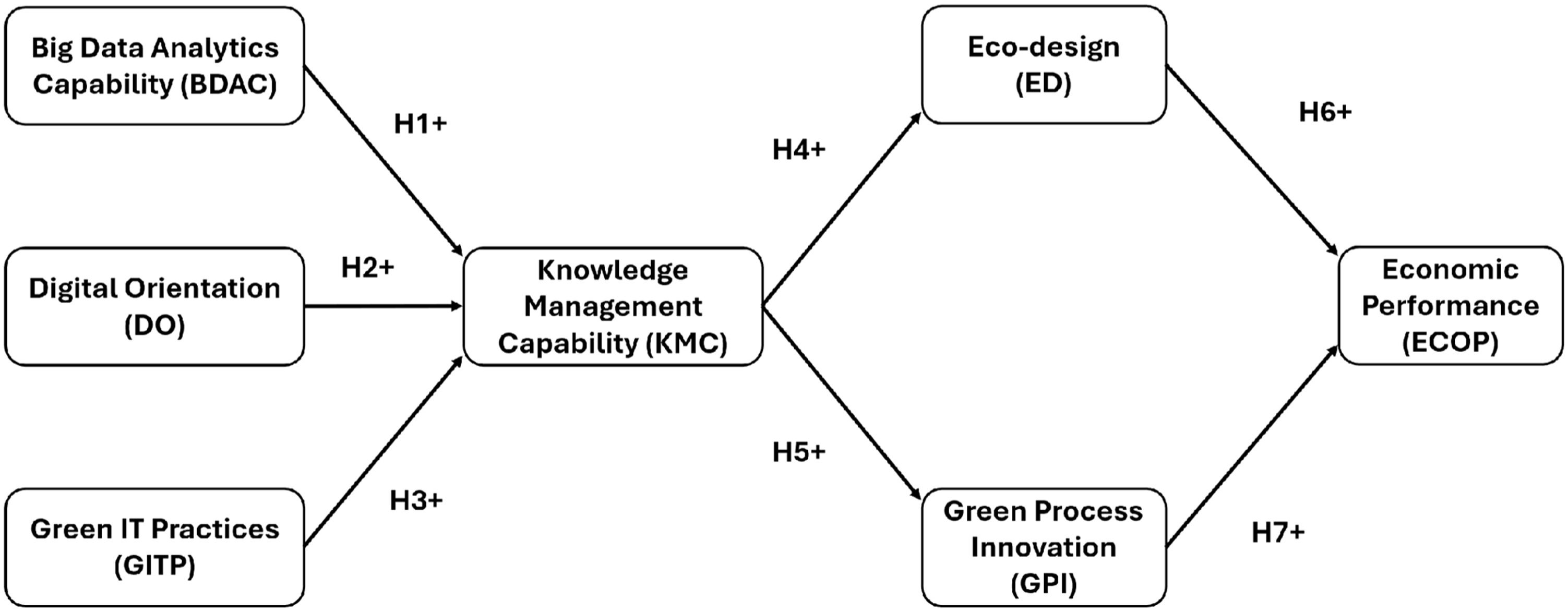
Building on DCV and KBV, we propose that firm capabilities influence economic performance through a sequential process involving knowledge management and innovation (Fig. 1).
Eco-design pathwayBDAC, DO, and GITP enhance the firm’s ability to generate and manage knowledge (KMC), which in turn enables eco-design initiatives. These eco-design efforts subsequently improve economic performance through efficiency gains and market differentiation.
Under the KBV, KMC transforms data into organizational learning and innovation. Studies show that BDAC enhances firm performance, primarily by facilitating knowledge management and organizational agility (Ferraris et al., 2019; Makhloufi et al., 2023). KMC causes Eco-Digital Innovation (ED), which is the application of digital technologies combined with sustainability practices to create solutions with environmental efficiency (Zhang et al., 2025). For instance, AI can optimize energy use and bring down costs while also creating circular economy platforms, which are apps that reduce waste. Mikalef et al. (2020) state that firms with high BDAC perform better financially due to knowledge-based eco-innovation.
H8a The effect of BDAC on ECOP is serially mediated by KMC and ED
According to DCV, DO acts as a dynamic capability that helps firms sense and seize digital opportunities. It helps to form a valuable culture of sharing and learning internally by looking through the KBV lens. Employers that have a high degree of openness invest in IT infrastructure, online training, and teamwork systems. These systems enhance knowledge management capacity, encouraging employees to have lifelong learning. KMC is the channel through which the DO drives Eco Digital Innovation (ED). The interaction of digital tools and sustainability initiatives have the potential produce eco-efficient results. Companies mix digital know-how with environmental experience and develop new technologies: carbon-tracking analytics, resource optimization digital twins, and smart sustainability systems (Ogbeibu et al., 2021). These technologies improve financial and environmental performance and is corroborated by empirical evidence whereby DO enhances innovation and profitability by integrating digital knowledge and being agile (Zhang et al., 2025).
H8b The effect of DO on ECOP is serially mediated by KMC and ED
Green IT Practices (GITP) entail building and operating IT systems in a sustainable manner, such as the use of energy-efficient centers, virtualization, cloud computing, and e-waste management (Chuang & Huang, 2018). Through DCV, GITP can be viewed as adaptive abilities matches the technological resources to the environmental goals. They create green knowledge under the KBV, which increases the learning ability and knowledge-sharing habits of a firm. High KMC can enable organizations to attract and share IT knowledge related to sustainability across the departments, contributing to the development of Eco-Digital Innovation (ED). When companies combine IT skills with environmental management, they create IT-related technologies such as smart energy systems using IoT or AI-powered garbage tracking, which is less expensive and more eco-friendly (Dubey et al., 2020). These technologies enhance the environmental reputation and returns (Chuang & Huang, 2018).
H8c The effect of GITP on ECOP is serially mediated by KMC and ED
Similar eco-design capabilities, firm capabilities enhance KMC, which facilitates the development of green process innovations. These innovations lead to improved economic performance through cost reduction and operational efficiency. In particular, KBV suggests that GPI is facilitated through BDAC and KMC, which transform data into process improvements that minimize waste and the use of energy. Effective knowledge sharing, in turn, transforms analytical results into long-term working practices, improving efficiency and profitability. Several empirical studies show that BDAC enhances green innovation and profitability based on knowledge management pathways (Makhloufi et al., 2023; Dubey et al., 2020).
H9a The effect of BDAC on ECOP is serially mediated by KMC and GPI
Based on the DCV, DO facilitates the continuous monitoring and reconfiguration of operations, whereas KBV emphasizes the need to promote digital learning and knowledge dissemination (Quinton et al., 2018). DO provides the flows of knowledge across functions to trigger Green Process Innovation (GPI) by automation to conserve energy or digitally monitor material efficiency through improved KMC. The benefits of such process innovations are that they lower the costs and environmental impact, enhancing financial performance (Wiengarten et al., 2013). The empirical data show that those firms that seek digital and sustainability changes in parallel with each other known as ‘twin transformation’ firms, are more efficient and profitable (Christmann et al., 2024).
H9b The effect of DO on ECOP is serially mediated by KMC and GPI
From DCV, GITP are adaptive capabilities that match IT resources and sustainability objectives. According to the DCV perspective; under KBV, GITP produces environmental knowledge, such as the environmentally responsible use of energy-saving systems, cloud services, and digital waste minimization, which reinforces KMC between departments. KMC incorporates the experience of IT monitoring and analytics to stimulate Green Process Innovation (GPI)- such as the reorganization of processes according to real-time energy information. These solutions enhance the use of resources, cost minimization and enhance environmental and economic performance (Yuan & Cao, 2022). Empirical evidence demonstrates that companies that invest in green IT are able to gain financial and competitive advantages by means of sustainable process enhancement (Chuang and Huang, 2018).
H9c The effect of GITP on ECOP is serially mediated by KMC and GPI
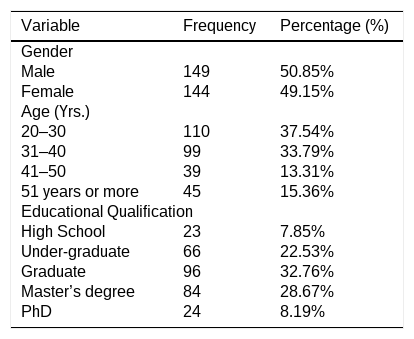
Data for this study were collected from professionals working in the supply chain and logistics industries across multiple countries, including the United States, the United Kingdom, South Africa, and Canada. A structured questionnaire, developed in English, was administered through Prolific, which is widely recognized for its high-quality participant pool and reliable data collection procedures. Before full deployment, the questionnaire was reviewed to ensure clarity and minimize ambiguity. A targeted sampling approach was employed to capture diversity across key demographic characteristics such as age, gender, education, and social media usage. 293 valid responses were obtained and used for analysis. The sample size recommendations of Westland (2010) suggest a minimum sample size of at least five times the number of measurement items. The sample size is adequate for the 35 items used in the present study. Data analysis was conducted using SmartPLS 4. A summary of the respondents’ demographic characteristics is presented in Table 1.
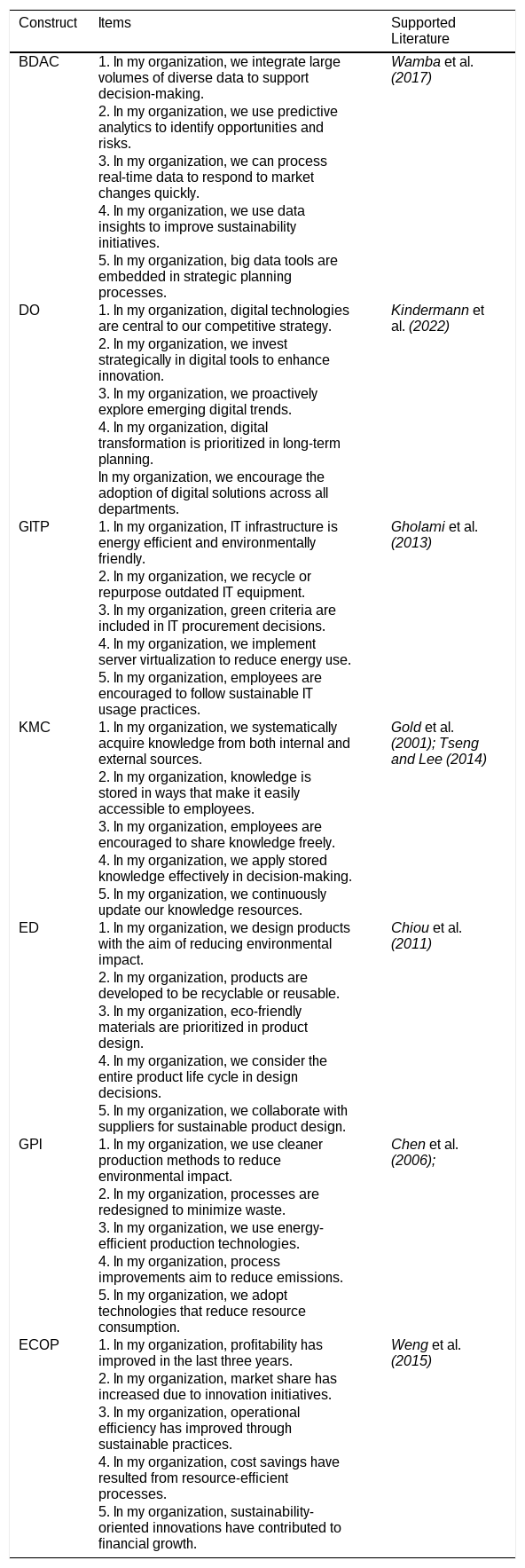
InstrumentsThe measurement items for BDAC, DO, GITP, KMC, ED, GPI, and ECOP were developed by adapting and synthesizing constructs from studies available in the literature. All items were assessed using a five-point Likert scale, where 1 denoted strong disagreement and 5 denoted strong agreement. Table 2 presents the complete list of measurement items with their respective adapted sources.
Measurement Items and Sources.
| Construct | Items | Supported Literature |
|---|---|---|
| BDAC | 1. In my organization, we integrate large volumes of diverse data to support decision-making. | Wamba et al. (2017) |
| 2. In my organization, we use predictive analytics to identify opportunities and risks. | ||
| 3. In my organization, we can process real-time data to respond to market changes quickly. | ||
| 4. In my organization, we use data insights to improve sustainability initiatives. | ||
| 5. In my organization, big data tools are embedded in strategic planning processes. | ||
| DO | 1. In my organization, digital technologies are central to our competitive strategy. | Kindermann et al. (2022) |
| 2. In my organization, we invest strategically in digital tools to enhance innovation. | ||
| 3. In my organization, we proactively explore emerging digital trends. | ||
| 4. In my organization, digital transformation is prioritized in long-term planning. | ||
| In my organization, we encourage the adoption of digital solutions across all departments. | ||
| GITP | 1. In my organization, IT infrastructure is energy efficient and environmentally friendly. | Gholami et al. (2013) |
| 2. In my organization, we recycle or repurpose outdated IT equipment. | ||
| 3. In my organization, green criteria are included in IT procurement decisions. | ||
| 4. In my organization, we implement server virtualization to reduce energy use. | ||
| 5. In my organization, employees are encouraged to follow sustainable IT usage practices. | ||
| KMC | 1. In my organization, we systematically acquire knowledge from both internal and external sources. | Gold et al. (2001); Tseng and Lee (2014) |
| 2. In my organization, knowledge is stored in ways that make it easily accessible to employees. | ||
| 3. In my organization, employees are encouraged to share knowledge freely. | ||
| 4. In my organization, we apply stored knowledge effectively in decision-making. | ||
| 5. In my organization, we continuously update our knowledge resources. | ||
| ED | 1. In my organization, we design products with the aim of reducing environmental impact. | Chiou et al. (2011) |
| 2. In my organization, products are developed to be recyclable or reusable. | ||
| 3. In my organization, eco-friendly materials are prioritized in product design. | ||
| 4. In my organization, we consider the entire product life cycle in design decisions. | ||
| 5. In my organization, we collaborate with suppliers for sustainable product design. | ||
| GPI | 1. In my organization, we use cleaner production methods to reduce environmental impact. | Chen et al. (2006); |
| 2. In my organization, processes are redesigned to minimize waste. | ||
| 3. In my organization, we use energy-efficient production technologies. | ||
| 4. In my organization, process improvements aim to reduce emissions. | ||
| 5. In my organization, we adopt technologies that reduce resource consumption. | ||
| ECOP | 1. In my organization, profitability has improved in the last three years. | Weng et al. (2015) |
| 2. In my organization, market share has increased due to innovation initiatives. | ||
| 3. In my organization, operational efficiency has improved through sustainable practices. | ||
| 4. In my organization, cost savings have resulted from resource-efficient processes. | ||
| 5. In my organization, sustainability-oriented innovations have contributed to financial growth. |
Note: BDAC – Big Data Analytics Capability; DO – Digital Orientation; GITP- Green IT Practices; KMC- Knowledge Management Capability, ED- Eco-design; GPI – Green Process Innovation; ECOP- Economic Performance.
To mitigate Common Method Bias (CMB), the study utilized statistical tools and relevant therapy (Podsakoff & Organ, 1986). The single-factor test established by Harman served as the primary detection method for identifying common method bias (CMB) in each construct of the research model in this work (Podsakoff & Organ, 1986). The Harman single-factor test is the predominant method for detecting common method bias due to its widespread application (Benzidia et al., 2021). The study's factor analysis of the evaluation items aims to identify a dominant factor and quantify the extent to which one component accounts for covariation (Kristoffersen et al., 2021). As factor analysis failed to reveal a predominant dimension, this study does not encounter common method bias concerns.
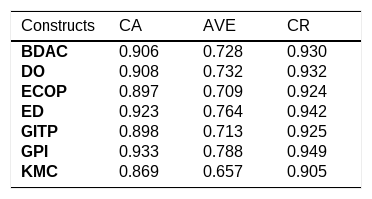
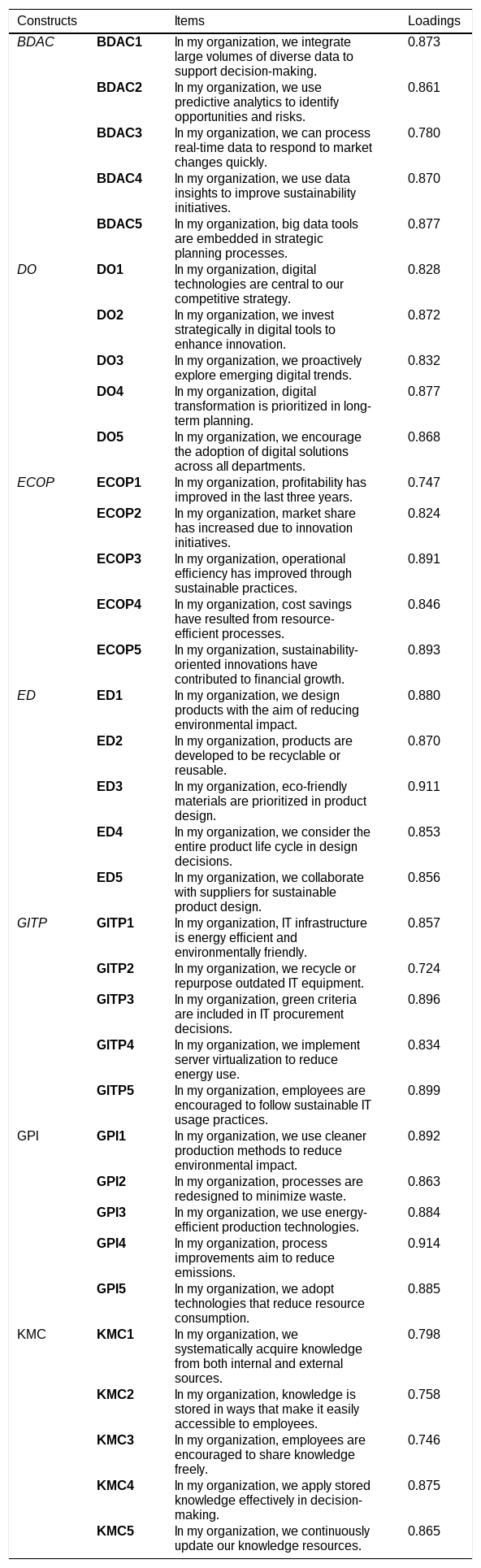
Reliability and validity analysisConstruct reliability and validity were assessed using established criteria (Fornell & Larcker, 1981). Indicator loadings exceeded the recommended threshold of 0.70, while Cronbach’s alpha and composite reliability (CR) values were above 0.70, indicating satisfactory internal consistency. Convergent validity was confirmed as the average variance extracted (AVE) for all constructs exceeded 0.50. Discriminant validity was established using both the Fornell–Larcker criterion and the HTMT ratio (Henseler et al., 2015). Specifically, the square root of AVE for each construct exceeded its inter-construct correlations, and all HTMT values were below the threshold of 0.90, indicating adequate discriminant validity. Detailed results are presented in Tables 3–5.
Reliability and validity analysis.
| Constructs | CA | AVE | CR |
|---|---|---|---|
| BDAC | 0.906 | 0.728 | 0.930 |
| DO | 0.908 | 0.732 | 0.932 |
| ECOP | 0.897 | 0.709 | 0.924 |
| ED | 0.923 | 0.764 | 0.942 |
| GITP | 0.898 | 0.713 | 0.925 |
| GPI | 0.933 | 0.788 | 0.949 |
| KMC | 0.869 | 0.657 | 0.905 |
Note: BDAC – Big Data Analytics Capability; DO – Digital Orientation; GITP- Green IT Practices; KMC- Knowledge Management Capability, ED- Eco-design; GPI – Green Process Innovation; ECOP- Economic Performance.
Measurement items loadings.
Note: BDAC – Big Data Analytics Capability; DO – Digital Orientation; GITP- Green IT Practices; KMC- Knowledge Management Capability, ED- Eco-design; GPI – Green Process Innovation; ECOP- Economic Performance.
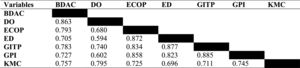
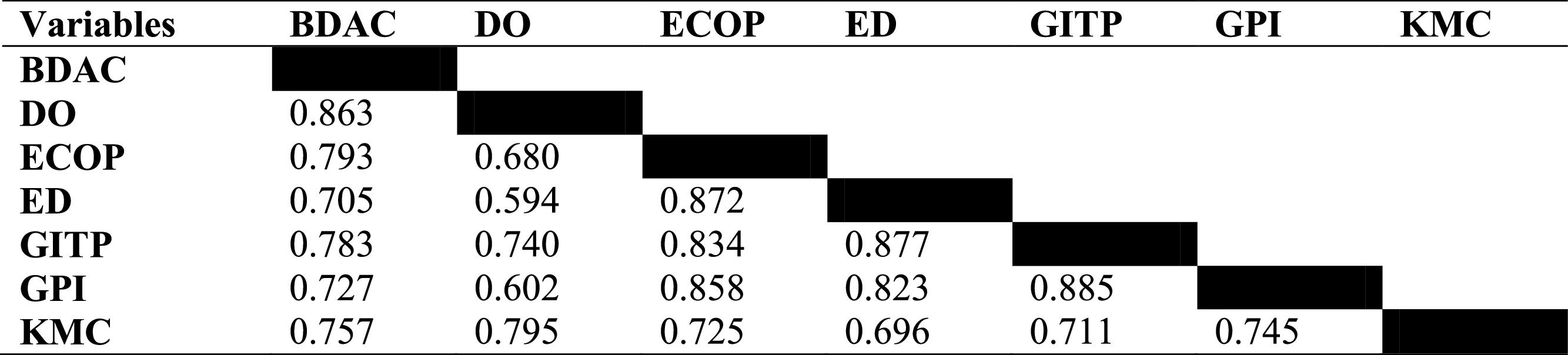
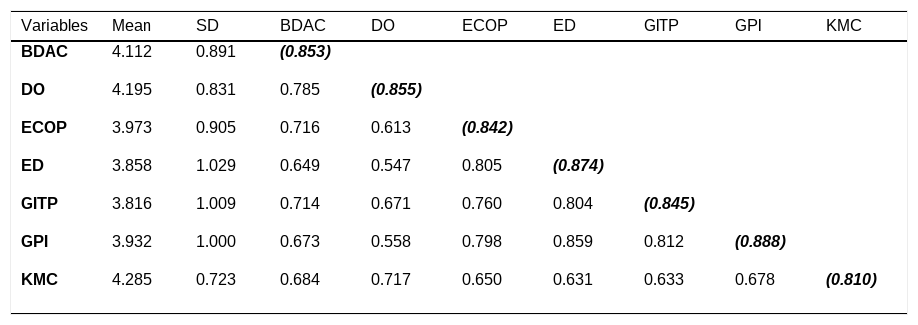
Table 6 displays the descriptive statistics and correlations of the study. The multicollinearity correlation matrix was analysed using the established criteria (Hair et al., 2013). Further, the correlation coefficients for each construct are all below 0.90, indicating that multicollinearity is not an issue (Dohoo et al., 1997; Chen & Rothschild, 2010).
Descriptive Statistics and Correlations.
Note: BDAC – Big Data Analytics Capability; DO – Digital Orientation; GITP- Green IT Practices; KMC- Knowledge Management Capability, ED- Eco-design; GPI – Green Process Innovation; ECOP- Economic Performance. The square-root of AVE is indicated in italics and brackets.
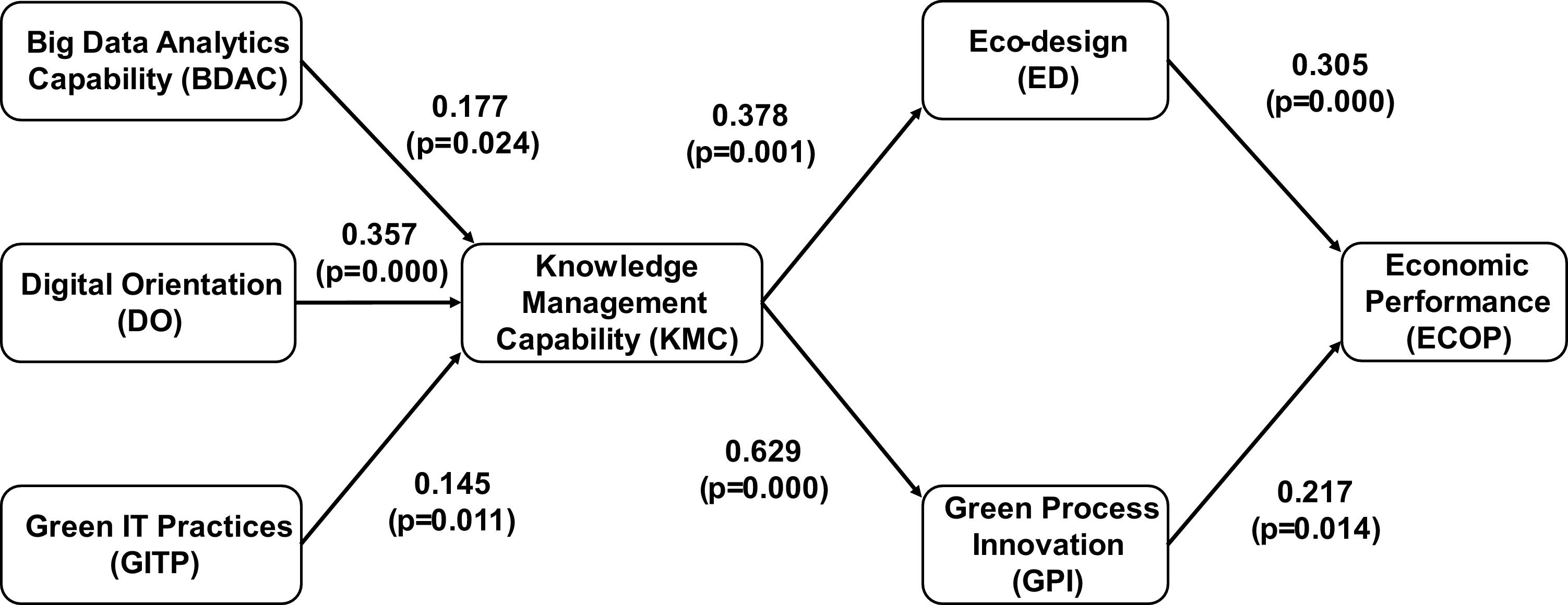
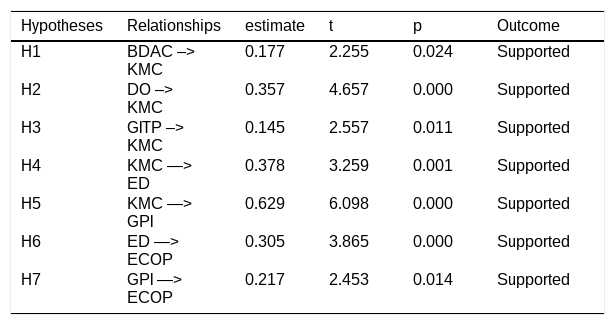
Table 7 presents the direct relationships among the study variables. Overall, all hypothesized direct effects are positive and statistically significant, although their strength varies across relationships. Among the predictors of KMC, DO shows the strongest effect (β = 0.357, p < .001), indicating that it is the most influential driver of KMC, supporting the study’s initial hypothesis. BDAC has a moderate positive effect (β = 0.177, p = .024) while GITP exhibits a relatively weaker but still significant effect (β = 0.145, p = .011), confirming support for both hypotheses 2 and 3. This suggests that while all three capabilities contribute to KMC, DO plays a more dominant role. KMC, as a driver of innovation, shows strong and moderate effects, such that KMC significantly influences both innovative outcomes, but with differing magnitudes. The effect of KMC on Green Process Innovation (GPI) is very strong (β = 0.629, p < .001), supporting hypothesis four. The effect on Eco-Design (ED) is moderate to strong (β = 0.378, p = .001). This indicates that KMC is particularly critical for process-level innovation, compared to product-level eco-design. Further results suggest that both innovation pathways contribute positively to economic performance (ECOP), where Eco-Design (ED) has a moderate effect (β = 0.305, p < .001) and Green Process Innovation (GPI) shows a somewhat weaker but still significant effect (β = 0.217, p = .014).
Direct Effects.
Note: BDAC – Big Data Analytics Capability; DO – Digital Orientation; GITP- Green IT Practices; KMC- Knowledge Management Capability, ED- Eco-design; GPI – Green Process Innovation; ECOP- Economic Performance.
Fig. 2 given below, depicts the estimated model showcasing the coefficients and p values for all linear relationships.
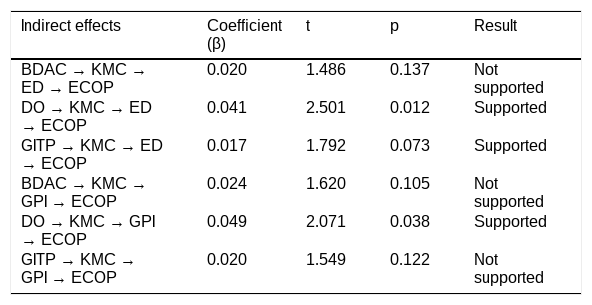
Mediation analysisTable 8 presents the results of the mediation analysis for the proposed serial pathways in hypotheses 8a, 8b, 8c, 9a, 9b, and 9c. Overall, the findings reveal a mixed pattern, with some relationships emerging as strong and consistent, while others are weak or not supported. Contrary to expectations, BDAC does not exhibit significant mediation effects in the eco-design pathway and finds no support for hypothesis 8a (stating that BDAC causes ECOP via KMC and ED). This means that the positive effects of BDAC on ECOP are not serially mediated by KMC and ED. Digital Orientation shows the strongest and most consistent mediation effects across the innovation pathway, as suggested by research hypothesis 8b (stating that DO causes ECOP via KMC and ED). The indirect effect of DO on ECOP through KMC and Eco-Design is positive and statistically significant (β = 0.041, p = .012), supporting hypothesis 8b In contrast, the research hypothesis 8c (stating that GITP causes ECOP via KMC and ED) is marginally significant (β = 0.017, p = .073), suggesting a weak but positive effect. Similar to BDAC findings in hypothesis 8a, the results do not support hypothesis 9a (that BDAC causes ECOP via KMC and GPI). These findings suggest that although BDAC is theoretically important, its impact on performance does not operate through the proposed knowledge–innovation mechanisms. This represents an unexpected result, indicating that BDAC may influence performance through alternative pathways (for instance, through direct efficiency gains or decision quality improvements).
Indirect effects.
Note: BDAC – Big Data Analytics Capability; DO – Digital Orientation; GITP- Green IT Practices; KMC- Knowledge Management Capability, ED- Eco-design; GPI – Green Process Innovation; ECOP- Economic Performance. Significance level at 10%.
However, hypothesis 9b (stating that DO causes ECOP via KMC and GPI) suggests a significant effect (β = 0.049, p = .038). Together, the results of hypotheses 8b and 9b indicate that DO reliably translates into performance gains through both product-based (ED) and process-based (GPI) green innovation mechanisms, making it the most robust driver in the model. Alternatively, the results are not consistent with hypothesis 9c (stating that GITP causes ECOP via KMC and GPI) (β = 0.020, p = .122). Together, the results of hypotheses 8c and 9c suggest that GITP contributes to performance primarily through product-related sustainability (eco-design) but does not effectively translate into process-level innovations. The following section discusses the implications of the findings in detail.
DiscussionThe findings explain why companies transform digital, knowledge, and green innovation potentials into economic and sustainable profits. We demonstrate that the journey to the sustainability outcomes following a digital transformation is not linear by combining the Dynamic Capabilities View (DCV) and the Knowledge-Based View (KBV). It depends on the capacity of the firm to deal with knowledge and transform the knowledge into eco-innovations.
In particular, Knowledge Management Capability (KMC) is reinforced by Big Data Analytics Capability (BDAC), Digital Orientation (DO), and Green IT Practices (GITP); KMC promotes Eco-Design (ED) and Green Process Innovation (GPI). These environmentally innovative products, in turn, enhance economic performance. The mediation pathway reflects a sequential mechanism that traverses DO (capability), KMC (Knowledge management), and both ED and GPI (Eco-innovations), revealing one key fact. Such digital investments are rewarded in sustainability-related environments (Eco-performance) when built into knowledge processes capable of promoting environmental innovation. Overall, the findings support the central premise (the research question asked in the introduction section) that capabilities create value when they are converted into knowledge and subsequently into innovation outcomes. Although this conversion is not uniform across all capability types, The following paragraphs explicitly articulate how and why one construct influences another, rather than embedding multiple theoretical perspectives simultaneously.
The central role of KMC and innovationConsistent with expectations, Knowledge Management Capability (KMC) emerges as a critical intermediary linking firm capabilities to both eco-design (ED) and green process innovation (GPI). The strong effect of KMC on GPI, in particular, underscores that process innovation is highly dependent on effective knowledge integration and cross-functional coordination. This aligns with the Knowledge-Based View, which positions knowledge integration as the foundation of innovation. The present findings are consistent with previous and recent research findings. For instance, Baquero (2024) of manufacturing firms found that KMC mediates the relationship between a green learning orientation and GPI. However, they found no mediation of KMC with product innovation, highlighting the role of effective resource allocation in maximizing environmental learning benefits for sustainable innovation. Earlier, Abbas and Sağsan (2019) reported that KMC significantly impacts green innovation equally for all types of manufacturing and service firms. Therefore, both ED and GPI positively influence economic performance, confirming that sustainability-oriented innovations generate tangible economic value. From a DCV perspective, these innovations reflect firms’ capability to reconfigure resources in response to environmental and market demands. From a KBV perspective, the present findings identify the role of KMC in enabling ED and GPI as a knowledge integrator and application mechanism rather than a broad dynamic capability discussion. The conceptual separation of ED and GPI (in the literature review section) is also reflected in the present findings, where KMC exerts a stronger influence on GPI than on eco-design.
Differential effects of capabilitiesAmong the antecedents, Digital Orientation (DO) shows the strongest and most consistent effects, both directly (on KMC) and indirectly (through ED and GPI). This suggests that DO operates as a higher-order, system-level capability that shapes not only technological investments but also organizational culture, learning, and collaboration. Because of its broad scope, DO more effectively activates knowledge processes and enables their translation into both product- and process-level innovations. Such findings are consistent with recent research. Shehzad et al. (2024) report that DO, as an enabler of knowledge management processes, significantly impacts two aspects of green innovation, green product and process innovation. As a result, DO enhances KMC by creating the behavioral and structural conditions necessary for effective knowledge creation and sharing. In essence, DO becomes an antecedent mechanism for why and where the knowledge flows.
In contrast, Big Data Analytics Capability (BDAC) and Green IT Practices (GITP) exhibit more limited or pathway-specific effects, highlighting that not all capabilities diffuse equally across innovation domains. The notable unexpected findings of the present paper refine the theoretical understanding of capability–innovation linkages in two ways.
First, BDAC does not significantly influence economic performance through either eco-design or green process innovation. This suggests that while BDAC enhances data-driven sensing and insight generation, these insights do not automatically translate into innovation outcomes. From a DCV perspective, BDAC is primarily a sensing capability, and its value depends on downstream integration. Without effective embedding into organizational routines, analytics outputs may remain confined to decision support rather than driving innovation. This highlights that analytical capability alone is insufficient without knowledge integration and execution alignment. Again, the findings are consistent with recent research. Hao et al. (2019) inform project leaders in both China and the U.S. that an innovative project performance can be increased by empowering project teams with optimal big data resources on user behavior, customer needs, technology development intelligence, and competitive intelligence (such as marketing, products, services, among others). Together, these findings suggest that BDAC is not purely a technical or analytical process but also a strategic implication. Additionally, Percin (2023) identifies barriers to BDAC capability in firms, such as a lack of financial resources, a lack of security, privacy, and trust, or a lack of skilled human resources. Theoretically, this non-significant serial mediation can be grounded in the distinction between sensing and reconfiguring within the DCV. BDAC primarily strengthens the sensing pole of the dynamic-capability sequence, generating descriptive and predictive signals; however, the conversion of these signals into eco-design or green process innovation requires complementary seizing and reconfiguring routines that BDAC alone does not supply. From a KBV standpoint, analytics outputs are largely explicit and codified, whereas eco-innovation depends on tacit, cross-functional sustainability knowledge that is created through experiential learning and inter-departmental dialogue. The contextual specificity of the sample, supply chain and logistics firms, further reinforces this interpretation: in such operationally driven settings, big data capabilities are often deployed for short-cycle efficiency decisions (routing, demand forecasting, inventory control) rather than for longer-horizon green product or process redesign, which weakens their indirect path to ECOP through eco-innovation. Thus, the non-significant mediation is not a contradiction of theory but a context-conditional boundary of when BDAC’s sensing strength alone is insufficient to drive sustainability-oriented innovation.
Second, GITP does not significantly mediate performance through GPI, although it shows a marginal effect via eco-design. This indicates that GITP, while promoting sustainability, may remain functionally concentrated within IT domains and may not extend effectively into broader operational processes required for GPI. Process innovation requires system-wide reconfiguration, whereas GITP tends to support incremental efficiency improvements. Thus, its impact can appear stronger in product design contexts, where digital tools more directly support sustainability integration.
Taken together, the present findings suggest that the effectiveness of firm capabilities depends not only on their presence but also on their scope, integration, and functional reach. Capabilities that are broad and systemic (such as DO) are more likely to permeate knowledge processes and drive innovation, whereas specialized capabilities (such as BDAC, GITP) may require stronger integration mechanisms to realize their full value. Some stronger integration mechanisms are discussed in the future directions of research.
We also validate that eco-design and green process innovation increase economic performance. This discovery revisits the Porter hypothesis and supports the argument that environmental innovation can improve competitiveness. Once the firms incorporate ecological requirements in the products and processes, they attain efficiency gains, reduction of waste, and differentiation, which translate to monetary returns. Based on the DCV, eco-innovation capabilities are indicative of a firm’s ability to reorganize both products and operations when environments change. ED and GPI have been indicative of applied knowledge that enhances efficiency in the environment and economy. The evidence highlights the importance of KMC; eco-innovation is knowledge-driven and requires the efficient flow of information between design, R&D, and operations.
Theoretical implicationsThese findings, put together, develop a theory in three directions. To begin with, we mediate DCV and KBV to discuss how digital and knowledge-based capabilities are developing to generate sustainable performance. Such integration adds to the discussion on the micro foundations of knowledge management by defining knowledge management as a learning process and a reconfigurative process, operationalizing the digital transformation. Second, we contribute to the development of the theory of eco-innovation because we integrate digital transformation within green innovation systems. We do not think of eco-innovation as a compliance or regulatory reaction, but we conceptualize this phenomenon as the product of organized digital and knowledge capabilities. This is in response to the demands of whole systems frameworks that reflect the multidimensionality of sustainable competitiveness. Third, through validation of the serial mediation mechanism, we demonstrate how several capabilities interact sequentially to drive performance. This goes past direct-effect models and lays sustainable value creation as a compounded, stratified process.
Managerial implicationsFor managers, the implications are practical. Sustainability and profitability will not be provided by the adoption of technology only. The value chain is in the form of organizational systems that capture, disseminate, and use digital technology-based knowledge. KMC involves investment in knowledge platforms, cross-functional routines, and a culture of learning. However, such intentions have the potential to be invested in technology fads rather than in the effectiveness of achieving organizational objectives. As technology integrators, managers must regard possible benefits with value (sustainable values) and cost (economic) to the firm.
The findings of the present study indicate that performance gains do not arise from isolated investments in digital or sustainability initiatives, but from their sequenced integration through knowledge processes and innovation outcomes. Accordingly, managers should prioritize investments across three layers, namely strategic orientation, knowledge infrastructure, and innovation execution.
As DO shows the strongest and most consistent effects (directly on KMC and indirectly via both ED and GPI), the message to firms is clear – fund orientation before tools. A clear digital–sustainability intent ensures downstream investments (such as analytics, green IT) are actually used and diffused. Further, firms can do well to develop explicit KPIs around leadership commitment to digital and sustainability goals, encourage cross-functional collaboration norms (for instance, between product, operations, and IT departments), and develop continuous learning systems (such as digital upskilling and experimentation budgets) for digital literacy. Each managerial prescription can be linked to an empirical finding from the model to make it actionable. The single action with highest leverage in the model is the integration of an explicit DO statement into the leadership agenda and of executive incentives to its diffusion across functions. The findings indicate that both the direct effect of DO on KMC and the serial indirect effect of DO on ECOP through KMC and ED are statistically significant. Second, the results show that green IT investments are only marginally leveraged by product design teams and lack direct integration into GPI; therefore, it is important that green IT investments are deliberately related to the product design teams (currently a pay-off is achieved) rather than expected to transform the production processes spontaneously. Third, both BDAC pathways are not significant, which means managers should not assume that the mere presence of analytics dashboards will translate into eco-innovation: analytics investments need to be linked to explicit routines for knowledge translation (e.g., analytics-to-design review cycles, cross-functional “insight-to-action” workflows) in order to ensure that the output of analytics leads to reconfiguring decisions. Combined, these data-driven prescriptions take the conversation beyond general exhortation and into a logical sequence of data-supported investments.
Lastly, the study offers managerial implications: eco-performance is achieved through integration of technology. First invest in orientation (DO), then in knowledge integration (KMC) and last in targeted innovation pathways (ED, GPI), with analytics (BDAC) and green IT (GITP) well integrated into these processes. In practice, these actions implement an eco-digital edge, bringing technological flexibility and ecological sustainability together.
ConclusionsThis study examined how digital capabilities, Big Data Analytics Capability (BDAC), Digital Orientation (DO), and Green IT Practices (GITP) contribute to economic performance (ECOP) through the mediating roles of knowledge management capability (KMC) and eco-innovation (Eco-design and Green Process Innovation). The findings demonstrate that while all three capabilities enhance KMC, their downstream effects on innovation and performance are uneven and pathway dependent. In particular, DO emerges as the most influential and consistent driver, enabling both eco-design and green process innovation through effective knowledge integration. In contrast, BDAC and GITP exhibit more limited or context-specific effects, suggesting that their value depends on the extent to which they are embedded within organizational knowledge processes and innovation routines. These results highlight the central role of KMC as the mechanism through which capabilities are transformed into actionable innovation outcomes. In particular, technology, knowledge, and sustainability become a coherent system of capability resulting in an eco-digital advantage.
To academics, the study advances understanding of how firms create value in digital sustainability contexts by integrating the Dynamic Capabilities View (DCV) and Knowledge-Based View (KBV). It suggests that performance gains are not driven by capabilities alone, but by their effective knowledge integration and translation into innovation. Accordingly, the study highlights that firms seeking sustainable economic performance must move beyond isolated investments and instead develop aligned systems that connect digital capabilities, knowledge management, and sustainability-oriented innovation. To practitioners, we suggest strategic investments and actions that build an eco-digital edge. In digital sustainability contexts, competitive advantage arises not from possessing capabilities, but from integrating them into knowledge and innovation systems that drive sustainable performance.
Limitations and future directionsThis study has a few limitations. The cross-sectional design restricts causal inference. Alternatively, a longitudinal design can help future research trace the process of development of digital and knowledge capabilities to sustain eco-innovation. Despite the heterogeneity of the sample, the industry is still heterogeneous; sector-specific future studies can be conducted to compare the manufacturing and services sectors to narrow the context. Conceptually, future research could further explore the role of stronger integration mechanisms that enable specialized capabilities such as big data analytics and green IT practices to translate into innovation outcomes. In particular, mechanisms such as cross-functional integration routines, absorptive capacity, and sustainability-oriented governance structures may facilitate the diffusion and recombination of knowledge across organizational domains. These mechanisms can help overcome the functional silos within which analytical and IT capabilities often operate, thereby strengthening their impact on both product- and process-level innovation. Additional applications to social sustainability would be applicable in future work, where digital and knowledge capabilities are connected to equity, safety, and community outcomes. Lastly, new areas of practice, such as circular economy, digital twins, and AI-based sustainability analytics, are worth consideration. The combination of firm and network design of multi-level data would show how eco-digital innovation is increased or hindered by the flow of knowledge among different firms.
Funding StatementPrincess Nourah bint Abdulrahman University Researchers Supporting Project Number (PNURSP2026R541), Princess Nourah bint Abdulrahman University, Riyadh, Saudi Arabia.
CRediT authorship contribution statementCanghong Wang: Writing – review & editing, Supervision, Software. Lubos Smutka: Writing – review & editing, Writing – original draft, Resources. Chaoliang Zheng: Writing – original draft, Data curation, Conceptualization. Rsha Alghafes: Writing – review & editing, Writing – original draft, Methodology, Investigation. Varun Chotia: Writing – review & editing, Writing – original draft, Supervision, Software.

