

Research links ambidexterity and innovation. However, the impact of the relationship between ambidextrous innovation and resilience relative to ambidexterity outcomes in the developing world remains atheoretical. Accordingly, this study introduces an ambidextrous innovation–resilience–ambidexterity interface to investigate 300 developing world SMEs. From this phenomenon–theory interface, equation, and regression modelling, we deduce theories to articulate the tenuous relationship between ambidextrous innovation strategies (IT [information technology] and learning capabilities) and resilience relative to ambidexterity outcomes for these SMEs. Juxtaposed against the ambidexterity–resilience link found in mainstream research, we show how the interplay of these ambidextrous innovation strategies with resilience weakens ambidexterity outcomes in a developing world setting, where essential entrepreneurship resources are too limited to meet SMEs’ needs. This study is original because it suggests that ambidextrous behavior may not always yield positive outcomes in a developing world setting, which has implications for research, policymaking, and SME practice.
Scholarly research describes how firms that simultaneously exploit their current knowledge and skills and explore new ones increase their innovation performance (Benner & Tushman, 2003; Berraies et al., 2015; Berraies & El Abidine, 2019). This body of knowledge suggests that an organization’s capacity to be ambidextrous relies on structural mechanisms that, on the one hand, support exploration and, on the other hand, advance exploitation by creating an innovation climate (SotoAcosta et al., 2018; Zuraik & Kelly, 2018) tethered on relational and organizational trust (Jena et al., 2018; Lewicki & Brinsfield, 2017). Within this research stream, ambidextrous innovation has been repeatedly identified as a common feature enabling organizations to renew their competencies and capture discontinuous innovations or generate incremental innovations (Doblinger et al., 2022; He & Wong, 2004; Junni et al., 2023; Scuotto et al., 2019; Tian et al., 2021). While this corpus of research has been successful in identifying a path detailing how organizations must juggle the paradoxes of ambidexterity (O’Reilly & Tushman, 2004), the research overlooks the mechanisms underlying ambidexterity outcomes when ambidextrous innovation strategies of IT and learning intersect with resilience in developing world SMEs (cf., Iborra et al., 2022; Yu et al., 2023).
Considering this research oversight, this study focuses on developing world SMEs in the construction industry. It draws upon a dynamic combination of economic and social factors of ambidextrous innovation strategies of IT and learning capabilities to develop theories with resilience relative to ambidexterity outcomes. The goal is to conceptualize their relationship with ambidexterity outcomes from a developing world SME perspective (cf., Morris et al., 2023; Wickert et al., 2024). Following this logic, the study introduces an integrated ambidextrous innovation–resilience–ambidexterity interface to decipher the interplay of ambidextrous innovation strategies (IT and learning capabilities) and resilience relative to the ambidexterity outcomes for SMEs that coexist in a developing world setting. Thus, the following question guides the investigation to exact our understanding.
How do ambidextrous innovation strategies of IT and learning capabilities, resilience, and ambidexterity outcomes interrelate in a developing world setting where essential entrepreneurship resources to meet SMEs’ needs are limited?
Addressing this critical research question requires attention to context (cf., Jacob et al., 2022; Jansen et al., 2006; Shepherd et al., 2025). Indeed, and although research on ambidexterity recognizes the impact of the business environment (e.g., Chakma & Dhir, 2023; Paliokaitė & Pačėsa, 2015), the literature has neglected how ambidextrous behavior (Hughes et al., 2021) and resilience interactions (Iborra et al., 2022) shape ambidexterity outcomes from a developing world SME perspective. Focusing on developing world SMEs characterized by intertwined and competing economic and social factors transcends the averages due to the dense dataset it generates that is rich in indigenous knowledge often ignored in mainstream research (see Bruton et al., 2022; Shepherd et al., 2025; Simba, 2026). Such focus enriches entrepreneurship research in several ways.
First, it contributes theoretical explanations to advance an ambidextrous innovation–resilience–ambidexterity nexus to articulate how the dual effects of ambidextrous innovation strategies and resilience attenuate ambidexterity outcomes in the context of developing world SMEs. Juxtaposed against the ambidexterity–resilience link mentioned in research elsewhere (e.g., Iborra et al., 2022; Stokes et al., 2019; Veiga et al., 2024), this study contributes theoretical perspectives elaborating how the interplay of ambidextrous innovation strategies with resilience in a developing world setup weakens ambidexterity outcomes. This relationship outcome deviates from the norm, suggesting that ambidexterity may not always yield high innovation performance or business continuity in a developing world setting.
Second, and building upon the theoretically grounded suppositions above, our study contributes contextualized theoretical perspectives elaborating an unexpected relationship of ambidextrous innovation strategies (particularly IT and learning capability) and resilience relative to ambidexterity outcomes observable in a developing world setting. Thus, the study contributes new knowledge to the literature with context as an antecedent underlying ambidextrous innovation strategies (Gibson & Birkinshaw, 2004; Jacob et al., 2022; Papachroni & Heracleous, 2020), resilience (Iborra et al., 2022) and ambidexterity realization (O’Reilly & Tushman, 2004) relationships. Such perspectives respond to a growing chorus of voices advocating the contextualization of theoretical perspectives of entrepreneurship (see Shepherd et al., 2025; Wickert et al., 2024). This is important because the entrepreneurial contexts in which many developing world SMEs coexist are either misunderstood or considered insignificant in the mainstream entrepreneurship literature due to the dominance of Western views of entrepreneurship that have become universal (Bruton et al., 2022; Simba, 2026).
Third, the study has research, policy, and practice implications. Its counterintuitive outcomes suggest that further research must consider the effects of context (Newbert et al., 2022; Shepherd et al., 2025) within the ambidexterity–resilience debate (Iborra et al., 2022). Policymakers can support entrepreneurship in a developing world setting through targeted reforms aimed at rebalancing the availability of capabilities that developing world SMEs need to establish an equilibrium of ambidextrous innovation strategies, resilience, and ambidexterity. Such a reform agenda can unlock access to resources embedded in local and regional innovation systems. At a practical level, SMEs gain insights into the issues associated with juggling the paradoxes of ambidextrous innovation strategies, resilience, and ambidexterity in a developing world setting.
Theoretical argumentScholarly research describes how ambidexterity ensures an organization’s competitive advantage when it successfully balances its requirements of simultaneously engaging in innovation while refining and extending existing processes (March, 1991). The assumption in the literature is that ambidextrous innovation must be the strategy of choice when the goal is to increase organizational performance in a fast-moving competitive landscape (O’Reilly & Tushman, 2008; Raisch & Birkinshaw, 2008; Voss & Voss, 2013). While this elevates ambidexterity as an essential strategy for gaining competitiveness (De Clercq et al., 2014), theories intersecting ambidextrous innovation strategies and resilience relative to ambidexterity outcomes from a developing world SME perspective remain underdeveloped. As research on ambidexterity has demonstrated, exploration relates to radical long-term goals (Birkinshaw & Gibson, 2004; Paliokaitė & Pačėsa, 2015) and pursuing such an ambidextrous innovation strategy where essential entrepreneurship resources are insufficient to meet SMEs’ needs requires further examination (cf., Iborra et al., 2020, 2022). A focus on ambidextrous innovation strategies, resilience, and ambidexterity outcomes tension from a developing world perspective enriches research by enabling contextualised theory development in entrepreneurship and SME research (Shepherd et al., 2025; Wickert et al., 2024). This is a crucial issue in the debate on the contextualization of entrepreneurship research as it departs from the one-size-fits-all approach that Western theories adopt (Simba, 2026). Research that has relied on Western perspectives utilises solely the developing world context to make superficial changes at the peripheries of mainstream theories (cf. Zahra et al., 2024). Such an approach has resulted in imbalanced literature and theories that are insensitive to context and economic geography (Gonk & Hassink, 2020).
With our emphasis on context, we argue that by recognizing the foundational role context plays in SME research, scholars can move beyond sample-size averages to better understand not only whether a given result is “true,” but more importantly, where, when, and for whom it is true or not (Newbert et al., 2022). Arguably, recognizing the essence of scholarly conversation with context in entrepreneurship research increases the inferential value of research outcomes. Thus, and by providing empirical outcomes that are driven by entrepreneurship, we engender indigenous theories often downplayed or relegated to mainstream research in which the tendency has been to rely on universal theories that are often insensitive to context (Bruton et al., 2022; Shepherd et al., 2025; Simba, 2026).
Hypotheses developmentDrawing on our comprehensive ambidextrous innovation–resilience–ambidexterity outcomes theory, we formulate hypotheses for advancing our reasoning and logic around this tenuous relationship. We use developing world perspectives that mainstream research often uses to tease out the boundary conditions of Western theories that offer little more than insignificant cosmetic changes (Banerjee, 2022; Bruton et al., 2022; Wickert et al., 2024). Starting with predictable relationships of ambidextrous innovation strategies of IT and learning capabilities and ambidexterity outcomes, we counterintuitively explain how ambidextrous innovation strategies and resilience attenuate ambidexterity outcomes in a developing world setting where essential entrepreneurship resources are insufficient to meet SMEs’ needs (cf., Simba et al., 2021).
Ambidextrous innovation strategiesAmbidextrous innovation draws on several resources, including but not limited to IT and learning capabilities (Benner & Tushman, 2002; Fleming & Sorenson, 2001; Scuotto et al., 2019) and financial, human and knowledge capital (Berraies & El Abidine, 2019; Conz et al., 2023; Li et al., 2018). Similarly, organizational learning ambidexterity underscores an organization’s ability to simultaneously engage in exploitative and exploratory learning (March 1991; O’Reilly & Tushman, 2008). This simultaneous adoption of learning strategies (ambidexterity) is essential for short- and long-term organizational success (Tian et al., 2020). However, and despite that SMEs have limited resources (Simba et al., 2021), achieving organizational learning ambidexterity requires pivoting towards other strategies mentioned in research, including open innovation, in which an organization ventures beyond its internal processes and procedures (Tian et al., 2020; Tan et al., 2021).
Nonetheless, a key question that research is yet to fully address relates to how the relationship between ambidextrous innovation strategies and resilience impacts ambidexterity outcomes for SMEs in a developing world setting. Notwithstanding this essential research question, mainstream research maintains that those SMEs that can cultivate an open mindset to effectively engage in organizational learning ambidexterity may access external resources that augment limited internal resources (Chang & Hughes, 2012; Hernández-Espallardo et al., 2011; Peng & Beamish, 2014; Tian et al., 2020). How this dynamic unfolds in a developing world setting is yet to be substantiated in research.
Extending the organizational learning ambidexterity argument, recent ambidexterity studies hint at the impact of IT capabilities (Rialti et al., 2018; Scuotto et al., 2020; Vrontis et al., 2017). This research describes how SMEs leverage IT capabilities to overcome crises, capitalize on innovative opportunities, adapt to shifting market conditions, and drive new competitive initiatives (Liu et al., 2023; Park et al., 2020; Wei et al., 2024; Zahoor et al., 2024). In this context, information technology and ambidexterity are considered as a single construct, assuming perfect equilibrium or simultaneously robust IT exploration and exploitation (Liang et al., 2022). However, SMEs struggle to endure the combined technological revolution and economic downturn owing to limited internal resources and underdeveloped managerial capabilities (Ko & Liu, 2019; Lee et al., 2015; Trieu et al., 2023). Reflecting on the learning and IT ambidexterity analysis presented herein, we formulate and examine the subsequent hypotheses.
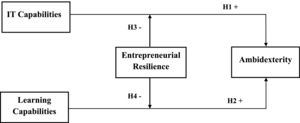
H1 IT capabilities influence the development of ambidextrous innovation strategies for developing world SMEs.
H2 Learning capabilities influence the development of ambidextrous innovation strategies for developing world SMEs.
Ambidexterity is a concept originating from an outside-in or inbound philosophy (West & Bogers, 2014; Scuotto et al., 2020). It presumes that organizations confronting intense market competition can pivot by simultaneously pursuing the complementary and contradictory goals of exploration and exploitation to enhance their performance and competitiveness (Dhir et al., 2018; Huang et al., 2021; Jacob et al., 2022; March 1991; O’Reilly & Tushman, 2013). While this assumption has been admissible as a “mechanistic” management system in stable entrepreneurial contexts characterized by clear hierarchies, well-defined roles and responsibilities, and clear job descriptions (Burns & Stalker, 1961), in many developing world contexts characterized by “organic” systems, lacking formally defined tasks, with more lateral coordination mechanisms and less reliance on formalization and specialization, ambidexterity outcomes are ambivalent (O’Reilly & Tushman, 2013). Moreover, it necessitates considerable effort, time, and experience to develop complex management systems that ambidextrous innovation strategies require for effective application (Gibson & Birkinshaw 2004; Voss & Voss, 2013).
Prior studies have shown how positive ambidexterity outcomes can be hard to achieve due to their associated exploration and exploitation strategies in which competition for the same resources is intense, making joint achievement tense in firms, especially small businesses (Iborra et al., 2020; March 1991). In this regard, SMEs face significant disadvantages compared to larger, more established organizations, owing to their smaller size and limited resources (Ebben & Johnson, 2005). Because they lack robust structures and systems, it is harder for them to develop separate strategic business units for exploration and exploitation (structural ambidexterity) especially in dynamic market conditions (Chang & Hughes, 2012; Rojas-Córdova et al., 2023).
Thus, it is logical that the costs organizations incur through experimenting with a high possibility of not achieving positive outcomes in organic systems make ambidextrous innovation strategies too risky and potentially less justifiable, particularly in the developing world (cf. Kaur et al., 2023). Research hints at how turbulent market conditions make purposeful efforts of ambidexterity less valuable (cf., Posen & Levinthal, 2012). In entrepreneurialism in the developing world, pressing issues of survival and resilience tend to supersede the need for, or benefit of, expanded adaptation efforts ambidextrous innovation strategies advocate (Agyapong et al., 2024; Yu et al., 2023). Prior research on varied contexts characterized by high market turbulence, rapid changes, uncertainty, and unpredictability organizations must confront face threats of obsolescence or business failure (Chen & Yu, 2022; Wang et al., 2022). Such threats to their survival and sustainability are attributable to internal and external factors comprising resource constraints, routine rigidity (Alcalde-Heras et al., 2019; König et al., 2021), structural inertia (Boin et al., 2017), and heightened market turbulence (Wang et al., 2022). Considering such high market dynamism, SMEs must shift towards harmonizing ambidextrous innovation strategies, resilience, and ambidexterity outcomes. Therefore, the following hypotheses are presented.
H3 Entrepreneurial resilience moderates the relationship between IT capabilities and ambidexterity outcomes in developing world SMEs.
H4 Entrepreneurial resilience moderates the relationship between learning capabilities and ambidexterity outcomes in developing world SMEs.
Based on our reasoning expressed in the hypotheses, Fig. 1 presents a visual depiction of the connectivity between the key variables of our study. The model depicts our integrated ambidextrous innovation–resilience–ambidexterity interface, demonstrating how ambidextrous innovation strategies of IT and learning capabilities lead to positive ambidexterity outcomes. However, when resilience is considered as a moderator between IT and learning capabilities, a negative ambidexterity outcome is likely owing to the resource constraints of developing world settings of SMEs.
Research approachSample descriptionThe sample comprises SMEs in the construction industry in the Free State province of South Africa. In addition to its symbolic significance as the province where the apartheid revolution was conceived, it is a regional economic powerhouse estimated to contribute an annual GDP of 5 % to the province’s overall economy (Free State Development Corporation [FSDC], 2023). Its uniqueness and heightened economic activity made it a suitable research setting. According to South Africa’s main Construction Industry Development Board (CIDB), there were approximately 760 registered and active construction businesses in this iconic province.
Setting a Raosoft sample-size calculator at 95 % confidence interval with a margin of error of 5 % and response distribution of 50 %, a target population of 760 generated a sample of 300. Given the poor response rate often associated with cross-sectional surveys (Manfreda et al., 2008; Rindfleisch et al., 2008), 400 questionnaires were distributed to improve the response rate (cf., Mellahi & Harris, 2016). From the total number of questionnaires distributed, 300 were returned representing a 75 % usable response.
The main source of the data was from 300 participants. Ethical clearance was obtained from the Research Ethics Board at the Central University of Technology in South Africa. Respondents were assured of confidentiality, anonymity, and voluntary participation, and informed consent was obtained prior to data collection. Over half of the participants, that is, 53.0 % were female, and 73.73 % were aged between 31 and 50 years with 56.8 % recorded as having a degree or diploma. Seventy-six percent of owner-managed construction businesses had been in operation for two to ten years; 33 % of those businesses were involved in civil and construction engineering and 28.7 % were involved in mechanical services. In terms of the legal structure of businesses, 38 % were classed as sole proprietors and 37 % were partnerships. Table 1 presents descriptive statistics, including the mean, minimum, and maximum values of key variables. Further details about the sample characteristics are provided in Appendix 1.
Variables and measurementTo test our hypotheses and measure the core constructs identified in this study, we developed a structured survey instrument comprising 56 items organized into five sections. The first section captured demographic information using six questions that were related to the participants’ background and firm characteristics. The second section assessed learning capability, comprising three sub-dimensions: transformative learning (7 items), exploitative learning (3 items), and explorative learning (3 items). The third section measured IT capability divided into two dimensions: IT infrastructure (5 items) and IT competence (5 items). The fourth section focused on innovation ambidexterity, operationalized to form two constructs: explorative innovation (7 items) and exploitative innovation (7 items). The final section evaluated entrepreneurial resilience (see Bullough & Renko, 2013) with 13 items. All the items, except for those in the demographic section, were measured on a five-point Likert scale ranging from 1 (strongly disagree) to 5 (strongly agree). Following the data collection phase, we performed a principal component analysis (PCA) to verify whether the items within each factor aligned with a single construct. This analysis refined the survey to 42 questions. The principal constructs are elucidated in the subsequent section (see Table 1). Consistent with Hair et al.’s (2009) guidance, we considered sample size in determining cutoff thresholds (e.g., for a sample size of approximately 300, a loading of 0.35 is required for significance). The final instrument comprised 42 items across the study constructs.
To further assess the reliability and validity of the measurement model, a confirmatory factor analysis (CFA) was conducted. The CFA evaluates factor loadings, internal consistency, and convergent validity, thereby providing stronger evidence for the reliability and unidimensionality of each construct (see Appendix 2). The results demonstrated significant factor loadings, high composite reliability, and evidence of convergent validity across all constructs. Discriminant validity was confirmed using correlation-based criteria, with the matrix presented in Appendix 3. The CFA results are summarized in Appendix 4.
Dependent variableTo assess innovation ambidexterity (Voss & Voss, 2012), entrepreneurs were requested to respond to 14 items comprising two constructs: explorative innovation (7 items) and exploitative innovation (7 items). Principal component analysis was conducted separately for each construct. The results demonstrated acceptable levels of explained variance, with eigenvalues exceeding the threshold of 1. Specifically, the eigenvalue for explorative innovation was 4.418, accounting for 63.12 % of the variance, while exploitative innovation had an eigenvalue of 3.26, explaining 81.57 % of the variance (see Table 1). Furthermore, the CFA results supported the measurement model. Factor loadings were 0.706 for explorative innovation and 0.527 for exploitative innovation. Cronbach’s alpha values (0.901 for explorative innovation and 0.919 for exploitative innovation) indicated strong internal consistency. Composite reliability values were 0.923 and 0.934, and the AVE values of 0.631 and 0.789 confirmed satisfactory convergent validity. In addition, rho_A values (0.905 for explorative innovation and 0.946 for exploitative innovation) further supported the reliability of the constructs (see Appendix 2).
To capture the overall innovation ambidexterity (March 1991), we constructed a composite variable by averaging the standardized scores (z-scores) derived from the PCA of the two constructs. Prior to this, we conducted an additional PCA including the two constructs (z-scores) to collectively represent a unidimensional measure of innovation ambidexterity. The analysis yielded a single component with an eigenvalue of 1.032, explaining 52 % of the total variance, supporting the creation of the composite measure. These results confirm the constructs reliably measure innovation ambidexterity.
However, the CFA results for the second-order construct are deemed adequate. Although the average variance extracted (AVE) is 0.40, which falls below the recommended threshold of 0.50, the composite reliability (CR) is 0.843, exceeding the minimum acceptable level. According to Fornell and Larcker (1981), when the AVE is slightly lower than 0.50 but the CR remains high, the convergent validity of the construct can still be regarded as satisfactory. Therefore, the convergent validity of the second-order construct is acceptable. Taken together, these findings demonstrate that the measurement model provides a reliable assessment of innovation ambidexterity (see Appendix 2).
Independent variablesTo measure IT capabilities (Liang et al., 2022; Zahoor et al., 2024), we used two dimensions: IT infrastructure and IT competencies. Each dimension was initially assessed using five items. Based on the results of the PCA, three items with high factor loadings were retained for each subscale. Items with a low loading were excluded to enhance construct validity. Following item reduction, PCA results indicated acceptable levels of explained variance, with eigenvalues surpassing 1 for both constructs. Specifically, the IT infrastructure component had an eigenvalue of 2.61, explaining 87.35 % of the variance, whilst the IT competencies component had an eigenvalue of 2.009, accounting for 69.97 % of the variance (see Table 1). The CFA results confirmed the measurement model. Factor loadings for IT infrastructure ranged from 0.872 to 0.969, showing strong indicator reliability. For IT competencies, loadings ranged from 0.716 to 0.941, also above the acceptable threshold. Cronbach’s alpha values (0.926 for IT infrastructure and 0.780 for IT competencies) indicated adequate internal consistency. CR values of 0.954 and 0.873 further supported construct reliability, and the AVE values of 0.874 and 0.699 demonstrated satisfactory convergent validity. The rho_A value (0.930 for IT infrastructure and 0.814 for IT competencies) provided additional evidence of construct reliability (see Appendix 2). Consistent with the treatment of the dependent variables, we created a composite variable representing overall IT capability by averaging the standardized scores (z-scores) obtained from the PCA results of the two subconstructs. To validate this composite measure, we conducted an additional PCA using the z-scores of the two components. The analysis produced a single factor with an eigenvalue of 1.48, explaining 74.31 % of the total variance, thereby supporting the one-dimensionality and appropriateness of the combined IT capability. The CFA results for the higher-order IT capability construct also provided support, with a CR of 0.894 and an AVE of 0.589. The AVE exceeded the recommended threshold of 0.50, indicating that the construct explains >50 % of the variance of its indicators and thus demonstrates adequate convergent validity (see Appendix 2).
To assess learning capabilities (Tian et al., 2020; Tan et al., 2021), the construct was based on three dimensions: transformative learning (7 items), exploitative learning (3 items), and explorative learning (3 items). PCA was conducted for each subdimension, and all items with strong factor loadings were retained. The PCA results demonstrated acceptable levels of explained variance, with eigenvalues exceeding 1 for all three constructs. Specifically, transformative learning yielded an eigenvalue of 5.181, explaining 74.01 % of the variance; exploitative learning had an eigenvalue of 2.342, accounting for 78.07 % of the variance; and explorative learning produced an eigenvalue of 2.401, explaining 80.04 % of the variance (see Table 1).
The CFA results supported the measurement model. Factor loadings ranged from 0.682 to 0.926 for transformative learning, from 0.743 to 0.954 for exploitative learning, and from 0.872 to 0.905 for explorative learning. Cronbach’s alpha values (0.940 for transformative learning, 0.854 for exploitative learning, and 0.874 for explorative learning) indicated strong internal consistency. CR values (0.952, 0.913, and 0.922, respectively) and rho_A values (0.951, 0.884, and 0.884) confirmed construct reliability. The AVE values of 0.74, 0.781, and 0.798 further supported satisfactory convergent validity (see Appendix 2). To derive a unified measure of overall learning capability, the standardized scores (z-scores) of the three subconstructs were averaged. An additional PCA was carried out using z-scores to validate the unidimensionality of the composite construct. The analysis yielded a single factor with an eigenvalue of 1.80, accounting for 60.02 % of the total variance, thereby supporting the validity and appropriateness of the aggregated learning capability measure. The CFA results for the higher-order learning capability construct also provided support with a CR of 0.924, an AVE of 0.501, and Cronbach’s alpha (α) of 0.909. The AVE met the recommended threshold of 0.50, showing that the construct captures sufficient variance from its indicators and thus provides evidence of convergent validity (see Appendix 2).
Moderating variablesHypotheses 4 and 5 focused on the moderating role of entrepreneurial resilience between IT capability and innovation ambidexterity (H4) and between learning capabilities and innovation ambidexterity (H5). To measure entrepreneurial resilience, entrepreneurs answered 13 survey items. A PCA indicated a single factor. Following established guidelines for exploratory factor analysis, we used 0.30 as the minimum acceptable cutoff for item retention, as items loading ≥ 0.30 have a meaningful association with the underlying factor in early-stage scale refinement. Items below this threshold were removed due to weaker contribution or conceptual redundancy (e.g., “I do not easily get discouraged by failure” [Q63] overlapped with “When things look hopeless, I do not give up” [Q60]; “I can achieve my goals” [Q59] reflected self-efficacy rather than resilience). The retained items captured distinct aspects of resilience such as perseverance, social support, emotional regulation, and decision-making under pressure. The final five-item scale (Q60, Q61, Q62, Q64, Q65) explained 72.77 % of the variance (eigenvalue = 3.63). The CFA results confirmed the measurement model for entrepreneurial resilience. Factor loadings ranged from 0.683 to 0.934, indicating that the items were well aligned with the construct. Cronbach’s alpha (0.920) showed high internal consistency, while CR (0.895) and rho_A (0.806) further supported construct reliability. The AVE value of 0.592 was above the recommended threshold of 0.50, providing evidence of convergent validity (see Appendix 2).
Control variablesWe included several control variables commonly cited in the entrepreneurship literature as potential influencers of innovation ambidexterity (see Khan & Mir, 2019; Voss & Voss, 2012). These controls encompassed the entrepreneur’s gender, age, educational attainment, firm age, type of business activity, and form of business ownership. Gender was coded as follows: 1 = Male, 2 = Female, and 3 = Other (specified). The age of the entrepreneur was captured using a five-point categorical scale: 1 = Below 20, 2 = 21–30, 3 = 31–40, 4 = 41–50, and 5 = Above 50. Educational qualification was measured using six categories: 1 = Primary, 2 = Secondary, 3 = Certificate, 4 = Diploma, 5 = Degree, and 6 = Postgraduate. Firm age was categorized into five groups: 1 = Up to 1 year, 2 = 2–5 years, 3 = 6–10 years, 4 = 11–20 years, and 5 = Over 20 years. The type of business activity was measured across five categories: 1 = Civil and Construction, 2 = Electrical, 3 = Mechanical Engineering, 4 = Plumbing, and 5 = Other (specified). Finally, form of business ownership was classified as: 1 = Sole Proprietorship, 2 = Partnership, 3 = Close Corporation, 4 = Private Company, and 5 = Other (specified).
Data analysisTo test Hypothesis 1, which highlights a significant relationship between a firm’s IT capabilities and its innovation ambidexterity (O’Reilly & Tushman, 2004, 2008), we employed ordinary least squares (OLS) regression analysis. OLS is a statistical technique widely regarded as the best linear unbiased estimator (BLUE), known for its efficiency and minimum variance when the assumptions of classical linear regression are met. Thus, drawing on OLS’s advantages, we assessed the direction and strength of the relationship between IT capabilities and innovation ambidexterity. Following the same analytical strategy, Hypothesis 2, which focuses on the effects of learning capabilities on innovation ambidexterity, was also tested using OLS regression.
Model 1 presents the relationship between IT capabilities and innovation ambidexterity, incorporating all control variables (H1). Model 2 examines the impact of learning capabilities (H2), while Model 3 evaluates the influence of entrepreneurial resilience, each including the same controls. These models provide a consistent framework to test the contributions of each independent variable to innovation ambidexterity. We ran Model 3 prior to running the interaction effect as entrepreneurial resilience is the moderating factor. The models and hypotheses are represented in the following equations, where α is a constant, β is the coefficient vector, and ε is the error term.
- (1)
Innovation Ambidexterity = α + β Control Variables + β IT Capabilities + Ɛ
- (2)
Innovation Ambidexterity = α + β Control Variables + β Learning Capabilities + Ɛ
- (3)
Innovation Ambidexterity = α + β Control Variables + β Entrepreneurial Resilience + Ɛ
To examine the moderating effects of entrepreneurial resilience, we analyzed its interaction with the independent variables on innovation ambidexterity. Specifically, for Hypothesis 3, which focuses on the interaction between IT capabilities and entrepreneurial resilience, we employed Model 4 using OLS regression in Stata, as specified in Equation 4. Similarly, for Hypothesis 4, which focuses on the interaction between learning capabilities and entrepreneurial resilience, we used Model 5.
In both models, OLS regression was used to estimate the interaction effects and assess whether entrepreneurial resilience moderates the relationship between the independent variables and innovation ambidexterity. The moderating role was evaluated by examining changes in R² values, which enabled a comparison between the main effects and the interaction models. This approach enabled us to determine the added explanatory power of the moderating variable beyond the direct effects of the predictors.
- (1)
Innovation Ambidexterity = α + β Control Variables + β IT Capability * Entrepreneurial Resilience + Ɛ
- (2)
Innovation Ambidexterity = α + β Control Variables + β Learning Capability * Entrepreneurial Resilience + Ɛ
To examine the potential presence of common method bias, we conducted Harman’s single factor test, following Podsakoff et al.’s (2003) guidelines. Based on this approach, if a single factor emerges and explains most of the variance, it may indicate substantial common method variance (Podsakoff & Organ, 1986). In our analysis, the unrotated factor solution revealed that the first factor accounted for 27.178 % of the total variance. As this value is well below the commonly accepted threshold of 50 %, we concluded that common method bias is unlikely to pose a significant threat to the validity of our findings. In designing the study, several steps were taken to reduce the possibility of common method bias. Respondents were assured of anonymity and confidentiality, which helped them answer honestly without concern for social desirability. The survey questions were written in clear and neutral language and placed in different sections of the questionnaire to separate constructs, limiting the risk of consistency bias. Clear instructions were also provided to reduce misunderstanding and ease evaluation pressure. Together, these steps helped minimize the risk of common method bias on the results.
Additionally, we employed partial least squares structural equation modelling (PLS-SEM) for confirmatory factor analysis and as a supplementary method for hypothesis testing alongside ordinary least squares, which not only assists in addressing common method bias but also provides greater direction and causality. PLS-SEM was selected as it is suitable for evaluating the measurement model and analyzing complex relationships between variables. It is particularly useful in prediction-oriented research and provides strong statistical power for estimating the effects of independent variables on dependent constructs (Hair et al., 2022).
Descriptive analysisThe correlations between variables are presented in Table 2. As expected, the main constructs—IT capabilities, learning capabilities, and entrepreneurial resilience—demonstrated statistically significant positive correlations with innovation ambidexterity. Among the control variables, several showed significant associations. Entrepreneur age correlated positively with ambidexterity, suggesting that more experienced entrepreneurs may draw on accumulated knowledge and networks to balance exploration and exploitation. Firm age also showed a positive bivariate correlation, indicating that more established firms may develop routines and resource bases that support ambidexterity, although this effect diminished in the regression models. Gender demonstrated a significant relationship, with female entrepreneurs more likely to exhibit ambidextrous behavior, possibly reflecting adaptive strategies and innovative problem-solving often reported among women entrepreneurs in resource-constrained contexts. In contrast, the type of business activity and form of business ownership exhibited negative correlations with ambidexterity, implying that certain sectors encounter more structural barriers to pursuing exploratory and exploitative innovation concurrently, and that some ownership forms (e.g., sole proprietorships) may lack the governance and financial flexibility required for ambidexterity. Notably, academic qualifications did not correlate significantly with ambidexterity, implying that formal education alone may not equip entrepreneurs with the experiential or adaptive skills needed to manage ambidextrous strategies. Multicollinearity can impact the stability and dependability of coefficient estimates, potentially resulting in biased interpretations and heightening the risk of endogeneity (Hofman, 2010; Mela & Kopalle, 2002). To further assess this, we conducted a multicollinearity diagnostic, which confirmed that the variance inflation factor (VIF) values for all variables were below 2, well within the acceptable range (typically VIF < 5, with more conservative thresholds such as VIF < 3 used in some studies).
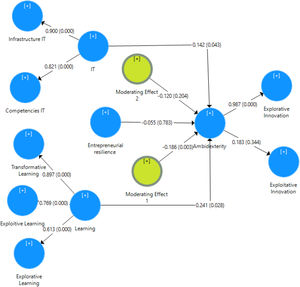
Hypothesis testing resultsModel 1 tested the effect of IT capabilities on innovation ambidexterity (see Table 3). The relationship was positive and significant (β = 0.229, p < 0.01), supporting Hypothesis 1. To check robustness, we then estimated the structural model in SmartPLS. The measurement model had already met reliability and validity requirements. The R² for the dependent variable was 0.252, indicating moderate explanatory power and exceeding the recommended minimum of 0.10 (Falk & Miller, 1992). Predictive relevance, assessed with the Stone-Geisser Q², was 0.087. Because all Q² values were above 0, the model shows good predictive relevance (Hair et al., 2019). These SmartPLS findings are consistent with the OLS results (see Appendix 4 and Fig. 2). SmartPLS path coefficients largely confirmed the OLS estimates while adding detail. Hypothesis 1 (see Table 4 and Fig. 2), the positive effect of IT capabilities on ambidexterity, was supported (β = 0.142, p < 0.05). This indicates that stronger IT capabilities directly enhance an entrepreneur’s ambidexterity.
To test H2, we estimated Model 2 in Table 3. Learning capabilities showed a significant positive effect on innovation ambidexterity (β = 0.384, p < 0.01), supporting H2. In SmartPLS, the same pattern held: H2 was supported (see Table 4 and Fig. 2), with a positive effect of learning capabilities on ambidexterity (β = 0.241, p < 0.05). These results align with the OLS findings and highlight the role of learning capabilities in promoting ambidexterity.
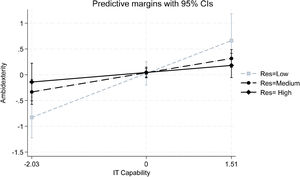
In Model 3, entrepreneurial resilience had a significant positive effect on innovation ambidexterity (β = 0.102, p < 0.05). To test the interaction, we examined entrepreneurial resilience as a moderator of the relationship between IT capabilities and innovation ambidexterity (H3) in Model 4 (see Table 3). The interaction term was significant (β = 0.102, p < 0.1, Model 4), supporting H3 (see Table 3). Using SmartPLS to test the moderating effect (Hypothesis 3), we again found support for H3: Entrepreneurial resilience moderated the link between IT capabilities and ambidexterity (see Table 4 and Fig. 2) with a negative coefficient (β = −0.186, p < 0.01), indicating that resilience attenuates the positive effect of IT capabilities. Consistent with this, Fig. 3 shows that the positive relationship between IT capabilities and innovation ambidexterity is stronger at lower levels of entrepreneurial resilience than at higher levels, confirming the negative moderating effect. For H4, OLS shows a significant negative moderation of resilience on the link between learning capabilities and innovation ambidexterity (β = 0.205, p < 0.01; Model 5), so H4 is supported (see Table 3). In contrast, the SmartPLS test of the same moderation (see Table 4 and Fig. 2) is not supported (β = −0.120, p > 0.1), diverging from the OLS finding. Overall, these results confirm the direct contributions of IT and learning capabilities to ambidexterity, while indicating that the moderating role of entrepreneurial resilience may vary depending on the capability examined.
DiscussionResearch generally associates ambidextrous innovation strategies with positive ambidexterity outcomes (Tian et al., 2021; Trieu et al., 2023). While this has been successful in showing how organizations can draw on ambidextrous innovation strategies to achieve positive ambidexterity outcomes in general (Islam et al., 2020), in a developing world setting, the impact of the relationship between ambidextrous innovation strategies (IT and learning capabilities) is misunderstood. Considering that in a typical developing world setting, essential entrepreneurship resources are insufficient to meet SMEs’ needs (Atiase et al., 2018), the overlapping links that emerge from the intersection of ambidextrous innovation strategies (IT and learning capabilities), resilience, and ambidexterity can advance new understanding. The inconsistency in existing literature means that entrepreneurship and SME researchers, as well as management scholars in general, forgo the rich and unique insights only observable in a developing world setting (cf., Bruton et al., 2022; Simba, 2026).
Accordingly, given this imbalance in the literature, which is often a source of misunderstanding in entrepreneurship and SME research, the results of this study advance the research in several ways. The contextualized theoretical explanations and perspectives derived at the ambidextrous innovation–resilience–ambidexterity nexus advance ambidexterity and SME research from a developing world perspective. Also, and contrary to a positive ambidexterity–resilience relationship mentioned in research elsewhere (e.g., Iborra et al., 2022; Stokes et al., 2019; Veiga et al., 2024; Voss & Voss, 2012), empirical results showing a tenuous relationship between ambidextrous innovation strategies of IT and learning capabilities and resilience relative to ambidexterity outcomes in a developing world setting not only enrich research, but also address the imbalance in research dominated by Western views (cf., Filatotchev et al., 2022; Bruton et al., 2022; Wickert et al., 2024). These counterintuitive explanations deviate from the norm (O’Reilly & Tushman, 2004; Voss & Voss, 2013) by showing how ambidextrous innovation strategies and resilience fail to complement each other in a developing world setting, and their incompatibility negatively affects ambidexterity outcomes. From that viewpoint, ambidexterity behavior in diverse entrepreneurial contexts such as the developing world may not generate high innovation performance or business continuity.
Based on this, the findings of this study transcend beyond the averages (Newbert et al., 2022). They showcase how, in a different setting, the combined effects of ambidextrous innovation strategies (Gibson & Birkinshaw, 2004; Jacob et al., 2022; Papachroni & Heracleous, 2020) of IT and learning capabilities (Rialti et al., 2018; Vrontis et al., 2017) and resilience (Iborra et al., 2022) lead to different ambidexterity results (O’Reilly & Tushman, 2004). Thus, considering ongoing research calls for contextualizing theory building in entrepreneurship and management research (see Banerjee et al., 2022; Shepherd et al., 2025; Welter, 2011; Wickert et al., 2024), this study strikes the right code. Indeed, due to the insensitivity of theoretical paradigms heavily influenced by universally accepted Western views, using a developing world setting to theorize SMEs’ actions and behaviors relative to their conditions is an essential step towards addressing the pervasive issues of coloniality of knowledge (Simba, 2026). Moreover, in ambidextrous innovation, resilience, and ambidexterity outcomes, alternative pathways explaining their link can be established to shape the support needs for SMEs. Having outlined the variables and their theoretical links, we note that H4, the moderating role of resilience between learning capabilities and ambidexterity, was not substantiated. This can happen for several logical reasons. Resilience often stabilizes the business and favours “bouncing back,” which can dampen the push to experiment ambidexterity needs. Under pressure, resilient entrepreneurs may conserve resources for survival rather than invest in the dual learning routines necessary for exploration and exploitation. Resilience may also complement, not substitute, learning: when learning is already robust, the added benefit of resilience is modest; when learning is feeble, resilience is employed to maintain operations rather than to foster innovation. The effect is context-dependent: in stable settings, resilience remains in the background, and in challenging settings, it is channelled towards recovery, not exploration. Finally, ambidexterity thrives on managing tensions; if resilience lowers perceived tension, it may inadvertently reduce the drive to balance exploration and exploitation.
The findings also highlight the differential influence of control variables on ambidexterity. While entrepreneurs’ age showed a positive relationship, consistent with the notion that accumulated experience enhances entrepreneurs’ ability to balance exploration and exploitation, academic qualifications were consistently nonsignificant. This suggests that in a developing world setting, ambidexterity may depend more on experiential learning, adaptive problem-solving, and resource recombination than on formal academic credentials. Similarly, firm age exhibited a positive bivariate correlation with ambidexterity but did not remain significant in the regression models, implying that organizational maturity alone does not explain ambidextrous behavior once key capabilities are considered. Importantly, female entrepreneurs demonstrated stronger associations with ambidexterity. This finding may reflect gendered patterns of entrepreneurial adaptation, where women, often operating in resource-constrained settings, develop flexible and innovative strategies to manage competing demands. Conversely, the negative associations observed for the type of business activity and form of business ownership emphasise the structural and institutional constraints facing entrepreneurs in certain sectors and ownership forms, where limited governance flexibility or resource availability may impede the balancing of innovation activities. Together, these results reinforce the centrality of dynamic capabilities (IT, learning, resilience) over structural characteristics in driving ambidextrous outcomes.
Research implicationsThe results of this study have academic, economic, and social application. Academics are presented with a new ambidextrous innovation–resilience–ambidexterity interface encouraging further research in related developing world settings. For SME managers, our new ambidextrous innovation–resilience–ambidexterity model provides insights into the benefits and challenges of engaging ambidexterity in a developing world setting where resources are often limited. In a sense, our findings catalogue the consequences of ambidextrous strategies in resource-constrained settings. For policymakers, evidence suggesting that ambidextrous innovation strategies combined with resilience do not always lead to positive ambidexterity outcomes in a developing world setting necessitates reforms to support the resource needs of small and medium-sized enterprises, as ambidexterity and resilience require substantial resource investments. Therefore, establishing viable local and regional innovation ecosystems must be a priority.
Research limitations and suggestions for future studiesAs with any other research project, this study has limitations. Whilst its dataset is unique in producing counterintuitive results, developing world SMEs similar to those we studied vary markedly due to resource availability and institutional support. Therefore, the ambidextrous–resilience connections that are likely to emerge may lead to unexpected ambidexterity outcomes owing to contextual factors, further bringing universal ambidexterity–resilience theoretical assumptions into question. Furthermore, whilst SmartPLS aids in alleviating certain measurement and model specification concerns and can partially address potential endogeneity, we recognize that endogeneity cannot be entirely eliminated within our design. Specifically, unobserved firm-level capabilities or contextual factors may concurrently influence both IT investment and innovation outcomes, giving rise to the possibility of omitted-variable bias.
ConclusionThis study draws on a grounded ambidextrous innovation–resilience–ambidexterity theoretical interface, equations, and regression results to provide theories that articulate a tenuous relationship between ambidextrous innovation strategies (IT and learning capabilities) and resilience relative ambidexterity outcomes for SMEs. Its counterintuitive outcomes are a departure from the norm in which mainstream research universally predicts a positive ambidexterity–resilience link irrespective of the context. In contrast, this study empirically verified that the interplay of ambidextrous innovation strategies with resilience diminishes ambidexterity outcomes in a developing world setting.
Based on our rigorous empirical findings, we conclude that even though a developing world SME undertakes ambidextrous innovation strategies, positive ambidexterity outcomes are not a foregone conclusion as they possess insufficient entrepreneurial resources for their needs. Thus, we conclude that ambidextrous behavior may not always yield positive outcomes, especially in a developing world setting. This has relevance for theory development, policymaking, and SME practice as it highlights the issue of context, need for SME resources, and understanding of ambidextrous behavior in small business.
CRediT authorship contribution statementAmon Simba: Writing – review & editing, Writing – original draft, Conceptualization. Mahdi Tajeddin: Validation, Methodology. Patient Rambe: Investigation, Formal analysis, Data curation. Felix Abrah Baah: Project administration, Investigation.
Variable list and principal component analysis.
Source: Authors’ work.
Descriptive analysis & correlation matrix.
| Variables | Min | Max | Mean | (1) | (2) | (3) | (4) | (5) | (6) | (7) | (8) | (9) | (10) |
|---|---|---|---|---|---|---|---|---|---|---|---|---|---|
| (1) Ambidexterity | −2.087 | 1.415 | 0 | 1.000 | |||||||||
| (2) IT Cap. | −2.031 | 1.512 | 0 | 0.336⁎⁎⁎ | 1.000 | ||||||||
| (3) Learning Cap. | −2.059 | 1.189 | 0 | 0.454⁎⁎⁎ | 0.471⁎⁎⁎ | 1.000 | |||||||
| (4) Ent. Resilience | −2.242 | .874 | 0 | 0.218⁎⁎⁎ | 0.426⁎⁎⁎ | 0.681⁎⁎⁎ | 1.000 | ||||||
| (5) Gender | 1 | 2 | 1.536 | 0.120⁎⁎ | −0.013 | 0.040 | 0.006 | 1.000 | |||||
| (6) Age – Entr. | 1 | 5 | 3.432 | 0.226⁎⁎⁎ | 0.256⁎⁎⁎ | 0.192⁎⁎⁎ | 0.173⁎⁎⁎ | −0.129⁎⁎ | 1.000 | ||||
| (7) Academic Deg. | 1 | 6 | 3.914 | −0.021 | 0.208⁎⁎⁎ | −0.148⁎⁎ | 0.058 | −0.046 | 0.082 | 1.000 | |||
| (8) Age – Firm | 1 | 5 | 2.633 | 0.162⁎⁎⁎ | 0.299⁎⁎⁎ | 0.290⁎⁎⁎ | 0.113* | −0.104* | 0.217⁎⁎⁎ | 0.007 | 1.000 | ||
| (9) Bus. Activity | 1 | 4 | 2.259 | −0.212⁎⁎⁎ | −0.296⁎⁎⁎ | −0.197⁎⁎⁎ | −0.125⁎⁎ | −0.029 | −0.264⁎⁎⁎ | −0.185⁎⁎⁎ | −0.204⁎⁎⁎ | 1.000 | |
| (10) Form of Own. | 1 | 4 | 2.05 | −0.195⁎⁎⁎ | 0.075 | 0.081 | −0.056 | −0.125⁎⁎ | 0.136⁎⁎ | 0.136⁎⁎ | 0.087 | −0.028 | 1.000 |
Regression results & interaction effects (hypothesis H1 through to H4).
| Ambidexterity | Model 1 | Model 2 | Model 3 | Model 4 | Model 5 |
|---|---|---|---|---|---|
| Gender | .164⁎⁎ | .132* | .173⁎⁎ | .174⁎⁎ | .118* |
| Age – Entr. | .129⁎⁎⁎ | .123⁎⁎⁎ | .144⁎⁎⁎ | .108⁎⁎ | .093⁎⁎ |
| Academic Deg. | -0.041 | .029 | -0.02 | -0.046 | .05* |
| Age – Firm | .044 | .016 | .089* | .04 | -0.011 |
| Bus. Activity | -0.054 | -0.046 | -0.079⁎⁎ | -0.053 | -0.046 |
| Form of Own. | -0.144⁎⁎⁎ | -0.163⁎⁎⁎ | -0.133⁎⁎⁎ | -0.153⁎⁎⁎ | -0.202⁎⁎⁎ |
| IT Cap. | .229⁎⁎⁎ | .184⁎⁎⁎ | |||
| Learning Cap. | .384⁎⁎⁎ | .547⁎⁎⁎ | |||
| Ent. Resilience | .102⁎⁎ | .006 | -0.276⁎⁎⁎ | ||
| IT Cap.* Ent. Resilience | -0.106* | ||||
| Lear. Cap.* Ent. Resilience | -0.205⁎⁎⁎ | ||||
| Constant | -0.234 | -0.344 | -0.464 | -0.088 | -0.041 |
| Pseudo r-squared | 0.220 | 0.309 | 0.176 | 0.233 | 0.381 |
| F-test | 10.892 | 17.231 | 8.235 | 9.052 | 18.363 |
| Number of OBS | 278 | 278 | 278 | 278 | 278 |
Structural estimates (hypotheses testing) by SmartPLS.
Details of the sample characteristics.
Source: Authors’ work.
Summary of Confirmatory Factor Analysis.
Source: Authors’ work.
Discriminant Validity: Fornell-Larcker Criterion.
Source: Authors’ work.