


metricas
Gastroenterología y Hepatología (English Edition) Endoscopic scoring system utilization for inflammatory bowel disease activity as...
Journal Information
Visits
270
Vol. 47. Issue 3.
Pages 219-318 (March 2024)
Original Article
Full text access

Endoscopic scoring system utilization for inflammatory bowel disease activity assessment: A multicenter real-world study from Argentina

Uso de puntajes endoscopicos para la medicion de la actividad mucosa en pacientes con enfermedades inflamatorias intestinales: un estudio de vida real multicentrico de la Argentina
Visits
270
Juan Lasaa,
Corresponding author
jlasa@hbritanico.com.ar

Corresponding author.
, Astrid Smolarczukb, Sofía Navarb, Carla Ponceb, Martín Galvarinib, Daniel Orellanab, Emiliano Carusob, Federico Espinosab, Noelia Meligranac, Germán Raineroc, Gustavo Corread, Martín Yantornod, María Garbid, Florencia Giraudod, Soledad Martíneza, Lucía Garcíae, Florencia Marcenoe, Victoria Marturanoe, Kevin Reyesf, Leandro Steinberge,f..., Lisandro Pereyrab, Pablo Oliveraa,gVer más
a Gastroenterology Department, CEMIC, Buenos Aires, Argentina
b Gastroenterology Department, Hospital Alemán, Buenos Aires, Argentina
c Gastroenterology Department, Hospital Universitario Austral, Pilar, Argentina
d Gastroenterology Department, HIGA San Martín, La Plata, Argentina
e Gastroenterology Department, Hospital General de Agudos Carlos Durand, Buenos Aires, Argentina
f Gastroenterology Department, Hospital Universitario Fundación Favaloro, Buenos Aires, Argentina
g Zane Cohen Centre for Digestive Diseases-Lunenfeld-Tanenbaum Research Institute-Sinai Health System-Gastroenterology, Toronto, Canada
This item has received
Article information
Abstract
Full Text
Bibliography
Download PDF
Statistics
Figures (2)
fig0005
fig0010
Tables (3)
Table 1. Main characteristics of included subjects.
Tables
Table 2. Comparison of report of endoscopic scores among Crohn's disease and ulcerative colitis patients.
Tables
Table 3. Comparison of endoscopy characteristics between endoscopies with and without endoscopic score reports.
Tables
Abstract
Background

The frequency and patterns of use of scores for the assessment of endoscopic activity in inflammatory bowel disease patients are not known.

Aim

To describe the prevalence of adequate use of endoscopic scores in IBD patients who underwent colonoscopy in a real-life setting.

Materials and methods

A multicenter observational study comprising six community hospitals in Argentina was undertaken. Patients with a diagnosis of Crohn's disease or ulcerative colitis who underwent colonoscopy for endoscopic activity assessment between 2018 and 2022 were included. Colonoscopy reports of included subjects were manually reviewed to determine the proportion of colonoscopies that included an endoscopic score report. We determined the proportion of colonoscopy reports that included all of the IBD colonoscopy report quality elements proposed by BRIDGe group. Endoscopist's specialty, years of experience as well as expertise in IBD were assessed.

Results

A total of 1556 patients were included for analysis (31.94% patients with Crohn's disease). Mean age was 45.94±15.46. Endoscopic score reporting was found in 58.41% of colonoscopies. Most frequently used scores were Mayo endoscopic score (90.56%) and SES-CD (56.03%) for ulcerative colitis and Crohn's disease, respectively. In addition, 79.11% of endoscopic reports failed to comply with all recommendations on endoscopic reporting for inflammatory bowel disease.

Conclusions

A significant proportion of endoscopic reports of inflammatory bowel disease patients do not include the description of an endoscopic score to assess mucosal inflammatory activity in a real-world setting. This is also associated with a lack of compliance in recommended criteria for proper endoscopic reporting.

Keywords:
Colonoscopy
Crohn's disease
Ulcerative colitis
Resumen
Introduccion

La frecuencia y el patrón de uso de puntajes para evaluar la actividad endoscópica en pacientes con enfermedades inflamatorias intestinales no se conoce bien.

Objetivo

Describir la prevalencia de uso adecuado de puntajes de actividad endoscópica en colonoscopias de pacientes con enfermedades inflamatorias intestinales en la vida real.

Materiales y métodos

Se realizó un estudio multicéntrico observacional en seis hospitales de comunidad en Argentina. Se incluyeron pacientes con enfermedad de Crohn o colitis ulcerosa sometidos a colonoscopia para evaluación de la actividad endoscópica entre 2018 y 2022. Se revisaron los reportes de colonoscopias de sujetos incluidos evaluando la proporción de reportes que incluyeron algún puntaje de actividad endoscópica. Se evaluó la proporción de reportes que incluyeron los elementos de calidad en reporte de colonoscopia en enfermedades inflamatorias intestinales sugeridos por el grupo BRIDGe. Se evaluó la especialidad de los operadores, sus años de experiencia y su experiencia en el manejo de enfermedades inflamatorias intestinales.

Resultados

Se incluyeron 1556 pacientes (31.94% con enfermedad de Crohn). La edad promedio fue de 45.94±15.46. El reporte de algún puntaje endoscópico se identificó en el 58.41% de las colonoscopias. Los puntajes más utilizados fueron el puntaje endoscópico de Mayo (90.56%) y el SES-CD (56.03%). El 79.11% de los reportes de colonoscopias no contaban con todas las recomendaciones para el correcto reporte de colonoscopias en enfermedades inflamatorias intestinales.

Conclusiones

Una proporción signifivativa de reportes de colonoscopias en sujetos con enfermedades inflamatorias intestinales no incluyen puntajes endoscópicos de actividad.


Palabras clave:
Colonoscopia
Enfermedad de Crohn
Colitis ulcerativa
Full Text
Introduction

Inflammatory bowel diseases (IBD) comprise both Crohn's disease (CD) and ulcerative colitis (UC), are chronic conditions which carry a significant risk of hospital admission, need for surgery and an increased risk of colorectal neoplasia.1,2 Colonoscopy has become a fundamental tool for diagnosis and management of these conditions. Endoscopic assessment of the intestinal mucosa has proven to be a strong prognostic tool in both UC and CD: patients with absence of inflammatory activity in endoscopy show better long-term outcomes when compared with patients with residual endoscopic inflammatory activity.3 Consequently, endoscopic outcomes assessed by colonoscopy, such as mucosal healing, have become one of the main therapeutic targets in IBD, both in clinical trials and everyday practice.4

Endoscopic assessment of the inflammatory activity may result in heterogeneity in reporting, due to subjective interpretation of findings. Therefore, a myriad of endoscopic scores have been developed to provide an objective measurement and interpretation of mucosal lesions.5–7 Most scoring systems were conceived to provide objective evaluations in the context of clinical trials.8 Studies have proven interobserver coherence of the most frequently used scoring systems.9,10 These endoscopic scores have been widely adopted and used in IBD referral centers – a phenomenon that was facilitated by the involvement of such centers in an exponentially increasing number of clinical trials.11 STRIDE II recommendations12 highlight the relevance of endoscopic mucosal healing as a treatment target for both UC and CD. They also state that mucosal healing should be assessed by means of endoscopic scores such as the Mayo endoscopic score (MES) or the ulcerative colitis endoscopic index of severity (UCEIS) for UC or the simple endoscopic score for CD (SES-CD).

There is a paucity of evidence regarding the acceptance and adherence to endoscopic scores use outside the context of highly-specialized IBD referral centers. We hypothesize that a non-neglectable proportion of endoscopists who perform colonoscopies on already-diagnosed IBD patients do not describe any endoscopic score to assess the inflammatory activity in their endoscopy reports. In addition, endoscopists who report an endoscopic score may use them inaccurately. Unveiling the appropriate use of endoscopic scores in clinical practice is relevant, as they can lead to major decisions in terms of therapeutic management of IBD patients and have prognostic implications. Hence, we sought to describe the proportion of adequate use of endoscopic scores for inflammation activity among already-diagnosed UC and CD patients.

Materials and methodsStudy design and population

An observational cross-sectional study was undertaken in six community hospitals in Argentina. Four centers were located in the Buenos Aires metropolitan area, one center was located in La Plata city and another in the city of Pilar. Study protocol was approved by local ethic committees. The study was registered in National Clinical Trials (NCT05576402).

From April 2022 to August 2022, endoscopy databases from the participating hospitals were reviewed. All participating centers were academic hospitals with an average colonoscopy volume of 2500 diagnostic procedures/year. All endoscopic units had an endoscopy fellowship program; two were public hospitals and only one did not have a specialized IBD unit. Adult subjects with an established diagnosis of CD or UC who had a colonoscopy between April 2018 and April 2022 were included for analysis. Subjects were excluded if their medical record was incomplete or data of interest of the colonoscopy was missing.

Outcomes measurement

We sought to determine the proportion of colonoscopies among already-diagnosed CD and UC patients, including the report of a validated endoscopic score for the assessment of the endoscopic inflammatory activity. We also reviewed the colonoscopy reports to determine the proportion of reports which included an accurate endoscopic score according to the underlying condition of the subject (i.e., MES or UCEIS in the case of an UC patient, or SES-CD or CDEIS in the case of a CD patient).

In addition, we reviewed the proportion of colonoscopy reports which included an accurate endoscopic score, and the report showed no discrepancy between the findings described and the estimated score (i.e., the report of the presence of ulcers in a colonoscopy of a UC patient and a MES of 3).

All included endoscopic reports were manually reviewed to determine the proportion of reports that complied with the recommendations of endoscopic reporting for IBD as published by Devlin et al.13 In short, the recommended information to be included in the reports of a colonoscopy in an IBD patient contemplate the following: report of rectal examination, report of perianal compromise (in the case of CD), report of maximum extension of disease, report of number and location of biopsy collection and report of summary of findings.

The following variables were recorded for each included subject: patient diagnosis, age, gender, colonoscopy date, bowel cleansing quality, cecal and/or ileal intubation, presence of stenosis, endoscopist specialty (gastroenterologist, surgeon, IBD specialist), and years of endoscopist experience.

Statistical analysis

There is a lack of information regarding the use of endoscopic scores in clinical practice; a survey among physicians attending an IBD-related conference published by Gaidos et al.14 showed that 21% of attendees reported a regular use of endoscopic scores in clinical practice. We hypothesize that 20% of endoscopic reports would lack the description of an endoscopic score to assess inflammatory activity; assuming an alpha error of 5% and power of 80%, we estimated that 1395 patients would have to be included for analysis.

Numerical variables were described as mean with their standard deviation, whereas categorical variables were described as percentages. Student's t test was used for the comparison of numerical variables and chi square test for the comparison of categorical variables.

A univariate comparison between subjects with and without the report of an endoscopic score was performed; odds ratios (OR) with their corresponding 95% confidence intervals (95% CI) were estimated. A multivariate analysis was later performed using a logistic regression model to determine variables significantly associated with the report of an endoscopic score in subjects with an established diagnosis of IBD. A P value of less than 0.05 was considered as statistically significant.

All analyses were performed with Stata™ software (v11.1, Statacorp, College Station, TX, USA).

ResultsPatient selection and characteristics

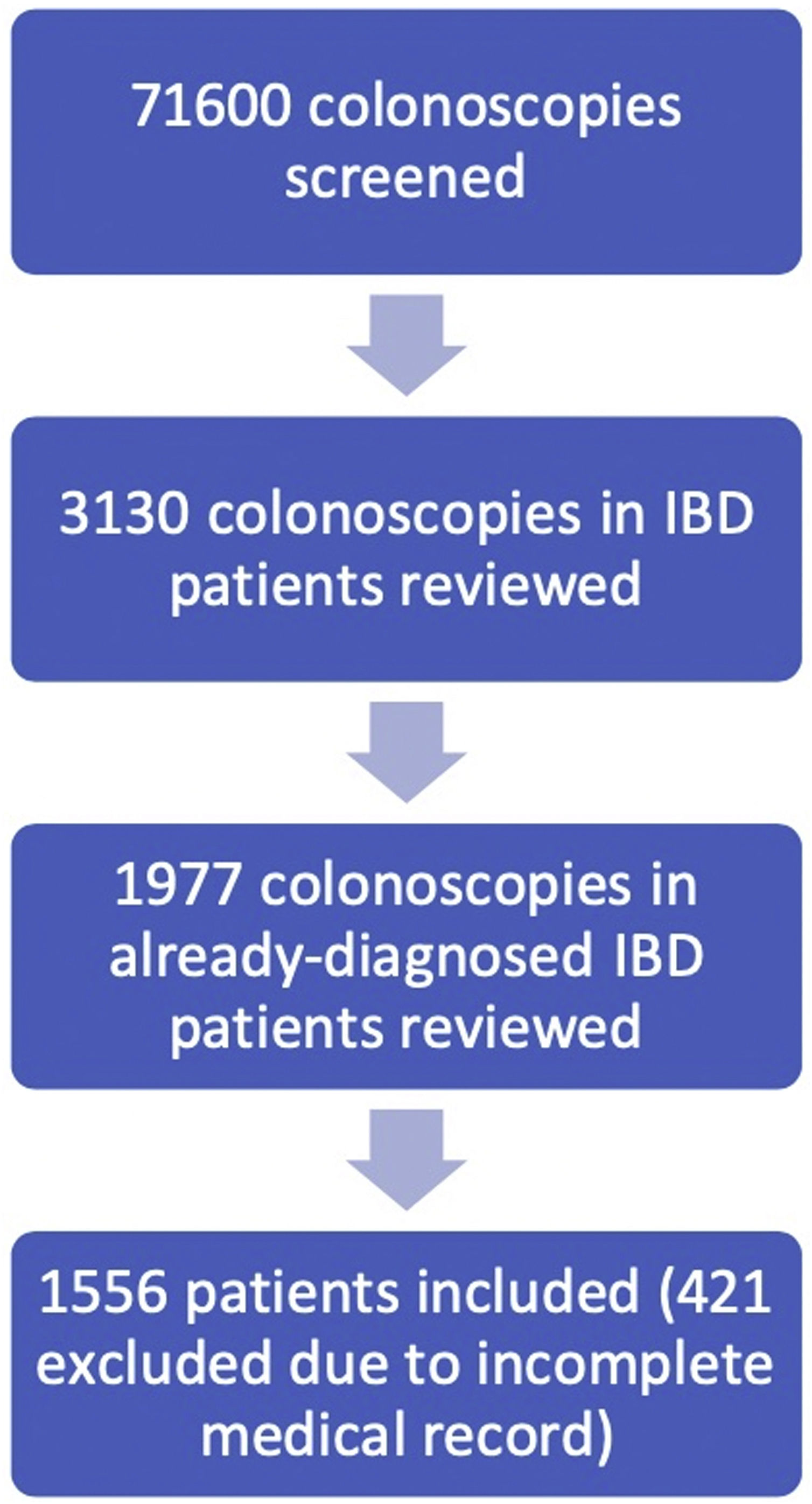
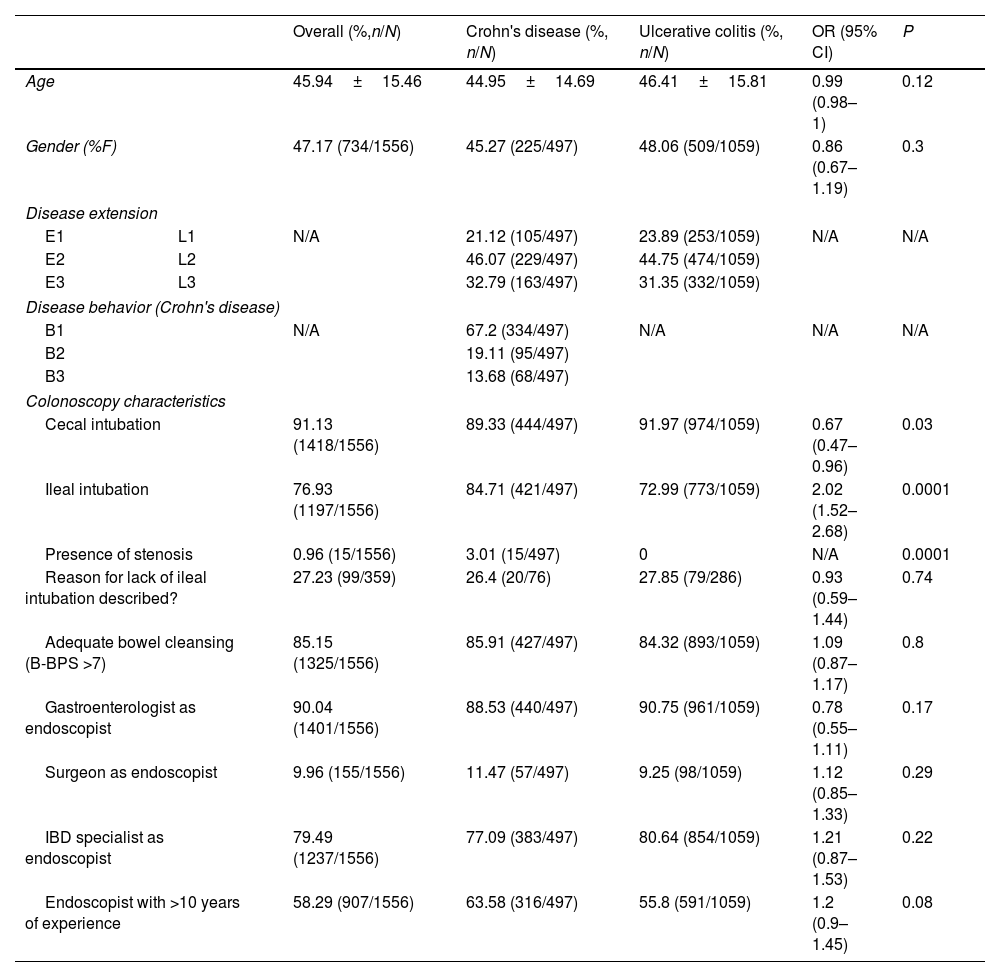
Overall, 1556 patients were finally included for analysis. Fig. 1 shows the flow chart describing the selection process of patients that fulfilled inclusion criteria. 31.94% had a diagnosis of CD. Mean age was 45.94±15.46 years and 53.8% were male (Table 1). Most endoscopic studies (90.04%) were performed by gastroenterologists, as observed in Table 1. In 79.49% of cases, the endoscopist was an IBD specialist – all of them had gastroenterology as their primary medical specialty. In addition, 58.29% of the endoscopists had more than 10 years of experience.

Figure 1.

Flowchart of patient inclusion process.

Table 1.

Main characteristics of included subjects.

    Overall (%,n/NCrohn's disease (%, n/NUlcerative colitis (%, n/NOR (95% CI)  P 
Age45.94±15.46  44.95±14.69  46.41±15.81  0.99 (0.98–1)  0.12 
Gender (%F)47.17 (734/1556)  45.27 (225/497)  48.06 (509/1059)  0.86 (0.67–1.19)  0.3 
Disease extension
E1  L1  N/A21.12 (105/497)  23.89 (253/1059)  N/AN/A
E2  L2  46.07 (229/497)  44.75 (474/1059) 
E3  L3  32.79 (163/497)  31.35 (332/1059) 
Disease behavior (Crohn's disease)
B1N/A  67.2 (334/497)  N/A  N/A  N/A 
B2  19.11 (95/497)       
B3  13.68 (68/497)       
Colonoscopy characteristics
Cecal intubation91.13 (1418/1556)  89.33 (444/497)  91.97 (974/1059)  0.67 (0.47–0.96)  0.03 
Ileal intubation76.93 (1197/1556)  84.71 (421/497)  72.99 (773/1059)  2.02 (1.52–2.68)  0.0001 
Presence of stenosis0.96 (15/1556)  3.01 (15/497)  N/A  0.0001 
Reason for lack of ileal intubation described?27.23 (99/359)  26.4 (20/76)  27.85 (79/286)  0.93 (0.59–1.44)  0.74 
Adequate bowel cleansing (B-BPS >7)85.15 (1325/1556)  85.91 (427/497)  84.32 (893/1059)  1.09 (0.87–1.17)  0.8 
Gastroenterologist as endoscopist90.04 (1401/1556)  88.53 (440/497)  90.75 (961/1059)  0.78 (0.55–1.11)  0.17 
Surgeon as endoscopist9.96 (155/1556)  11.47 (57/497)  9.25 (98/1059)  1.12 (0.85–1.33)  0.29 
IBD specialist as endoscopist79.49 (1237/1556)  77.09 (383/497)  80.64 (854/1059)  1.21 (0.87–1.53)  0.22 
Endoscopist with >10 years of experience58.29 (907/1556)  63.58 (316/497)  55.8 (591/1059)  1.2 (0.9–1.45)  0.08 

F: female; OR: odds ratio; 95% CI: 95% confidence interval; B-BPS: Boston Bowel Preparation Scale.

Endoscopic scores use and quality of endoscopic report

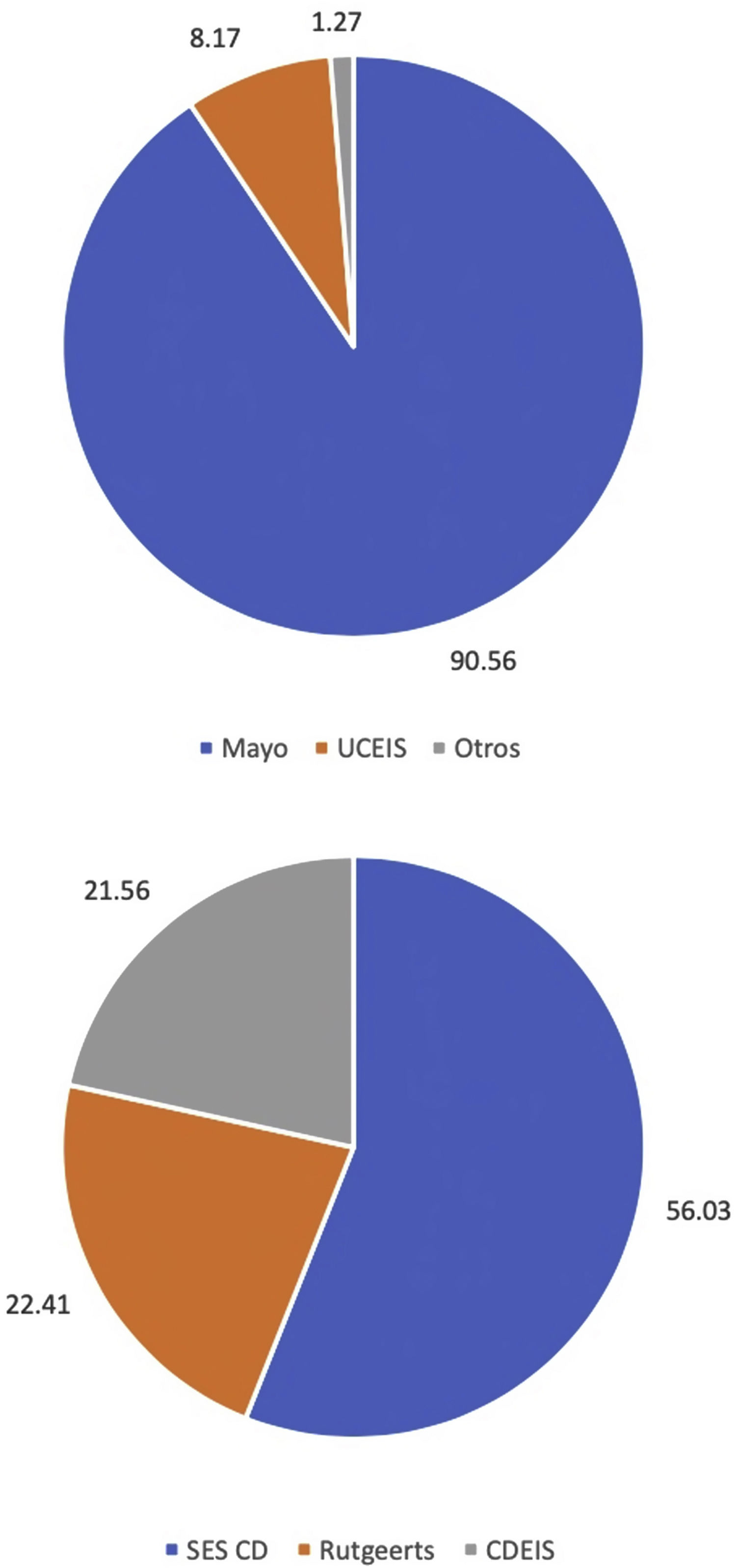
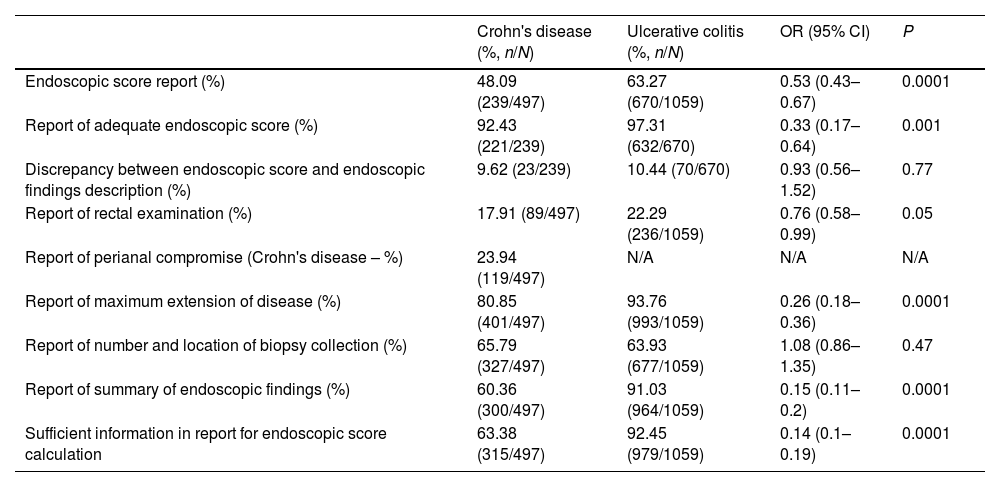
Overall, an endoscopic score to assess inflammatory activity of the intestinal mucosa was included in 58.41% of colonoscopies. The proportion was significantly lower among CD patients [48.09% versus 63.27%, OR 0.53 (0.43–0.67)], as seen in Table 2. The most frequently used endoscopic score in colonoscopies performed on UC patients was the MES (90.56%, Fig. 2A), whereas the SES-CD was the most frequently used among CD patients (56.03%, Fig. 2B). Among colonoscopies including the report of an endoscopic score, the majority showed the use of an adequate endoscopic score (93.84%). However, colonoscopies performed on CD patients showed a significantly lower proportion of adequate endoscopic score report [92.43% versus 97.31%, OR 0.33 (0.17–0.64)]. In addition, 79.11% of endoscopic reports failed to comply with all the recommendations for endoscopic reporting for IBD. The proportion of these recommendations’ compliance was significantly lower among colonoscopies performed on CD patients (Table 2).

Table 2.

Comparison of report of endoscopic scores among Crohn's disease and ulcerative colitis patients.

  Crohn's disease (%, n/NUlcerative colitis (%, n/NOR (95% CI)  P 
Endoscopic score report (%)  48.09 (239/497)  63.27 (670/1059)  0.53 (0.43–0.67)  0.0001 
Report of adequate endoscopic score (%)  92.43 (221/239)  97.31 (632/670)  0.33 (0.17–0.64)  0.001 
Discrepancy between endoscopic score and endoscopic findings description (%)  9.62 (23/239)  10.44 (70/670)  0.93 (0.56–1.52)  0.77 
Report of rectal examination (%)  17.91 (89/497)  22.29 (236/1059)  0.76 (0.58–0.99)  0.05 
Report of perianal compromise (Crohn's disease – %)  23.94 (119/497)  N/A  N/A  N/A 
Report of maximum extension of disease (%)  80.85 (401/497)  93.76 (993/1059)  0.26 (0.18–0.36)  0.0001 
Report of number and location of biopsy collection (%)  65.79 (327/497)  63.93 (677/1059)  1.08 (0.86–1.35)  0.47 
Report of summary of endoscopic findings (%)  60.36 (300/497)  91.03 (964/1059)  0.15 (0.11–0.2)  0.0001 
Sufficient information in report for endoscopic score calculation  63.38 (315/497)  92.45 (979/1059)  0.14 (0.1–0.19)  0.0001 

OR: odds ratio; 95% CI: 95% confidence interval.

Figure 2.

Endoscopic score use for ulcerative colitis (A) and Crohn's disease (B).

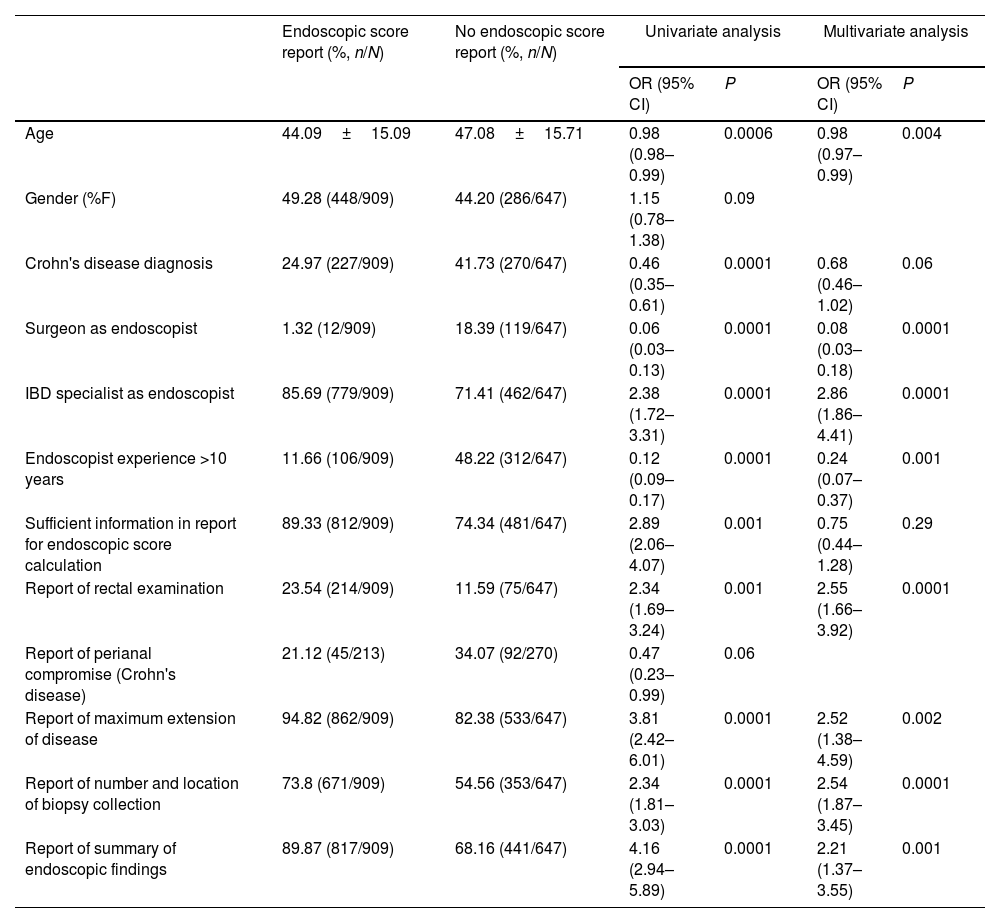
Table 3 describes the comparison of the main characteristics of endoscopies between those endoscopic reports with and without the description of endoscopic scores for the assessment of intestinal inflammatory activity. Endoscopist specialty had an influence in the odds of endoscopic score use: surgeon as endoscopist were significantly more frequent among endoscopies without an endoscopic score report [18.39% versus 1.32%, OR 0.06 (0.03–0.13)], whereas IBD specialists as operators were significantly more frequent among endoscopies with an endoscopic score report [85.69% versus 71.41%, OR 2.38 (1.72–3.31)]. Endoscopies with an endoscopic score report showed a lower odds of being performed by endoscopists with more than 10 years of experience [11.66% versus 48.22%, OR 0.12 (0.09–0.17)]. Compliance of the recommendations for endoscopic reporting in IBD was significantly more common in endoscopies report that included an endoscopic score (Table 3).

Table 3.

Comparison of endoscopy characteristics between endoscopies with and without endoscopic score reports.

  Endoscopic score report (%, n/NNo endoscopic score report (%, n/NUnivariate analysisMultivariate analysis
      OR (95% CI)  P  OR (95% CI)  P 
Age  44.09±15.09  47.08±15.71  0.98 (0.98–0.99)  0.0006  0.98 (0.97–0.99)  0.004 
Gender (%F)  49.28 (448/909)  44.20 (286/647)  1.15 (0.78–1.38)  0.09     
Crohn's disease diagnosis  24.97 (227/909)  41.73 (270/647)  0.46 (0.35–0.61)  0.0001  0.68 (0.46–1.02)  0.06 
Surgeon as endoscopist  1.32 (12/909)  18.39 (119/647)  0.06 (0.03–0.13)  0.0001  0.08 (0.03–0.18)  0.0001 
IBD specialist as endoscopist  85.69 (779/909)  71.41 (462/647)  2.38 (1.72–3.31)  0.0001  2.86 (1.86–4.41)  0.0001 
Endoscopist experience >10 years  11.66 (106/909)  48.22 (312/647)  0.12 (0.09–0.17)  0.0001  0.24 (0.07–0.37)  0.001 
Sufficient information in report for endoscopic score calculation  89.33 (812/909)  74.34 (481/647)  2.89 (2.06–4.07)  0.001  0.75 (0.44–1.28)  0.29 
Report of rectal examination  23.54 (214/909)  11.59 (75/647)  2.34 (1.69–3.24)  0.001  2.55 (1.66–3.92)  0.0001 
Report of perianal compromise (Crohn's disease)  21.12 (45/213)  34.07 (92/270)  0.47 (0.23–0.99)  0.06     
Report of maximum extension of disease  94.82 (862/909)  82.38 (533/647)  3.81 (2.42–6.01)  0.0001  2.52 (1.38–4.59)  0.002 
Report of number and location of biopsy collection  73.8 (671/909)  54.56 (353/647)  2.34 (1.81–3.03)  0.0001  2.54 (1.87–3.45)  0.0001 
Report of summary of endoscopic findings  89.87 (817/909)  68.16 (441/647)  4.16 (2.94–5.89)  0.0001  2.21 (1.37–3.55)  0.001 

F: female; OR: odds ratio; 95% CI: 95% confidence interval.

Discussion

Our study showed that there is a significantly low proportion of endoscopy reports among patients with established IBD that includes the description of an endoscopic score assessing inflammatory activity. To our knowledge, this is the first study that evaluates how endoscopic scores for inflammatory activity in IBD patients in a real-world setting, outside referral centers with a great experience in the conduction of IBD-related clinical trials.

Endoscopic scores measuring the inflammatory gastrointestinal activity for both CD and UC were developed in the context of clinical trials.15 Most scores that are widely used in clinical practice were initially conceived for their use in the context of clinical trials, such as the Mayo endoscopic score.8 Indeed, these scoring systems have been used to determine trial eligibility and to determine endoscopic outcomes. Over the past decade, the concept of mucosal healing has gained significant relevance since it proved to be an outcome with a strong predictive capacity. This has been reinforced by expert recommendations, such as the European Crohn's and Colitis Organisation, which advocates for the use of endoscopic outcomes in clinical practice.16

Endoscopic scores for CD and UC show a series of pitfalls: some of them lack validation, such as the Rutgeerts score, or lack validation on how to define mucosal healing, such is the case of the MES.17 In other cases, such as CDEIS, its complexity precludes it from being used in clinical practice.18 A common characteristic of these scores is that they require a minimum training by the endoscopist.19

Since endoscopic scores have been widely adopted in the context of clinical trials, it is expected to find that referral centers adopted in a systematic fashion the use of endoscopic scores. Our results show that this may not be the case in the real-world setting. This is a very relevant finding, since the specialists who treat IBD patients will make fundamental therapeutic decisions based on the reported findings in patients’ colonoscopies. As stated before, endoscopic scoring systems provide objectivity and standardization with reporting of mucosal appearances.20,21 This lack of endoscopic score reporting becomes more evident among CD patients. This might be explained by the intrinsic characteristics of CD, with significant heterogeneity and extent of the mucosal lesions, which in turn is translated into scopes, such as the SES-CD or the CDEIS, which are more challenging to learn and implement, and usually requires some assistance for proper calculation.

Another interesting finding of our study shows that a small but non-neglectable proportion of endoscopic reports included the description of an inaccurate endoscopic score. Again, this was observed more frequently among endoscopic reports of CD patients. Furthermore, even in the scenario in which an endoscopy report included an accurate scoring system, a proportion of reports showed a discrepancy between the report of the descriptive findings and the estimated endoscopic score. These observations are also relevant and highlight the need for educational interventions to prevent these types of mistakes from occurring in the real-world setting. As stated by Fernandes et al.,22 training, instead of experience, should be the key solution to reduce these types of pitfalls. The findings of our study also suggest this, as we did not find an association between the appropriate use of endoscopic scores and the years of experience of the endoscopists; on the contrary, it would seem that more experienced endoscopists tend to use scores less frequently and more inadequately.

Our study identified some operator characteristics that were significantly associated with the lack of use of endoscopic scores. Of notice, surgeon endoscopists were significantly associated with higher odds of neglecting the report of an endoscopic score. On the contrary, when the endoscopist was an IBD specialist, we observed increased odds of endoscopic score reporting.

Our results also showed that a significantly high proportion of the endoscopic reports included in the study did not comply with at least one of the recommendations described in the criteria by Devlin et al.13 Non-adherence to the recommended endoscopic reporting criteria was significantly associated with the lack of scoring report. This association may highlight the need to emphasize in endoscopists’ education in terms of adequate endoscopic reporting in the context of IBD patient assessment.

Limitations should be mentioned. First, this is a retrospective study, with the limitations that this design carries. We did not include sigmoidoscopies, which may have shown different results in the case of UC; we wanted to assess the compliance of recommended endoscopic reporting criteria, so sigmoidoscopy inclusion would have not contributed to this assessment. There was a high proportion of endoscopies performed by IBD specialists, which may not accurately represent the quality of endoscopic reports among IBD patients. In addition, the study is limited to six community-based hospitals in Argentina which may limit the generalizability of our findings; all of the institutions which included patients have an IBD unit and are teaching hospitals: even in a setting in which a high quality of endoscopic reporting is expected, a non-neglectable proportion of IBD endoscopic reports were incomplete. These characteristics may not necessarily be representative of the quality of endoscopic reporting in other settings: Argentina's healthcare system comprises a wide variety of institutions, many of them do not include an IBD unit. We hypothesize that the proportion of endoscopic scoring system use could be smaller if institutions without IBD units were included in our analysis. As mentioned before, adequate endoscopic reporting in IBD patients is relevant since endoscopic activity has a significant influence in terms of therapeutic decisions. This finding highlights the importance of medical education and surveillance of the adherence to quality indicators of IBD endoscopic reporting.

The challenge ahead lies in finding ways to improve endoscopists’ adherence to reporting recommendations as well as adequate and systematic use of endoscopic scores: the incorporation of endoscopic score calculators as well as pre-determined templates for reports would be of benefit to improve this situation.

In conclusion, a significant proportion of endoscopic reports of IBD patients do not include the description of an endoscopic score to assess mucosal inflammatory activity in a real-world setting. This is also associated with a lack of compliance in recommended criteria for proper endoscopic reporting. Emphasis on endoscopist education and training on these subjects is crucial to overcome these findings.

Authors’ contributions

JL: Protocol and idea development, statistical analysis, draft writing; AS: database review and patient inclusion; SN: database review and patient inclusion; CP: database review and patient inclusion; DO: database review and patient inclusion; EC: database review and patient inclusion; FE: database review and patient inclusion; NM: database review, patient inclusion and critical review of draft; GR: database review, patient inclusion and critical review of draft; GC: database review, patient inclusion and critical review of draft; MY: database review and patient inclusion; MG: database review and patient inclusion; LG: database review and patient inclusion; FG: protocol development, database review, patient inclusion and critical review of draft; SM: database review and patient inclusion; LG: database review and patient inclusion; FM: database review and patient inclusion; VM: database review and patient inclusion; KR: database review and patient inclusion; LS: idea development, database review; LP: protocol and idea development; PO: protocol development, draft writing, statistical analysis and critical review of draft.

Conflicts of interest

Juan Lasa declares consulting fees from Abbvie and honoraria from Janssen, Takeda and Pfizer.

Pablo Olivera declares consulting fees from Abbvie, Takeda, and Janssen; honoraria from Takeda and Janssen; and financial support for attending meetings, travel, or both from Abbvie, Takeda, Janssen, and Ferring.

All other authors declare no conflicts of interest.

References
[1]
S. Lega, M.C. Dubinsky.
What are the targets of inflammatory bowel disease management.
Inflamm Bowel Dis, 24 (2018), pp. 1670-1675
[2]
J.F. Colombel, R. Panaccione, P. Bossuyt, M. Lukas, F. Baert, T. Vanásek, et al.
Effect of tight control management on Crohn's disease (CALM): a multicentre, randomised, controlled phase 3 trial.
Lancet, 390 (2017), pp. 2779-2789
[3]
G. Pineton de Chambrun, P. Blanc, L. Peyrin-Biroulet.
Current evidence supporting mucosal healing and deep remission as important treatment goals for inflammatory bowel disease.
Expert Rev Gastroenterol Hepatol, 10 (2016), pp. 915-927
[4]
L. Peyrin-Biroulet, J. Panes, W.J. Sandborn, S. Vermeire, S. Danese, B.G. Feagan, et al.
Defining disease severity in inflammatory bowel diseases: current and future directions.
Clin Gastroenterol Hepatol, 14 (2016),
[5]
M. Daperno, G. D’Haens, G. Van Assche, F. Baert, P. Bulois, V. Maunoury, et al.
Development and validation of a new, simplified endoscopic activity score for Crohn's disease: the SES-CD.
Gastrointest Endosc, 60 (2004), pp. 505-512
[6]
T. Sipponen, H. Nuutinen, U. Turunen, M. Färkkilä.
Endoscopic evaluation of Crohn's disease activity: comparison of the CDEIS and the SES-CD.
Inflamm Bowel Dis, 16 (2010), pp. 2131-2136
[7]
N. Mohammed Vashist, M. Samaan, M.H. Mosli, C.E. Parker, J.K. MacDonald, S.A. Nelson, et al.
Endoscopic scoring indices for evaluation of disease activity in ulcerative colitis.
Cochrane Database Syst Rev, 1 (2018), pp. CD011450
[8]
W.J. Tremaine, K.W. Schroeder, J.M. Harrison, A.R. Zinsmeister.
A randomized, double-blind, placebo-controlled trial of the oral mesalamine (5-ASA) preparation, Asacol, in the treatment of symptomatic Crohn's colitis and ileocolitis.
J Clin Gastroenterol, 19 (1994), pp. 278-282
[9]
J.F. Colombel, G. D’haens, W.J. Lee, J. Petersson, R. Panaccione.
Outcomes and strategies to support a treat-to-target approach in inflammatory bowel disease: a systematic review.
J Crohns Colitis, 14 (2020), pp. 254-266
[10]
S.P. Travis, D. Schnell, B.G. Feagan, M.T. Abreu, .D.G. Altman, S.B. Hanauer, et al.
The impact of clinical information on the assessment of endoscopic activity: characteristics of the ulcerative colitis endoscopic index of severity [UCEIS].
J Crohns Colitis, 9 (2015), pp. 607-616
[11]
R. Khanna, G. Zou, G. D’Haens, P. Rutgeerts, J.W.D. McDonald, M. Daperno, et al.
Reliability among central readers in the evaluation of endoscopic findings from patients with Crohn's disease.
[12]
D. Turner, A. Ricciuto, A. Lewis, F. D’Amico, J. Dhaliwal, A.M. Griffiths, et al.
STRIDE-II: an update on the selecting therapeutic targets in inflammatory bowel disease (STRIDE) initiative of the International Organization for the Study of IBD (IOIBD): determining therapeutic goals for treat-to-target strategies in IBD.
Gastroenterology, 160 (2021), pp. 1570-1583
[13]
S.M. Devlin, G.Y. Melmed, P.M. Irving, D.T. Rubin, A. Kornbluth, P.L. Kozuch, et al.
Recommendations for quality colonoscopy reporting for patients with inflammatory bowel disease: results from a rand appropriateness panel.
Inflamm Bowel Dis, 22 (2016), pp. 1418-1424
[14]
J.K. Gaidos, B. Al-Bawardy, F. Farraye, M. Regueiro.
S1013 use of IBD endoscopic scoring systems in practice.
Am J Gastroenterol, 117 (2022), pp. e733-e734
[15]
C. Pagnini, F. Menasci, F. Desideri, V.D. Corleto, G. Delle Fave, E. Di Giulio.
Endoscopic scores for inflammatory bowel disease in the era of ‘mucosal healing’: old problems, new perspectives.
Dig Liv Dis, 48 (2016), pp. 703-708
[16]
A. Sturm, C. Maaser, E. Calabrese, V. Annese, G. Fiorino, T. Kucharzik, et al.
ECCO-ESGAR guideline for diagnostic assessment in inflammatory bowel disease.
J Crohns Colitis, 13 (2018), pp. 273-284
[17]
C. Manginot, C. Baumann, L. Peyrin-Biroulet.
An endoscopic Mayo score of 0 is associated with a lower risk of colectomy than a score of 1 in ulcerative colitis.
[18]
L. Vuitton, P. Marteau, W.J. Sandborn, B.G. Levesque, B. Feagan, S. Vermeire, et al.
IOIBD technical review on endoscopic indices for Crohn's disease clinical trials.
[19]
M. Daperno, M. Comberlato, F. Bossa, A. Armuzzi, L. Biancone, A.G. Bonamoni, et al.
Training programs on endoscopic scoring systems for inflammatory bowel disease lead to a significant increase in interobserver agreement among community gastroenterologists.
J Crohns Colitis, 11 (2017), pp. 556-561
[20]
J.K. Limdi, M. Picco, F.A. Farraye.
A review of endoscopic scoring systems and their importance in a “treat to target” approach in inflammatory bowel disease.
Gastrointest Endosc, 91 (2019), pp. 733-745
[21]
G. D’Haens, W.J. Sandborn, B.G. Feagan, K. Geboes, S.B. Hanauer, E.J. Irvine, et al.
A review of activity indices and efficacy end points for clinical trials of medical therapy in adults with ulcerative colitis.
Gastroenterology, 132 (2007), pp. 763-786
[22]
S.R. Fernandes, J.S. Lopes Dias Pinto, P. Marques da Costa, L. Correia.
Disagreement among gastroenterologists using the Mayo and Rutgeerts endoscopic scores.
Inflamm Bowel Dis, 24 (2018), pp. 254-260
Copyright © 2023. Elsevier España, S.L.U.. All rights reserved
Article options
Tools