

Understanding the relationship between antipsychotic drugs (ATDs) use and schizophrenia (SCZ) is crucial. Thus, the objective is to explore the bidirectional causal relationship between ATDs use and SCZ via Two-Sample Mendelian Randomization (TSMR) analysis, aiming to offer new insights for the clinical treatment of SCZ.
MethodsWe employed data from Genome-Wide Association Studies (GWAS) and conducted TSMR analysis using the Inverse Variance Weighted (IVW) method. The results were evaluated using P-values, OR values, and 95% Confidence Intervals (95% CI) to assess the bidirectional causal relationship.
ResultsAt the genetic level, we found a bidirectional positive correlation between European ATDs use and SCZ [OR: 1.283, 95% CI: 1.136–1.449; P = 5.73E-05] and [OR: 1.130, 95% CI: 1.082–1.180; P = 4.27E-08]. East Asian ATDs use and SCZ also showed a positive correlation [OR: 1.174, 95% CI: 1.038–1.328; P = 0.011], while no significant causal relationship was found between East Asian SCZ and ATDs use [OR: 1.004, 95% CI: 0.999–1.009; P = 0.161]. Sensitivity analysis further supported the robustness and reliability of these findings.
ConclusionAt the genetic level, we found that European and East Asian ATDs use may increase the risk of developing SCZ. This can help in formulating clinical medication strategies, where more caution may be needed in deciding whether to prescribe ATDs to SCZ patients. Additionally, we discovered that European SCZ might increase ATDs use, whereas no such risk was found in East Asians.

Schizophrenia (SCZ) is a complex idiopathic mental disorder and one of the most significant global health issues.1 Its etiology involves multiple factors, including genetics (SCZ has a heritable component) ,2 environment (such as childhood adversity closely linked to increased SCZ risk) ,3 and neurobiology (viewing SCZ as a neurodevelopmental disorder) .4 This disease typically manifests as severe disruptions in thinking, emotions, and behavior, impacting patients' daily functioning and quality of life. Due to the common occurrence of depression in SCZ patients, most psychiatrists regard depression as a common issue throughout the course of SCZ, making the prescription of antidepressants (ATDs) in clinical practice common.5
Previous studies have indicated that ATDs may have bidirectional effects on SCZ patients. Some studies have found that ATDs are used as adjunctive therapy for SCZ, primarily to improve negative symptoms, depressive symptoms, obsessive-compulsive symptoms, and cognitive impairments.6 The American Psychiatric Association guidelines suggest that the use of ATDs can have therapeutic effects on the negative and depressive symptoms of SCZ.7 However, the British treatment guidelines do not recommend the clinical use of ATDs for treating SCZ due to a lack of high-quality evidence.8 Despite these guidelines, the use of ATDs to treat SCZ has become increasingly common in clinical practice; studies have found that the proportion of SCZ patients using ATDs in different countries ranges from 15.2% to 24.1%.9 A recent study in the United States reported that 40.6% of SCZ patients use ATDs,10 and it has been found that one-third of first-episode SCZ patients begin treatment with a combination of ATDs.11
However, there is no simple answer to the question of whether the use of ATDs is beneficial for treating SCZ patients. To our knowledge, the efficacy of adjunctive ATDs for depressive symptoms in SCZ patients varies significantly. Additionally, the use of ATDs in treatment carries the risk of worsening psychosis and other symptoms, potentially leading to deterioration of the patient's mental state and increased occurrence of hallucinations and delusions.12
The prescription rate of ATDs for SCZ patients varies significantly across different geographic regions. In Western countries, the prescription rate of ATDs for SCZ patients was about 15% in 1990 and has increased to 40% in the past decade. Interestingly, we found that the use of ATDs in the adjunctive treatment of SCZ is generally much lower in Asian countries compared to Western countries.5
Traditional observational analyses have limitations in inferring causality due to potential biases introduced by numerous confounding factors such as different lifestyles and health conditions.13 With the rapid development of genetic research, Mendelian randomization (MR) analysis has emerged as a novel analytical method based on genome-wide association studies (GWAS), using single nucleotide polymorphisms (SNPs) as instrumental variables (IVs) to reveal causal relationships.14 MR analysis can circumvent the impact of confounding factors on the accuracy of association results, making the strength of the evidence more reliable than traditional observational studies or even randomized controlled trials.15
Therefore, we used a Two-Sample Mendelian Randomization (TSMR) analysis to explore the bidirectional causal relationship between ATDs use and SCZ, providing new insights for the clinical treatment of SCZ. We also investigated whether genetic differences exist between European and East Asian populations in different regions.
Data sources and methodsData sourcesWe utilized the GWAS summary database (https://gwas.mrcieu.ac.uk). From the GWAS summary database, we obtained genetic summary data for ATDs use from 118,669 individuals of European ancestry from FinnGen (accessible via https://www.finngen.fi/en/access_results). Additionally, we selected genetic summary data for ATDs use from 178,726 individuals of East Asian ancestry from BioBank Japan (BBJ). We primarily used the Anatomical Therapeutic Chemical Classification (ATC) of the World Health Organization (WHO) for drug classification. The ATC is used to classify drugs based on the organ or system on which they act, as well as their therapeutic, pharmacological, and chemical properties. We retrieved drug use phenotype information by text mining 7018,972 drug records.16
The genetic data for SCZ were obtained from the Schizophrenia Working Group of the Psychiatric Genomics Consortium,17 involving 77,096 individuals of European ancestry, and from BBJ, involving 177,893 individuals of East Asian ancestry. The diagnosis of SCZ was primarily based on clinical evaluation by healthcare professionals. Detailed information on data download and selection is summarized in Table 1.
Summary of data sources information.
We conducted a bidirectional Two-Sample Mendelian Randomization (TSMR) analysis, treating ATDs use and SCZ as both exposure and outcome factors to explore their bidirectional causal relationship. To minimize bias due to population stratification, the exposure and outcome factors used in our study were derived from the same population. Additionally, we performed separate analyses on populations of European and East Asian ancestry to investigate potential genetic differences between regions. All data used in this study were obtained from published research and publicly available GWAS data, which provided ethical approval and informed consent. Our study adhered to the reporting guidelines of the Strengthening the Reporting of Observational Studies in Epidemiology for Mendelian Randomization (STROBE-MR) .18
We used genetic data SNPs as IVs. To ensure the effectiveness of IVs, they must satisfy three core assumptions19: IVs must be strongly associated with the exposure factor. IVs must be independent of any confounding factors. IVs must be related to the outcome solely through the exposure factor, with no direct relationship with the outcome. The study design is illustrated in Fig. 1.
Selection of instrumental variables (IVs)We selected SNPs that were closely associated with the exposure factors and met the genome-wide significance level (P < 5E-08). Additionally, we applied thresholds (r2 < 0.001, Clumping distance = 10,000KB) to remove SNPs in linkage disequilibrium, ensuring the independence of the IVs. When selecting SNPs closely associated with the exposure factors (European ATDs use, East Asian ATDs use, East Asian SCZ), due to the insufficient number of SNPs extracted for TSMR analysis, we used more relaxed significance thresholds (P < 5E-06, P < 5E-05, P < 5E-04) instead of the stringent threshold (P < 5E-08) to increase the number of SNPs and improve statistical power. While this approach enhances statistical power, it may also introduce weak instrument bias, increasing the risk of violating MR assumptions. Therefore, we further estimated the strength of each SNP using the F-statistic for weak instrument bias. The F-statistic is calculated as follows: F=[(N-K-1)/K]*[ R2/(1-R2)], where N is the sample size for the exposure factor, K is the number of instrumental variables, and R 2 is the proportion of variance in the exposure factor explained by the instrumental variables. An F-statistic > 10 indicates no weak instrument bias.20 We excluded SNPs with F-statistics < 10 to reduce the risk of weak instrument bias.21
MR analysisWe primarily used the IVW method to evaluate causal relationships.22 Odds Ratios (OR) and 95% Confidence Intervals (95% CI) were used as the main effect measures, with P < 0.05 considered statistically significant. The IVW method, employed as the primary analysis method in MR analysis, is based on summary data of genotypes, mainly obtaining an overall estimate by summarizing the Wald estimates of each SNP.23
Sensitivity analysisTo avoid horizontal pleiotropy and violations of core MR assumptions, we employed sensitivity analysis methods such as Weighted Median, Weighted Mode, and MR Egger.24 These methods were used to test the consistency of MR analysis results from the IVW method and to detect and correct for horizontal pleiotropy. The MR Egger method is used in MR analysis to detect and adjust for pleiotropy, providing causal effect estimates. If the intercept deviates from zero, it indicates the presence of horizontal pleiotropy (P for horizontal pleiotropy < 0.05), suggesting that not all included IVs are valid, and the IVW method's causal relationship assessment may be biased; to address this, we used the MR-PRESSO method to detect and correct outliers caused by pleiotropy in MR analysis. Conversely, if P for horizontal pleiotropy > 0.05, it indicates that the IVs do not significantly affect the outcome through pathways other than the exposure, confirming the IVW method's robustness.25
The Weighted Median and Weighted Mode methods provide valid MR estimates even if up to 50% of the included instruments are invalid. These methods calculate estimates by sorting genetic variations based on the size of their estimates.26 Additionally, to assess whether the individual effect sizes of the IVs are associated with pleiotropy rather than randomness, we used Cochran's Q statistical test.27 If heterogeneity is not significant (P for Cochran's Q > 0.05), the IVW fixed-effects method (FE) is used; otherwise, the IVW multiplicative random-effects method (MRE) is applied to reduce bias caused by heterogeneity.28
Furthermore, to check the robustness of the IVW method and whether any specific SNPs influence the causal association, we performed a "leave-one-out" analysis.21 All MR analyses were conducted using R (version 4.0.3) and the R package "TwoSampleMR" (version 0.5.5) .29
ResultsResults of IVsWe identified 47, 77, 49, and 209 SNPs as IVs that met the linkage disequilibrium independence and genome-wide significance level requirements from the GWAS summary databases for European ATDs use, SCZ, East Asian ATDs use, and East Asian SCZ, respectively (see Fig. 2). These IVs were used for MR analysis. The F-statistics for all IVs ranged from 12.16 to 143.41, all greater than 10, indicating no weak instrument bias and confirming the reliability of the IVs.
Bidirectional causal relationship between European ATDs use and SCZIn the Cochran's Q heterogeneity test, we found that the P for Cochran's Q for both European ATDs use and SCZ (P = 5.17E-15) and European SCZ and ATDs use (P = 3.50E-06) was < 0.05. Therefore, the IVW (MRE) method was mainly used in the TSMR analysis to reduce bias caused by heterogeneity.
Our genetic-level predictions showed a positive correlation between European ATDs use and SCZ [OR: 1.283, 95% CI: 1.136–1.449; P = 5.73E-05]. Similarly, European SCZ and ATDs use also showed a positive correlation [OR: 1.130, 95% CI: 1.082–1.180; P = 4.27E-08]. This indicates that genetic predictions suggest European SCZ increases ATDs use, and European ATDs use increases the risk of developing SCZ. Details are shown in Fig. 2.
Bidirectional causal relationship between East Asian ATDs use and SCZIn the Cochran's Q heterogeneity test, we found that the P for Cochran's Q for both East Asian ATDs use and SCZ (P = 0.888) and East Asian SCZ and ATDs use (P = 0.502) was > 0.05. Therefore, the IVW (FE) method was mainly used in the TSMR analysis.
Our genetic-level predictions showed a positive correlation between East Asian ATDs use and SCZ [OR: 1.174, 95% CI: 1.038–1.328; P = 0.011]. However, no significant causal relationship was found between East Asian SCZ and ATDs use [OR: 1.004, 95% CI: 0.999–1.009; P = 0.161]. This indicates that genetic predictions suggest East Asian SCZ does not increase ATDs use, but East Asian ATDs use increases the risk of developing SCZ. Details are shown in Fig. 2.
Sensitivity analysisWe conducted sensitivity analyses and found that in the bidirectional TSMR analysis of European ATDs use and SCZ, both the IVW (FE) method and the Weighted Median method confirmed a bidirectional positive causal relationship between European ATDs use and SCZ. Similarly, in the analysis of East Asian ATDs use and SCZ, both the IVW (MRE) method and the Weighted Median method confirmed a positive causal relationship between East Asian ATDs use and SCZ. Although the Weighted Mode and MR Egger methods (P > 0.05) showed that the causal relationship was not significant, the direction of the slope of these methods was consistent with that of the IVW method, both being positive, further validating the positive causal relationship (see Figs. 2 and 3).
Scatter Plot of the Causal Relationship between ATDs Use and SCZ. (A) European ATDs use and SCZ; (B) European SCZ and ATDs use; (C) East Asian ATDs use and SCZ; (D) East Asian SCZ and ATDs use. Different colored lines represent various MR tests. The slope of the line indicates the causal relationship; an upward slope indicates a positive correlation, while a downward slope indicates a negative correlation.
Additionally, we used the MR Egger method to test for horizontal pleiotropy, showing that the P for horizontal pleiotropy for European ATDs use and SCZ (P = 0.971), European SCZ and ATDs use (P = 0.921), East Asian ATDs use and SCZ (P = 0.842), and East Asian SCZ and ATDs use (P = 0.238) were all > 0.05. This indicates that the IVs do not significantly affect the outcomes through pathways other than the exposure, suggesting no bias due to horizontal pleiotropy. Furthermore, the MR-PRESSO method did not detect any outlier SNPs. Thus, the IVW method's assessment of causal relationships was not biased, confirming the robustness and reliability of our study results (see Fig. 2).
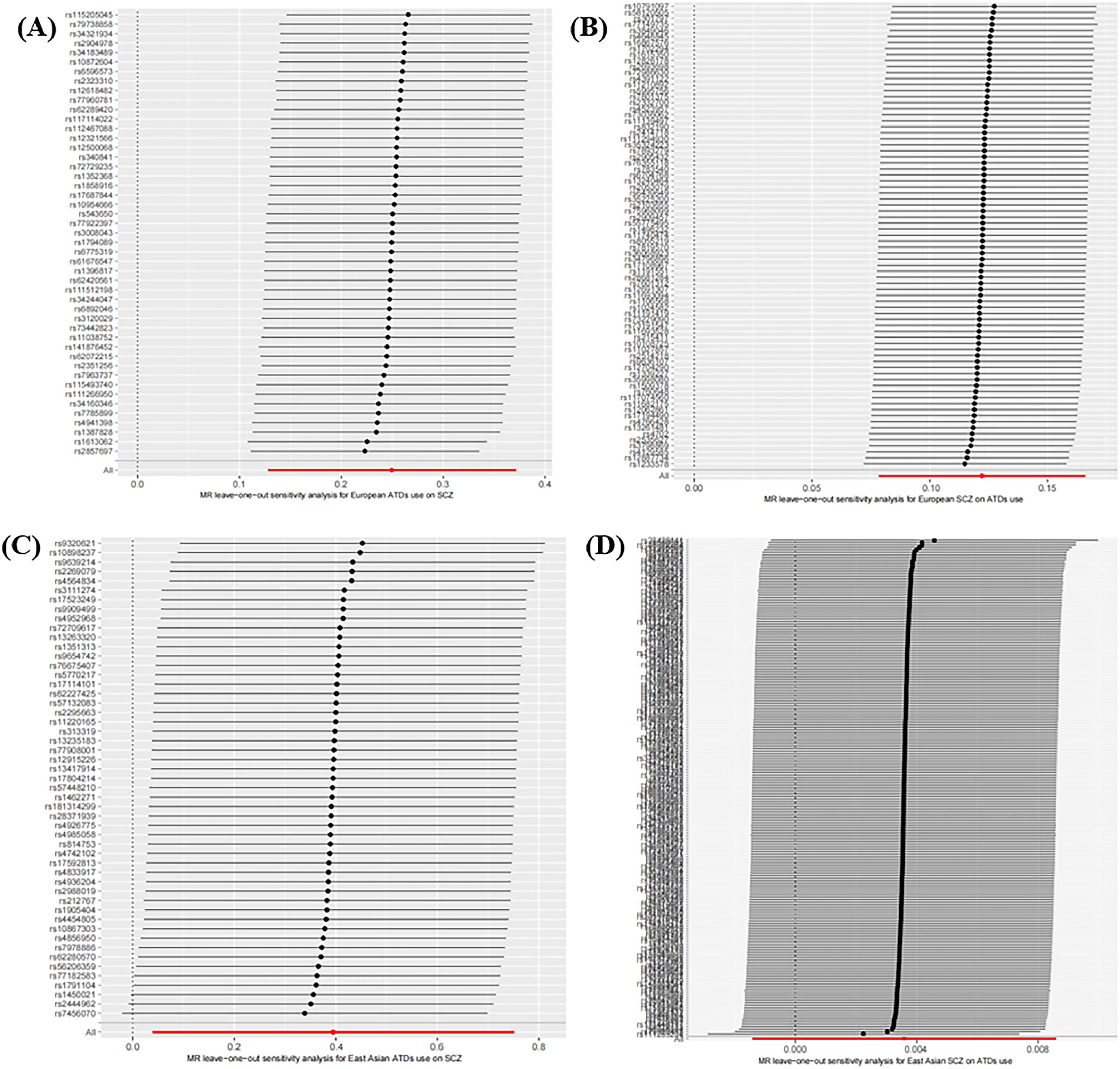
Finally, we conducted a "leave-one-out" analysis, which showed that no single SNP influenced the overall causal relationship (see Fig. 4). Additionally, the funnel plot showed a roughly symmetrical distribution of causal effects, indicating no obvious bias and further proving the stability of our study results (see Fig. 5).
Leave-One-Out Analysis of the Causal Relationship between ATDs Use and SCZ. (A) European ATDs use and SCZ; (B) European SCZ and ATDs use; (C) East Asian ATDs use and SCZ; (D) East Asian SCZ and ATDs use. By sequentially excluding each SNP, the robustness and reliability of the causal relationship are evaluated. No significant bias was observed.
Funnel Plot of the Causal Relationship between ATDs Use and SCZ. (A) European ATDs use and SCZ; (B) European SCZ and ATDs use; (C) East Asian ATDs use and SCZ; (D) East Asian SCZ and ATDs use. The funnel plot compares the distribution of causal effects in the study to assess bias and reliability of the results. The distribution is roughly symmetrical, with no significant bias observed.
Previous studies have found significant geographical differences in the ATDs use among SCZ patients. In Western countries, the prescription rate of ATDs for SCZ patients has increased from approximately 15% in 1990 to 40% in the past decade.5 This is consistent with our finding that European SCZ may increase ATDs use.
Many psychiatrists in Western countries follow recommendations developed by the Schizophrenia Patient Outcomes Research Team (PORT) based on existing scientific evidence for the use of ATDs in treating SCZ.30 In 48.3% of hospitalized SCZ patients, at least one comorbid depression criterion was met, and 33.8% of these patients were taking ATDs; among outpatients, 42.8% met the depression criteria, and 45.7% were prescribed ATDs.7 This could explain the increasing prescription rates of ATDs for SCZ patients in most Western countries.31
Interestingly, we found no predicted correlation between East Asian SCZ and ATDs use. Studies have shown that the use of ATDs in the treatment of SCZ is generally much lower in Asian countries compared to Western countries; although the prescription rate of ATDs for SCZ patients in Western countries has increased over time, the average prescription rate of ATDs for SCZ patients in Asian regions remains just over 10%.5 Reasons for the lower usage rate of ATDs in Asia may include concerns about exacerbating positive symptoms and the potential increase in adverse drug reactions. For example, the combined use of ATDs might raise the blood concentration of antipsychotic drugs through competitive metabolic inhibition, worsening psychotic symptoms such as delusions and hallucinations.32 Additionally, combined treatment with antipsychotics and ATDs may exacerbate side effects such as weight gain and sedation.33
In addition to differences in ATD prescription rates, this may also be related to multiple factors, including genetic, environmental, and cultural differences. There are significant differences in drug metabolism-related genes, such as the CYP450 enzyme family, between European and East Asian populations, which may affect the pharmacokinetics and pharmacodynamics of ATDs.34,35 For example, the higher frequency of loss-of-function alleles in CYP2D6 and CYP2C19 in East Asian populations may lead to different drug metabolism rates, thereby affecting the long-term effectiveness and side effects of ATDs.36,37 SCZ-related genes, such as COMT, BDNF, and SLC6A4, may have different allele frequencies and effect sizes across populations.38,39 These genetic background differences may explain the inconsistent use of ATDs for SCZ between European and East Asian populations. Furthermore, differences in diagnostic standards, treatment strategies, and social acceptance of mental illness across regions may also contribute to this. For instance, the stigma associated with mental illness in East Asia may lead to underdiagnosis or delayed treatment, thus affecting research outcomes.40 This highlights the importance of cultural and social factors in mental health research and may help explain the differences in ATD usage in SCZ between European and East Asian populations. Environmental factors such as diet, pollution, and social stress may influence the risk of mental illness through epigenetic mechanisms,41,42 potentially explaining the differences in ATD usage across populations.
Our study demonstrates the genetic and pharmacological differences between populations and suggests that clinicians should adjust medication strategies based on geographic and ethnic factors. Analyzing these racial and geographic differences not only promotes clinical research tailored to specific populations but also facilitates global drug development and usage strategies.
Causal relationship between ATDs Use and SCZ in different populationsSome studies have found that ATDs can be used as adjunctive therapy for SCZ, primarily to improve negative symptoms, depressive symptoms, obsessive-compulsive symptoms, and cognitive impairments.6,7 Research has shown that the novel non-monoaminergic rapid antidepressant (ketamine) exhibits significant antidepressant effects in depressed patients with a history of psychosis, but it has the potential to exacerbate dissociative or psychotic symptoms.43 Additionally, some studies indicate no significant difference in outcomes between the ATDs and placebo groups; in clinical practice, SCZ patients with “depression” show poor response to ATDs treatment. Analysis of SCZ (depressive and negative symptoms) suggests that the beneficial effect of adjunctive antidepressants is minimal.43,44 Currently, no studies have shown that ATDs use increases the risk of developing SCZ. Our study innovatively discovered that genetic predictions suggest that both European and East Asian ATDs use may increase the risk of developing SCZ, which is a novel finding.
The mechanism by which ATDs might increase the risk of SCZ is currently unclear. Possible hypotheses include: for SCZ patients, ATDs are always used in conjunction with antipsychotics. ATDs might increase the blood concentration of antipsychotic drugs through competitive metabolic inhibition, worsening symptoms such as delusions and hallucinations.43,45 Additionally, some ATDs might affect the function of neurotransmitter systems, particularly the dopamine and glutamate systems, which also play key roles in the pathogenesis of SCZ.46,47 SCZ is associated with overactivity in the dopaminergic system, and it is hypothesized that ATDs may influence the balance of neurotransmitters, potentially leading to downregulation of serotonin receptors. This could relieve inhibition on dopaminergic neurons, increasing dopamine levels, and thereby indirectly raise the risk of SCZ.48 Additionally, increasing evidence suggests that immune-inflammatory responses play a significant role in the pathogenesis of SCZ.49 It is hypothesized that certain ATDs may modulate the immune system, such as increasing levels of pro-inflammatory cytokines, which could further elevate the risk of SCZ. Studies have shown that ATDs exert therapeutic effects by promoting neuroplasticity.50 However, prolonged use of ATDs may have negative effects on neuroplasticity, such as reducing hippocampal neurogenesis and synaptic plasticity,51 and these changes may be linked to the pathophysiology of schizophrenia.52
Although ATDs have clear efficacy in treating depression and other mood disorders, our findings suggest that their use may be associated with an increased risk of schizophrenia. Therefore, clinicians must carefully weigh the risks and benefits when prescribing ATDs. Especially in cases of comorbidity between schizophrenia and depression, ATDs may be a necessary treatment option, but close monitoring of symptoms and side effects is essential, with treatment adjustments made based on the patient's response. Furthermore, individualized treatment is crucial, and clinicians should consider the patient's genetic background, drug metabolism capacity, comorbidities, and prior treatment responses to develop the most suitable treatment plan.
Strengths and limitationsStrengths: Our study used the GWAS database, which provides large sample sizes and high measurement accuracy, improving statistical power and making the study results more reliable. Furthermore, there are currently no studies investigating the bidirectional causal relationship between ATDs use and SCZ. We innovatively used the bidirectional TSMR analysis method to genetically predict the bidirectional causal relationship between European and East Asian ATDs use and SCZ. Compared to traditional observational studies, we used genetic SNPs to evaluate causal relationships, overcoming the influence of confounding factors and filling a gap in this research field.
We also conducted sensitivity analyses, further validating the reliability of our study results. The "leave-one-out" analysis showed that no single SNP significantly influenced the results. The funnel plot showed a roughly symmetrical distribution of causal effects, indicating no significant bias and further proving the stability of our study results. MR Egger and MR-PRESSO methods did not detect horizontal pleiotropy, increasing the reliability of our results.
Limitations: Our study has certain limitations. Although we innovatively discovered the bidirectional causal relationship between ATDs use and SCZ in different populations, it is limited to European and East Asian populations. Extending these results to other populations, ethnicities, and regions worldwide requires further validation. Additionally, Relaxing the threshold when selecting IVs may introduce bias risks. Although we have used F-statistics to eliminate weak instrument bias and conducted multiple sensitivity analyses to demonstrate the robustness of our findings after adjustment, future studies will require larger sample sizes for GWAS data. Additionally, the use of Polygenic Score (PGS) methods for analysis would be beneficial for comparison and mutual validation with our results. Finally, GWAS data represents statistical associations of SNPs, not direct causal variants. The path from SNP to gene expression, protein function, and ultimately to phenotype is complex and full of uncertainty. Phenotypes are likely influenced by multiple genes, environmental factors, and their interactions. Our study provides statistical inferences at the population level, rather than at the individual level. Differences in genetic backgrounds, environmental exposures, and lifestyle factors between individuals may lead to distinct phenotypic outcomes. Future research should integrate multi-omics data (such as genomics, transcriptomics, proteomics, and epigenomics) along with functional experiments to more comprehensively uncover the biological mechanisms between SNPs and phenotypes.
ConclusionIn summary, through the bidirectional TSMR analysis method, we have provided preliminary genetic evidence. At the genetic level, we found that both European and East Asian ATDs use might increase the risk of developing SCZ. This finding can assist clinicians in making informed medication decisions. Physicians may need to be more cautious in considering whether to prescribe ATDs to SCZ patients or opt for alternative treatments such as psychotherapy or other medications. Additionally, we discovered at the genetic level that European SCZ might increase ATDs use, whereas no such risk was found in East Asians. This suggests that there is a need for regulation of ATDs use in European SCZ patients, monitoring their symptoms and drug reactions to prevent the misuse of ATDs.
In the future, greater emphasis should be placed on personalized treatment in clinical practice, especially when prescribing antidepressants (ATDs). For patients who require long-term use of ATDs, regular monitoring of symptoms and side effects is crucial, and treatment plans should be adjusted promptly based on the patient's response. Moreover, for patients with comorbid schizophrenia and depression, a comprehensive treatment strategy should be adopted, including pharmacotherapy, psychotherapy, and social support, to maximize treatment effectiveness and minimize potential risks.
Author contributionsZhiqiang Du and Haohao Zhu conceived the study; Ying Jiang, Xiangjun Zhou, Qin Zhou and Rongrong Lu collected the report; Zhiqiang Du and Haohao Zhu wrote the manuscript and edited the manuscript. All authors have approved publishment of the manuscript.
The authors declare no conflicts of interest.


