


Research on humanitarian aid workers (HAWs) deployed to intentional human-made catastrophe contexts—such as armed conflicts—is scarce and seldom grounded in systematic theoretical frameworks, leaving psychopathological comorbidity largely unexamined. Guided by the p Factor and Hierarchical Taxonomy of Psychopathology frameworks, we assessed anxiety, depression, and post-traumatic stress disorder symptom caseness in HAWs (N = 432) using validated self-report instruments and hierarchical log-linear modeling. Symptom co-occurrence exceeded statistical independence, pairwise association strengths differed by spectrum, and comorbidity patterns deviated from chance distributions. These results are consistent with transdiagnostic clustering of psychopathology under extreme stress, supporting integrated approaches in humanitarian contexts.
Humanitarian aid workers (HAWs) deployed in intentional human-made catastrophe contexts (IHMCCs) are repeatedly exposed to high stress, insecurity, and human suffering. These experiences increase their vulnerability to mental disorders such as anxiety, depression, and post-traumatic stress disorder (PTSD). Research has identified significant psychological burden in this population, yet empirical work rarely examines comorbidity within contemporary models of psychopathology1. Investigating comorbidity is vital, as clinical interventions differ between individuals presenting a single versus multiple simultaneous syndromes2–4.
The current study uses two complementary frameworks—the general psychopathology factor (p Factor)5 and the Hierarchical Taxonomy of Psychopathology (HiTOP)6—to examine patterns of probable symptom co-occurrence in HAWs deployed to IHMCCs. According to Caspi et al.5, a single general psychopathology factor (p) captures shared vulnerability across disorders, producing a positive manifold among symptoms. This implies that disorders will co-occur more frequently than predicted by chance, especially when considered categorically5,7. In parallel, HiTOP reconceptualizes psychopathology as a dimensional hierarchy, where related syndromes form spectra that reflect overlapping liabilities, predicting correlated symptom elevations across disorders within the same spectrum.
This study pursues three related aims. First, we test whether symptom caseness for anxiety, depression, and PTSD deviates from statistical independence—an evaluation of whether observed co-occurrence exceeds chance expectations, as predicted by both p Factor and HiTOP models. Second, we investigate differential pairwise associations (anxiety-depression, anxiety-PTSD, depression-PTSD). The p Factor accommodates disorder-specific residual variance, meaning syndromes sharing more features retain stronger co-occurrence than those spanning multiple spectra. Anxiety and depression, both situated within HiTOP's internalizing distress subfactor, are therefore expected to show the tightest association. PTSD spans multiple HiTOP subfactors, predicting weaker pairwise associations relative to the anxiety-depression pair. Finally, we evaluate the degree of comorbidity among the three symptom syndromes (no caseness, single-syndrome caseness, two-way comorbidity, three-way comorbidity). Caspi et al.5 predict non-random clustering, with extreme-stress exposure amplifying p Factor effects across subpopulations.
MethodsParticipants were employees of an international humanitarian organization operating in armed conflict and war zones (i.e., Lebanon, Myanmar, Nigeria) with a C1 English proficiency level requirementa. Employees (N = 1062) were invited by email to complete an online survey containing the original English versions of validated questionnaires. Participation was voluntary. Up to three reminders were sent to non-respondents; data collection ran throughout February 2018 (response rate: 40.7%). All participants provided informed consent. The final sample comprised 432 individuals (53.7% male; mean age = 37.12, SD = 9.29), exceeding the minimum for medium-effect detection.
The study employed a cross-sectional design. Analyses were performed using Spearman rank-order correlations on continuous symptom totals and hierarchical log-linear modeling to test independence versus interactions among disorder variables and to examine pairwise and higher-order associations. All analyses were two-sided with results evaluated at p < .05.
MeasuresAnxiety symptoms were assessed using the State-Trait Anxiety Inventory 6 (STAI-6)8, a six-item condensation of Spielberger’s9 State-Trait Anxiety Inventory, with items rated on a 4-point scale (1 = Not at all to 4 = Very much; internal consistency Cronbach α = .82; α = .811 in the present study)8. Scores were rescaled to the standard 20–80 range10; caseness was defined at cutoff ≥ 40 e.g.,11.
Depression symptoms were assessed using the Patient Health Questionnaire-2 (PHQ-2), a two-item questionnaire (scores 0–6; 0 = Not at all to 3 = Nearly every day)12. A score ≥ 2 defined depression caseness, per Manea et al.13. In the present study, the internal consistency was Cronbach α = .765.
PTSD symptoms were measured using the PTSD Checklist for Diagnostic and Statistical Manual of Mental Disorders-Fifth Edition (PCL-5)14, a 20-item self-report scale assessing intrusion, avoidance, negative mood, and arousal symptoms with items rated on a 5-point scale (0 = Not at all to 4 = Extremely; internal consistencies α = .94-.95; test-retest reliability: r = .82). A cutoff ≥ 31 was adopted per authors’ recommendations to define PTSD caseness, consistent with validation in trauma-exposed populations14. In the present study, internal reliability Cronbach α = .923.
ResultsSymptom caseness rates were (N = 432): anxiety, n = 245 (56.7%, 95% CI [52.0% – 61.4%]); depression, n = 181 (41.9%, 95% CI [37.2% – 46.6%]); and PTSD, n = 70 (16.2%, 95% CI [12.7% – 19.7%]). The independence model fit the data poorly, G2(4) = 142.988, p < .001, indicating that observed symptom caseness for anxiety, depression, and PTSD deviated significantly from statistical independence. This necessitated retention of the saturated model, which provided a significantly better fit than the independence model, indicating that symptom co-occurrence exceeded that expected under statistical independence.
Pairwise Spearman correlations revealed differences in strength: anxiety and depression, rs(430) = .545, p < .001; anxiety and PTSD, rs(430) = .557, p < .001; depression and PTSD, rs(430) = .460, p < .001. Hierarchical log-linear analyses corroborated this pattern: relative to the independence model, each two-way term significantly improved fit (anxiety-depression, ΔG2(1) = 72.954, p < .001; anxiety-PTSD, ΔG2(1) = 48.279, p < .001; depression-PTSD, ΔG2(1) = 43.108, p < .001), supporting the pattern of co-occurrence reported above. The saturated model, selected via backward AIC-based elimination, best reflected the marked three-way symptom excess evident in the Pearson residuals.
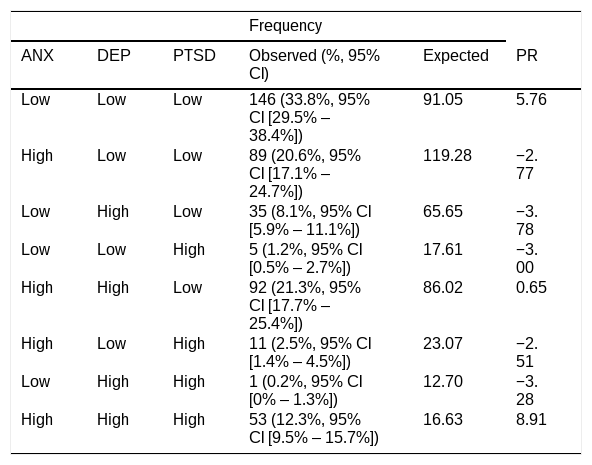
Symptom caseness diverged markedly from independence: none = 146 (33.8%, 95% CI [29.5% – 38.4%]), one = 129 (29.9%, 95% CI [25.7% – 34.3%]), two-way comorbidity = 104 (24.1%, 95% CI [20.3% – 28.3%]), and three-way comorbidity = 53 (12.3%, 95% CI [9.5% – 15.7%]). Table 1 presents the observed and expected frequencies (assuming independence), 95% CIs, and Pearson residuals for every symptom configuration.
Comorbidity clustering of anxiety (ANX), depression (DEP), and post-traumatic stress disorder (PTSD) symptoms with observed frequencies, prevalence rate and 95% Confidence Interval (CI), expected frequencies assuming independence, and Pearson Residuals (PR) (N = 432).
Anxiety, depression, and post-traumatic stress disorder (PTSD) symptoms in humanitarian aid workers (HAWs) deployed in intentional human-made catastrophe contexts (IHMCCs) are strongly interrelated. Symptom co-occurrence exceeded chance expectations, with individuals screen-positive for all three syndromes greatly overrepresented and single-syndrome cases underrepresented, suggesting that comorbidity is consistent with, though not establishing, a shared latent liability rather than independent symptom clusters.
This outcome is consistent with dimensional frameworks of psychopathology. The p Factor5 posits shared general liability across disorders, which HiTOP6 organizes hierarchically by spectrum, predicting that individuals with high dimensional psychopathology cluster across multiple related disorders. This clustering pattern is congruent with the observed symptom co-occurrence, rather than with discrete, independently occurring diagnostic categories.
Descriptive results revealed differential patterns of associations: although not formally tested, anxiety-depression and anxiety-PTSD associations appeared stronger than depression-PTSD, consistent with HiTOP’s placement of anxiety and depression within the same internalizing subfactor and the p Factor’s tolerance for disorder-specific residual variance. Comorbidity distributions further diverged from independence, showing overrepresentation at both extremes (no caseness and three-way comorbidity) alongside underrepresentation of single-syndrome presentations—consistent with a theoretical interpretation, derived from the p Factor framework, of amplified general liability under extreme stress—though the present design did not directly assess general psychopathology.
Direct comparison with prior research is constrained by the scarcity of comorbidity data in this population. To our knowledge, only De Jong et al.15 have assessed psychopathological comorbidity in HAWs, reporting pooled prevalence for 'any anxiety disorders' (6.6%) and 'any current disorders' (18.8%), without specifying co-occurrence patterns across discrete symptom syndromes. Individual symptom caseness rates—anxiety (56.7%), depression (41.9%), and PTSD (16.2%)—markedly exceed pooled self-report estimates in prior research (24.46%, 30.84%, and 9.09%, respectively)1, likely reflecting both the higher-exposure, conflict-specific sample and the well-documented tendency of self-report screening instruments to yield higher prevalence rates than diagnostic clinical interviews.
Several limitations warrant consideration. Converting dimensional symptom scales into dichotomous categories could artificially inflate or distort comorbidity patterns and potentially conflict with the dimensional rationale of HiTOP; future research should examine symptom relationships using continuous scores. The single-organization sample and a response rate of 40.7% may have introduced selection bias, as individuals experiencing greater or lesser distress may have been differentially likely to participate, potentially influencing estimates and compromising generalizability. The cross-sectional design precludes causal inference, and self-report measures are subject to response bias. Furthermore, analyses were not adjusted for demographic or contextual variables such as age, sex, or deployment region, as the study tested theoretically derived comorbidity hypotheses rather than demographic moderation; future research should address these factors systematically. Associations between psychopathological symptoms might also have been mediated by unaccounted transdiagnostic factors.
Overall, these results appear consistent with dimensional and transdiagnostic frameworks of psychopathology in a highly stress-exposed occupational group. While transdiagnostic frameworks offer conceptual parsimony, their implementation in clinical settings may be complicated by practitioners' reliance on categorical diagnoses. Practically, screening or interventions focused on single symptom syndromes may underestimate aid workers’ complex symptom profiles; rather, we suggest adopting integrated, transdiagnostic approaches, which appear to be beneficial. Though not constituting a direct validation of the p Factor and HiTOP frameworks, these findings may offer a theoretically grounded empirical basis for future longitudinal and multi-organizational research.
Ethics declarationWritten informed consent to take part in the study and to publish the article has been obtained from all participants or their legal representatives. The privacy rights of participants have been observed.
This study was performed in compliance with relevant laws, regulatory frameworks and guidelines where the research took place. This study was approved by the Ethics Committee of the Faculty of Psychology and Educational Sciences of the University of Geneva, Switzerland. (Approval No PSE.20170803.15)
FundingThe authors received no specific funding for this work.
None.

