Suicide is the second leading cause of death in adolescence, and its frequency has notably increased in Western countries.1 Self-harming behavior is a major issue among adolescents, with estimates suggesting that up to 17 % of them have engaged in some form of self-harm, a figure that rises to 24 % in the case of adolescent females in the United States.2 Despite its importance, relatively few interventions for children and adolescents have demonstrated efficacy, and the quality of the evidence according to GRADE criteria was mostly low.3
Cutting, or the act of cutting one's skin, represents the most common form of self-harm, but it is difficult to determine its exact frequency as it is not always a reason for seeking help. It is known that its presence doubles the risk of suicide compared to other forms of self-harm, such as medication overdoses.4
This study aims to examine the social, familial, and emotional characteristics associated with self-harming behavior in an adolescent population treated at the Child and Adolescent Mental Health Unit at the University Hospital Virgen de las Nieves (HUVN) in Granada, and its evolution after 12 months of follow-up. This project was approved by the Research Ethics Committee of Granada.
A total of 34 adolescents (aged 12 to 18) with self-harming behaviors were included and evaluated baseline and after 12 months. All patients and their parents or guardians voluntarily agreed to participate in the study by signing the informed consent form.
The following variables were studied: age and sex; family and social environment factors (family history, economic situation, family structure, history of abuse and/or bullying, academic performance, friendships, sports activities, and interpersonal relationships), the patient's prior diagnoses, substance use, and characteristics of the self-harm (personal history, type, topography, object used, frequency, trigger, purpose, contact with other self-harming adolescents, suicidal ideation). Additionally, standardized questionnaires were administered: the Family APGAR (which evaluates family functionality), the Children's Depression Inventory (CDI) (which assesses depressive symptoms), and the Suicide Risk Screening Tool (which assesses suicide risk).
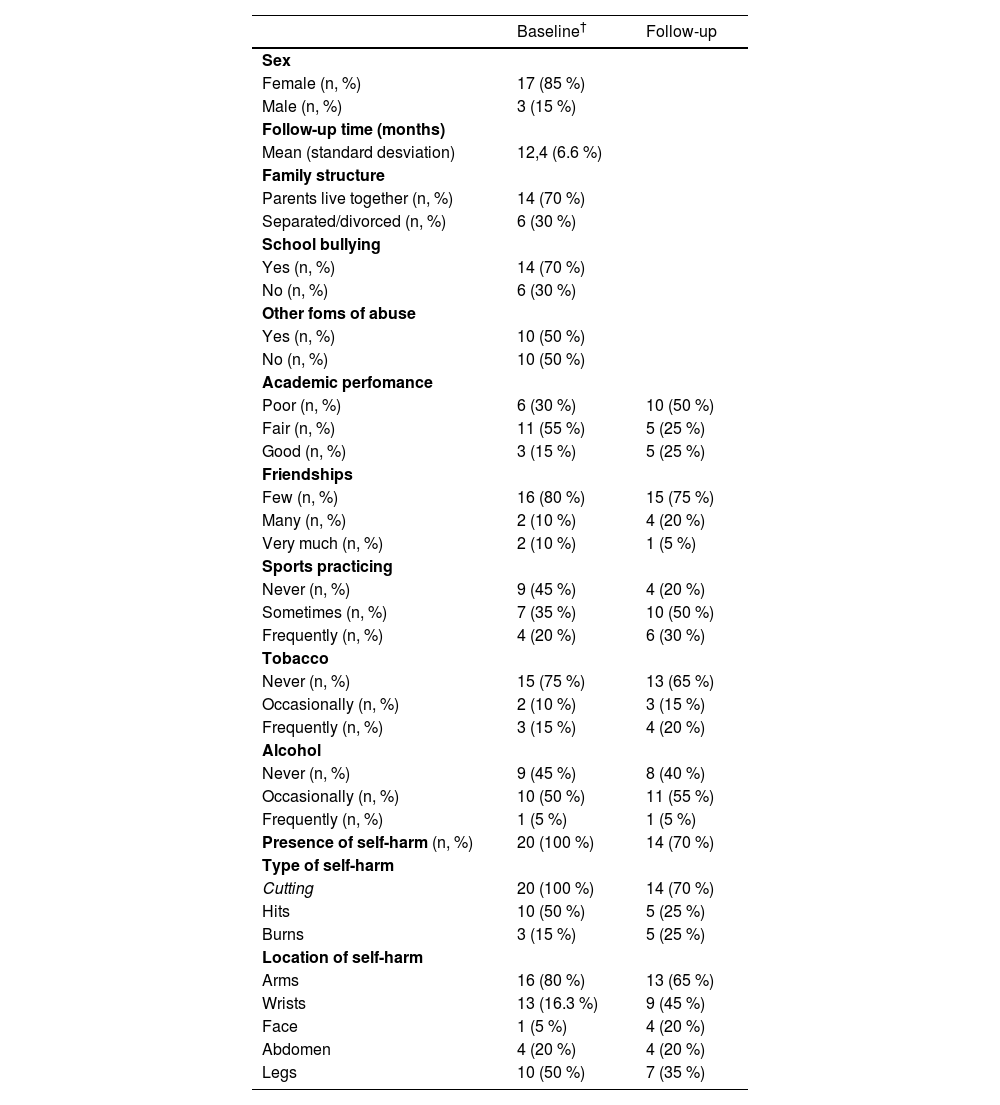
Of the 34 patients initially included, 20 were reassessed after 12 months, while the remaining 14 could not be contacted. Sociodemographic characteristics, lifestyle habits, and clinical variables are detailed in Table 1. Statistical analyses were performed using the IBM® SPSS® Statistics software, version 25.
Clinical and sociodemographic characteristics (n = 20).
| Baseline† | Follow-up | |
|---|---|---|
| Sex | ||
| Female (n, %) | 17 (85 %) | |
| Male (n, %) | 3 (15 %) | |
| Follow-up time (months) | ||
| Mean (standard desviation) | 12,4 (6.6 %) | |
| Family structure | ||
| Parents live together (n, %) | 14 (70 %) | |
| Separated/divorced (n, %) | 6 (30 %) | |
| School bullying | ||
| Yes (n, %) | 14 (70 %) | |
| No (n, %) | 6 (30 %) | |
| Other foms of abuse | ||
| Yes (n, %) | 10 (50 %) | |
| No (n, %) | 10 (50 %) | |
| Academic perfomance | ||
| Poor (n, %) | 6 (30 %) | 10 (50 %) |
| Fair (n, %) | 11 (55 %) | 5 (25 %) |
| Good (n, %) | 3 (15 %) | 5 (25 %) |
| Friendships | ||
| Few (n, %) | 16 (80 %) | 15 (75 %) |
| Many (n, %) | 2 (10 %) | 4 (20 %) |
| Very much (n, %) | 2 (10 %) | 1 (5 %) |
| Sports practicing | ||
| Never (n, %) | 9 (45 %) | 4 (20 %) |
| Sometimes (n, %) | 7 (35 %) | 10 (50 %) |
| Frequently (n, %) | 4 (20 %) | 6 (30 %) |
| Tobacco | ||
| Never (n, %) | 15 (75 %) | 13 (65 %) |
| Occasionally (n, %) | 2 (10 %) | 3 (15 %) |
| Frequently (n, %) | 3 (15 %) | 4 (20 %) |
| Alcohol | ||
| Never (n, %) | 9 (45 %) | 8 (40 %) |
| Occasionally (n, %) | 10 (50 %) | 11 (55 %) |
| Frequently (n, %) | 1 (5 %) | 1 (5 %) |
| Presence of self-harm (n, %) | 20 (100 %) | 14 (70 %) |
| Type of self-harm | ||
| Cutting | 20 (100 %) | 14 (70 %) |
| Hits | 10 (50 %) | 5 (25 %) |
| Burns | 3 (15 %) | 5 (25 %) |
| Location of self-harm | ||
| Arms | 16 (80 %) | 13 (65 %) |
| Wrists | 13 (16.3 %) | 9 (45 %) |
| Face | 1 (5 %) | 4 (20 %) |
| Abdomen | 4 (20 %) | 4 (20 %) |
| Legs | 10 (50 %) | 7 (35 %) |
In our sample, it was observed a trend towards stabilization of self-injurious behavior in adolescents after 12 months of follow-up, with 70 % of the individuals continuing to engage in self-harm after a year. Depressive symptoms, assessed by the Children's Depression Inventory (CDI), and suicidal ideation were significantly more pronounced in the recurrent self-harm group compared to those who did not continue self-injuring (Table 2).
Comparative analysis of the sample (n = 20) based on the CDI depression questionnaire and the presence/absence of self-harm and suicidal ideation.
CDI: Children Depression Inventory; SD, Standard deviation.
The association between depression and self-harm has been well-documented in the adult literature; however, in adolescent populations, depressive symptoms are frequently underrecognized.5 Despite the small sample size, our results suggest that the total CDI score may serve as a predictor of current self-harm risk in adolescents and should therefore be examined more comprehensively in future studies involving larger samples of the Spanish population.
In our study, no significant association was found between family functioning, assessed by the APGAR questionnaire, and the risk of self-harm. While many studies report a relationship between lack of family support during childhood and increased suicide risk in adolescence,6 the small sample size in the present study may explain these findings.
Cutting was the most prevalent form of self-harm in our sample, followed by hitting and burns on the arms and wrists, which is consistent with the existing literature.7 The most common motivation for self-injury was emotional relief. Additionally, most patients reported knowing other adolescents who engaged in similar behaviors, underscoring the risk of imitative behavior from peers and individuals with high-profile suicidal issues.
Our findings are consistent with a recent study conducted in Taiwan, which employed supervised machine learning classification algorithms to predict early indicators of suicidal ideation in children and adolescents. The study reported that sadness and depression increased the likelihood of suicidal thoughts by >25-fold, while anxiety, loneliness, and exposure to abusive language increased this likelihood by more than three-fold, with an overall predictive accuracy of approximately 90 %.8
Although individual risk factors are generally considered modest predictors of suicidal thoughts and behaviors, research highlights the importance of examining multiple risk factors and their complex interactions.9 In this context, interpersonal negative life events have been shown to predict a higher incidence of suicidal thoughts over the short term in high-risk adolescents.10 A critical research priority is the identification of vulnerability states and risk factors to facilitate the development of effective interventions.11
For instance, among high-risk adolescents, lower engagement in social media may reflect social anhedonia or withdrawal, which could heighten the risk of suicidal ideation or treatment noncompliance.12
The present study has certain limitations that have hindered the attainment of more significant results. Undoubtedly, the primary issue is the small sample size (n = 20), largely due to participant attrition during follow-up. This may have introduced a bias, as individuals with milder symptoms may be underrepresented. However, difficulties in follow-up have also been noted in a longitudinal study of 164 adolescents in the United States, only 75 % completed follow-up and <60 % participated in a third interview.13
On the other hand, the main strength of this study is its longitudinal design, as there are very few follow-up studies on self-harm in adolescents. Although the small sample size necessitates cautious interpretation of the findings, it is noteworthy that after approximately one year of follow-up, 70 % of participants continued engaging in self-harm, and 40 % maintained suicidal ideation.
Based on these findings, we conclude that, in adolescents with psychiatric disorders, it is crucial to systematically explore the presence of self-injurious behavior and depressive symptoms due to their strong association with the persistence of self-harm over time and elevated suicide risk.
Ethical considerationsThis project was approved by the Research Ethics Committee of Granada. All patients and their parents or guardians voluntarily agreed to participate in the study by signing the informed consent form.
ContributionsJavier Vera-Martínez: designed the study, performed the statistical analysis, discuss the results, and approved the final version of the manuscript.
Sara Jiménez-Fernández and Pablo González-Domenech: contributed to the statistical analysis, the discussion of results, drafted the initial manuscript, and approved the final version of the manuscript.
Luis Gutiérrez Rojas: performed a critical review of the manuscript and approved the final version.
Francisco Díaz-Atienza: designed the study, participated in the recruitment, the statistical analysis, the discussion of results, performed a critical review of the manuscript, and approved the final version.
The authors declare that they have no conflict of interest related to the contents of this work.
This study did not receive any funding.