metricas
Enfermería Intensiva (English Edition) Vascular complications of intravenous vancomycin: Safety of peripheral, midline ...
Journal Information
Vol. 37. Issue 4. (In progress)
(October - December 2026)
Cite
Cite
Share
Download PDF
More article options
Visits
148
Vol. 37. Issue 4. (In progress)
(October - December 2026)
Review article

Vascular complications of intravenous vancomycin: Safety of peripheral, midline and central catheters. A scoping review

Complicaciones vasculares de la vancomicina intravenosa: seguridad de los catéteres periféricos, de línea media y centrales. Revision exploratoria
Visits
148
Irrintzi Fernández-Aedoa,b, Sendoa Ballesteros-Peñaa,b,c, Gorka Vallejo-De La Hoza,b,d, Julia Fernandez-Alonsoa,e,
Corresponding author
Julia.fernandez@ehu.eus

Corresponding author.
a Biobizkaia Health Research Institute, Spain
b Nursing I Department, Faculty of Medicine and Nursing, University of the Basque Country (UPV/EHU), Spain
c Osakidetza, Santa Marina Hospital, Spain
d Osakidetza, Galdakao-Usansolo Hospital, Spain
e Physiology Department, Faculty of Medicine and Nursing, University of the Basque Country (UPV/EHU), Spain
This item has received
Article information
Abstract
Full Text
Bibliography
Download PDF
Statistics
Abstract
Introduction

Vancomycin treats severe infections by resistant bacteria, but its acidity and local toxicity demand careful intravenous administration. Central venous catheters reduce these risks but pose complications. Midline catheters offer a less invasive alternative, though evidence remains limited.

Objectives

To map and describe the available clinical evidence on the safety and vascular complications associated with peripheral intravenous administration of vancomycin, compared with other vascular access devices, focusing on the type of complications reported, their diagnostic methods, and the methodological characteristics of the studies.

Method

A scoping review was conducted following the PRISMA-ScR guidelines. A comprehensive literature search was performed in Medline (via PubMed), Web of Science, Cochrane Library, CINAHL, and CUIDEN databases to identify studies reporting on intravenous vancomycin administration, catheter type and associated complications.

Results

Four studies met the inclusion criteria—two clinical trials and two cohort studies—with sample sizes ranging from 14 to 1087 participants. All studies reported complications attributed to vancomycin, regardless of catheter type. Two studies reported low rates of certain complications in patients receiving vancomycin through midline catheters, while other studies described complications associated with peripheral administration or recommended central access based on clinical considerations.

Conclusion

The available studies report heterogeneous findings regarding vascular complications associated with different vascular access devices for vancomycin administration. The evidence is limited and methodologically diverse, highlighting important gaps in the literature regarding outcome definitions, diagnostic approaches, and comparative evaluation across catheter types.

Keywords:
Vancomycin
Midline catheter
Peripheral intravenous catheter
Central venous catheter
Phlebitis
Thrombosis
Scoping review
Resumen
Introducción

La vancomicina es utilizada para tratar infecciones graves por bacterias resistentes, pero su acidez y toxicidad local exigen una administración intravenosa controlada. Los catéteres venosos centrales reducen estos riesgos, aunque pueden generar complicaciones. Los catéteres de línea media representan una alternativa menos invasiva, aunque la evidencia sigue siendo limitada.

Objetivos

Mapear y describir la evidencia clínica disponible sobre la seguridad y las complicaciones vasculares asociadas con la administración intravenosa periférica de vancomicina, en comparación con otros dispositivos de acceso vascular, centrándose en el tipo de complicaciones notificadas, sus métodos de diagnóstico y las características metodológicas de los estudios.

Método

Se realizó una revisión exploratoria siguiendo las directrices PRISMA-ScR. Se llevó a cabo una búsqueda bibliográfica exhaustiva en las bases de datos Medline (a través de PubMed), Web of Science, Cochrane Library, CINAHL y CUIDEN para identificar estudios que informaran sobre la administración intravenosa de vancomicina, el tipo de catéter y las complicaciones asociadas.

Resultados

Cuatro estudios cumplieron los criterios de inclusión (dos ensayos clínicos y dos estudios de cohortes), con tamaños muestrales entre 14 y 1.087 participantes. Todos informaron de complicaciones atribuidas a la vancomicina, independientemente del tipo de catéter. Dos estudios señalaron bajas tasas de determinadas complicaciones en pacientes con vancomicina administrada a través de catéteres de línea media, mientras que otros estudios describieron complicaciones asociadas a la administración periférica o recomendaron el acceso central.

Conclusión

Los estudios disponibles presentan resultados heterogéneos en cuanto a las complicaciones vasculares asociadas a los distintos dispositivos de acceso vascular utilizados para la administración de vancomicina. La evidencia es limitada y metodológicamente diversa, lo que pone de manifiesto importantes lagunas en la literatura en lo que respecta a las definiciones de los resultados, los enfoques diagnósticos y la descripción de la evidencia disponible.

Palabras clave:
Vancomicina
Catéter de línea media
Catéter intravenoso periférico
Catéter venoso central
Flebitis
Trombosis
Revisión exploratoria
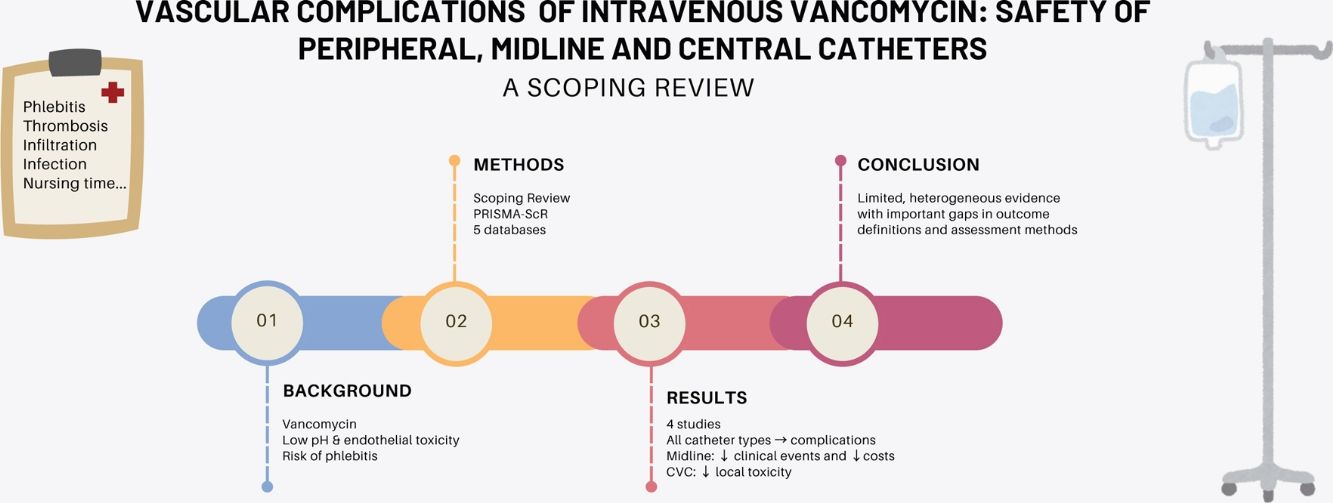
Graphical abstract

Article

These are the options to access the full texts of the publication Enfermería Intensiva (English Edition)
Subscriber
Subscriber

If you already have your login data, please click here .

If you have forgotten your password you can you can recover it by clicking here and selecting the option “I have forgotten my password”
Purchase
Purchase article

Purchasing article the PDF version will be downloaded

Purchase now
Contact
Phone for subscriptions and reporting of errors
From Monday to Friday from 9 a.m. to 6 p.m. (GMT + 1) except for the months of July and August which will be from 9 a.m. to 3 p.m.
Calls from Spain
932 415 960
Calls from outside Spain
+34 932 415 960
E-mail
References
[1]
M.J. Rybak.
The pharmacokinetic and pharmacodynamic properties of vancomycin.
Clin Infect Dis, 42 (2006), pp. S35-S39
[2]
M. Drouet, F. Chai, C. Barthélémy, G. Lebuffe, B. Debaene, B. Décaudin, et al.
Influence of vancomycin infusion methods on endothelial cell toxicity.
Antimicrob Agents Chemother, 59 (2015), pp. 930-934
[3]
S. Ballesteros-Peña, I. Fernández-Aedo, G. Vallejo-De la Hoz, J. Tønnesen, C. Miguelez.
Identificación de medicamentos intravenosos potencialmente irritantes.
Enferm Intensiva, 33 (2022), pp. 132-140
[4]
L. Hadaway, S.N. Chamallas.
Vancomycin: new perspectives on an old drug.
J Infus Nurs, 26 (2003), pp. 278-284
[5]
P. Blanco.
El catéter venoso de línea media: the midline venous catheter.
Rev Hosp Dr Emilio Ferreyra, 2 (2021), pp. e3-e9
[6]
K.R. Qin, M. Pittiruti, R.M. Nataraja, M. Pacilli.
Long peripheral catheters and midline catheters: insights from a survey of vascular access specialists.
J Vasc Access, 22 (2021), pp. 905-910
[7]
G.B. Deutsch, S.A. Sathyanarayana, N. Singh, J. Nicastro.
Ultrasound-guided placement of midline catheters in the surgical intensive care unit: a cost-effective proposal for timely central line removal.
J Surg Res, 191 (2014), pp. 1-5
[8]
E.B. Nielsen, L. Antonsen, C. Mensel, N. Milandt, L.S. Dalgaard, B.S. Illum, et al.
The efficacy of midline catheters: a prospective, randomized, active-controlled study.
Int J Infect Dis, 102 (2021), pp. 220-225
[9]
R. Dawson, L. Moureau.
Midline catheters: an essential tool in CLABSI reduction [Internet].
[10]
A. Mushtaq, B. Navalkele, M. Kaur, A. Krishna, A. Saleem, N. Rana, et al.
Comparison of complications in midlines versus central venous catheters: are midlines safer than central venous lines?.
Am J Infect Control, 46 (2018), pp. 788-792
[11]
M. Urtecho, V.D. Torres Roldan, T. Nayfeh, N.R. Espinoza Suarez, N. Ranganath, P. Sampathkumar, et al.
Comparing complication rates of midline catheter vs peripherally inserted central catheter: a systematic review and meta-analysis.
Open Forum Infect Dis, 10 (2023), pp. ofad024
[12]
A.C. Tricco, E. Lillie, W. Zarin, K.K. O’Brien, H. Colquhoun, D. Levac, et al.
PRISMA Extension for Scoping Reviews (PRISMA-ScR): checklist and explanation.
Ann Intern Med, 169 (2018), pp. 467-473
[13]
O.D. Lopez-Cortes, A. Betancourt-Núñez, M.F. Bernal Orozco, B. Vizmanos.
Scoping reviews: una nueva forma de síntesis de la evidencia.
Investig Educ Med, 11 (2022), pp. 98-104
[14]
J. McGowan, S. Straus, D. Moher, E.V. Langlois, K.K. O’Brien, T. Horsley, et al.
Reporting scoping reviews-PRISMA ScR extension.
J Clin Epidemiol, 123 (2020), pp. 177-179
[15]
Cochrane. Risk of Bias 2 (RoB 2) tool [Internet]. Cochrane Methods [cited 2026 Jun 7]. Available from: https://www.cochrane.org/learn/courses-and-resources/cochrane-methodology/risk-bias/about-risk-bias-2-rob-2.
[16]
Cochrane. ROBINS-I tool [Internet]. Cochrane Methods [cited 7 June 2026]. Available from: https://www.cochrane.org/learn/courses-and-resources/cochrane-methodology/risk-bias/robins-i-tool-resources-and-reporting-guidance.
[17]
S. Roszell, C. Jones.
Intravenous administration issues: a comparison of intravenous insertions and complications in vancomycin versus other antibiotics.
J Infus Nurs, 33 (2010), pp. 112-118
[18]
J.V. Caparas, J.P. Hu.
Safe administration of vancomycin through a novel midline catheter: a randomized, prospective clinical trial.
J Vasc Access, 15 (2014), pp. 251-256
[19]
J.V. Caparas, H.-S. Hung.
Vancomycin administration through a novel midline catheter: summary of a 5-year, 1086-patient experience in an urban community hospital.
J Assoc Vasc Access, 22 (2017), pp. 38-41
[20]
M. Scarano, S. D’Arrigo, S. De Letteriis, S. Grasso, M. Pittiruti, G. Scoppettuolo.
Risk of thrombophlebitis associated with continuous peripheral infusion of vancomycin: the effect of dilution.
J Vasc Access, 25 (2024), pp. 107-112
[21]
S.M. Park, I.S. Jeong, S.S. Jun.
Identification of risk factors for intravenous infiltration among hospitalized children: a retrospective study.
[22]
A.C. Bulmer, R. Nightingale, W. Hewage, G. Keijzers, P.J. Snelling.
Ultrasound evaluation of peripheral intravenous catheter thrombus formation associated with intravenous flucloxacillin administration: a prospective observational pilot study.
Australas J Ultrasound Med, 28 (2025),
[23]
P. Balsorano, G. Virgili, G. Villa, M. Pittiruti, S. Romagnoli, A.R. De Gaudio, et al.
Peripherally inserted central catheter-related thrombosis rate in modern vascular access era-when insertion technique matters: a systematic review and meta-analysis.
J Vasc Access, 21 (2020), pp. 45-54
[24]
N. Marsh, J. Webster, A.J. Ullman, G. Mihala, M. Cooke, V. Chopra, et al.
Peripheral intravenous catheter non-infectious complications in adults: a systematic review and meta-analysis.
J Adv Nurs, 76 (2020), pp. 3346-3362
[25]
S. Keogh, J. Flynn, N. Marsh, G. Mihala, K. Davies, C. Rickard.
Varied flushing frequency and volume to prevent peripheral intravenous catheter failure: a pilot, factorial randomised controlled trial in adult medical-surgical hospital patients.
[26]
M. Drouet, E. Cuvelier, F. Chai, S. Genay, P. Odou, B. Décaudin.
Disturbance of vancomycin infusion flow during multidrug infusion: influence on endothelial cell toxicity.
Antibiotics (Basel), 11 (2022), pp. 16
[27]
K.A. Cawcutt, R.J. Hankins, T.A. Micheels, M.E. Rupp.
Optimizing vascular-access device decision-making in the era of midline catheters.
Infect Control Hosp Epidemiol, 40 (2019), pp. 674-680
[28]
L.A. Gorski.
The 2016 Infusion Therapy Standards of Practice.
Home Healthc Now, 35 (2017), pp. 10
[29]
V. Chopra, J.C. O’Horo, M.A.M. Rogers, D.G. Maki, N. Safdar.
The risk of bloodstream infection associated with peripherally inserted central catheters compared with central venous catheters in adults: a systematic review and meta-analysis.
Infect Control Hosp Epidemiol, 34 (2013), pp. 908-918
[30]
N.L. Moureau.
Is the pH of vancomycin an indication for central venous access?.
J Vasc Access, 15 (2014), pp. 249-250
[31]
M. Abdulelah, O. Haider, H. Abdulelah, K.T. Jamouss, T.L. Higgins.
Venous access devices (Review).
Med Int (Lond), 5 (2025), pp. 1-10
[32]
J.M. Porter, R.B. Rutherford, G.P. Clagett, J.J. Cranley, T.F. O’Donnell, S. Raju, et al.
Reporting standards in venous disease.
J Vasc Surg, 8 (1988), pp. 172-181
[33]
S. Manrique-Rodríguez, I. Heras-Hidalgo, M.S. Pernia-López, A. Herranz-Alonso, M.C. Del Río Pisabarro, M.B. Suárez-Mie, et al.
Standardization and chemical characterization of intravenous therapy in adult patients: a step further in medication safety.
Drugs R D, 21 (2021), pp. 39-64
[34]
N. Marsh, E.N. Larsen, M. Takashima, T. Kleidon, S. Keogh, A.J. Ullman, et al.
Peripheral intravenous catheter failure: a secondary analysis of risks from 11,830 catheters.
asdasdasd
Article options
Tools
Supplemental materials