metricas
Enfermería Intensiva (English Edition) Swanson's theory of caring applied to mechanical ventilation weaning in the ICU:...
Journal Information
Vol. 37. Issue 4. (In progress)
(October - December 2026)
Cite
Cite
Share
Download PDF
More article options
Visits
140
Vol. 37. Issue 4. (In progress)
(October - December 2026)
Original article

Swanson's theory of caring applied to mechanical ventilation weaning in the ICU: Humanizing care

Teoría de Swanson en el destete de ventilación mecánica en UCI
Visits
140
Juan Ramón Milanés Grageraa,
Corresponding author
juan.milanes@salud-juntaex.es

Corresponding author.
, Noemí Román Románb, Inmaculada Galán Sáncheza, Verónica Merino Durána, Jorge Macías Blancoa
a Unidad de Cuidados Intensivos, Complejo Hospitalario Universitario de Cáceres, Hospital San Pedro de Alcántara, Cáceres, Spain
b Unidad Pruebas Funcionales, Complejo Hospitalario Universitario de Cáceres, Hospital Universitario de Cáceres, Cáceres, Spain
This item has received
Article information
Abstract
Full Text
Bibliography
Download PDF
Statistics
Abstract
Objective

To analyze the scientific evidence on the application of Swanson's Theory of Caring in the process of invasive mechanical ventilation weaning in Intensive Care Units (ICU), identifying nursing interventions that correspond to Swanson's five theoretical processes (knowing, being with, doing for, enabling, and maintaining belief) and assessing their implications for clinical practice.

Method

Scoping review conducted according to the methodological framework of Arksey and O’Malley (2005), enhanced by Levac et al. (2010), and the updated JBI guidance for scoping reviews (Peters et al., 2020). Reporting followed the PRISMA extension for Scoping Reviews (PRISMA-ScR). A search of scientific literature published between January 2020 and January 2026 was performed in PubMed/MEDLINE, SciELO, CUIDEN, Cochrane Library and CINAHL, complemented by backward citation tracking. Forty-five articles were included after applying rigorous selection criteria, through independent screening by two reviewers with discrepancies resolved by consensus. Data were analyzed through structured extraction and narrative synthesis, organizing interventions according to Swanson's five caring processes.

Results

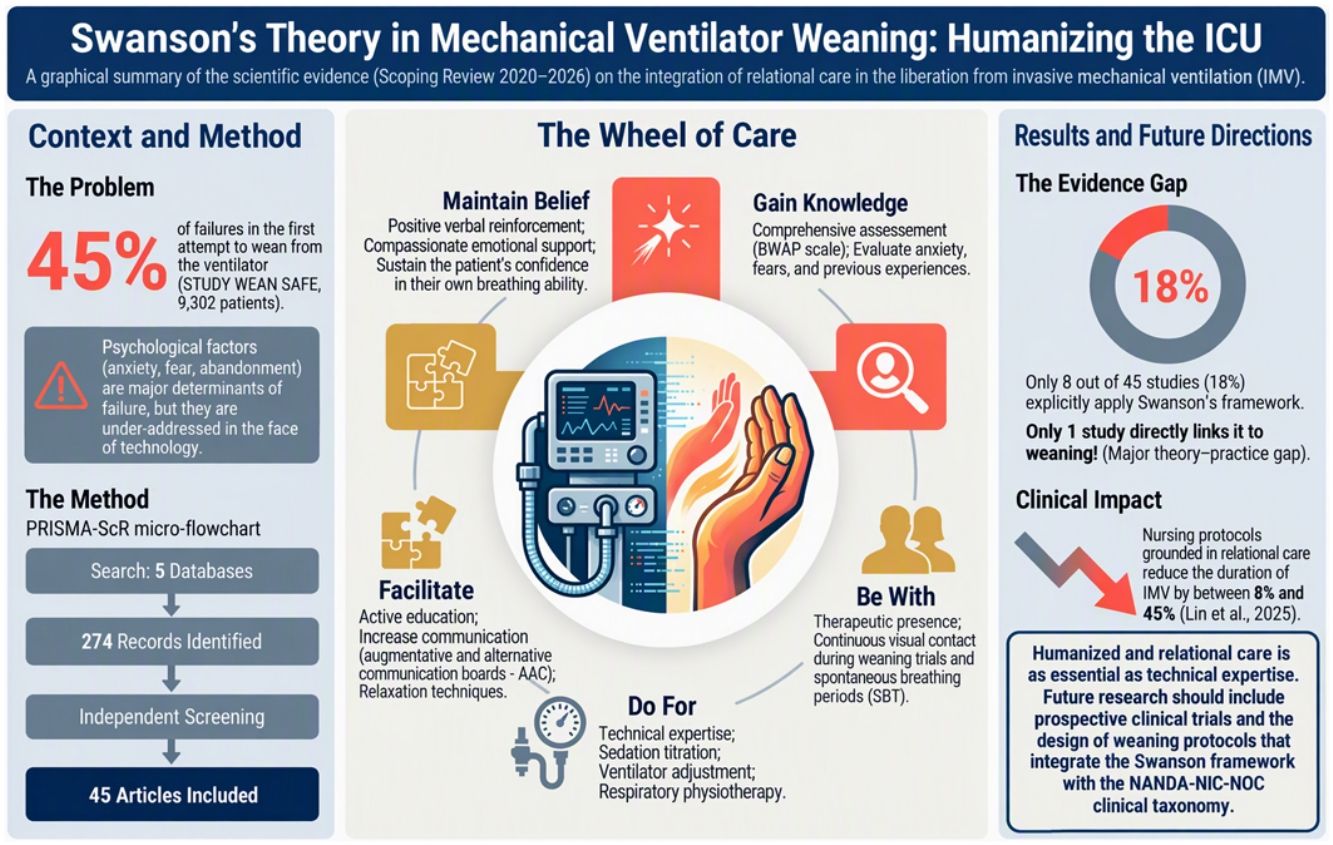
The review identified multiple nursing interventions during ventilator weaning that showed conceptual correspondence with Swanson's theory. Only 8 of the 45 articles (18%) explicitly used Swanson's framework, and a single study directly linked it to ventilator weaning, identifying a significant knowledge gap. The “knowing” process includes individualized assessment using validated scales and continuous monitoring. “Being with” is manifested through therapeutic presence, effective communication, and facilitation of family contact. “Doing for” encompasses sedation titration, ventilation management, and respiratory physiotherapy techniques. “Enabling” comprises health education, use of augmentative communication systems, and support in decision-making. “Maintaining belief” is materialized through positive reinforcement, management of realistic expectations, and emotional accompaniment.

Conclusions

Swanson's Theory of Caring provides a relevant and potentially operational theoretical framework to structure and humanize nursing care during ventilator weaning in the ICU. The conceptual correspondence identified suggests that its systematic application could contribute to improving patient experience, reducing psychological complications, and optimizing weaning outcomes. Implementation gaps are evident due to the absence of prospective studies, scarcity of data to quantify the impact of relational care on the weaning process, and the absence of specific protocols that merge the NANDA-NIC-NOC taxonomy and the Swanson theoretical framework. Prospective studies applying Swanson's framework from the design phase are required to evaluate the specific impact of interventions based on this theory through controlled clinical trials.

Keywords:
Ventilator weaning
Nursing theory
Nursing care
Intensive care units
Patient-centered care
Holistic nursing
Swanson's model
Resumen
Objetivo

Analizar la evidencia científica sobre la aplicación de la teoría del cuidado de Swanson en el proceso de destete de ventilación mecánica invasiva en las unidades de cuidados intensivos (UCI), identificando las intervenciones de enfermería que se corresponden con los 5 procesos teóricos de Swanson (conocer, estar con, hacer por, facilitar y mantener la fe) y valorando sus implicaciones para la práctica clínica.

Método

Revisión de alcance scoping review conducida según el marco metodológico de Arksey y O’Malley (2005), mejorado por Levac et al. (2010), y la guía actualizada del JBI para scoping reviews (Peters et al., 2020). Se siguió la extensión PRISMA para revisiones de alcance (PRISMA-ScR). Búsqueda de literatura científica publicada entre enero de 2020 y enero de 2026 en PubMed/MEDLINE, SciELO, CUIDEN, Cochrane Library y CINAHL, complementada con búsqueda inversa. Se incluyeron 45 artículos tras aplicar criterios de selección rigurosos, mediante cribado independiente por 2 revisores con resolución de discrepancias por consenso. Los datos se analizaron mediante extracción estructurada y síntesis narrativa, organizando las intervenciones según los 5 procesos del cuidado de Swanson.

Resultados

La revisión identificó múltiples intervenciones de enfermería durante el destete ventilatorio que presentan correspondencia conceptual con la teoría de Swanson. Solo 8 de los 45 artículos (18%) utilizaron explícitamente el marco de Swanson, y un único estudio lo vinculó directamente con el destete ventilatorio, identificando una laguna significativa de conocimiento. El proceso «conocer» incluye la valoración individualizada mediante escalas validadas. «Estar con» se concreta en la presencia terapéutica, comunicación efectiva y facilitación del contacto familiar. «Hacer por» engloba la titulación de sedación, manejo de la ventilación y fisioterapia respiratoria. «Facilitar» comprende educación sanitaria y sistemas de comunicación aumentativa. «Mantener la fe» se materializa en el refuerzo positivo y acompañamiento emocional.

Conclusiones

La teoría del cuidado de Swanson ofrece un marco teórico relevante y potencialmente operativo para estructurar y humanizar los cuidados de enfermería durante el destete ventilatorio en la UCI. La correspondencia conceptual identificada sugiere que su aplicación sistemátca podría contribuir a mejorar la experiencia del paciente. Se evidencian lagunas de implementación tanto por ausencia de estudios prospectivos, escasez de datos para cuantificar impacto del cuidado relacional en el proceso de destete y ausencia de protocolos especificos que fusionen la taxonomia NANDA-NIC-NOC y el marco teórico de Swanson. Se requieren estudios prospectivos que apliquen el marco de Swanson desde la fase de diseño para evaluar el impacto específico de intervenciones basadas en esta teoría.

Palabras clave:
Destete de la ventilación mecánica
Teoría de enfermería
Cuidados de enfermería
Unidades de cuidados intensivos
Atención dirigida al paciente
Cuidado holístico
Modelo de Swanson
Graphical abstract

Article

These are the options to access the full texts of the publication Enfermería Intensiva (English Edition)
Subscriber
Subscriber

If you already have your login data, please click here .

If you have forgotten your password you can you can recover it by clicking here and selecting the option “I have forgotten my password”
Purchase
Purchase article

Purchasing article the PDF version will be downloaded

Purchase now
Contact
Phone for subscriptions and reporting of errors
From Monday to Friday from 9 a.m. to 6 p.m. (GMT + 1) except for the months of July and August which will be from 9 a.m. to 3 p.m.
Calls from Spain
932 415 960
Calls from outside Spain
+34 932 415 960
E-mail
References
[1]
H. Wunsch, J. Wagner, M. Herlim, D.H. Chong, A.A. Kramer, S.D. Halpern.
ICU occupancy and mechanical ventilator use in the United States.
Crit Care Med., 41 (2013), pp. 2712-2719
[2]
T. Pham, L. Heunks, G. Bellani, F. Madotto, I. Aragao, G. Beduneau, et al.
Weaning from mechanical ventilation in intensive care units across 50 countries (WEAN SAFE): a multicentre, prospective, observational cohort study.
Lancet Respir Med., 11 (2023), pp. 465-476
[3]
M.E. Merchán-Tahvanainen, C. Romero-Belmonte, M. Cundín-Laguna, P. Basterra-Brun, A. San Miguel-Aguirre, E. Regaira-Martínez.
Experiencias del paciente durante la retirada de la ventilación mecánica invasiva: una revisión de la literatura.
Enferm Intensiva., 28 (2017), pp. 58-68
[4]
K.J. Bosma, K.E.A. Burns, C.M. Martin, Y. Skrobik, J. Mancebo Cortés, S. Mulligan, et al.
Proportional-assist ventilation for minimizing the duration of mechanical ventilation.
N Engl J Med., 393 (2025), pp. 1088-1103
[5]
K.M. Swanson.
Nursing as informed caring for the well-being of others.
Image J Nurs Sch., 25 (1993), pp. 352-357
[6]
I. Beristain-García, A. Álvarez-Aguirre, M.I. Huerta-Baltazar, L. Casique-Casique.
Teoría de los cuidados de Kristen Swanson: revisión de literatura.
[7]
H. Arksey, L. O’Malley.
Scoping studies: towards a methodological framework.
Int J Soc Res Methodol., 8 (2005), pp. 19-32
[8]
D. Levac, H. Colquhoun, K.K. O’Brien.
Scoping studies: advancing the methodology.
Implement Sci., 5 (2010), pp. 69
[9]
M.D.J. Peters, C. Marnie, A.C. Tricco, D. Pollock, Z. Munn, L. Alexander, et al.
Updated methodological guidance for the conduct of scoping reviews.
JBI Evid Synth., 18 (2020), pp. 2119-2126
[10]
M.E. Kvande, S. Angel, A.H. Nielsen.
Humanizing intensive care: a scoping review (HumanIC).
Nurs Ethics., 29 (2022), pp. 498-510
[11]
A.H. Nielsen, M.E. Kvande, S. Angel.
Humanizing and dehumanizing intensive care: Thematic synthesis (HumanIC).
J Adv Nurs., 79 (2023), pp. 385-401
[12]
N. Nin Vaeza, M.C. Martin Delgado, G. Heras La Calle.
Humanizing intensive care: toward a human-centered care ICU model.
Crit Care Med., 48 (2020), pp. 385-390
[13]
J.M. Velasco Bueno, G. Heras La Calle.
Humanizing intensive care: from theory to practice.
Crit Care Nurs Clin North Am., 32 (2020), pp. 135-147
[14]
M.P. Ramírez-García, L.C. Martínez-Fonseca, S.M. Hernández-Zambrano.
Open-door ICU model and humanized care: a systematic review.
Healthcare (Basel)., 15 (2025), pp. 406
[15]
F. Taghinezhad, E. Mohammadi, M. Khademi, A. Kazemnejad.
Framework of humanistic care for patients in the ICU: a preliminary study.
Intensive Crit Care Nurs., 74 (2023),
[16]
C. Silva-Fuentealba, M.P. Lorca-Martínez, R. Yáñez-Yáñez.
Fenomenología de la humanización del cuidado en enfermería de pacientes críticos.
Aquichan., 21 (2021), pp. e2137
[17]
M.R. Pereira, K.G. Padilha, I. Kamada.
Humanized nursing care in critical care units: beyond the biomedical model.
Texto Contexto Enferm., 30 (2021),
[18]
I. Baeza Gómez, L.C. Quispe Hoxsas.
Proyecto "Humanizando los Cuidados Intensivos", nuevo paradigma de orientación de los Cuidados Intensivos.
Index Enferm., 29 (2020),
[19]
L.A. Sánchez-Alfaro, Y. Carmona González, Y.V. Silva Pinilla, L.F. Garzón Ortiz, M.A. Medina Carrión.
Significados de la humanización en cuidado crítico.
Rev Bioética Derecho., (2022), pp. 183-205
[20]
E.M. Sili, E.R.P. Nascimento, L.B.H. Malfussi, P.M. Vieira Hermida, A.I. Jatobá de Souza, D. Delacanal Lazzari, et al.
Humanized care in the Intensive care unit: discourse of Angolan nursing professionals.
Rev Bras Enferm., 76 (2023),
[21]
E. Álvarez Muñoz, E. Rivas-Riveros.
Cuidado de enfermería durante el proceso de extubación: desde la teoría de Kristen Swanson.
Horiz Enferm., 34 (2023), pp. 577-593
[22]
M.B. Kellogg, A.E. Schierberl Scherr, M.R. McDonough, B. Ayotte, R. Letourneau.
Caring for the unvaccinated during a pandemic: connecting Swanson’s theory of caring.
Res Theory Nurs Pract., 39 (2025), pp. 119-133
[23]
S. Mårtensson, E.A. Hodges, S. Knutsson, C. Hjelm, A. Broström, K.M. Swanson, et al.
Caring Behavior Coding Scheme based on Swanson’s Theory of Caring - development and testing among undergraduate nursing students.
Scand J Caring Sci., 35 (2021), pp. 1123-1133
[24]
R. Gilbert, A.C. Larsen, K. Lindqvist, M. Ringdal.
Caring to the end: an empirical application of Swanson’s caring theory to end-of-life care.
Adv Nurs Sci., 48 (2025), pp. 150-165
[25]
N. Esquivel-Garzón, M. Delgado-Galeano, M. Marquez-Herrera.
Development of a caring model applying the conceptual, theoretical and empirical structure from caring science theory.
J Clin Nurs., (2025),
[26]
K. Jarvis.
Swanson’s theory of caring: an application to the role of nursing education.
Int J Hum Caring., 23 (2019), pp. 266-271
[27]
S.F. Amalina, R. Rachmawaty, I. Ilkafah, E. Erfina.
Patient experiences of nurse caring behaviors based on Swanson’s theory in Indonesian hospital.
Enferm Clin., 30 (2020), pp. 332-336
[28]
A.C. Tricco, E. Lillie, W. Zarin, K.K. O’Brien, H. Colquhoun, D. Levac, et al.
PRISMA Extension for Scoping Reviews (PRISMA-ScR): checklist and explanation.
Ann Intern Med., 169 (2018), pp. 467-473
[29]
E.M. Abanto Cueva, M.V. Quispe Mamani.
Cuidados de enfermería durante el proceso de destete de ventilación mecánica en el paciente crítico en una unidad de cuidados intensivos: una revisión bibliográfica [Tesis].
Universidad Peruana Cayetano Heredia, (2024),
[30]
Z. Ahmadi, A. Yazdannik, L. Borimnejad.
The Effect of nursing interventions based on burns wean assessment program on successful weaning from mechanical ventilation: a randomized controlled clinical trial.
Acute Crit Care., 36 (2021), pp. 115-124
[31]
M. Sepahyar, S. Molavynejad, M. Adineh, M. Savaie, E. Maraghi.
The effect of nursing interventions based on Burns Wean Assessment Program on successful weaning from mechanical ventilation: a randomized controlled clinical trial.
Iran J Nurs Midwifery Res., 26 (2021), pp. 34-41
[32]
A. Ghanbari, A. Mohammad Ebrahimzadeh, E. Paryad, Z. Atrkar Roshan, M. Kazem Mohammadi, et al.
Comparison between a nurse-led weaning protocol and a weaning protocol based on physician’s clinical judgment in ICU patients.
Heart Lung., 49 (2020), pp. 296-300
[33]
A.H. Nielsen, S. Angel, I. Egerod, T.H. Lund, M. Renberg, T.B. Hansen.
The effect of family-patient communication on anxiety: an integrative review.
Nurs Crit Care., 27 (2022), pp. 187-198
[34]
F. Sterr, M. Hechinger, L. Bauernfeind, C. Rester, R. Palm, S. Metzing.
Being an observer of one’s own life - a meta-synthesis on the experience of mechanically ventilated patients in intensive care units.
[35]
R. Goñi-Viguria, E. Yoldi-Arzoz, L. Casajús-Sola, T. Aquerreta-Larraya, P. Fernández-Sangil, et al.
Respiratory physiotherapy in intensive care unit: systematic review [Article in English, Spanish].
Enferm Intensiva (Engl Ed)., 30 (2019), pp. e31-50
[36]
L. Xue, H. Jiang, Z. Wang, J. Zhang, X. Wang, S. Song, et al.
Nurse-led evidence-based protocolized weaning for invasive mechanical ventilation patients in the ICU: a hybrid type 1 effectiveness-implementation study.
BMC Pulm Med., 25 (2025), pp. 491
[37]
J.A. Moussanang, G. Thery, O. Marcq, S. Sellam, D. Jolly, B. Mourvillier, et al.
A nurse-driven protocol for early weaning from mechanical ventilation in patients with acute respiratory failure: a pilot study.
Intensive Crit Care Nurs., 89 (2025),
[38]
Y.C. Lin, R.L. Chang, C.C. Tang.
Safety and efficacy of nurse-led weaning protocols on ICU patients: a systematic review and meta-analysis of randomized controlled trials.
Worldviews Evid Based Nurs., 22 (2025),
[39]
P. Akella, S. Chawla, L. Voigt.
To wean or not to wean: a practical patient focused guide to ventilator weaning.
J Intensive Care Med., 38 (2023), pp. 593-607
[40]
L. Istanboulian, L. Rose, Y. Yunusova, F. Gorospe, C. Dale.
Barriers to and facilitators for use of augmentative and alternative communication and voice restorative devices in the adult ICU: a scoping review.
BMJ Open., 10 (2020),
[41]
M. Ortega López, R. Morán Asencio, R. Oviedo Rodríguez, E. Apolinario Olaya.
Ejes del cuidado humanizado de enfermería en las Unidades de Cuidados Intensivos.
Polo del Conocimiento., 8 (2023), pp. 207-222
[42]
C.J. Cederwall, L. Rose, S. Naredi, S. Olausson, M. Ringdal.
Care practices for patients requiring mechanical ventilation more than seven days in Swedish intensive care units: a national survey.
Intensive Crit Care Nurs., 74 (2023),
[43]
G. Heras La Calle, Á.A. Oviés, V. Gómez Tello.
A plan for improving the humanisation of intensive care units.
Intensive Care Med., 43 (2017), pp. 547-549
[44]
B. Blackwood, F. Alderdice, K.E. Burns, C.R. Cardwell, G. Lavery, P. O’Halloran.
Protocolized versus non-protocolized weaning for reducing the duration of mechanical ventilation in critically ill adult patients.
Cochrane Database Syst Rev., (2011),
[45]
A. Silva Oliveira, W. Baptista Asunción, M. Castro Reis, D. Cardoso Miranda, I. Nazaret Cantarino.
Humanización en la Unidad de Cuidados Intensivos: cuidado de equipo multiprofesional para pacientes y familias.
REASE., 9 (2023), pp. 649-660
asdasdasd
Article options
Tools