metricas
Enfermería Intensiva (English Edition) Impact of the RUPICC course on self-perception of clinical competencies in cardi...
Journal Information
Vol. 37. Issue 4. (In progress)
(October - December 2026)
Cite
Cite
Share
Download PDF
More article options
Visits
348
Vol. 37. Issue 4. (In progress)
(October - December 2026)
Original article

Impact of the RUPICC course on self-perception of clinical competencies in cardiac surgery: a quasi-experimental pre-post course study in healthcare professionals

Impacto del curso RUPICC en la autopercepción de competencias clínicas en cirugía cardiaca: estudio cuasi-experimental pre-post curso en profesionales sanitarios
Visits
348
Ana Isabel Moreno Tenaa, María Susana Roig Serrab, Miguel Ángel Giménez Lajarac,d, Mercedes de la Torre Garcíaa,d, Carmen Sánchez Martíne, Elena Sandovald,f, María Ascaso Arbonad,g, Judith Prats Barrerad,h, Elena Querol Vallési, Ana Moral Vázqueza,
Corresponding author
anamoral@clinic.cat

Corresponding author.
a Unidad de Cuidados Intensivos Cardíacos, ICCV, Hospital Clínic de Barcelona, Barcelona, Spain
b Unidad de Cuidados Intensivos Hepáticos, ICMDM, Hospital Clínic de Barcelona, Barcelona, Spain
c Coordinador Hospital de día de Cardiología, ICCV, Hospital Clínic de Barcelona, Barcelona, Spain
d Universitat de Barcelona, Barcelona, Spain
e Hospital de día de Cardiología, ICCV, Hospital Clínic de Barcelona, Barcelona, Barcelona, Spain
f FEBCTS. Departamento de Cirugía Cardiovascular, ICCV, Hospital Clínic de Barcelona, Barcelona, Spain
g Departamento de Cirugía Cardiovascular, ICCV, Hospital Clínic de Barcelona, Barcelona, Spain
h Coordinadora Unidad de Cirugía Cardiovascular, ICCV, Hospital Clínic de Barcelona, Barcelona, Spain
i Enfermera Clínica, ICCV, Hospital Clínic Barcelona, Barcelona, Spain
Ver más
This item has received
Article information
Abstract
Full Text
Bibliography
Download PDF
Statistics
Abstract
Introduction

The care of patients undergoing cardiac surgery requires specific skills in resuscitation, clinical leadership, and crisis management.

Objectives

This study aims to evaluate the impact of the Urgent Sternotomy in Patients operated on for Cardiac Surgery (RUPICC) course on the self-perception of clinical competence of healthcare professionals working in Intensive Care Units (ICUs).

Methods

A quasi-experimental pre-test-posttest study without a control group was carried out at the Hospital Clínic de Barcelona to evaluate the impact of the RUPICC course on ICU professionals. A total of 262 doctors and nurses with cardiac surgery care activity participated. The intervention consisted of an intensive course of 7,5 h with theoretical content, high-fidelity clinical simulation and structured debriefing. Self-perception of competencies was assessed using a Likert scale (1–5) before and after training. The statistical analysis used Wilcoxon test, with significance at P<.05.

Results

Effect estimation showed significant improvements in all items (P<.001), with especially marked increases in participants with less experience or lower baseline scores. The areas with the greatest impact were sterile resternotomy, advanced life support, and postoperative crisis management. The stratification of the population by sex, years of experience, care unit or professional category also showed improvements in the perception of competencies, with similar post-course scores, and with greater room for improvement in less specialized profiles. On the other hand, women started from lower pre-course scores, but achieved comparable scores after training.

Conclusions

The RUPICC course significantly improves the self-perception of clinical competencies in ICU professionals. Advanced simulation proves to be effective in standardizing skills in multidisciplinary teams, reducing gaps by sex, experience or care unit.

Keywords:
Simulation training
Cardiac surgical procedures
Intensive care units
Education continuing
Sex factors
Resumen
Introducción

La atención a pacientes sometidos a cirugía cardíaca requiere habilidades específicas en reanimación, liderazgo clínico y manejo de crisis.

Objetivo

Este estudio pretende evaluar el impacto del curso Reesternotomía Urgente en Pacientes Intervenidos de Cirugía Cardiaca (RUPICC) en la autopercepción de competencia clínica de profesionales sanitarios que trabajan en la unidad de cuidados intensivos (UCI).

Métodos

Se realizó un estudio cuasi‑experimental pretest–postest sin grupo control en el Hospital Clínic de Barcelona para evaluar el impacto del curso RUPICC en profesionales de UCI. Participaron 262 médicos y enfermeras con actividad asistencial en cirugía cardíaca. La intervención consistió en un curso intensivo de 7,5 horas con contenidos teóricos, simulación clínica de alta fidelidad y debriefing estructurado. La autopercepción de competencias se evaluó mediante una escala Likert (1–5) antes y después de la formación. El análisis estadístico utilizó pruebas de Wilcoxon, con significación en p < 0,05.

Resultados

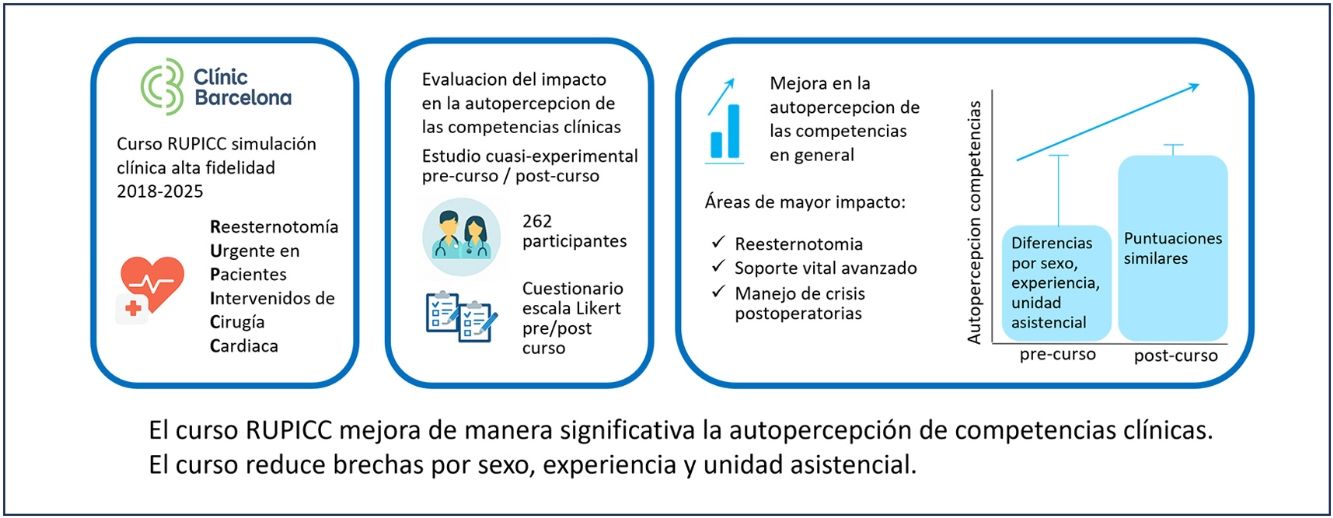
La estimación del efecto mostró mejoras significativas en todos los ítems (p < 0,001), con incrementos especialmente marcados en participantes con menor experiencia o puntuaciones iniciales más bajas. Las áreas con mayor impacto fueron reesternotomía estéril, soporte vital avanzado y manejo de crisis postoperatorias. La estratificación de la población por sexo, años de experiencia, unidad asistencial o categoría profesional mostraron igualmente mejoras en la percepción de las competencias, con puntuaciones post-curso similares, y con mayor margen de mejora en perfiles menos especializados. Por otro lado, las mujeres partieron de puntuaciones pre-curso más bajas, pero alcanzaron puntaciones comparables tras la formación.

Conclusión

El curso RUPICC mejora de manera significativa la autopercepción de competencias clínicas en profesionales de UCI. La simulación avanzada demuestra ser eficaz para estandarizar habilidades en equipos multidisciplinares, reduciendo brechas por sexo, experiencia o unidad asistencial.

Palabras clave:
Simulación clínica
Procedimientos quirúrgicos cardiacos
Unidades de cuidados intensivos
Educación continua
Factores sexuales
Graphical abstract

Article

These are the options to access the full texts of the publication Enfermería Intensiva (English Edition)
Subscriber
Subscriber

If you already have your login data, please click here .

If you have forgotten your password you can you can recover it by clicking here and selecting the option “I have forgotten my password”
Purchase
Purchase article

Purchasing article the PDF version will be downloaded

Purchase now
Contact
Phone for subscriptions and reporting of errors
From Monday to Friday from 9 a.m. to 6 p.m. (GMT + 1) except for the months of July and August which will be from 9 a.m. to 3 p.m.
Calls from Spain
932 415 960
Calls from outside Spain
+34 932 415 960
E-mail
References
[1]
L. Poghosyan, C.B. Maier.
Advanced practice nurses globally: responding to health challenges, improving outcomes.
[2]
D.J. Kim, Y.C. Shin, D.J. Kim, J.S. Kim, C. Lim, K.H. Park.
The safety of resternotomy in the intensive care unit for postcardiotomy bleeding control.
J Card Surg., 31 (2016), pp. 672-676
[3]
J. Weile, M.A. Nebsbjerg, S.H. Ovesen, C. Paltved, M.L. Ingeman.
Simulation-based team training in time-critical clinical presentations in emergency medicine and critical care: a review.
[4]
A. Tsiouris, A. Protos, V. Keys, D. Chambers, A. Jeyakumar, J. Shake.
Simulation training for emergency sternotomy in the cardiovascular intensive care unit.
Crit Care Nurse., 44 (2024), pp. 12-18
[5]
J.M. King, D.L. Reising.
Teaching advanced cardiac life support protocols: the effectiveness of static vs high-fidelity simulation.
Nurse Educ., 36 (2011), pp. 62-65
[6]
D.L. Rodgers, S. Securro Jr, R.D. Pauley.
The effect of high-fidelity simulation in an advanced cardiac life support course outcomes.
Simul Healthc., 4 (2009), pp. 200-206
[7]
M.S. Tjønnås, A. Das, C. Våpenstad, S.O. Ose.
Simulation-based skills training: a qualitative interview study exploring surgical trainees’ experience of stress.
[8]
C.H. Chan, T.N. Chan, M.C. Yuen, W.K. Tung.
Evaluation of a simulation-based workshop on clinical performance for emergency physicians and nurses.
World J Emerg Med., 6 (2015), pp. 16-22
[9]
J.P. Duff, K.J. Morse, J. Seelandt, I.T. Gross, M. Lydston, J. Sargeant, et al.
Debriefing methods for simulation in healthcare: a systematic review.
Simul Healthc., 19 (2024), pp. S112-S121
[10]
M.I. Figueroa, R. Sepanski, S.P. Goldberg, S. Shah.
Improving teamwork, confidence, and collaboration among members of a pediatric cardiovascular intensive care unit multidisciplinary team using simulation-based team training.
Pediatr Cardiol., 34 (2013), pp. 612-619
[11]
S. Giri, D. Gyeltshen, N. Wangchuk, K. Dorji, L. Drakpa, S. Wangdi, et al.
Improving role allocation for cardiopulmonary resuscitation (CPR) in the emergency department: a quality improvement project.
[12]
T.C. Sung, H.C. Hsu.
Improving critical care teamwork: simulation-based interprofessional training for enhanced communication and safety.
J Multidiscip Healthc., 18 (2025), pp. 355-367
[13]
B. Simpler, S. Jones, K. Chance.
Effectiveness of interdisciplinary simulation training on the self-efficacy and anxiety of healthcare professionals in managing a medical emergency.
Hosp Top., 17 (2025 Feb), pp. 1-8
[14]
European Association for Cardio-Thoracic Surgery.
EACTS guidelines on perioperative training in cardiac surgery.
Eur J Cardiothorac Surg., 57 (2020), pp. 547-555
[15]
J. Dunning, A. Levine, J. Ley, T. Strang, D.E. Lizotte Jr, Y. Lamarche, et al.
The society of thoracic surgeons expert consensus for the resuscitation of patients who arrest after cardiac surgery.
Ann Thorac Surg., 103 (2017), pp. 1005-1020
[16]
A. Cortegiani, V. Russotto, F. Montalto, P. Iozzo, C. Palmeri, S.M. Raineri, et al.
Effect of high-fidelity simulation on medical students’ knowledge about advanced life support: a randomized study.
[17]
M.I. Langdorf, S.L. Strom, L. Yang, C. Canales, C.L. Anderson, A. Amin, et al.
High-fidelity simulation enhances ACLS training.
[18]
S.R. Reder, A. Rohou, N. Keric, K.U. Beiser, A.E. Othamn, M.A. Abello Mercado, et al.
Gender differences in self-assessed performance and stress level during training of basic interventional radiology maneuvers.
Eur Radiol., 34 (2024), pp. 308-317
[19]
E.M. Olson, D.M. Sanborn, T.G. Dyster, D.J. Kelm, S.G. Murray, L. Santhosh, et al.
Gender disparities in critical care procedure training of internal medicine residents.
[20]
D.J. Brewster, J.A. Barrett, E. Gherardin, J.A. O’Neill, D. Sage, G. Hanlon.
Evaluating team-based inter-professional advanced life support training in intensive care—a prospective observational study.
Anaesth Intensive Care., 45 (2017),
[21]
D.R. Deters, J. Hunninghake, J. Ruiz, D.J. Marquez, D.J. Ramirez, R.V. Coffman.
Increase intensive care staff comfort and proficiency with emergent re-sternotomy in the post–open-heart patient by using SynDaver® simulation.
[22]
C. Dickens, A. Beserra, J. Keller, S. Corbridge, M. Carlucci.
Nurse practitioners and physician assistants: building a team and optimizing practice in the medical ICU.
Chest., 167 (2025), pp. 1451-1457
[23]
D.A. Davis, P.E. Mazmanian, M. Fordis, R. Van Harrison, K.E. Thorpe, L. Perrier.
Accuracy of physician self-assessment compared with observed measures of competence: a systematic review.
JAMA., 296 (2006), pp. 1094-1102
[24]
K.W. Eva, G. Regehr.
Self-assessment in the health professions: a reformulation and research agenda.
[25]
W. Arthur Jr, W. Bennett Jr, P.L. Stanush, T.L. McNelly.
Factors that influence skill decay and retention: a quantitative review and analysis.
Hum. Perform., 11 (1998), pp. 57-101
[26]
C.W. Yang, Z.S. Yen, J.E. McGowan, H.C. Chen, W.C. Chiang, M.E. Mancini, et al.
A systematic review of retention of adult advanced life support knowledge and skills in healthcare providers.
Resuscitation., 83 (2012), pp. 1055-1060
asdasdasd
Article options
Tools
Supplemental materials