


To describe the levels of fear of recurrence in cancer patients in the follow-up phase.
MethodCross-sectional descriptive study carried out from June 2023 to February 2024. A sample of 315 adult patients with a diagnosis of non-metastatic cancer in the process of follow-up at least 6 months after the end of active treatment, seen in the oncology department of the Juan Ramón Jiménez University Hospital in Huelva, was included. The FCR7-SP questionnaire was used to measure fear of recurrence. Permission was obtained from the Provincial Ethics Committee. Data analysis was performed using SPSS software v.29.0.1.0.
ResultsAn average score of 26.5 out of 35 points was observed on the FCR7-SP scale, suggesting a moderate level of fear. Mean age was 57.91 years (SD ± 11.80). The most frequent cancer was breast cancer (63%) followed by mostly stage II colorectal cancer (20%). There is a statistically significant relationship between fear of recurrence and gender, nationality, treatment and type of cancer. Five cut-off points of the FCR7-SP scale are proposed based on the percentiles obtained.
ConclusionsThe level of fear of recurrence in cancer patients in the follow-up phase at the Juan Ramón Jiménez University Hospital in Huelva is moderate. It is essential to identify the factors that influence the level of fear of recurrence in order to design preventive interventions and/or an early approach.
Describir los niveles de miedo a la recidiva en pacientes oncológicos en fase de seguimiento.
MetodologíaEstudio descriptivo transversal llevado a cabo desde junio de 2023 hasta febrero de 2024. Se incluyó una muestra de 315 pacientes adultos, con diagnóstico de cáncer no metastásico en proceso de seguimiento tras al menos 6 meses después de la finalización del tratamiento activo, atendidos en consulta de Oncología del Hospital Universitario Juan Ramón Jiménez de Huelva. Se utilizó el cuestionario para medir el miedo a la recidiva el FCR7-SP. Se obtuvo el permiso del Comité de Ética Provincial. El análisis de datos se realizó con el programa SPSS® v.29.0.1.0.
ResultadosSe observó una puntuación media de 26,5 sobre 35 puntos en la escala de FCR7-SP, lo que sugiere un nivel moderado de miedo. La media de edad fue 57,91 años (DE ± 11,80). El cáncer más frecuente fue el cáncer de mama (63%) seguido del cáncer colorrectal (20%) en estadio II mayoritariamente. Existe una relación estadísticamente significativa entre el miedo a la recidiva y género, nacionalidad, tratamiento y tipo de cáncer. Se proponen cinco puntos de corte de la escala FCR7-SP en base a los percentiles obtenidos.
ConclusionesEl nivel de miedo a la recidiva en los pacientes oncológicos en fase de seguimiento del Hospital Universitario Juan Ramón Jiménez de Huelva es moderado. Es fundamental identificar los factores que influyen en el nivel de miedo a la recidiva para diseñar intervenciones preventivas y/o abordaje precoz.

Fear of cancer recurrence is one of the main concerns of cancer patients. It is underestimated and under-addressed during follow-up.
What it contributesData on the prevalence of fear of recurrence in cancer patients undergoing hospital follow-up. The identification of the influence of sociodemographic and clinical variables on the level of fear of recurrence, as well as its relationship with certain types of cancer.
Cancer is a complex disease where preventive measures and early diagnosis, as well as advances in treatment, have achieved a 20% increase in overall survival in recent years.1 The needs of those affected can vary depending on the type of cancer and its prognosis, the diagnostic tests and types of treatment they undergo2 and entail a continuous adaptation process with profound changes that directly affect the quality of life of patients and their families.3,4 The increase in life expectancy and the growing clinical complexity of the process make it essential to focus on the needs of patients considered “long-term survivors.”
Among the most common problems reported by cancer patients is the fear of recurrence (FCR), defined as “fear or worry that the cancer may return or progress in the same or another part of the body.”5
In this sense, the presence of a certain level of FCR is considered normal and functional in cancer survivors,6 although the level of concern is not always appropriate. When FCR is high, it can lead to functional decline, psychological symptoms, loss of concentration, decreased quality of life, a tendency toward depression, and increased use of healthcare services, as well as the use of hypnotic medications.7 Some studies suggest that FCR increases the demands placed on patients and their families, with a greater number of diagnostic requests and visits to specialised services, thus increasing the burden on care.8
Although there is no consensus on the available data, it is estimated that in 30%–70% of cancer survivors, FCR becomes a chronic concern that negatively affects daily functioning and quality of life.9 However, despite the high prevalence of FCR and its impact on patients' lives,10 there is a significant undervaluation and lack of approach within traditional follow-up programmes in the healthcare system.11–14
Despite this, professionals recognise that FCR is a common problem they face in clinical practice, but they are unsure how to manage it.12 Specific assessment systems that enable the identification of levels of fear of recurrence should be incorporated to address it early and prevent it from progressing to a severe level, where management is much more complex.
Against this backdrop this study was proposed, the objective of which was to describe the levels of fear of recurrence in cancer patients in the follow-up phase treated in the Oncology Department of the Juan Ramón Jiménez University Hospital of Huelva (HUJRJ).
MethodDesignAn observational, descriptive, and cross-sectional study was conducted.
Population and study scopeAll cancer patients in the follow-up phase who attended the Oncology Clinics of the Juan Ramón Jiménez University Hospital in Huelva from June 2023 to February 2024 were included.
Selection criteriaInclusion criteria- a)
Individuals over 18 years of age.
- b)
Ability to read and understand Spanish.
- c)
Diagnosis of non-metastatic cancer in follow-up at least 6 months after the end of active treatment. An observational, descriptive, and cross-sectional study was conducted.
Patients with hearing impairment or blindness, with mental health problems, undergoing palliative treatment, or with altered levels of consciousness.
Sample sizeParticipants were selected using consecutive, non-probability sampling according to the inclusion criteria. The sample size was calculated based on the available clinical data. According to data from the HUJRJ (National Cancer Institute) for 2022, the patients under follow-up who had completed treatment in the previous 6 months were primarily those with breast cancer (380) and colon cancer (400). Based on these data, the study population would be 780.
According to calculations made using QuestionPro with a 95% confidence level and a 5% margin of error, the necessary sample size is estimated at 259 people plus an additional 20% to cover possible losses (259 + 51.8 = 310.8).
Variables and toolA set of sociodemographic and clinical variables related to the cancer diagnosis and treatment process, detailed below, were selected, along with the FCR7-SP questionnaire as an instrument for assessing fear of recurrence.
Sociodemographic variablesDate of birth, sex, place of residence, nationality, civil status, family unit living in the home, number of children, family dependencies, educational level, employment and income.
Clinical variablesDiagnosis, date of diagnosis, stage, treatment received, date of active treatment termination, current treatment, psycho-oncologist visit, attendance at the HUJRJ Oncology Unit, contact with the advanced nurse practitioner (ANP) and use of social support services.
InstrumentThe original English version of the FCR7 questionnaire to assess fear of recurrence in cancer patients was developed by Humphris15 in 2018 at the University of St. Andrews (Scotland) and has been adapted and validated into Spanish by Díaz-Periánez.16,17 This instrument consists of 7 items with a Likert-type measurement scale from 1 (not at all) to 5 (all the time), with scores ranging from 7 to 35 points. Higher scores indicate greater fear of recurrence. Reliability is adequate, with an omega coefficient of .93 and a Cronbach's alpha of .92.
Data collectionData collection took place from June 2023 to February 2024. Patients were recruited by nursing staff at the HUJRJ Oncology outpatient clinics. They informed patients about the study details and gave them an information sheet with the different options for participation: through a web link/QR code to complete the form independently or, if they wished, to be contacted by phone. All patients signed an informed consent form prior to participation.
Data analysisA univariate analysis of the sample was performed. Data on qualitative variables were expressed as percentages and frequencies, and quantitative variables were expressed as means, medians, standard deviations, interquartile ranges, and minimum and maximum values. Spearman's correlation coefficient was applied to explore possible correlations, given that the normality test (Kolmogorov-Smirnov) determined a lack of symmetry in the distribution of FCR7 scores. The nonparametric Mann-Whitney U test was used to compare means in two groups, and the Kruskall-Wallis test was used to compare means between more than two groups. A post hoc contrast (Dwass-Steel-Critchlow-Fligne test) was performed to test for differences between groups. Statistical significance was established at a P value ≤.05. Data analysis was performed using IBM® SPSS (v. 29.0.1.0).
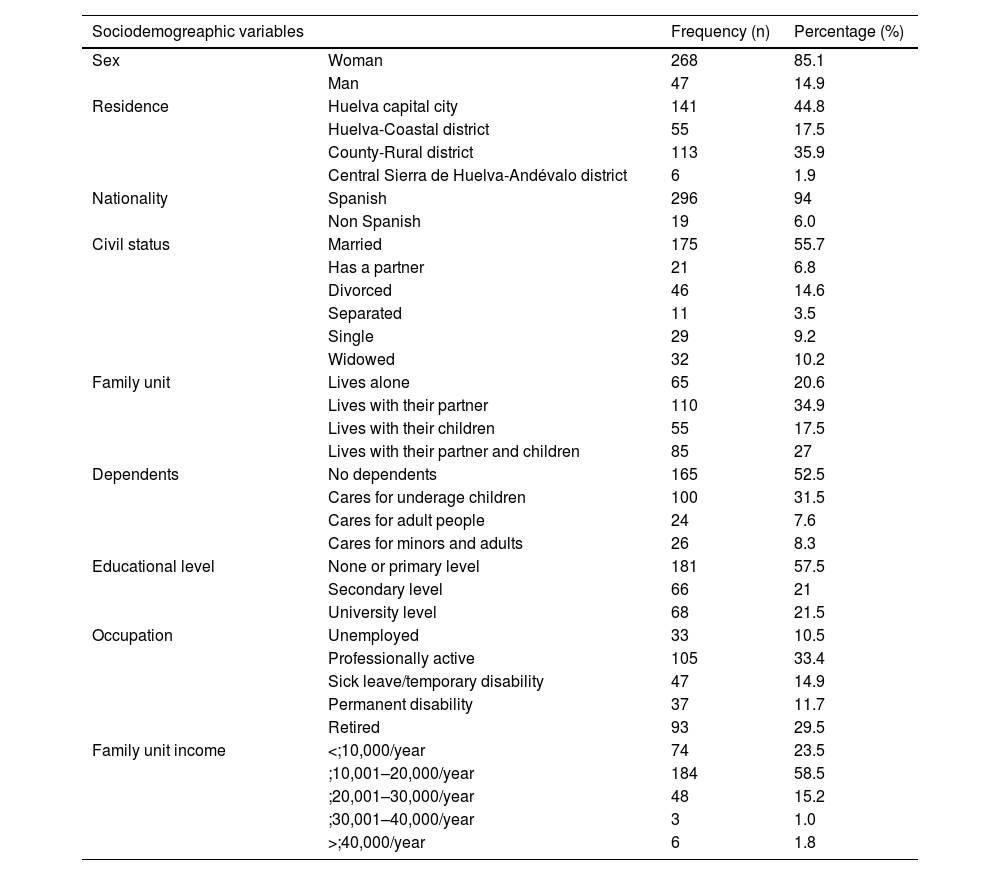
ResultsSociodemographic and clinical profile of the sampleData from 315 participants were analysed, whose sociodemographic characteristics are presented in Table 1. As a general profile, it is worth noting that 85.1% were women, with a mean age of 57.91 years (SD: ±11.80). The majority resided in the city of Huelva (55.6%), were Spanish (94%), married (55.6%), and had no dependents (52.4%). In terms of education, more than half (57.5%) had primary education and 21.6% had university degrees. Regarding employment, 33.3% of participants were actively employed. The predominant annual income was between ;10,001 and ;20,000 (58.5%).
Description of the sociodemographic variables.
| Sociodemogreaphic variables | Frequency (n) | Percentage (%) | |
|---|---|---|---|
| Sex | Woman | 268 | 85.1 |
| Man | 47 | 14.9 | |
| Residence | Huelva capital city | 141 | 44.8 |
| Huelva-Coastal district | 55 | 17.5 | |
| County-Rural district | 113 | 35.9 | |
| Central Sierra de Huelva-Andévalo district | 6 | 1.9 | |
| Nationality | Spanish | 296 | 94 |
| Non Spanish | 19 | 6.0 | |
| Civil status | Married | 175 | 55.7 |
| Has a partner | 21 | 6.8 | |
| Divorced | 46 | 14.6 | |
| Separated | 11 | 3.5 | |
| Single | 29 | 9.2 | |
| Widowed | 32 | 10.2 | |
| Family unit | Lives alone | 65 | 20.6 |
| Lives with their partner | 110 | 34.9 | |
| Lives with their children | 55 | 17.5 | |
| Lives with their partner and children | 85 | 27 | |
| Dependents | No dependents | 165 | 52.5 |
| Cares for underage children | 100 | 31.5 | |
| Cares for adult people | 24 | 7.6 | |
| Cares for minors and adults | 26 | 8.3 | |
| Educational level | None or primary level | 181 | 57.5 |
| Secondary level | 66 | 21 | |
| University level | 68 | 21.5 | |
| Occupation | Unemployed | 33 | 10.5 |
| Professionally active | 105 | 33.4 | |
| Sick leave/temporary disability | 47 | 14.9 | |
| Permanent disability | 37 | 11.7 | |
| Retired | 93 | 29.5 | |
| Family unit income | <;10,000/year | 74 | 23.5 |
| ;10,001–20,000/year | 184 | 58.5 | |
| ;20,001–30,000/year | 48 | 15.2 | |
| ;30,001–40,000/year | 3 | 1.0 | |
| >;40,000/year | 6 | 1.8 |
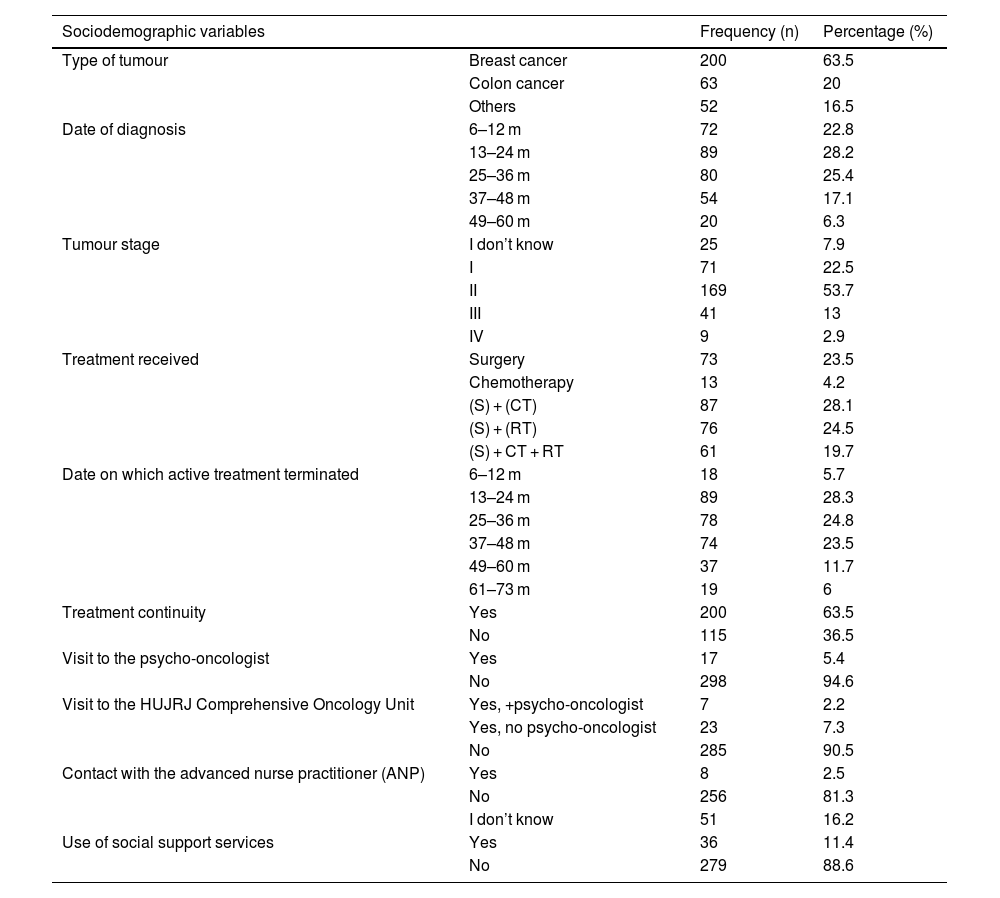
Regarding the clinical characteristics of the participants, as shown in Table 2, breast cancer was the most common (63.5%), followed by colorectal cancer (20%) and other types of cancer (16.5%). The majority of diagnoses were stage II (53.7%). Regarding treatments, 23.2% received surgery as the sole option, while 27.6% combined this with chemotherapy, and 24.1% with radiotherapy. The average time from diagnosis was 34 months, and from the end of active treatment, 27 months. At the time of the interview, 64% were receiving hormonal treatment.
Description of the clinical variables.
| Sociodemographic variables | Frequency (n) | Percentage (%) | |
|---|---|---|---|
| Type of tumour | Breast cancer | 200 | 63.5 |
| Colon cancer | 63 | 20 | |
| Others | 52 | 16.5 | |
| Date of diagnosis | 6–12 m | 72 | 22.8 |
| 13–24 m | 89 | 28.2 | |
| 25–36 m | 80 | 25.4 | |
| 37–48 m | 54 | 17.1 | |
| 49–60 m | 20 | 6.3 | |
| Tumour stage | I don’t know | 25 | 7.9 |
| I | 71 | 22.5 | |
| II | 169 | 53.7 | |
| III | 41 | 13 | |
| IV | 9 | 2.9 | |
| Treatment received | Surgery | 73 | 23.5 |
| Chemotherapy | 13 | 4.2 | |
| (S) + (CT) | 87 | 28.1 | |
| (S) + (RT) | 76 | 24.5 | |
| (S) + CT + RT | 61 | 19.7 | |
| Date on which active treatment terminated | 6–12 m | 18 | 5.7 |
| 13–24 m | 89 | 28.3 | |
| 25–36 m | 78 | 24.8 | |
| 37–48 m | 74 | 23.5 | |
| 49–60 m | 37 | 11.7 | |
| 61–73 m | 19 | 6 | |
| Treatment continuity | Yes | 200 | 63.5 |
| No | 115 | 36.5 | |
| Visit to the psycho-oncologist | Yes | 17 | 5.4 |
| No | 298 | 94.6 | |
| Visit to the HUJRJ Comprehensive Oncology Unit | Yes, +psycho-oncologist | 7 | 2.2 |
| Yes, no psycho-oncologist | 23 | 7.3 | |
| No | 285 | 90.5 | |
| Contact with the advanced nurse practitioner (ANP) | Yes | 8 | 2.5 |
| No | 256 | 81.3 | |
| I don’t know | 51 | 16.2 | |
| Use of social support services | Yes | 36 | 11.4 |
| No | 279 | 88.6 |
CT: chemotherapy; m: months; RT: radiotherapy; S: surgery.
The use of specialised support services was limited: 94.6% of participants had never contacted psycho-oncology, while only 5.4% did so directly or through the oncology unit (OU). Consultations with the OU were made in 9.5% of cases, and only 2.5% had contact with the ANP. Notably, 16.2% indicated they were unaware of this position. The use of social support resources was low: 11.3% were linked to associations such as the Spanish Association Against Cancer or the Huelva Breast Cancer Association.
Fear of cancer recurrenceThe mean score obtained on the FCR7-SP was 26.5 points (95% CI: 25.8–27.3) (Table 3).
Descriptive analysis of the FCR7-SP items.
| Items | Mean (95% CI) | Median | Standard deviation |
|---|---|---|---|
| FCR1. I'm afraid cancer may occur. | 4.25 (4.15−4.36) | 5 | 0.98 |
| FCR2. I'm worried or anxious about the possibility of cancer recurring. | 3.91 (3.78−4.03) | 4 | 1.12 |
| FCR3. How often do you worry about getting cancer again? | 3.85 (3.73−3.96) | 4 | 1.05 |
| FCR4. I have strong feelings about cancer coming back. | 3.26 (3.13−3.4) | 3 | 1.24 |
| FCR5. I think about cancer coming back even when I don't want to. | 2.93 (2.78−3.98) | 3 | 1.36 |
| FCR6. I check myself for physical signs of cancer. | 4.54 (4.43−4.65) | 5 | 1 |
| FCR7. To what extent does worry about developing cancer again take over or interfere with your thoughts and activities? | 3.8 (3.69−3.91) | 4 | 0.99 |
| Total FCR7 | 26.55 (25.8−27.3) | 27 | 6.491 |
95% CI: 95% confidence interval.
Five cut-off points were identified based on the percentiles obtained:
- •
Very low: ≤18 points (10% of participants).
- •
Low: 19–23 points (25%).
- •
Medium: 24–27 points (50%).
- •
High: 28–32 points (75%).
- •
Very high: 33–35 points (90%).
According to these data, the mean FCR level was moderate (higher values reflect greater fear) (Fig. 2, Chart 2, Fig. 2). Detailed item analysis revealed that the lowest scores were found in items 4, 5, and 7 (Table 3). Means ranged from 2.93 (item 5: “I think about cancer coming back even when I don't want to”) to a mean of 4.54 (item 6: “I check myself for physical signs of cancer”). The latter presented a narrow confidence interval, indicating consistent responses, while item 5 showed greater variability.
Fig. 1, Chart 1, Fig. 1 represents the response percentage for each item, where the response trend for each question can be observed. The overall response trend leaned toward high levels for items 1 (“I fear cancer may occur”) and 6, where 78.1% reported constantly checking themselves for signs of cancer. In item 7, 34.9% indicated that concern about cancer frequently affects their thoughts and activities.
Inferential analysisStatistically significant differences were identified in the level of fear of recurrence (FCR) according to sex, nationality, and active treatment status, with medium effect sizes for nationality and large ones for sex and active treatment (Table 4).
Relationship between fear of recurrence and sociodemographic and clinical variables.
| Variables | M (SD) | Pa value | Effect sizeb (g of Hedges) | |
|---|---|---|---|---|
| Sex | Woman n = 289 | 27.3 (6.19) | ||
| Man n = 47 | 22.2 (6.51) | |||
| <.001* | .816 | |||
| Children | Yes n = 257 | 26.4 (6.48) | ||
| No n = 58 | 27.4 (6.52) | |||
| .224 | .153 | |||
| Nationality | Spanish n = 296 | 26.3 (6.54) | ||
| Non Spanish n = 19 | 30.2 (4.29) | |||
| .013* | .604 | |||
| Lives alone | Yes n = 65 | 26.7 (6.69) | ||
| Lives with someone n = 250 | 26.5 (6.45) | |||
| .843 | .030 | |||
| Active treatment | No n = 115 | 23.4 (6.89) | ||
| Yes n = 200 | 28.4 (5.49) | |||
| <.001* | .826 | |||
| Psycho-oncologist during treatment | Yes n = 17 | 26.7 (6.37) | ||
| No n = 298 | ||||
| No | 23.2 (7.84) | |||
| .066 | .541 |
M (SD): mean (standard deviation).
Significant differences were also observed according to cancer type, particularly between the breast, colorectal, and other cancer groups, suggesting a relationship between the nature of the diagnosis and the level of fear of recurrence (Table 5).
Analysis of fear of recurrence according to the type of cáncer.
| Breast cancer (n = 200) | Colorectal cancer (n = 63) | Other types of cancer (n = 52) | Chi-squared | Kruskall-Wallis contrast test | Effect size | DSCF post hoc | |
|---|---|---|---|---|---|---|---|
| M (SD) | M (SD) | M (SD) | Chi-squared | P value | ɛ2 | ||
| Fear of recurrence (FCR7-SP) | 28.4(5.16) | 21.9(6.57) | 25.1(7.81) | 47.7 | ≤.001* | .152 | a, b (P ≤ .001)** |
| a, c (P = .015)** | |||||||
| b, c (P = .040)** |
DSCF: The Dwass-Steel-Critchlow-Fligner; M (SD): mean (standard deviation); ɛ2: epsilon squared. The effect size ranges from 0 to 1, with 1 being the maximum effect.
The results obtained in this study reflect that participants present moderate levels of fear of cancer recurrence (FCR), measured using the FCR7-SP instrument. Although limited data exist, a previous multicentre study conducted in 2024 in Spain established that 28% of cancer patients undergoing follow-up have low FCR levels and 72% have high levels.18 It should be noted that the instrument used in this study, the CancerWorryScale, is a questionnaire designed for the general population and not specifically for cancer patients, which could have influenced the data obtained.
The observed dispersion in the fear of recurrence scores indicates considerable variability, which could be related to the individual characteristics of the participants, the type of cancer, the time elapsed since diagnosis, and previous treatment experiences. This variability is consistent with previous studies that have shown that fear of recurrence is not uniform in the oncology population, but rather varies based on multiple clinical and emotional factors.9,12
The higher mean score obtained on the FCR7-SP can be explained by the scale's breadth and its ability to capture higher levels of FCR, which could be relevant in the clinical context. Greater dispersion also suggests that the FCR7-SP allows for more precise differentiation between patients with low, moderate, and high levels of fear of recurrence. This discriminatory capacity is essential, as it facilitates the identification of those individuals who require specific and tailored interventions for the management of severe FCR. In order to confirm the proposed cut-off points, it would be necessary to conduct future larger-scale prevalence studies to confirm this model, which would help establish more precisely the pathological levels targeted for intervention.
In this sense, the results underscore the need to select instruments that are not only valid and reliable, but also sensitive to higher levels of FCR. The use of the FCR7-SP in clinical settings could provide a more robust tool for detecting and monitoring this phenomenon, allowing healthcare professionals to prioritise early interventions for patients with higher levels.
Since the exact predictors of FCR remain unknown, it is essential that healthcare teams be sensitive to identifying signs and symptoms at different stages of the oncological process, detecting pathological levels of fear of recurrence. Early recognition, support, and validation, along with appropriate referrals to psychosocial oncology, can be beneficial for many patients.19
In this case, it is confirmed that the instrument used is sensitive to variations in sex, nationality, treatment, and cancer type, a matter of great importance for its application in different clinical settings. Fear of recurrence is different for breast cancer compared to other cancers such as colorectal cancer, possibly due to the larger sample size and longer survival rates in breast cancer, which may influence the manifestations of fear of recurrence.20 In any case, it would be appropriate to further explore these results by incorporating a gender perspective in future studies in this field.
These findings highlight the importance of routinely assessing fear of recurrence in the oncology population. Accurate measurement with standardised instruments, such as the FCR7-SP, could contribute to optimising the clinical management of FCR and designing more effective support strategies for patients who present this constant concern.21–25
In conclusion, the average level of fear of recurrence in the oncology patients in the follow-up phase at the Juan Ramón Jiménez University Hospital in Huelva included in the study is moderate. Women, patients undergoing active treatment, and those diagnosed with breast cancer show higher levels of fear of recurrence, underscoring the need to prioritise specific care for these vulnerable groups. Identifying the factors that influence the level of fear of recurrence is essential to design preventive interventions and/or early treatment. A comprehensive approach to the fear of recurrence should be a priority in oncological management, not only to improve the emotional well-being of patients, but also to optimise the use of healthcare resources, promoting more efficient and equitable care.
CRediT authorship contribution statementAll the authors contributed to the development of this research.
Ethical liabilitiesThe ethical principles applicable to healthcare research, as set forth in the Declaration of Helsinki 2024 and the Belmont Report, were adhered to. The provisions of Organic Law 3/2018, of December 5, on the protection of personal data and the guarantee of digital rights were also adhered to. The questionnaires were encrypted, and the database was safeguarded by the principal investigator, with the institutional data protection guarantees of the University of Huelva, as this is the institution that hosts the Redcap database. The information was carefully handled, and its completion maintained the confidentiality and right to privacy of patients. An information sheet was provided, and the corresponding informed consent was requested from all participants. A favourable opinion was obtained from the Provincial Research Ethics Committee of Huelva and the Managing Directorate of the participating centre (PI 2167/N/21).
The authors have no conflict of interests to declare.


