




Cancer-related fatigue is a common symptom that occurs in patients with cancer. This symptom is also experienced by cancer patients who receive chemotherapy, radiation therapy, bone marrow transplantation, or other cancer treatments. A survey conducted on 1569 cancer patients found that fatigue was experienced by 80% of cancer patients who received chemotherapy and/or radiotherapy. In patients with cancer that has metastasized, the prevalence of fatigue exceeds 75%. Patients who have healed from cancer report that fatigue is a symptom that is experienced for months or even years after the cancer treatment is over. Continued fatigue in cancer patients can interfere with their quality of life so that good assessment and management of this condition are needed. The purpose of this study is to identify the assessment and treatment of cancer-related fatigue currently conducted by health care providers in Indonesia. The study was conducted by requesting the participation of health care providers in an electronic survey carried out according to their respective roles. One hundred and twelve health care providers working with cancer patients consisting of nurses, doctors, nutritionists, and physiotherapists participated in this electronic survey. Overall, there is a perception that cancer-related fatigue is only assessed by less than one-third of health care providers, treatment is carried out only by a quarter of health care providers, and there are no clinical guidelines regarding the management of this condition. Awareness of interventions for fatigue varies among health care providers. There is no definitive clinical service for or management of cancer-related fatigue. The respondents identified the need for clinical guidelines both for the assessment and management of cancer-related fatigue, training and better expertise, and access to provide services to cancer patients who are experiencing fatigue.
The incidence and prevalence of cancer continue to increase throughout the world. The incidence of cancer reached 14.1 billion in 2012 and is expected to increase to 23.6 billion by 2030 worldwide. The country with the highest incidence of cancer in the world is Denmark (338 cases per 100,000 population), followed by France (325 cases per 100,000 population), Australia (323 cases per 100,000 population), United States (318 cases per 100,000), and South Korea (308 cases per 100,000 population). According to the data on cancer sufferers in Indonesia, the prevalence of cancer across all ages in 2013 was 1.4% or estimated to be around 347,792 people. The Special Region of Yogyakarta had the highest prevalence of cancer, which was 4.1%. Cancer prevalence in Bali was 2% or an estimated 8279 people. The increase in cancer incidence is followed by the development of various therapies for cancer. Both the cancer itself and the cancer therapy can cause various side effects in patients, including fatigue.1–3
Cancer-related fatigue is one of the common symptoms that occurs in patients with cancer. This symptom is also experienced by cancer patients who receive chemotherapy, radiation therapy, bone marrow transplantation, or other cancer treatments. A survey conducted on 1569 cancer patients found that fatigue was experienced by 80% of cancer patients who received chemotherapy and/or radiotherapy. In patients with cancer that has metastasized, the prevalence of fatigue exceeds 75%. Patients who have healed from cancer report that fatigue is a symptom that is experienced for months or even years after cancer treatment is over. Continual fatigue in cancer patients can disrupt their quality of life so that optimal assessment and treatment are needed.4–6 In Indonesia, cancer-related fatigue is experienced by 67% of cancer patients, both those who receive palliative care and those who have been declared cured.7
Cancer-related fatigue is cognitive, physical, emotional, or subjective fatigue related to cancer or cancer treatment. This condition can even continue several months to several years after therapy, and appears not only in patients receiving palliative care for cancer, but also in patients who have been declared cured of cancer. This condition can interfere with both the physical and psychological functions of patients with cancer. Cancer sufferers consider cancer-related fatigue as the most troublesome symptom associated with cancer and its treatment, more severe than pain or nausea and vomiting, which can generally be managed with drugs.8,9 There is considerable variability related to the experience of fatigue in cancer patients. Individual factors are thought to be the main predisposition in the development and persistence of this fatigue. Research has begun to identify genetic, biological, psychosocial, and behavioral risk factors associated with cancer-related fatigue.10,11
Accurate information regarding how health care providers carry out assessment and treatment of cancer-related fatigue is not yet clearly known in Indonesia. Patients often do not report symptoms, and even fatigue often goes undiagnosed.7 Various obstacles in handling fatigue are lack of information related to risk factors, mechanisms, and signs and symptoms, as well as effective treatment of fatigue. Based on a number of studies on fatigue, there are various risk factors for cancer-related fatigue, such as genetic, psychosocial, and biological risk factors. Factors related to the inflammatory process, including depression, sleep disorders, physical activity, body mass index, stress, and loneliness can become the factors affecting the severity of cancer-related fatigue.12,13
The development of new research in cancer management and increased life expectancy of cancer patients, as well as the development of multidisciplinary care and improvement in health care services for cancer patients require the support and awareness of health care providers to cope better with cancer-related fatigue in Indonesia. The purpose of this study is to identify the assessment and treatment of cancer-related fatigue currently conducted by health care providers in Indonesia. This study also discusses how health care providers take rational steps in the assessment and management of cancer-related fatigue that have an impact on the quality of life of cancer patients. These data are very important for the development of better care and collaboration in cancer care, especially in the assessment and management of cancer-related fatigue. Further research and practical steps to overcome the problem of cancer-related fatigue in Indonesia involving all health care workers including doctors, nurses, and others can be another objective of the survey data collection.
MethodsThis study is an exploratory-descriptive study with an electronic survey. The health care providers in this survey were recruited with the help of a cancer organization in the country. Those who were eligible to participate were health care providers who had been treating cancer patients for at least one year. The assessment and management of cancer-related fatigue by health care providers were assessed by a questionnaire sent to the participants’ mobile phones. Demographic data related to cancer-related fatigue treatment were gathered as part of the survey. There were 197 participants who were sent an electronic survey but only 112 answered the survey completely. Data analysis was carried out through the steps of editing, coding, and validation of data completeness. Descriptive statistics and proportion tests were used in the data analysis process.
With respect to the ethical aspects of this study, a review was carried out and approval for this study was granted by the Institutional Ethics Committee of the Faculty of Medicine, Udayana University.
ResultsThere were 112 survey data that met the criteria of all the data collected from a total of 197 respondents who were sent the survey electronically. Most of the participants were female 72 (64.3%). The age of the respondents was mostly 31–40 years (45 respondents, 40.2%). The length of their involvement in cancer care was mostly 7–9 years (31 respondents, 31.3%). Their level of education was mostly Bachelor's degree (55 respondents, 49.1%). Nurse was the health care provider group with the highest number of participants in the survey (66 respondents, 58.9%). These results can be seen in Table 1.
Respondent demographic data.
| n | % | |
|---|---|---|
| Sex | ||
| Male | 40 | 35.7 |
| Female | 72 | 64.3 |
| Total | 112 | 100 |
| Age (year) | ||
| 20–30 | 33 | 29.5 |
| 31–40 | 45 | 40.2 |
| 41–50 | 32 | 28.6 |
| 51–60 | 3 | 2.7 |
| Total | 112 | 100 |
| Length of involved in cancer care (year) | ||
| 1–3 | 20 | 17.9 |
| 4–6 | 33 | 29.5 |
| 7–9 | 35 | 31.3 |
| 10–12 | 20 | 17.9 |
| More than 12 | 7 | 6.3 |
| Total | 112 | 100 |
| Education | ||
| Diploma | 47 | 42.0 |
| Bachelor | 55 | 49.1 |
| Magister/specialist | 10 | 8.9 |
| Total | 112 | 100 |
| Type of health care provider | ||
| Doctor | 31 | 27.7 |
| Nurse | 66 | 58.9 |
| Physiotherapist | 10 | 8.9 |
| Nutritionist | 5 | 4.5 |
| Total | 112 | 100 |
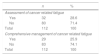
The results of the survey on cancer-related fatigue assessment show that cancer-related fatigue was only assessed by 32 respondents (28.6%), whereas 80 respondents (71.4%) had not assessed this condition. Cancer-related fatigue management was already carried out by 29 respondents (25.9%), while 83 respondents (74.1%) had not carried out cancer-related fatigue management. These results can be seen in Table 2.
DiscussionCancer-related fatigue is a fairly complex problem that can disrupt the quality of life of cancer patients. With studies and management related to cancer, fatigue is a problem that can be overcome. Appropriate handling and dealing with this problem need to be employed through proper assessment conducted by health care providers.14,15 Various treatments that can be used for fatigue associated with cancer include the treatment of anemia, exercise or physical activity, overcoming psychosocial problems such as fear, anxiety, and stress, and nutritional counseling.16–18
The purpose of the assessment of cancer-related fatigue is to determine the various conditions that exist in individuals with cancer that can be a trigger factor for fatigue, both physical and psychological. Effective management and discussion of fatigue related to cancer are very important for patients and present a challenge for health care providers. Based on the results of the study, very few health care providers carried out the assessment and management of cancer-related fatigue. The various factors considered by the researchers include the level of knowledge related to cancer-related fatigue, the patient's fear of reporting problems related to cultural factors, and the patient's concern about being considered uncooperative for not accepting the side effects of the therapy if they reported this symptom.19–23
In Indonesia, research and outreach related to cancer-related fatigue as a patient problem have not yet been revealed in the study of health care, evidence-based practices, and updates in the care of cancer patients. Fatigue has actually become a nursing diagnosis. However, most nurses have a lack of resources both in assessing and in managing this condition. The interdisciplinary care team only treats the signs and symptoms. Guidelines for the comprehensive management of cancer-related fatigue are not yet regulated in the policy on handling cancer patients in Indonesia, so there are still many health care providers that ignore this problem.
Instruments for assessing fatigue related to cancer have been developed and refined through various clinical assessments and research applications. The developed instruments can be used as part of a clinical assessment of patients and developed according to the needs of health care providers. Clinical guidelines for the assessment and management of cancer-related fatigue are widely available in various health references. The challenges for countries such as Indonesia are to disseminate new scientific evidence on cancer-related fatigue, include the assessment and management of fatigue in the education curriculum for health care providers, and make the assessment and management of cancer-related fatigue part of the clinical policy.
ConclusionsCancer related fatigue is a comprehensive problem that requires the proper collaboration between health care providers both in assessment and treatment. Appropriate measurement tools that are part of important policies need to be developed related to the assessment and comprehensive management of cancer related fatigue.
AcknowledgementsThe authors would like to acknowledge for the support to the Doctoral Program, School of Medicine, Udayana University and School of Nursing, Faculty of Medicine Udayana University.
Conflict of interestThe authors declare no conflict of interest.
Peer-review under responsibility of the scientific committee of the International Nursing Research Conference of Udayana University. Full-text and the content of it is under responsibility of authors of the article.

