



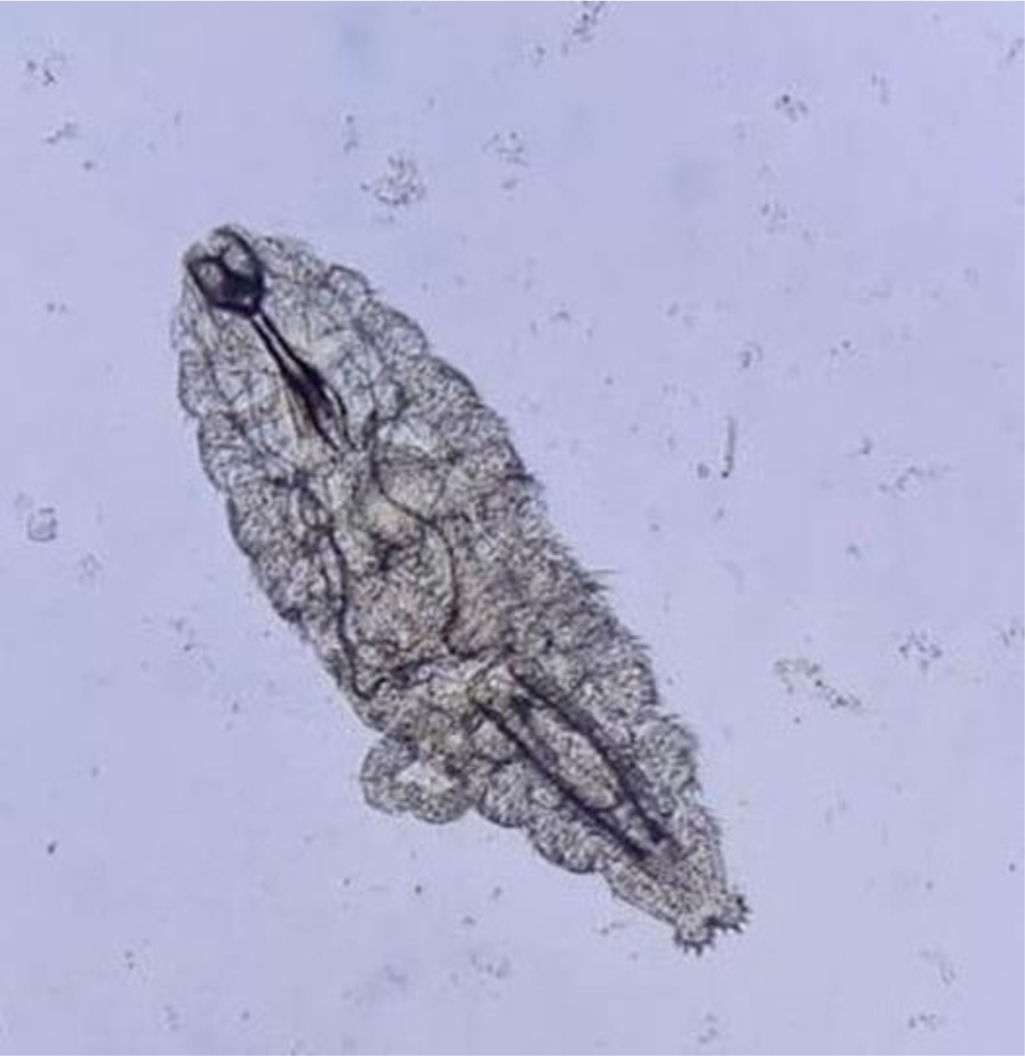
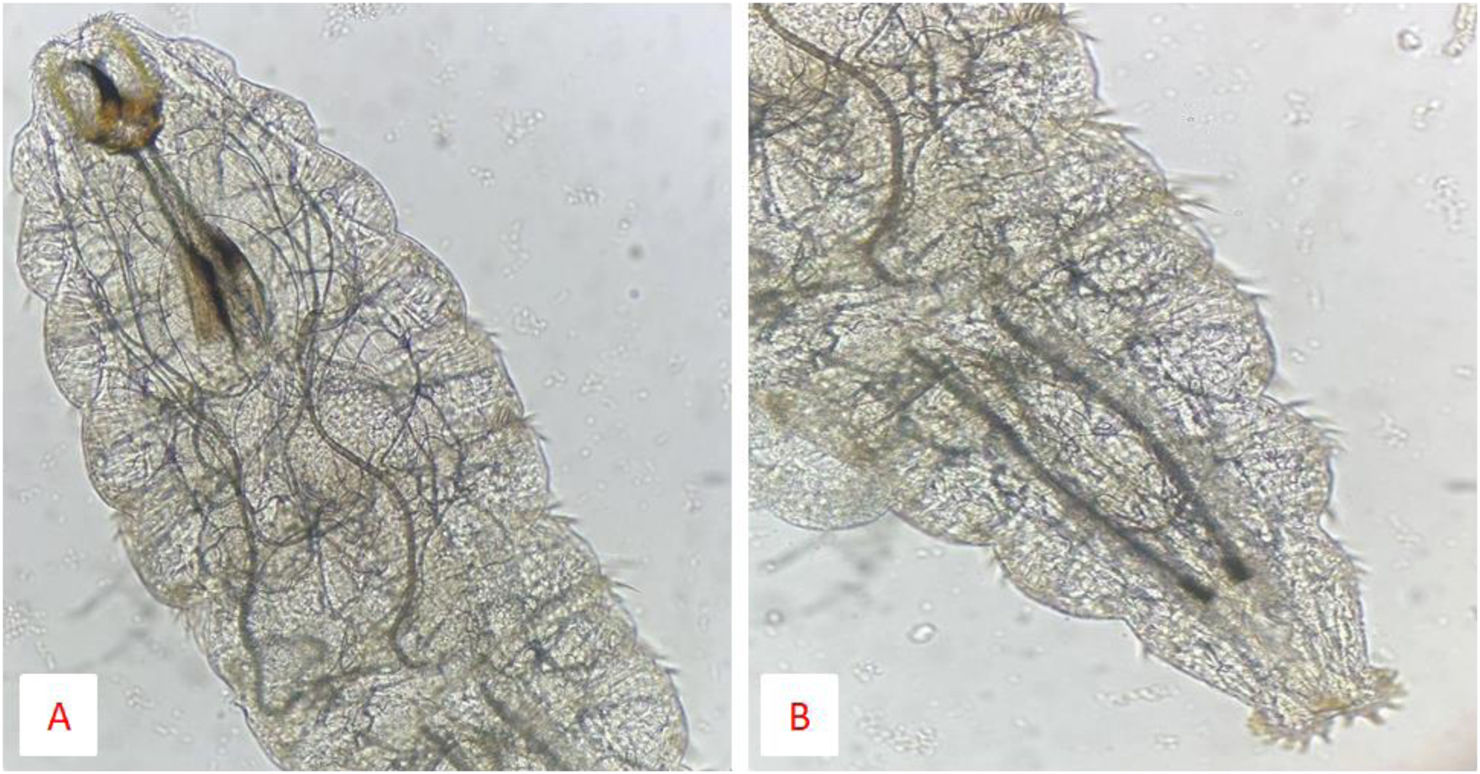
This was a 17-year-old male, resident in an urban area of Murcia in Spain, who came to the emergency department due to redness, excessive tearing, and a sensation of a foreign body in his right eye which increased with blinking. He had no relevant medical history, and reported not having had any contact with animals or recent travel. He was strolling down the street when he felt the impact of a foreign body in his eye. Two hours later, he developed eye symptoms. He also said he had been playing in a park in the days previous to this. On examination, multiple small, transparent larvae of approximately 2 mm in size and moving were identified in the area of the bulbar conjunctiva, tarsus and fornices; examination after application of fluorescein showed a fine central keratitis. More than 15 larvae were removed with spear sponges and sent to Microbiology for identification. After the complete extraction of the larvae, we prescribed antibiotic treatment with tobramycin ointment 3 mg/g every eight hours for a week and an appointment was made for a check-up after that time. Microscopic examination at 10× and 40× revealed a clear larva, with a distinctive morphology in the anterior part, characterised by its powerful cephalopharyngeal skeleton, which included a pair of prominent mouth hooks. The body consisted of multiple abdominal segments surrounded by numerous spines, and the posterior part terminated in a forked end covered with spines; they were identified as L1 stage larvae of Oestrus ovis (Figs. 1 and 2).1

L1 stage larvae of Oestrus ovis observed by optical microscope (10×).1

Characteristic details of L1 stage of Oestrus ovis larva (40×). Photo A. At the upper pole, you can see the well-developed buccal hooks shaped like horns, which are part of the cephalopharyngeal skeleton. Photo B. At the caudal end, the presence of two terminal bulges with numerous spines is prominent.1
The patient returned for a check-up one week later, with the symptoms having resolved and his eye examination was normal.
CommentsThe case reported here corresponds to ophthalmomyiasis caused by O. ovis, known as “sheep botfly”, one of the species responsible for myiasis in sheep. It can be found anywhere, with a high prevalence in warm and humid areas.2 Female flies seek mucosal orifices such as the eyes and nostrils of sheep and goats, where they deposit L1 stage larvae, which migrate to sinus cavities where they transform into L2 and L3. They then return to the nasal cavity to be expelled to the ground along with nasal secretions in the form of pupae, completing their maturation in a period of three to six weeks.3O. ovis females are larviparous, and known for rapidly depositing the larvae in the host without having to interrupt their flight4; this could explain why the patient did not see the fly. The larvae are small in size and tend to flee from light; using their mouth hooks they attach themselves to the cornea and conjunctiva, causing an irritating action (conjunctivitis), which may persist, with the symptoms not resolving.5
External ophthalmomyiasis is the most common documented human infection caused by O. ovis and is typical of rural areas. It is a rare infestation that is usually benign and self-limiting in most patients, since the development of larvae beyond the L1 instar does not usually occur in immunocompetent individuals.
It is usually resolved by removing the larvae, although it can sometimes progress to internal forms, due to the difficulty in ensuring complete removal.
In Europe it is common in the Mediterranean area, including across Spain.2,6 This form of parasitosis mainly depends on climatic factors such as temperature. The activity of O. ovis is stimulated by heat and radiation, which means that the highest incidence of ophthalmomyiasis occurs in the summer months and during the central hours of the day.7
Therefore, although rare, and to our knowledge the first case of ophthalmomyiasis by O. ovis described in the Region of Murcia, the fly can cause parasitism in patients without risk factors (direct contact with animals or rural environment). It is therefore necessary to know the species responsible in order to propose adequate treatment and follow-up in patients with this parasitosis, as well as recommend the most effective health interventions in livestock.
FundingThe authors declare that they received no funding to conduct this study.

