


The care of patients with severe bacterial infections presents clinical, organizational, and human challenges. This study proposes a system to objectively assess the quality of humanized care in this context.
MethodsUsing a multidisciplinary approach, unmet needs were identified and five strategic lines, twenty subdimensions, and a set of evaluation indicators were defined. The proposal was validated through a pilot in two hospitals.
ResultsThe indicators were designed to be applicable in different hospital settings to assess aspects such as treatment, care coordination, and communication. The pilot confirmed the feasibility of implementation and their usefulness for improvement planning.
ConclusionsThe proposed indicator system is a useful tool to support progress toward more humanized and objectively measurable care for patients with severe bacterial infections.
La atención a las personas con infecciones bacterianas graves plantea retos asistenciales, organizativos y humanos. Este estudio presenta una propuesta para evaluar de forma objetiva la calidad de la atención humanizada en este contexto.
MétodosA través de un enfoque multidisciplinar, se identificaron necesidades no cubiertas y se definieron cinco líneas estratégicas, veinte subdimensiones y un conjunto de indicadores de evaluación. La propuesta fue validada mediante un piloto en dos hospitales.
ResultadosSe diseñaron indicadores aplicables en distintos entornos hospitalarios para medir aspectos como el trato, la coordinación asistencial o la comunicación. El pilotaje permitió comprobar la viabilidad de su implementación y su utilidad para generar planes de mejora.
ConclusionesEl sistema de indicadores propuesto representa una herramienta útil para avanzar hacia una atención más humanizada y basada en criterios objetivos en personas con infección bacteriana grave.
The humanization of healthcare in the care of patients with conditions requiring a stay and treatment in hospital has become more important in recent years, particularly in the management of complex diseases such as severe bacterial infections. Patients suffering from such infections can have to deal with lengthy hospital admissions, multiple treatments and a significant level of emotional impact for themselves and their families. In this context, the project “HUMANIZAcción” (a play on words in Spanish referring to humanization and action) seeks to improve the care and accompaniment of these people through a comprehensive proposal for the humanization of the healthcare system.1 This approach is aligned with the priorities set out in the Estrategia de Seguridad del Paciente del Sistema Nacional de Salud [Spanish National Health System’s Patient Safety Strategy], which stresses the need for safe, person-centred care.2
In line with the World Health Organization (WHO) global strategy on person-centred care,3 this article aims to describe the process of creating the strategic lines, sub-dimensions and indicators that make it possible to assess the quality of humanized care for these patients. We also discuss the piloting of these indicators in reference hospitals to validate their utility in the real-life clinical setting.
The choice of serious bacterial infections as a field of application is due both to their high burden of care and to the characteristics that make them an ideal context for assessing humanization: emotional impact on the patient; risk of stigmatisation; organisational complexity; and the need for coordination between different care levels and profiles. This type of disease allows for clear identification of areas for improvement in care and provides a useful framework for developing indicators that are transferable to other clinical settings.
Objectives of the “HUMANIZAcción” projectThe HUMANIZAcción project was developed with the aim of identifying current shortcomings in the care of patients with serious bacterial infections in Spain and generating proposals for improvement. The approach to this work has been multidimensional, addressing not only the patient experience, but also the well-being of the healthcare professionals, coordination between services and optimisation of available resources.
The main objective was to create humanization indicators which can be objectively applied in hospitals to measure the degree of personalised and patient-centred care, and so contribute to the continuous improvement of care processes.
MethodsFor the development of the project, a multidisciplinary scientific committee was set up, composed of infectious disease experts, healthcare professionals, managers and patient representatives. The committee worked in several phases to identify the key dimensions of humanization in the context of caring for patients with severe bacterial infections.
The process began with focus groups with healthcare professionals and patients, in which the main unmet needs in current healthcare were discussed. From these sessions, five main strategic lines were defined, covering essential aspects of humanized care. These lines were further broken down into more specific sub-dimensions, from which the indicators were derived. The focus groups were developed following a semi-directed structure, guided by a battery of questions previously agreed on by the scientific committee. The sessions were recorded and subsequently analysed through a thematic coding process, using an inductive content analysis approach. This technique made it possible to identify emerging categories systematically and extract key dimensions of participants' experience, which served as a basis for the preliminary design of the strategic lines and sub-dimensions.
The end result was the creation of a set of indicators for objectively measuring aspects such as patient communication, resource management, healthcare professional training and the implementation of more humanized healthcare policies.
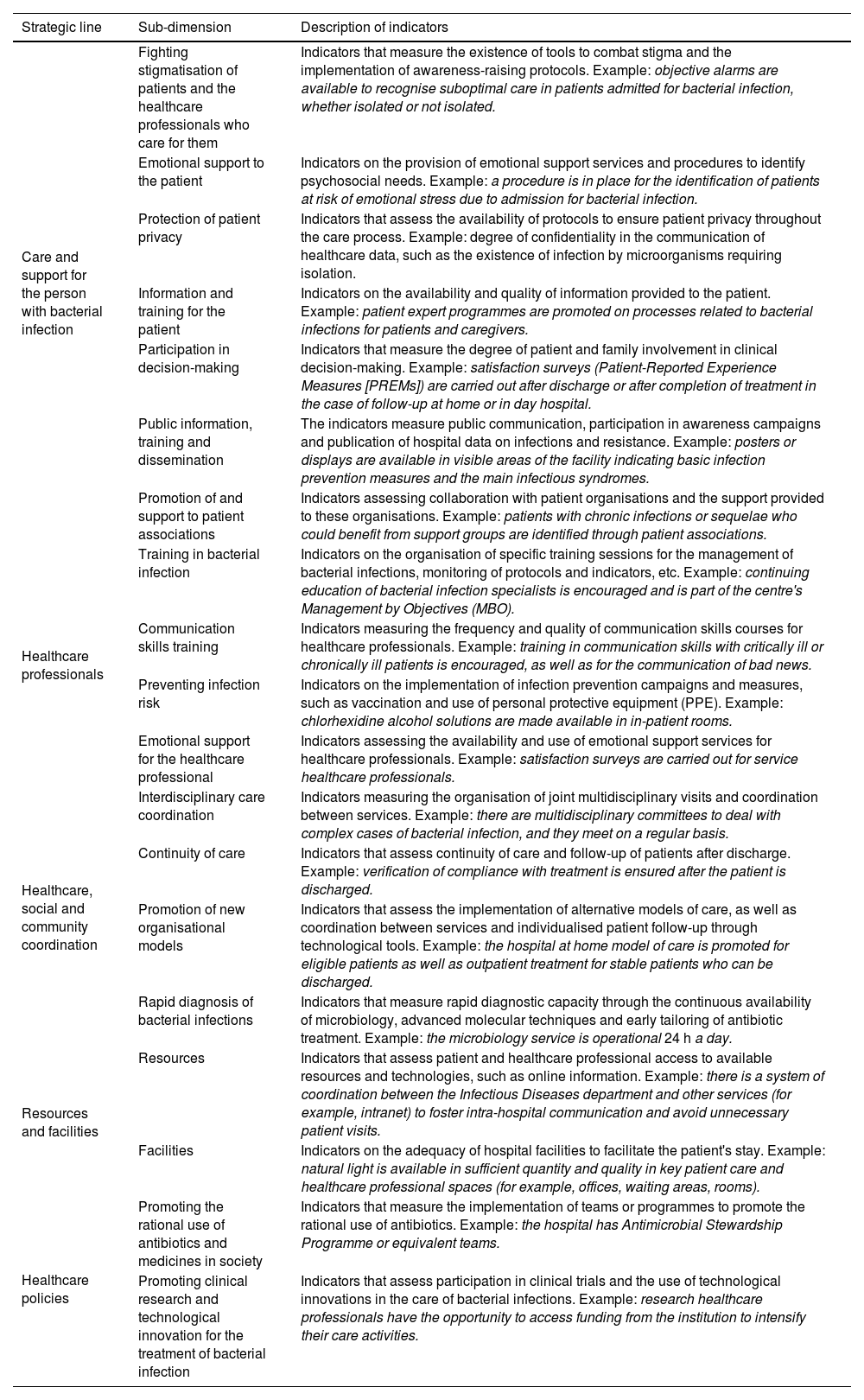
ResultsStrategic lines and sub-dimensionsThe five strategic lines identified represent the key areas for improving humanized care in the treatment of patients with severe bacterial infections. Each strategic line is broken down into several sub-dimensions, ranging from direct patient care to resource management and healthcare policy design. These sub-dimensions were the basis for defining specific indicators to assess different aspects of humanization in a structured way. Table 1 provides a systematic listing of the five strategic lines, their associated sub-dimensions and a description of the type of indicators developed for each one, accompanied by a representative example.
Strategic lines, sub-dimensions and type of indicators with examples.
| Strategic line | Sub-dimension | Description of indicators |
|---|---|---|
| Care and support for the person with bacterial infection | Fighting stigmatisation of patients and the healthcare professionals who care for them | Indicators that measure the existence of tools to combat stigma and the implementation of awareness-raising protocols. Example: objective alarms are available to recognise suboptimal care in patients admitted for bacterial infection, whether isolated or not isolated. |
| Emotional support to the patient | Indicators on the provision of emotional support services and procedures to identify psychosocial needs. Example: a procedure is in place for the identification of patients at risk of emotional stress due to admission for bacterial infection. | |
| Protection of patient privacy | Indicators that assess the availability of protocols to ensure patient privacy throughout the care process. Example: degree of confidentiality in the communication of healthcare data, such as the existence of infection by microorganisms requiring isolation. | |
| Information and training for the patient | Indicators on the availability and quality of information provided to the patient. Example: patient expert programmes are promoted on processes related to bacterial infections for patients and caregivers. | |
| Participation in decision-making | Indicators that measure the degree of patient and family involvement in clinical decision-making. Example: satisfaction surveys (Patient-Reported Experience Measures [PREMs]) are carried out after discharge or after completion of treatment in the case of follow-up at home or in day hospital. | |
| Public information, training and dissemination | The indicators measure public communication, participation in awareness campaigns and publication of hospital data on infections and resistance. Example: posters or displays are available in visible areas of the facility indicating basic infection prevention measures and the main infectious syndromes. | |
| Promotion of and support to patient associations | Indicators assessing collaboration with patient organisations and the support provided to these organisations. Example: patients with chronic infections or sequelae who could benefit from support groups are identified through patient associations. | |
| Healthcare professionals | Training in bacterial infection | Indicators on the organisation of specific training sessions for the management of bacterial infections, monitoring of protocols and indicators, etc. Example: continuing education of bacterial infection specialists is encouraged and is part of the centre's Management by Objectives (MBO). |
| Communication skills training | Indicators measuring the frequency and quality of communication skills courses for healthcare professionals. Example: training in communication skills with critically ill or chronically ill patients is encouraged, as well as for the communication of bad news. | |
| Preventing infection risk | Indicators on the implementation of infection prevention campaigns and measures, such as vaccination and use of personal protective equipment (PPE). Example: chlorhexidine alcohol solutions are made available in in-patient rooms. | |
| Emotional support for the healthcare professional | Indicators assessing the availability and use of emotional support services for healthcare professionals. Example: satisfaction surveys are carried out for service healthcare professionals. | |
| Healthcare, social and community coordination | Interdisciplinary care coordination | Indicators measuring the organisation of joint multidisciplinary visits and coordination between services. Example: there are multidisciplinary committees to deal with complex cases of bacterial infection, and they meet on a regular basis. |
| Continuity of care | Indicators that assess continuity of care and follow-up of patients after discharge. Example: verification of compliance with treatment is ensured after the patient is discharged. | |
| Promotion of new organisational models | Indicators that assess the implementation of alternative models of care, as well as coordination between services and individualised patient follow-up through technological tools. Example: the hospital at home model of care is promoted for eligible patients as well as outpatient treatment for stable patients who can be discharged. | |
| Rapid diagnosis of bacterial infections | Indicators that measure rapid diagnostic capacity through the continuous availability of microbiology, advanced molecular techniques and early tailoring of antibiotic treatment. Example: the microbiology service is operational 24 h a day. | |
| Resources and facilities | Resources | Indicators that assess patient and healthcare professional access to available resources and technologies, such as online information. Example: there is a system of coordination between the Infectious Diseases department and other services (for example, intranet) to foster intra-hospital communication and avoid unnecessary patient visits. |
| Facilities | Indicators on the adequacy of hospital facilities to facilitate the patient's stay. Example: natural light is available in sufficient quantity and quality in key patient care and healthcare professional spaces (for example, offices, waiting areas, rooms). | |
| Healthcare policies | Promoting the rational use of antibiotics and medicines in society | Indicators that measure the implementation of teams or programmes to promote the rational use of antibiotics. Example: the hospital has Antimicrobial Stewardship Programme or equivalent teams. |
| Promoting clinical research and technological innovation for the treatment of bacterial infection | Indicators that assess participation in clinical trials and the use of technological innovations in the care of bacterial infections. Example: research healthcare professionals have the opportunity to access funding from the institution to intensify their care activities. |
Note: The table includes a representative example of the indicators developed for each sub-dimension. The full set of indicators can be found in the HUMANIZAcción document, cited in the reference section.1
The development of indicators has been a central process in the project. Each sub-dimension was carefully analysed in order to transform the general proposals into concrete, measurable indicators applicable to different hospital contexts. Three types of indicators can be distinguished:
- 1
Process indicators: measure the implementation of protocols, activities and tools which have a direct impact on patient care. For example, having a procedure for identifying patients at risk of emotional stress due to admission for bacterial infection.
- 2
Outcome indicators: assess the clinical and patient experience outcomes resulting from the application of humanization processes. For example, the percentage of patients who report receiving clear and understandable information about their disease in satisfaction surveys.
- 3
Perception indicators: capture the perception of patients, relatives and healthcare professionals on the quality of treatment and care received at the hospital. For example, the results obtained in PREMs surveys after discharge, which assess aspects such as respect for privacy, degree of kindness in the way they were treated or participation in clinical decisions.
These are essential in order to be able to objectively assess the degree of humanization in hospitals and thus enable a process of continuous improvement.
Piloting and validation in hospitalsIn order to validate the indicators developed, a pilot project was started in two reference hospitals in Spain: Hospital Clínic Barcelona and Hospital Universitario 12 de Octubre. These centres have used the indicators to objectively measure the situation in their respective infectious diseases and internal medicine departments. Over time, this will make it possible to determine the impact of the consensus-based improvements implemented on the care provided.
Piloting seeks to test the applicability of the indicators in a real-life setting, adjusting any necessary aspects and generating results that make the methodology more robust. Initial validation has shown that these indicators are useful for both patient-related and healthcare professional actions, which reinforces their applicability to other hospitals.
Anticipated outcomes of the pilotingIt is hoped that, after the piloting with each of the departments, improvements will be reported in key areas such as communication with patients, their involvement in decision-making and the reduction of stigma associated with serious bacterial infections. In the first analyses carried out in both centres, patterns of improvement have been identified in aspects such as patient perception of communication with healthcare professionals, clarity of information received and involvement in clinical decisions. There has also been an increase in the involvement of healthcare staff in training activities on humanization, as well as greater coordination between clinical and social services in post-discharge follow-up. These preliminary observations reinforce the applicability of the proposed model and justify its extension to other centres.
In addition, the promotion of training activities on the application of humanistic values in the day-to-day work of healthcare professionals can improve the inter-relation between the different actors in the care ecosystem, be they patients and their environment or care and administrative profiles.
In both participating hospitals, the process has culminated in the development and internal validation of an improvement plan agreed by the teams involved, covering organisational, care and relational aspects. The application of the indicators has demonstrated their utility as a tool for promoting reflection on processes, detecting critical points and guiding specific interventions directed towards more humanized care. In the case of Hospital Clínic Barcelona, the first centre to be certified using this model, its institutional commitment to the humanization of care for people with severe bacterial infection has been publicly recognised. At Hospital Universitario 12 de Octubre, the piloting has been completed and is currently in the institutional review and communication phase.
ConclusionsThe HUMANIZAcción project has succeeded in defining a robust set of indicators for objectively measuring the degree of humanization in the care of patients with severe bacterial infections. Pilot validation has confirmed the utility of these indicators, clearing the way for their implementation in a larger number of hospitals throughout Spain. This model can serve as an example for other areas of healthcare, where humanization is key to improving patient experience and clinical outcomes, as is already being planned in settings such as intensive care units.4
The multidisciplinary and patient-centred approach adopted by the HUMANIZAcción report provides a valuable tool for improving the quality of care by promoting more personal and individualised care. This model can serve as an example for other areas of healthcare, where humanization is key to improving patient experience and clinical outcomes.
Limitations and future perspectivesThe indicator model presented here is based on a process of healthcare professional consensus and active participation of patients and experts, without applying formal methodologies such as the Delphi method or nominal groups. This may partially affect the reproducibility of the model or its external validation in other contexts.
Furthermore, although the pilot has been carried out in two reference hospitals with different organisational frameworks, its implementation in smaller centres or with different organisational structures may require adaptations. However, it should be noted that the HUMANIZAcción document, the basis of this work, was developed with the participation of healthcare professionals from different hospitals in Spain, which provides a good cross-section of opinion for the identification of needs and proposals.
Indicators, by their nature, are designed to be dynamic tools. As they begin to be used in different hospitals and implementation data are collected, they can be adjusted and refined, and so accompany the evolving changes in healthcare provision and the emerging values around the humanization of the healthcare system.
FundingThe project has been promoted by Fundación Humans, and it has been made possible thanks to the unconditional sponsorship of Angelini Pharma España.
Jaime Lora-Tamayo, co-author of this article, has received speaking and consultancy fees from Angelini Pharma España, Advanz Pharma, Menarini, Novartis and MSD. He has also received grants to attend scientific congresses from Angelini Pharma España, Advanz Pharma and Menarini. Lastly, he has established scientific collaboration contracts with Advanz Pharma and Menarini.
Laura Morata, co-author of this article, has received speaking and consultancy fees from Angelini Pharma España, Advanz Pharma, Menarini, Pfizer and MSD. She has also received grants to attend scientific congresses from Angelini Pharma España, Pfizer and Menarini. Lastly, she has established scientific collaboration contracts with Advanz Pharma.
Xavier Oleart, co-author of this article, declares no conflicts of interest.
Irantzu Rosselló, co-author of this article, is an employee of Angelini Pharma España, which funded this project through unconditional sponsorship.
Julio Zarco, as the main author of this article, has received fees and grants for work and attendance as a speaker at scientific congresses from Angelini Pharma España, AstraZeneca, Lundbeck, GSK and Johnson & Johnson.


