



Resistance to β-lactams has risen globally among Bacteroides species. Consequently, delafloxacin has emerged as a therapeutic alternative against these microorganisms. The main objective of this study is to analyse the MIC of delafloxacin in Bacteroides spp. isolates and compare it with commonly used anaerobic antimicrobial agents.
MethodThe susceptibility of delafloxacin and other anaerobic antibiotics was assessed in 370 isolates of the genus Bacteroides and MIC50 and MIC90 values were determined for all antibiotics.
ResultsIn Bacteroides spp. and the Bacteroides fragilis sensu stricto group the MIC50 values for delafloxacin were lower than those of other antibiotics, except for tigecycline and metronidazole.
ConclusionGiven the potent in vitro anaerobic activity and its broad spectrum, delafloxacin may represent a favourable alternative in the treatment of mixed bacterial infections, particularly those involving multidrug-resistant strains.
La resistencia a betalactámicos ha aumentado globalmente en el género Bacteroides. En este contexto, delafloxacino se presenta como una alternativa terapéutica frente a este microorganismo. El objetivo principal de este estudio es analizar la CMI de delafloxacino en aislados de Bacteroides spp. y compararla con fármacos anaerobicidas de uso habitual.
MétodoSe ha analizado la sensibilidad de delafloxacino y otros antibióticos anaerobicidas en 370 aislamientos del género Bacteroides y se han calculado los valores de CMI₅ₒ y CMI₉ₒ para todos los antibióticos.
ResultadosEn el grupo de Bacteroides spp. y Bacteroides fragilis SS los valores de CMI₅ₒ y CMI₉ₒ a delafloxacino fueron menores al resto de antibióticos, excepto para tigeciclina y metronidazol.
ConclusionesTeniendo en cuenta la potente actividad in vitro anaerobicida y su amplio espectro, delafloxacino podría ser una buena alternativa en el tratamiento prolongado de las infecciones mixtas especialmente en contextos de resistencia creciente.
Species of the genus Bacteroides are common members of the human intestinal microbiota and may cause severe infections when they gain access to normally sterile body compartments following trauma, surgery or disruption of the mucosal barrier.
Compared with other anaerobes associated with infections, Bacteroides spp. are increasingly becoming reservoirs of antimicrobial resistance. In particular, species belonging to the B. fragilis group are characterised by marked genetic plasticity, which facilitates adaptation to different ecological niches and enhances the dissemination of resistance mechanisms.1,2
Several studies have documented a worldwide increase in resistance to β-lactams and carbapenems among B. fragilis isolates.3,4 This growing prevalence may lead to reduced or failed therapeutic efficacy, as these antibiotics are often the drugs of choice for treatment.5,6 In our region in 2024, resistance rates to β-lactams were high within the Bacteroides fragilis group: 39% for amoxicillin–clavulanic acid and piperacillin–tazobactam, and 9% for meropenem, applying EUCAST breakpoints.7 In this scenario, there is a clear need to identify effective therapeutic alternatives for these patients and, in this context, delafloxacin emerges as a potential option for targeted therapy of infections caused by Bacteroides spp.
Delafloxacin is a novel fourth-generation fluoroquinolone with a broader antibacterial spectrum, a more favourable pharmacokinetic profile and lower toxicity than the other quinolones.8
Unlike other fluoroquinolones, delafloxacin is considered a dual-target agent, as it shows equivalent affinity for DNA gyrase and topoisomerase IV. This property explains the broad in vitro activity of delafloxacin against anaerobic, Gram-negative and Gram-positive bacteria. One of its main advantages over the other quinolones is the lack of a basic group at position C7. This modification results in an anionic molecule at neutral pH and a neutral molecule at acidic pH. Consequently, delafloxacin shows greater intracellular activity and enhanced activity in acidic environments (biofilms, abscesses, chronic wounds, etc.) 9,10 Indeed, a 2- to 32-fold reduction in minimum inhibitory concentration (MIC) has been observed when susceptibility testing is performed under acidic conditions.11
Delafloxacin is currently approved for the treatment of Skin structures and soft tissue infections and community-acquired pneumonia,10 but given its characteristics, it may play a potential role in other infectious diseases, such as osteomyelitis and osteoarticular infections, due to the frequent complication of biofilm formation, as well as in mixed or polymicrobial infections.
The main objective of this study was to analyse the MIC of delafloxacin in Bacteroides spp. isolates and to compare these data with those obtained for other commonly used anaerobic antimicrobial agents.
MethodsIn this study, MIC values of Bacteroides species to different anaerobic antimicrobial agents were analysed and compared. Bacteroides spp. isolates from clinical samples collected between January 2024 and March 2025 were included. Bacteroides spp. were isolated on anaerobic selective medium (Anaerobe Blood Agar with Neomycin and Aztreonam, Oxoid) after 24–48 h of incubation under anaerobic conditions at 35–37 °C. Colonies were identified by MALDI-TOF MS (Bruker Biotyper). As MALDI-TOF MS is unable to differentiate between B. thetaiotaomicron/B. faecis and B. ovatus/B. xylanisolvens, these species were grouped in pairs for analysis.12 Antimicrobial susceptibility testing was performed using the gradient diffusion method (Liofilchem® MIC Test Strips, MTS). The following antibiotics were tested: amoxicillin–clavulanic acid, piperacillin–tazobactam, meropenem, clindamycin, tigecycline, metronidazole and delafloxacin. For this purpose, Bacteroides strains were subcultured on fastidious anaerobic agar (FAA; Oxoid) from a 0.5 McFarland bacterial suspension and incubated at 35 °C under anaerobic conditions for 24–48 h. Anaerobic conditions were generated using the AnaeroGen system (Oxoid). As susceptibility to moxifloxacin was not tested in these isolates, but had been tested in all strains prior to that period, MIC data from 300 isolates obtained in 2023 and processed using the same methodology were additionally retrieved. MIC results for the different antibiotics were categorised according to EUCAST 2024 guidelines. MIC50 and MIC90 values were calculated for all antibiotics, and B. fragilis sensu stricto (SS) was analysed separately from the overall Bacteroides genus.
ResultsThis study included 370 Bacteroides spp. isolates obtained from 370 patients. The origin of the isolates was as follows: 54% (200) from intra-abdominal or pelvic abscesses, 22% (81) from skin abscesses and surgical wounds, 11% (41) from blood cultures and 13% (48) from other specimens. Regarding species distribution, 70% were B. fragilis sensu stricto and 30% other species. As no breakpoints for delafloxacin have been established by international committees (CLSI or EUCAST), isolates were categorised using the B. fragilis sensu stricto EUCAST epidemiological cut-off value (ECOFF) for moxifloxacin (MIC ≤ 2 μg/mL). Of all isolates, only 14 showed an MIC > 2 μg/mL to delafloxacin (14/370). When analysing B. fragilis sensu stricto separately, only three isolates showed an MIC > 2 μg/mL (3/260). Notably, in our series, isolates grouped as B. thetaiotaomicron/faecis showed the highest proportion of isolates with reduced susceptibility to delafloxacin (MIC > 2 μg/mL) (11/69).
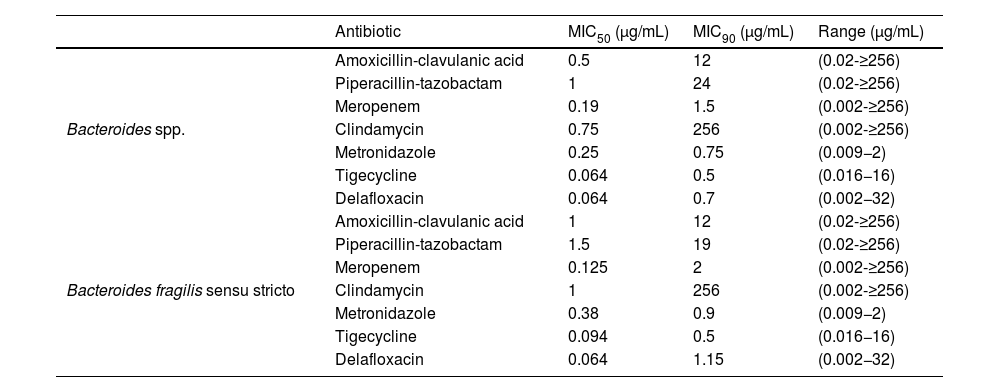
The comparative MIC50 and MIC90 results for the antibiotics tested are shown in Tables 1 and 2.
MIC50 and MIC90 results of anti-anaerobic antibiotics.
| Antibiotic | MIC50 (μg/mL) | MIC90 (μg/mL) | Range (μg/mL) | |
|---|---|---|---|---|
| Bacteroides spp. | Amoxicillin-clavulanic acid | 0.5 | 12 | (0.02-≥256) |
| Piperacillin-tazobactam | 1 | 24 | (0.02-≥256) | |
| Meropenem | 0.19 | 1.5 | (0.002-≥256) | |
| Clindamycin | 0.75 | 256 | (0.002-≥256) | |
| Metronidazole | 0.25 | 0.75 | (0.009−2) | |
| Tigecycline | 0.064 | 0.5 | (0.016−16) | |
| Delafloxacin | 0.064 | 0.7 | (0.002−32) | |
| Bacteroides fragilis sensu stricto | Amoxicillin-clavulanic acid | 1 | 12 | (0.02-≥256) |
| Piperacillin-tazobactam | 1.5 | 19 | (0.02-≥256) | |
| Meropenem | 0.125 | 2 | (0.002-≥256) | |
| Clindamycin | 1 | 256 | (0.002-≥256) | |
| Metronidazole | 0.38 | 0.9 | (0.009−2) | |
| Tigecycline | 0.094 | 0.5 | (0.016−16) | |
| Delafloxacin | 0.064 | 1.15 | (0.002−32) |
In our series, in the Bacteroides spp. group, delafloxacin showed good in vitro activity compared with other antibiotics, with MIC50 (0.064 μg/mL) and MIC90 (0.7 μg/mL) values lower than those of the other agents, except for the MIC90 of tigecycline (0.5 μg/mL). In the Bacteroides fragilis sensu stricto group, delafloxacin also demonstrated good in vitro activity, with MIC50 (0.064 μg/mL) and MIC90 (1.15 μg/mL) values lower than those of other antibiotics, except for the MIC90 values of tigecycline and metronidazole (0.5 μg/mL and 0.9 μg/mL, respectively). These results are consistent with those reported by Cobo et al.,12 who compared the in vitro anaerobic activity of delafloxacin against different anaerobic species involved in human infections with that of other commonly used antimicrobials. In that study, delafloxacin showed lower MIC50 and MIC90 values (0.047 μg/mL and 0.38 μg/mL, respectively) than the other agents tested in the Bacteroides spp. group.
The main limitation of our study is that in vitro susceptibility testing was performed under neutral pH conditions, whereas available evidence suggests that testing under acidic conditions would be more appropriate. In addition, delafloxacin was not tested against other bacteria involved in the pathogenesis of mixed infections, although other quinolones were tested, from which susceptibility categorisation could, in some cases, be inferred. Early in vitro susceptibility studies have shown high categorical agreement between ciprofloxacin and delafloxacin for Escherichia coli and Klebsiella pneumoniae.13
Given the potent anaerobic activity of delafloxacin, its broad spectrum, good penetration and enhanced activity in acidic microenvironments, this antibiotic may be an option for prolonged treatment of mixed infections, such as intra-abdominal, intra-peritoneal and pelvic abscesses. The presence of β-lactam–resistant Bacteroides spp. in mixed infections often requires combination therapy with two or more agents when switching to oral treatment, posing a therapeutic challenge in terms of oral antibiotic availability, safety and tolerability. In these cases, a β-lactam is usually combined with an anaerobic agent, most commonly metronidazole. However, due to its toxicity profile, metronidazole may not be a safe option for prolonged treatment of these infections as it has been associated with serious adverse effects when used long term and/or at high doses.14
Finally, EUCAST and/or CLSI need to establish specific breakpoints for delafloxacin against anaerobes to facilitate its use as an alternative to conventional therapies. Further studies are needed to evaluate its clinical efficacy in the treatment of mixed infections.
CRediT authorship contribution statementAll authors actively participated in the preparation of the manuscript and contributed jointly to the drafting, revision and final approval of the content.
Informed consentNot applicable, as no personal data were collected and no studies involving human participants were conducted.
Ethical considerationsBecause this study did not involve experiments on human beings or animals, approval by an ethics committee was not required.
Declaration of Generative AI and AI-assisted technologies in the writing processArtificial intelligence was not used in the preparation of the manuscript content.
FundingNone.
The authors declare no conflicts of interest.


