Adolescence is marked by significant physiological and psychological changes that can lead to body image dissatisfaction and eating disorders (ED). Adolescents with type 1 diabetes mellitus (T1DM) may engage in restrictive dieting or insulin manipulation to control weight, risking severe complications. This study aims to identify adolescents with T1DM at risk for diabetes-specific eating behaviors using the Diabetes-Specific Eating Problems Scale-Revised (DEPS-R) and assess associated psychopathological factors, including diabulimia.
MethodsAdolescents (10–18 years) with T1DM who were under follow-up in our clinic within the past year were included. Patients were categorized into 3 metabolic control groups according to HbA1c levels: good (<7%), moderate (7–9%), and poor (>9%) based on the cumulative glycemic index that was calculated from the average HbA1c values over the past year. Eating behaviors were assessed using the DEPS-R scale, with scores≥20 indicating risk for ED. Individuals with high DEPS-R scores (at-risk group) were referred for psychiatric evaluation.
ResultsA total of 11.2% our of 80 adolescents, were identified as at risk for EDs. The mean DEPS-R score of the at-risk group was significantly higher vs the other group (25.8±3.5 vs 10.0±4.6, p<0.001). No significant differences were observed for age, gender, height SDS, and relative BMI. Although the at-risk group had a higher cumulative glycemic index and longer diabetes duration, there was no statistical significance (p=0.29, 0.28, respectively). Logistic regression analysis, adjusted for age, sex, diabetes duration, and comorbidities, did not identify statistically significant predictors of high DEPS-R scores. A weak positive correlation was found between high DEPS-R scores and basal-bolus insulin therapy (r=0.09, p=0.03). Psychopathology was observed in 55% of high-risk adolescents, with a higher prevalence in the poor metabolic control subgroup.
ConclusionAlthough the DEPS-R scale is a valuable tool for identifying not only EDs but also early changes in eating behaviors in adolescents with T1DM, psychiatric evaluation is essential for confirming underlying psychopathology. Psychological factors play a key role in shaping eating behaviors, highlighting the need for integrated care combining diabetes management with psychological support.
La adolescencia se caracteriza por cambios fisiológicos y psicológicos significativos que pueden generar insatisfacción con la imagen corporal y trastornos de la conducta alimentaria (TCA). Los adolescentes con diabetes tipo 1 (DT1) pueden recurrir a dietas restrictivas o manipulación de la insulina para controlar el peso, con riesgo de complicaciones graves. Este estudio tiene como objetivo identificar a los adolescentes con DT1 en riesgo de comportamientos alimentarios específicos de la diabetes mediante la Escala de Problemas Alimentarios Específicos de Diabetes-Revisada (DEPS-R) y evaluar los factores psicopatológicos asociados, incluida la diabulimia.
MétodosSe incluyeron adolescentes (10–18 años) con DT1 que estuvieron en seguimiento en nuestra clínica durante el último año. Los pacientes se clasificaron en tres grupos según el control metabólico basado en los niveles de HbA1c: bueno (<7%), moderado (7–9%) y pobre (>9%), según el índice glucémico acumulativo calculado a partir del promedio de HbA1c del último año. Los comportamientos alimentarios se evaluaron mediante la escala DEPS-R, considerando puntuaciones ≥20 como indicativas de riesgo de TCA. Los individuos con puntuaciones altas en DEPS-R (grupo en riesgo) fueron referidos a evaluación psiquiátrica.
ResultadosDe 80 adolescentes, el 11,2% fueron identificados como en riesgo de TCA. La puntuación media de DEPS-R del grupo en riesgo fue significativamente mayor que la del otro grupo (25,8± 3,5 vs 10,0±4,6, p<0,001). No se observaron diferencias significativas en edad, sexo, SDS de altura y IMC relativo. Aunque el grupo en riesgo presentó un índice glucémico acumulativo más alto y una mayor duración de la diabetes, no se encontró significancia estadística (p=0,29 y 0,28, respectivamente). El análisis de regresión logística, ajustado por edad, sexo, duración de la diabetes y comorbilidades, no identificó predictores estadísticamente significativos de puntuaciones altas en DEPS-R. Se encontró una débil correlación positiva entre puntuaciones altas de DEPS-R y terapia basal-bolo de insulina (r=0,09, p=0,03). Se observó psicopatología en el 55% de los adolescentes de alto riesgo, con mayor prevalencia en el subgrupo de mal control metabólico.
ConclusiónLa escala DEPS-R es una herramienta útil para identificar no solo trastornos alimentarios, sino también cambios tempranos en los comportamientos alimentarios en adolescentes con DT1; sin embargo, la evaluación psiquiátrica es esencial para confirmar la psicopatología subyacente. Los factores psicológicos desempeñan un papel clave en la configuración de los comportamientos alimentarios, destacando la necesidad de un enfoque integrado que combine el manejo de la diabetes con apoyo psicológico.
Type 1 diabetes mellitus (T1DM) is a chronic metabolic disease resulting from impaired insulin secretion and/or insulin action.1,2 This condition requires careful management in many aspects of the individual's daily life. The complexity of this management process also impacts the psychological state of individuals. Particularly during adolescence, which is marked by both physiological and psychological changes, acceptance of the diagnosis becomes challenging, and there is an increase in non-compliance with diabetes management, making it harder to achieve appropriate glycemic control.3,4 Changes during this period can lead to dissatisfaction with body image, which in turn leads to an increased prevalence of eating disorders (EDs) in adolescents with diabetes.4–7 The relationship between diabetes and EDs has been a topic of increasing interest in recent years. A distinct form of eating disorder in patients with diabetes, known as “diabulimia,” is especially prevalent in adolescent individuals.6–9 Prevalence studies report that 25–39% of adolescents with T1DM show disordered eating symptoms (DES), and 7–25% meet the criteria for an ED.6–9 Adolescents with diabetes may also exhibit disordered eating behaviors, such as restrictive dieting, purging, or binge eating, to reduce or maintain body weight, but the deliberate inadequate insulin intake behavior distinguishes dyabulimia from other EDs. As insulin, exercise, and nutrition are all key components in the treatment of T1DM, such behavior can lead to serious complications.3,6
Diabulimia can have profound effects on both the physical and psychological health of individuals. Long-term, it can increase the risks of complications such as blood sugar imbalances, diabetic ketoacidosis (DKA), and damage to the kidneys and nerves. Furthermore, it has been associated with mental health issues such as depression, anxiety, and suicidal thoughts.7,10 This behavior pattern can be confused with poor diabetes control. If diabulimia is not recognized early, it can negatively impact not only the individual's physical and mental health but also their psychosocial well-being.11–13 Therefore, early diagnosis and proper management of EDs in individuals with T1DM are critical.
To raise awareness and support early diagnosis and treatment processes, the Diabetes Eating Problem Survey-Revised (DEPS-R) was developed for routine examinations. The DEPS-R is an assessment tool designed to evaluate eating behaviors and their psychological impacts on individuals with T1DM.5 Studies conducted in various populations have supported the validity and reliability of the DEPS-R.6 The revised Turkish version of the DEPS-R for children and adolescents has been used as a reliable and valid assessment tool in our country since 2017.14
In this study, the aim is to identify adolescents with T1DM at risk of diabetes-specific eating behavior disorders using the DEPS-R scale, evaluate the presence of associated psychopathological factors in these high-risk individuals, and examine the prevalence and effects of diabulimia.
MethodsAdolescents aged 10–18 years who were diagnosed with T1DM and were followed up at Ankara University Pediatric Endocrinology Clinic within the last year were included in the study. Written informed consent was obtained from both the adolescents and their parents/guardians prior to participation. All patients undergoing treatment at the time of presentation, with accessible clinical data, were evaluated. Patients with syndromic conditions, a prior psychiatric diagnosis, or those currently undergoing medical or psychotherapeutic treatment were excluded from the study. Data were collected on the patients’ anthropometric measurements, age, sex, age at diabetes diagnosis, insulin administration methods, presence of comorbidities, family history of diabetes, and T1DM-related complications. The study protocol was approved by our Institutional Ethics Review Board in accordance with the principles of the Declaration of Helsinki (Approval code: 2025/7).
Metabolic control was assessed using the cumulative glycemic index, calculated as the area under the curve of HbA1c measurements over the past year divided by the total time interval, representing the mean cumulative HbA1c. Patients’ metabolic control status was classified according to the cumulative glycemic index as good (<7%), moderate (7–9%), or poor (>9%). The distribution of DEPS-R scores across these cumulative glycemic index groups was then assessed.
Weight and height were expressed as standard deviation scores (SDS, z-scores) based on age- and sex-specific reference values. Body mass index (BMI) was calculated as weight in kilograms divided by height in meters squared. To account for differences in growth and sex, relative BMI (RBMI, %) was calculated using the formula: RBMI=(Child BMI/50th percentile BMI for same age and sex)×100, allowing standardized comparison across ages and sexes. Based on RBMI, children were categorized as normal weight (RBMI<100%), overweight (RBMI≥100% and <120%), obese (RBMI≥120% and <160%), or severely obese (RBMI≥160%).
For all patients, the DEPS-R scale, a validated and reliable 16-item questionnaire designed to evaluate eating behaviors and psychological status, was administered through one-on-one interviews by a nurse specialized in diabetes care. The scale includes four areas: body weight, eating habits, methods to reduce body weight (e.g., conscious vomiting or skipping insulin doses), and general diabetes management. Patients rated each item on a scale from 0 (never) to 5 (always). Patients were categorized into 2 groups based on their DEPS-R scores: those with a total score≥20 were classified as the at-risk group for diabetes-related EDs, while those with scores<20 comprised the non-risk group. The characteristics and DEPS-R responses of the at-risk group were analyzed.
Patients from the at-risk group (DEPS-R≥20) were referred to the Adolescent Psychiatry Department for evaluation of psychosocial support needs and any necessary interventions, and patients from the non-risk group did not undergo psychiatric assessment.
Multivariate correlation analysis was used to examine the factors associated with DEPS-R scores.
Statistical analysisAll analyses were conducted using SPSS version 23.0. To analyze data distribution, the Shapiro–Wilk test was performed to determine whether the distribution was normal. An Independent t-test assessed differences across groups for normally distributed data. For non-normally distributed data, the Mann–Whitney U test was employed. A one-way ANOVA test was used to analyze the differences between the normally distributed groups with >2 categories. Furthermore, Pearson and Spearman correlation coefficients were calculated to examine the relationships between the 2 variables. Pearson correlation was applied for normally distributed data, while Spearman correlation was used for ranked or non-normally distributed data. A p-value of 0.05 was considered statistically significant. The post hoc power analysis based on the observed effect size (Cohen's d≈3.8) indicated that the statistical power was sufficiently high despite the sample imbalance.
To identify factors associated with being in the at-risk group (DEPS-R≥20), a multivariable binary logistic regression analysis was performed. The dependent variable was risk group status (at-risk vs not at-risk). Predictor variables (age, sex, diabetes duration, and comorbidities) were selected a priori based on clinical relevance and previous literature. All predictors were entered simultaneously using the enter method. No issues of complete or quasi-complete separation were observed, and no penalized regression methods were required. Formal calibration procedures (e.g., Hosmer–Lemeshow test) were not conducted due to the limited sample size.
ResultsA total of 80 cases, with a mean age of 13.7±2.1 years, including 37 men (46%), were included in the study. All cases had low C-peptide levels and were insulin-dependent. Insulin therapy was administered through basal-bolus insulin injection in 92.6% of the cases, while 7.4% used insulin pump therapy. The mean duration of diabetes was 4.7 years (range, 1.2–13.3 years). Chronic lymphocytic thyroiditis was the most common comorbid condition (24.1%), followed by celiac disease (13%). Other autoimmune diseases, such as psoriasis, vitiligo, and Behçet's disease, were found in 0.7% of the cases. No complications were detected in any case.
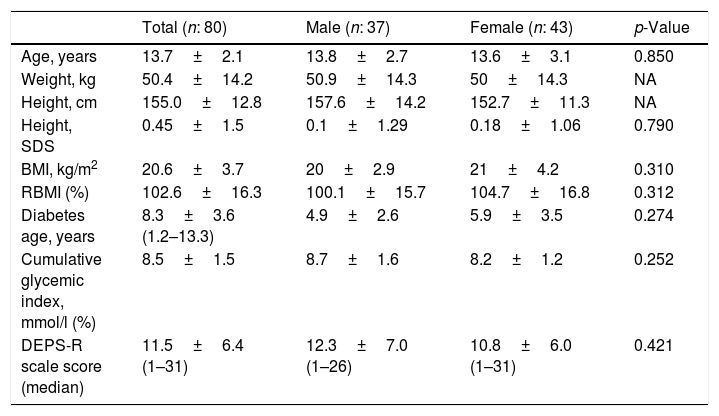
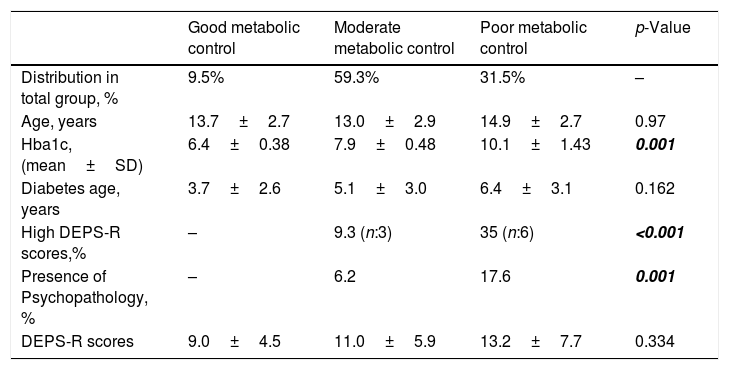
The mean age at diabetes diagnosis was 8.3±3.6 years, and the cumulative glycemic index was 8.5±1.5%. There were no significant differences in the mean DEPS-R scale scores between genders (women, 10.8±6.0; men, 11.6±7.3) (p=0.671) (Table 1). Patients were categorized according to metabolic control as follows: 9.5% in the good control group, 59.3% in the moderate control group, and 31.5% in the poor control group. The mean DEPS-R scores in these groups were 9.0±4.5, 11.0±5.9, and 13.2±7.7 points, respectively. The differences in DEPS-R score distributions among the groups were not statistically significant (p=.334) (Table 2).
Demographic, anthropometric, and metabolic characteristics of the study group by gender.
| Total (n: 80) | Male (n: 37) | Female (n: 43) | p-Value | |
|---|---|---|---|---|
| Age, years | 13.7±2.1 | 13.8±2.7 | 13.6±3.1 | 0.850 |
| Weight, kg | 50.4±14.2 | 50.9±14.3 | 50±14.3 | NA |
| Height, cm | 155.0±12.8 | 157.6±14.2 | 152.7±11.3 | NA |
| Height, SDS | 0.45±1.5 | 0.1±1.29 | 0.18±1.06 | 0.790 |
| BMI, kg/m2 | 20.6±3.7 | 20±2.9 | 21±4.2 | 0.310 |
| RBMI (%) | 102.6±16.3 | 100.1±15.7 | 104.7±16.8 | 0.312 |
| Diabetes age, years | 8.3±3.6 (1.2–13.3) | 4.9±2.6 | 5.9±3.5 | 0.274 |
| Cumulative glycemic index, mmol/l (%) | 8.5±1.5 | 8.7±1.6 | 8.2±1.2 | 0.252 |
| DEPS-R scale score (median) | 11.5±6.4 (1–31) | 12.3±7.0 (1–26) | 10.8±6.0 (1–31) | 0.421 |
Independent sample t-test and Mann–Whitney U test. Data expressed mean±standard deviation, median [minimum, maximum], and percentage [%]. Statistically significant differences are indicated in bold and italicized with a p-value<0.05. DEPS-R scores>20 were categorized into the high-score group. DEPS-R: Diabetes-Specific Eating Problems Survey-Revision, Cumulative glycemic index calculated from the average HbA1c values over the past year. NA: not-appropriate; BMI: body mass index; RBMI; relative BMI.
Evaluation of the relation between metabolic control status and DEPS-R scores, and psychopathological condition.
| Good metabolic control | Moderate metabolic control | Poor metabolic control | p-Value | |
|---|---|---|---|---|
| Distribution in total group, % | 9.5% | 59.3% | 31.5% | – |
| Age, years | 13.7±2.7 | 13.0±2.9 | 14.9±2.7 | 0.97 |
| Hba1c, (mean±SD) | 6.4±0.38 | 7.9±0.48 | 10.1±1.43 | 0.001 |
| Diabetes age, years | 3.7±2.6 | 5.1±3.0 | 6.4±3.1 | 0.162 |
| High DEPS-R scores,% | – | 9.3 (n:3) | 35 (n:6) | <0.001 |
| Presence of Psychopathology, % | – | 6.2 | 17.6 | 0.001 |
| DEPS-R scores | 9.0±4.5 | 11.0±5.9 | 13.2±7.7 | 0.334 |
One-way ANOVA, DEPS-R: Diabetes-Specific Eating Problems Survey-Revision, Cumulative glycemic index calculated from the average HbA1c values over the past year. The metabolic control was based on the mean HbA1c. Classification: ≤7% good, 7–9% moderate, and ≥9% poor metabolic control. Statistically significant differences are indicated in bold and italicized with a p-value<0.05.
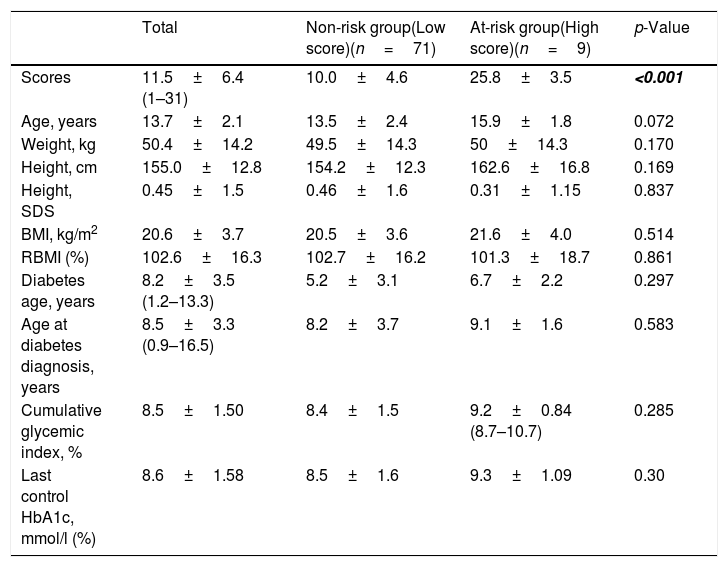
When patients were categorized into 2 groups based on DEPS-R scores, 9 individuals (11.2%) were classified into the at-risk group with scores≥20. The at-risk group had a mean DEPS-R score of 25.8±3.5, whereas the non-risk group had a mean score of 10.0±4.6, with the difference being statistically significant (p<0.001). Although the mean age of the at-risk group was higher, no statistically significant difference was found vs the non-risk group. The groups had no significant differences regarding weight SDS, height SDS, and RBMI (%). Although the cases in the at-risk group had a longer duration of diabetes and higher cumulative glycemic index, no statistically significant difference was found (p=0.29 and p=0.28) (Table 3). While 9.3% of the cases from the moderate metabolic control group had a DEPS-R score of ≥20, this rate significantly differed at 35% in the poor metabolic control group (p=0.001).
Evaluation of the demographic and laboratory characteristics between groups with low and high DEPS-R scale scores.
| Total | Non-risk group(Low score)(n=71) | At-risk group(High score)(n=9) | p-Value | |
|---|---|---|---|---|
| Scores | 11.5±6.4 (1–31) | 10.0±4.6 | 25.8±3.5 | <0.001 |
| Age, years | 13.7±2.1 | 13.5±2.4 | 15.9±1.8 | 0.072 |
| Weight, kg | 50.4±14.2 | 49.5±14.3 | 50±14.3 | 0.170 |
| Height, cm | 155.0±12.8 | 154.2±12.3 | 162.6±16.8 | 0.169 |
| Height, SDS | 0.45±1.5 | 0.46±1.6 | 0.31±1.15 | 0.837 |
| BMI, kg/m2 | 20.6±3.7 | 20.5±3.6 | 21.6±4.0 | 0.514 |
| RBMI (%) | 102.6±16.3 | 102.7±16.2 | 101.3±18.7 | 0.861 |
| Diabetes age, years | 8.2±3.5 (1.2–13.3) | 5.2±3.1 | 6.7±2.2 | 0.297 |
| Age at diabetes diagnosis, years | 8.5±3.3 (0.9–16.5) | 8.2±3.7 | 9.1±1.6 | 0.583 |
| Cumulative glycemic index, % | 8.5±1.50 | 8.4±1.5 | 9.2±0.84 (8.7–10.7) | 0.285 |
| Last control HbA1c, mmol/l (%) | 8.6±1.58 | 8.5±1.6 | 9.3±1.09 | 0.30 |
Independent sample t-test and Mann–Whitney U test. Data expressed mean±standard deviation, median [minimum, maximum], and percentage [%]. Statistically significant differences are indicated in bold and italicized with a p-value<0.05. DEPS-R scores>20 were categorized into the high-score group. DEPS-R: Diabetes-Specific Eating Problems Survey-Revision, Cumulative glycemic index calculated from the average HbA1c values over the past year. BMI: body mass index; RBMI; relative BMI.
No significant differences were found between insulin treatment type and DEPS-R scores. All patients from at-risk individuals received basal-bolus insulin therapy. A statistically significant yet weak positive correlation was found between basal-bolus insulin therapy and DEPS-R scores in univariate correlation analysis (r=0.09, p=0.03).
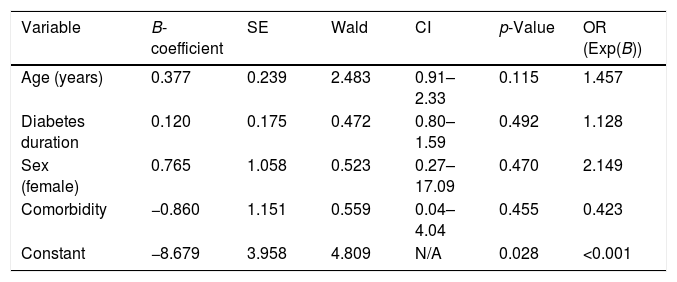
Multivariate logistic regression analysis was performed to examine factors associated with being in the at-risk group. Although none of the predictors reached statistical significance (p>0.05), older age (OR, 1.46, 95%CI, 0.91–2.33, p=0.115) and female sex (OR, 2.15, 95%CI, 0.27–17.09, p=0.470) showed a trend toward higher DEPS-R scores. Diabetes duration (OR, 1.13, 95%CI, 0.80–1.59, p=0.492) and the presence of comorbidities (OR, 0.42, 95%CI, 0.04–4.04, p=0.455) were not associated with increased risk. These findings should be interpreted with caution, as the number of high-risk cases was limited and the events-per-variable ratio (EPV: 2,25) was below recommended thresholds, which may have contributed to unstable estimates and wide confidence intervals (Table 4).
Binary logistic regression analysis of risk factors associated with elevated DEPS-R scores (≥20).
| Variable | B-coefficient | SE | Wald | CI | p-Value | OR (Exp(B)) |
|---|---|---|---|---|---|---|
| Age (years) | 0.377 | 0.239 | 2.483 | 0.91–2.33 | 0.115 | 1.457 |
| Diabetes duration | 0.120 | 0.175 | 0.472 | 0.80–1.59 | 0.492 | 1.128 |
| Sex (female) | 0.765 | 1.058 | 0.523 | 0.27–17.09 | 0.470 | 2.149 |
| Comorbidity | −0.860 | 1.151 | 0.559 | 0.04–4.04 | 0.455 | 0.423 |
| Constant | −8.679 | 3.958 | 4.809 | N/A | 0.028 | <0.001 |
Logistic regression analysis. Coefficients, OR: odds ratio; SE: standard error; CI: confidence interval; p-values (significance), and odds ratios [OR (Exp(B)] are presented. Statistically significant variables (p<0.05) are highlighted. N/A: not applicable.
Two individuals from the at-risk group had a family history of T1DM. Nine individuals had exceptionally high scores on the DEPS-R questions related to body weight control (questions 1, 6, and 12), while they scored low on other items addressing weight control methods, such as skipping insulin doses or vomiting.
Specifically, high scores were observed for the following items:
- •
Question 1: “Losing weight is important to me.”
- •
Question 6: “I find it difficult to lose weight while trying to control my diabetes.”
- •
Question 12: “People around me say I should better control my diabetes.”
Patients from the at-risk group were referred to the Child and Adolescent Mental Health Department for further evaluation. Psychopathology was detected in 5 cases, corresponding to 55% of the at-risk group.
The presence of psychopathology was, then, examined across metabolic control groups. No cases were identified in the good metabolic control group. Psychopathology was observed in 6.2% of adolescents in the moderate metabolic control group and in 17.6% of adolescents in the poor metabolic control group, based on those within each metabolic control subgroup.
In the assessment, 1 patient was diagnosed with obsessive-compulsive disorder, 2 with borderline personality disorder, and 2 with an unspecified eating disorder. Psychotherapy was scheduled to commence in all instances.
Given the emphasis on diabulimia, we further analyzed the responses to the DEPS-R items directly assessing insulin omission. Eleven patients provided a positive response (any option other than “never”) to at least 1 of these items, although all had total DEPS-R scores<20. For the item “I try to eat until my urine tests positive for ketones” (item 10), 4 patients responded positively: 2 patients (DEPS-R scores of 9 and 18) reported “rarely” (1 point), 1 patient (score 12) reported “sometimes” (2 points), and 1 patient (score 11) reported “always” (5 points). For the item “When I overeat, I skip my next insulin dose” (item 13), 7 patients responded positively: 4 patients (scores 16, 12, 8, and 17) reported “sometimes” (2 points), 2 patients (both with scores of 12) reported “rarely” (1 point), and 1 patient (score 15) reported “always” (4 points).
DiscussionOur study shows significant findings regarding the risk of EDs in adolescents diagnosed with T1DM. Further evaluations identified significant psychopathological findings in 11.2% of the cases, which were at risk for diabulimia. Our study emphasizes that individuals with a DEPS-R scale score of ≥20 should be closely monitored from both psychological and behavioral perspectives.
The 5th edition of the Diagnostic and Statistical Manual of Mental Disorders (DSM-5) outlines diagnostic criteria for EDs such as anorexia nervosa, bulimia nervosa, binge eating disorder, and unspecified eating or feeding disorders. Symptoms of altered eating behavior that do not meet diagnostic criteria but include behaviors such as dieting for weight loss, compulsive eating, excessive exercise, and the use of diuretics, laxatives, or self-induced vomiting are defined as disordered eating symptoms (DES).6,15 As previously defined, diabulimia (T1DM-associated eating disorder) refers to an ED specific to individuals with T1DM, characterized by deliberate insulin omission to induce weight loss.15,16
Eating behavior disorders in individuals with T1DM are often observed to start before the age of 25.6,8 Studies conducted on female adolescents with T1DM have reported that the prevalence of ED is 25–30%, while insulin restriction behaviors range from 5% to 40%.6 In 1 study, eating disorder symptoms were observed in 32.4% of adolescents, and 8.5% had an unspecified eating behavior disorder. In the meta-analysis of 5 studies with 664 adolescents with T1DM and 1894 healthy adolescents conducted by Young et al., disordered eating symptoms were found in 39.3% of the DM group vs 32.5% from the control group.8 This finding reveals that eating behavior disorders are more common in the diabetic group healthy adolescent group.
In a study from Turkey, 25% of 200 adolescents aged 9–18 years were found to be at risk for diabulimia.14 Taken together, the high prevalence of EDs in adolescents with T1DM demonstrates that adolescents with T1DM represent a significant risk group for disordered eating behaviors. The clinical significance of EDs extends beyond psychiatric morbidity, as they are closely linked to poor metabolic control and severe diabetes-related complications. These children exhibit higher rates of diabetic ketoacidosis, increased hospitalizations, and earlier onset of microvascular complications, particularly retinopathy.8,9,17,18 Indeed, the risk of retinopathy has been reported to be 2.5-fold higher in this population, with microvascular complications observed as early as within the first four years.17,18 However, in our series, none of the patients were found to have microvascular complications.
Additionally, former studies have highlighted the significant psychosocial burden associated with diabulimia, including anxiety disorders, personality disorders, depression, and increased suicidal ideation.7 Comorbidity studies indicate that personality disorders are highly prevalent in patients with EDs. In 2 adult cases, aged 25 and 35, with borderline personality disorder, insulin misuse was reported as impulsive behavior, similar to reckless actions, as a form of atypical weight control without conscious suicidal intent.10 Due to its serious consequences, diabulimia has gained significant media attention and has even been described as “the world's most dangerous ED”.19
The prevalence of EDs and DES should be assessed using surveys designed explicitly for T1DM patients, as routine surveys may not capture the unique aspects of the disease. Routine questionnaires, part of diabetes care, could misinterpret behaviors such as dietary restrictions or food avoidance as disease symptoms. Additionally, such questionnaires may not include questions assessing diabetes-specific conditions, such as insulin deficiency.20 To make a subclinical diagnosis, detailed validity studies have been published for 5 screening tools: DEPS-R, SCOFF, Stanford Expectations of Eating Disorder Scale (SEEDS), EDI-3RC (Eating Disorder Inventory-3: Referral Criteria), and Yale Eating Disorder Examination Questionnaire (YEDEQ).
Among these, the DEPS-R scale is the most widely validated tool for adolescents with T1DM, showing high internal reliability, concurrent validity, and criterion validity.5,8 Studies employing the DEPS-R scale have shown that disordered eating behaviors are positively correlated with elevated HbA1c and BMI, and occur more frequently in women.8,14
In our study, adolescents with high DEPS-R scores (≥20) showed patterns similar to those reported in former studies, including higher cumulative HbA1c, greater prevalence in women, and trends toward older age, reflecting increased disordered eating risk vs the non-risk group. Psychiatric evaluation of these high-risk cases revealed comorbid psychopathologies such as obsessive-compulsive disorder, personality disorders, and EDs, underscoring the importance of integrating routine DEPS-R screening into diabetes care. Moreover, consistent with the literature, psychological and adherence-related problems were more pronounced among patients with elevated DEPS-R scores.21 Furthermore, our data suggest that adolescents with scores>20 may benefit from targeted psychological support and intervention, while the lack of psychiatric evaluation in those scoring<20 may have led to an underestimation of comorbidity prevalence. In our evaluation, although a few patients responded other than “never” to DEPS-R items directly related to insulin neglect, their total DEPS-R scores remained low, and therefore, they were not referred for psychiatric evaluation. This raises an important issue: although the DEPS-R is widely used as a screening tool for diabetes-specific EDs, it may not be sufficient on its own to detect diabulimia if insulin neglect behaviors are underrepresented in the total score. More attention may be needed to responses to items 10 and 13, in particular, because they specifically capture insulin neglect. Even in patients with low overall DEPS-R scores, future studies should assess the presence of diabulimia through psychiatric evaluation when positive responses to these items are present to better clarify the risk of diabulimia.
When interpreting the DEPS-R scale, it is noted that DEPS-R score points>1 SDS may indicate significant results.5 Furthermore, a score>20 has been shown to predict a risk for diabulimia.14 A known limitation of the Turkish version is that it has not yet been validated via a structured clinical interview by a pediatric psychiatrist.
Our study found that 11.2% of patients scored≥20 on the DEPS-R, and after psychiatric evaluation, 6.2% were confirmed to have clinically relevant psychopathology. Notably, half of those identified by the DEPS-R as at risk exhibited detectable psychiatric disorders, emphasizing the importance of follow-up assessments. These findings highlight that the DEPS-R should primarily be regarded as a screening tool rather than a diagnostic instrument, and that psychiatric evaluation remains essential for confirmation. While 55% of adolescents identified as at-risk based on high DEPS-R scores were found to have psychopathology upon psychiatric evaluation, it should be emphasized that not all individuals with elevated DEPS-R scores had a confirmed disorder. This highlights that the DEPS-R is a screening tool, useful for flagging adolescents who may require further assessment, but it cannot replace structured psychiatric evaluation. Therefore, integrating DEPS-R results into a multidisciplinary diabetes care model involving both endocrinologists and mental health professionals may improve early detection and comprehensive management of disordered eating behaviors in adolescents with T1DM.
Another important point is that in cases with low DEPS-R scores, clinical suspicion should still prompt attention to questions within the scale. Our study found that individuals with high scores gave exceptionally high responses to questions reflecting body weight control and the influence of the environment. For example, responses such as “Losing weight is important to me,” “I think losing weight is hard while trying to control my diabetes,” and “People around me say I should manage my diabetes better” received high scores. Similarly, in another study, these questions were also highly rated, with answers such as “Losing weight is an important goal for me” and “People around me say I should manage my diabetes better” being among the most frequently rated high (23.8%/16.9%).22 Additionally, responses like “I make myself vomit,” “I try to keep my blood sugar high to lose weight,” and “I try to eat until I get a positive ketone result in my urine” should be considered carefully, regardless of the score, as these could signal significant concerns. These findings reinforce the need for psychiatric evaluation and multidisciplinary follow-up for adolescents scoring>20 on the DEPS-R, while also drawing attention to potential risks in those with lower scores based on specific item responses.
In contrast, our study did not find significant differences related to gender or obesity between the risk and non-risk groups. Instead, the most distinctive features of our high-risk group were a longer duration of diabetes and a higher cumulative glycemic index. Although these associations did not reach statistical significance, they are consistent with findings in the literature. For example, Altınok et al. reported positive correlations between DEPS-R scores and age, HbA1c, and BMI-SDS.14
The relationship between poor glycemic control and EDs has been highlighted in several studies.23-28 Rydall et al. demonstrated that there is a higher prevalence of EDs in patients with elevated HbA1c levels (11.1% vs 8.9%),18 and similar associations were observed in a larger cohort of 770 T1DM patients.25 Frequent hypoglycemia has also been suggested as a potential risk factor.26 While poor glycemic control was not statistically significant in our study, the longer diabetes duration and higher glycemic index in the high-risk group suggest that metabolic factors may contribute to vulnerability. Clinically, voluntary insulin misuse to influence body weight remains an important concern. In patients suspected of non-compliance with treatment, there may be a connection between voluntary misuse of insulin to control body weight and the presence of ED or DES. Individuals who consistently exhibit poor metabolic control, experience repeated ketoacidosis attacks, and express concerns about weight or body image should be evaluated early for potential comorbidities, such as personality disorders, depression, and EDs.
Effective management of eating disturbances or disordered eating behaviors in T1DM requires a multidisciplinary approach. Alongside optimal diabetes care, nutritional counseling and psychological support should be integrated into treatment plans.21,27 Larrañaga et al. emphasized several critical points in this regard: avoiding overly strict glycemic targets in vulnerable patients, considering psychological factors when metabolic control is poor, and systematically screening at-risk patients with validated questionnaires.7 While cognitive-behavioral and mindfulness-based therapies have shown efficacy in reducing maladaptive eating-related fears,28 evidence regarding their effectiveness in diabulimia remains limited and inconclusive.12,29
Overall, our findings support the literature in underscoring the importance of early detection and holistic care. Individualized, multidisciplinary management appears to be the most effective strategy, offering the potential to improve both treatment adherence and psychological well-being in adolescents with T1DM at risk of EDs.21
Strengths and limitationsThe primary strength of our study lies in the psychiatric evaluation of adolescents identified as being at risk for disordered eating, along with the structured, face-to-face administration of the DEPS-R questionnaire, which likely enhanced the reliability of the responses.
Limitations include the relatively small sample size, particularly in the DEPS-R≥20 group, and the fact that only high-scoring patients underwent psychiatric evaluation, which may limit the assessment of sensitivity and specificity. Additionally, the study population may not fully represent the broader adolescent T1DM population, limiting generalizability. Another limitation is the absence of continuous glucose monitoring data, which could have provided additional insights into metabolic control. Despite these limitations, the effect size between the at-risk and non-risk groups was large, and post hoc power analysis suggests adequate statistical power. Future studies with larger and more diverse cohorts are needed to confirm and extend these findings.
ConclusionsIn conclusion, the DEPS-R scale is a valuable screening tool for identifying adolescents with T1DM at risk for disordered eating and underlying psychopathology. However, it cannot replace structured psychiatric evaluation, as not all adolescents with high DEPS-R scores had confirmed disorders. Integrating DEPS-R into multidisciplinary diabetes care involving mental health professionals may improve early detection and management. Future longitudinal and multicenter studies are needed to validate these findings and evaluate causality, and guide the integration of screening tools into routine diabetes care.
Authors’ contributionsConceptualization: MEB, ZA; Methodology: MEB, ZA; Investigation: MEB, HS; Data curation: HS, MEB; Writing – original draft preparation: MEB; Writing – review and editing: ZA, EO; Supervision: ZŞ, MB. All authors have read and agreed to the published version of the manuscript.
Ethical approvalThis study was conducted in full compliance with the principles outlined in the Declaration of Helsinki and approved by the Institutional Ethics Committee, under approval code (No. 2025/7).
Informed consentInformed consent was obtained from all subjects before the DEPS-R questionnaire.
FundingNone declared.
Conflicts of interestNone declared.