


For decades, the fight against low-density lipoprotein cholesterol (LDL-C) has focused primarily on achieving "desirable" levels at specific stages of adulthood.1 However, current evidence indicates that the risk of developing a cardiovascular event is determined not only by LDL concentration but also by the time of exposure to these levels, which directly influences the total atherosclerotic plaque burden accumulated over time.2,3 The sustained increase over time in plasma concentrations of LDL particles and other atherogenic lipoproteins rich in apolipoprotein B (ApoB) favours their retention and accumulation in the subendothelial space of the arterial wall, contributing to the progression of atherogenesis, a pathological process that is initially asymptomatic but progressive, culminating in an increased risk of acute cardiovascular events. This is the basis of the so-called hypothesis of cumulative exposure to LDL-C over time.
Against this backdrop, sustained reduction of LDL-C levels from early life can limit the number of atherogenic particles that infiltrate the arterial intima, slow the progression of atherosclerosis, and delay the formation of advanced plaques. This approach results in a significant reduction in the cumulative risk of atherosclerotic cardiovascular disease (ASCVD) throughout life. However, this implies a fundamental transformation in the concept of cardiovascular prevention: "It's not just about how much cholesterol you have, but how long you've had it." Current scientific evidence shows that assessing cholesterol levels at age 50 or 60 is not enough to estimate long-term risk; it is essential to consider the atherogenic burden accumulated throughout life.4
The implication is profound: a person with only moderately elevated levels maintained from a young age may be at greater risk than another with higher but short-lived peaks. In other words, the damage accumulates silently, and by the time it becomes clinically apparent, the margin for reversibility is already limited. Therefore, the truly determining factor is the duration of exposure to elevated LDL-C concentrations, as this "cumulative burden" constitutes a more robust predictor of cardiovascular risk throughout life.
From a practical perspective, several questions arise. One is how to estimate cumulative lifetime exposure; another is how to address the challenge of redefining both prevention and treatment. We therefore face several challenges. Let's begin with how to measure cumulative lifetime exposure to LDL-C.
Cumulative exposure to LDL-C is often expressed in units such as "cholesterol years" or "LDL-C years." This measurement emphasizes the cholesterol content carried by LDL, rather than the concentration of atherogenic lipoprotein particles. This approach has certain limitations given that scientific evidence indicates that the lifetime risk of developing ASCVD is primarily determined, as noted above, by the cumulative number of LDL particles and other ApoB-containing lipoproteins trapped in the arterial wall over time. This risk is not directly dependent on the cholesterol content carried by these particles, which calls into question the validity of the "cholesterol years" concept. From various studies including a large population sample of 1.1 million men and 1.2 million women in the United Kingdom, the cumulative lifetime cardiovascular risk of major cardiovascular events has been determined based on years of exposure to elevated LDL-C levels (plaque years).5 Therefore, based on this evidence, it would be more appropriate to use the term "plaque years" for LDL, which better reflects the accumulated atherogenic burden. This concept is measured in millimoles per litre (mmol/L) or milligrams per decilitre (mg/dL), and would be more aligned with the pathophysiological mechanisms underlying cardiovascular disease. Finally, it should be noted that if periodic LDL-C measurements are unavailable to estimate plaque years, a simplified estimation method is proposed that, although considerably less precise, can serve as a guide. To this end, we propose a comparative estimate between plasma LDL-C levels measured in an individual and the median LDL-C levels corresponding to people of the same sex and age group within the same population. This comparison would allow the degree of accumulated exposure to be assessed in relation to a population standard.
Ultimately, reducing and maintaining low LDL-C levels can significantly reduce the risk of ASCVD throughout life. However, there are significant challenges to implementing this strategy preventively. One of the main challenges is that the ideal timing and intensity of LDL-C reduction necessary to sufficiently reduce cumulative cholesterol exposure and thus slow the progression of atherosclerosis are still unknown. Mendelian randomisation studies only provide estimates of the benefit of maintaining low LDL-C levels throughout life, while randomised clinical trials reflect the impact of lowering LDL-C for only a few years, usually in more advanced stages, when atherosclerosis is already present. To overcome this limitation, deep learning and machine learning algorithms have been developed that are capable of modelling the biological causal effect of LDL-C in discrete time units, considering prior exposure and cumulative plaque burden. This tool allows for more accurate estimates of the benefit of lowering LDL-C levels at different ages and for different periods of time.
Evidence suggests that starting with a modest LDL-C reduction at an early-age results in lower cumulative exposure and, therefore, a lower risk of cardiovascular events compared to a more intensive intervention initiated at later stages. This indicates that the duration of exposure to low LDL-C levels may be more relevant than the magnitude of its reduction in preventing cardiovascular events.4
A good example of this is the familial hypercholesterolaemia (FH) model. A recent study included 90 patients with a genetic diagnosis of FH and 45 volunteers without the disease, with a mean age of 41 years.6 This study evaluated the impact of cumulative LDL-C exposure on coronary atherosclerosis in young patients with FH. Coronary computed tomography angiography and artificial intelligence-assisted analysis showed that patients with FH had a higher coronary plaque burden than people without the disease, even if they started treatment at an early age. The key finding is that lifetime cumulative exposure to LDL-C is the main determinant of coronary plaque volume, with an increase of 75 mmol/L per year associated with a doubling of plaque volume. Although early treatment slightly reduces this exposure, it does not always translate into lower plaque burden if treatment intensity is not sufficiently high. Therefore, initiating LDL-C-lowering therapies early and with sufficient intensity is essential to reduce the long-term risk of cardiovascular disease in FH.
Another interesting aspect to analyse is the benefit and cost/effectiveness of early treatment. A study based on a microsimulation model, using data from the UK Biobank and genetic evidence (Mendelian randomization), showed that starting interventions such as statins or combinations with ezetimibe at age 30 or 40 yields greater benefits in terms of quality-adjusted life years (QALYs) and at a lower incremental cost per benefit obtained.7 Thus, lowering LDL-C from an early age is significantly more effective and cost-effective in the primary prevention of coronary artery disease than starting treatment at a later age. As treatment initiation is delayed, benefits diminish and costs increase, particularly due to the greater plaque burden accumulated in the arteries. Therefore, a prevention strategy focused on early and sustained LDL-C reduction can optimise both clinical outcomes and the use of healthcare resources.
Change of paradigmUsing cumulative LDL exposure as a therapeutic target allows for personalised ASCVD prevention. However, clinical benefit depends not only on how much LDL-C is reduced, but also on when and for how long it is kept low. The later the intervention is initiated, the greater the accumulated plaque burden, and the more intensive the strategy must be to remain below the risk threshold. This approach also redefines prevention and treatment planning. Starting early, even with modest reductions, generates exponential benefits. Initiating intensive but late interventions does not compensate for lost time. Moreover, economic models show that reducing LDL-C from an early age is not only more effective but also more cost-effective for healthcare systems.
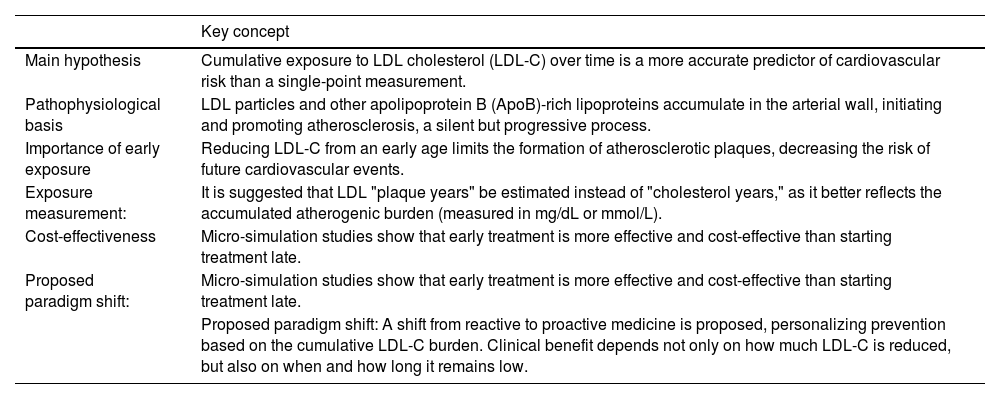
We therefore face a challenge and an opportunity (Table 1). We must transition from reactive medicine to proactive medicine, one that does not wait for risk to arise, but rather acts before plaque forms. This medicine does not just concentrate on the now, it calculates the impact of a lifetime of exposure. As a medical and scientific society, we have a duty to rethink our guidelines, to educate from a young age, to personalise prevention with tools that calculate this accumulated burden and guide long-term therapeutic goals. Ultimately, the time has come to focus not only on how much cholesterol we have today, but also on how long it has been elevated. Time is the critical variable in this equation, and the sooner we act, the more lives we will save.
Main concepts regarding cumulative exposure to LDL cholesterol (LDL-C) and its impact on lifetime cardiovascular risk.
| Key concept | |
|---|---|
| Main hypothesis | Cumulative exposure to LDL cholesterol (LDL-C) over time is a more accurate predictor of cardiovascular risk than a single-point measurement. |
| Pathophysiological basis | LDL particles and other apolipoprotein B (ApoB)-rich lipoproteins accumulate in the arterial wall, initiating and promoting atherosclerosis, a silent but progressive process. |
| Importance of early exposure | Reducing LDL-C from an early age limits the formation of atherosclerotic plaques, decreasing the risk of future cardiovascular events. |
| Exposure measurement: | It is suggested that LDL "plaque years" be estimated instead of "cholesterol years," as it better reflects the accumulated atherogenic burden (measured in mg/dL or mmol/L). |
| Cost-effectiveness | Micro-simulation studies show that early treatment is more effective and cost-effective than starting treatment late. |
| Proposed paradigm shift: | Micro-simulation studies show that early treatment is more effective and cost-effective than starting treatment late. |
| Proposed paradigm shift: A shift from reactive to proactive medicine is proposed, personalizing prevention based on the cumulative LDL-C burden. Clinical benefit depends not only on how much LDL-C is reduced, but also on when and how long it remains low. |
This document was prepared independently and has not been funded by any pharmaceutical company or business.
PP-M received fees for scientific consulting, lectures, and educational activities from Ferrer, Lilly, Novo-Nordisk, Boehringer Ingelheim, Daiichi-Sankyo, Amgen, and Esteve. JL-M received fees for scientific consulting, lectures, and educational activities from Sanofi, Amgen, Novartis, Esteve, and Ferrer.

