

metricas
Cirugía Española (English Edition) Delphi study robot consenso: Strategies for the implementation of robotic surger...
Journal Information
Vol. 104. Issue 10.
(October 2026)
Cite
Cite
Share
Download PDF
More article options
Visits
518
Vol. 104. Issue 10.
(October 2026)
Special article

Delphi study robot consenso: Strategies for the implementation of robotic surgery in general surgery in the Spanish hospital network

Estudio delphi robot consenso: estrategias para la implementación de la cirugía robótica en la especialidad de cirugía general y digestiva en la red hospitalaria española
Visits
518
Sara Gortázara, Ernesto Barzolab,
Corresponding author
drbarzola@gmail.com

Corresponding author.
, Ana Sánchezc, Mario Álvarez-Gallegod, Jacobo Trébole, Luis Sánchezf, Benedetto Ielpog, Asunción Acostah, Iván Arteagai, Jaime Iturbej, Carmen Cagigask, Jaime Lópeze, María Caballerol, Manuel Lozanom, Juan Carlos Gómez Rosadon, Juan Bellidon, Grupo Colaborativo ROBOT CONSENSO
a Servicio de Cirugía General y del Aparato Digestivo, Hospital Universitario de Getafe, Madrid, Spain
b Servicio de Cirugía General y del Aparato Digestivo, Hospital Clinic, Barcelona, Spain
c Servicio de Cirugía General y del Aparato Digestivo, Hospital Universitario Puerta de Hierro, Madrid, Spain
d Servicio de Cirugía General y del Aparato Digestivo, Hospital Universitario La Paz, Madrid, Spain
e Servicio de Cirugía General y del Aparato Digestivo, Hospital Clínico Universitario de Salamanca, Salamanca, Spain
f Servicio de Cirugía General y del Aparato Digestivo, Hospital Universitario de Elche, Elche, Spain
g Servicio de Cirugía General y del Aparato Digestivo, Hospital del Mar, Barcelona, Spain
h Servicio de Cirugía General y del Aparato Digestivo, Hospital Universitario Dr. Negrín, Gran Canaria, Spain
i Servicio de Cirugía General y del Aparato Digestivo, Hospital Universitario de Canarias, Tenerife, Spain
j Servicio de Cirugía General y del Aparato Digestivo, Hospital Universitario Central de Asturias, Oviedo, Spain
k Servicio de Cirugía General y del Aparato Digestivo, Hospital Universitario Marqués de Valdecilla, Santander, Spain
l Servicio de Cirugía General y del Aparato Digestivo, IVO – Instituto Valenciano de Oncología, Valencia, Spain
m Servicio de Cirugía General y del Aparato Digestivo, Hospital Universitario Virgen del Rocío, Sevilla, Spain
n Servicio de Cirugía General y del Aparato Digestivo, Hospital Virgen Macarena, Sevilla, Spain
Ver más
This item has received
Article information
Abstract
Full Text
Bibliography
Download PDF
Statistics
Abstract
Introduction

The implementation of robotic surgery in public hospitals presents multiple logistical, educational, and organizational challenges. In the absence of unified guidelines, a national consensus is required to optimize its safe and efficient adoption.

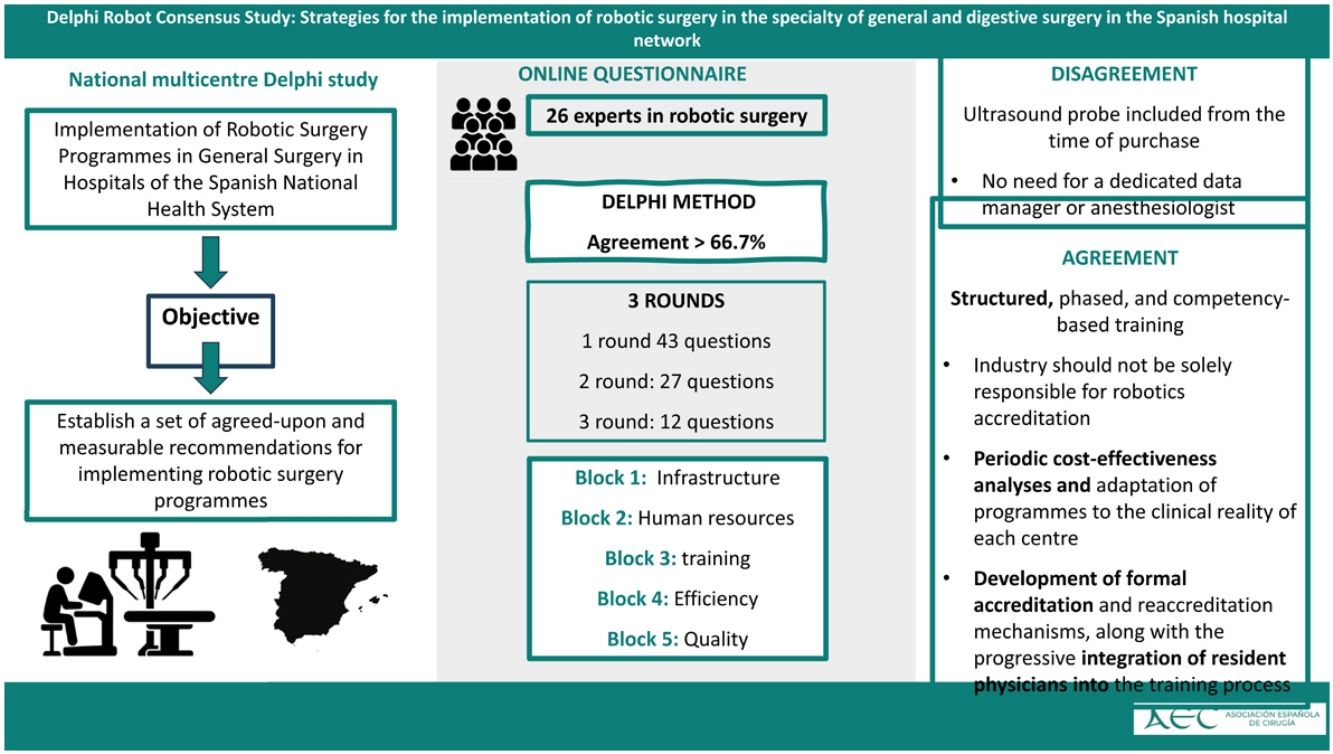
This study aimed to establish a set of consensus-based and measurable recommendations for the implementation of robotic surgery programs in hospitals within the Spanish National Health System, based on the experience of centres with established robotic programs and intended to serve as guidance for hospitals that are initiating or planning their implementation.

Methods

A national Delphi study was conducted with the participation of robotic surgery experts from 26 public hospitals. The expert panel was composed exclusively of digestive surgeons with experience in robotic surgery. Three iterative rounds of expert panel evaluation were conducted between March 2024 and March 2025. The questions were grouped into five thematic blocks. Consensus was defined as an agreement level of ≥66.7%. Kendall’s W coefficient was used to assess concordance.

Results

High levels of consensus were achieved on key aspects related to infrastructure, structured training, cost evaluation, and quality assurance mechanisms. Areas of disagreement were also identified, such as the need for a dedicated anaesthesiologist, purchase of accessory instruments during the initial phase, and official accreditation pathways.

Conclusions

This study provides a guideline for developing a national robotic surgery strategy focused on patient safety, program sustainability, and standardized training of surgical teams. These recommendations can guide hospitals at different stages of robotic technology adoption. Given that the consensus was reached from an exclusively surgical perspective, the recommendations focus on patient safety, program sustainability, and standardized training of the surgical team, and should be interpreted in an adaptable manner according to each centre’s context, case volume, and available resources.

Keywords:
Robotic Surgical Procedures
Surgery, Computer-Assisted
Delphi technique
Personnel, Hospital
Health policy
Resumen
Introducción

La implementación de la cirugía robótica en hospitales públicos presenta múltiples desafíos logísticos, formativos y organizativos. En ausencia de guías unificadas, se requiere un consenso nacional para optimizar su adopción segura y eficiente. El objetivo fue establecer un conjunto de recomendaciones consensuadas y medibles para la implementación de programas de cirugía robótica en hospitales del Sistema Nacional de Salud español, basadas en la experiencia de centros con programas robóticos consolidados y orientadas a servir de guía para hospitales que estén iniciando o planificando su implantación.

Métodos

Se realizó un estudio Delphi nacional con participación de expertos en cirugía robótica de 26 hospitales públicos. El panel estuvo compuesto exclusivamente por cirujanos digestivos con experiencia en cirugía robótica. Se desarrollaron tres rondas de consulta entre marzo de 2024 y marzo de 2025. Las preguntas se agruparon en cinco bloques temáticos. Se definió consenso como un nivel de acuerdo ≥66,7%. Se utilizó el coeficiente W de Kendall para evaluar la concordancia.

Resultados

Se alcanzaron altos niveles de consenso en aspectos clave relacionados con infraestructura, formación estructurada, evaluación de costes y mecanismos de calidad. Se identificaron también áreas de desacuerdo, como la figura del anestesista exclusivo, la compra de instrumental accesorio desde la fase inicial y las vías de acreditación oficial.

Conclusiones

Este estudio proporciona recomendaciones basadas en la experiencia de centros con programas de cirugía robótica consolidados, concebidas como una guía práctica para hospitales del Sistema Nacional de Salud que se encuentren en fases iniciales o de planificación de la adopción de esta tecnología. Dado que el consenso se obtuvo desde una perspectiva exclusivamente quirúrgica, las recomendaciones se centran en la seguridad del paciente, la sostenibilidad de los programas y la capacitación estandarizada del equipo quirúrgico, y deben interpretarse de forma adaptable al contexto, volumen de actividad y recursos disponibles de cada centro.

Palabras clave:
Cirugía Asistida por Robot
Técnica Delphi
Procedimientos Quirúrgicos Robóticos
Personal de Hospital
Política de Salud
Graphical abstract

Article

These are the options to access the full texts of the publication Cirugía Española (English Edition)
Subscriber
Subscriber

If you already have your login data, please click here .

If you have forgotten your password you can you can recover it by clicking here and selecting the option “I have forgotten my password”
Purchase
Purchase article

Purchasing article the PDF version will be downloaded

Purchase now
Contact
Phone for subscriptions and reporting of errors
From Monday to Friday from 9 a.m. to 6 p.m. (GMT + 1) except for the months of July and August which will be from 9 a.m. to 3 p.m.
Calls from Spain
932 415 960
Calls from outside Spain
+34 932 415 960
E-mail
References
[1]
Abex. Press release 2023. Abex Excelencia Robótica (ed) Spain [Internet]. 2023; 1-6. Available from: https://www.abexsl.es/f/documenti/Dossier de Prensa ABEX 2023.pdf.
[2]
L. Lawrie, K. Gillies, L. Davies, et al.
Current issues and future considerations for the wider implementation of robotic-assisted surgery: a qualitative study.
BMJ Open, 12 (2022),
[3]
L. Lawrie, K. Gillies, E. Duncan, L. Davies, D. Beard, M.K. Campbell.
Barriers and enablers to the effective implementation of robotic assisted surgery.
PLoS One [Internet], 17 (2022),
[4]
A. Gomolin, W. Gotlieb, S. Lau, S. Salvador, F. Racovitan, J. Abitbol.
Mandate to evaluate robotic surgery implementation: a 12-year retrospective analysis of impact and future implications.
J Robot Surg [Internet], 16 (2022), pp. 783-788
[5]
D. Beiderbeck, N. Frevel, H.A. von der Gracht, S.L. Schmidt, V.M. Schweitzer.
Preparing, conducting, and analyzing Delphi surveys: cross-disciplinary practices, new directions, and advancements.
MethodsX [Internet], 8 (2021),
[6]
K.M. Ramji, M.C. Cleghorn, J.M. Josse.
Comparison of Clinical and economic outcomes between robotic, laparoscopic, and open rectal cancer surgery: early experience at a tertiary care center.
Surg Endosc, 30 (2016), pp. 1337-1343
[7]
S. Pasupuleti.
The integration of robotic systems in healthcare infrastructure: challenges and solutions.
J Health Statist Rep, 2022 (2022), pp. 1-6
[8]
A. Pasquer, S. Ducarroz, J.C. Lifante, S. Skinner, G. Poncet, A. Duclos.
Operating room organization and surgical performance: a systematic review.
Patient Saf Surg [Internet], 18 (2024),
[9]
R.G. Olsen, F. Bjerrum, L. Konge, et al.
How experienced robotic nurses adapt to the HugoTM RAS system.
J Robot Surg [Internet], 18 (2024),
[10]
E. Barzola, P. Planellas, L. Cornejo, et al.
Impact of team experience on robot-assisted surgery for rectal cancer: A comparative study.
[11]
Y. Yao, H. Wang, Q. Zhang, H. Teng, H. Qi, Q. Zhang.
Learning curves for itinerant nurses to master the operation skill of Ti-robot-assisted spinal surgery equipment by CUSUM analysis: a pilot study.
PLoS One [Internet], 19 (2024),
[12]
M.S. Kim, W.J. Kim, W.J. Hyung.
Comprehensive learning curve of robotic surgery: discovery from a multicenter prospective trial of robotic gastrectomy.
[13]
P.C. Müller, C. Kuemmerli, A.T. Billeter.
Competency, proficiency, and mastery: learning curves for robotic distal pancreatectomy at 16 international expert centers.
[14]
P. Hertz, K. Houlind, J. Jepsen.
Identifying curriculum content for a cross-specialty robotic-assisted surgery training program: a Delphi study.
Surg Endosc, 36 (2021), pp. 7
[15]
R. Ao, K. Ho, M. Chang.
A systematic review of robotic surgery curricula using a contemporary educational framework.
[16]
B. Zhao, J. Lam, H.M. Hollandsworth.
General surgery training in the era of robotic surgery: a qualitative analysis of perceptions from resident and attending surgeons.
Surg Endosc, 36 (2020), pp. 2833-2841
[17]
Robotic-assisted surgery: A pathway to the future — Royal College of Surgeons [Internet] [accessed 2 Feb 2026]. Available from: https://www.rcseng.ac.uk/standards-and-research/standards-and-guidance/good-practice-guides/robotic-assisted-surgery/.
[18]
SAGES/MIRA Consensus Document on Robotic Surgery - A SAGES Publication [Internet] [accessed 2 Feb 2026]. Available from: https://www.sages.org/publications/guidelines/consensus-document-robotic-surgery/.
asdasdasd
Article options
Tools
