

metricas
Cirugía Española (English Edition) Defining safety limits in organ donation: The non-standard risk donor
Journal Information
Cite
Cite
Share
Download PDF
More article options
Visits
2261
Special article

Defining safety limits in organ donation: The non-standard risk donor

Definiendo límites de seguridad en la donación de órganos: el donante de riesgo no estándar
Visits
2261
Antonio Ríosa,b,c,
Corresponding author
arzrios@um.es

Corresponding author.
, Beatriz Mahíllod, Beatriz Domínguez-Gild
a Servicio de Cirugía General y del Aparato Digestivo, IMIB - Hospital Clínico Universitario Virgen de la Arrixaca, Murcia, Spain
b Departamento de Cirugía, Pediatría, Obstetricia y Ginecología, Universidad de Murcia, Murcia, Spain
c Director del Proyecto Colaborativo Internacional Donante, Murcia, Spain
d Organización Nacional de Trasplantes (ONT), Madrid, Spain
This item has received
Article information
Abstract
Full Text
Bibliography
Download PDF
Statistics
Abstract

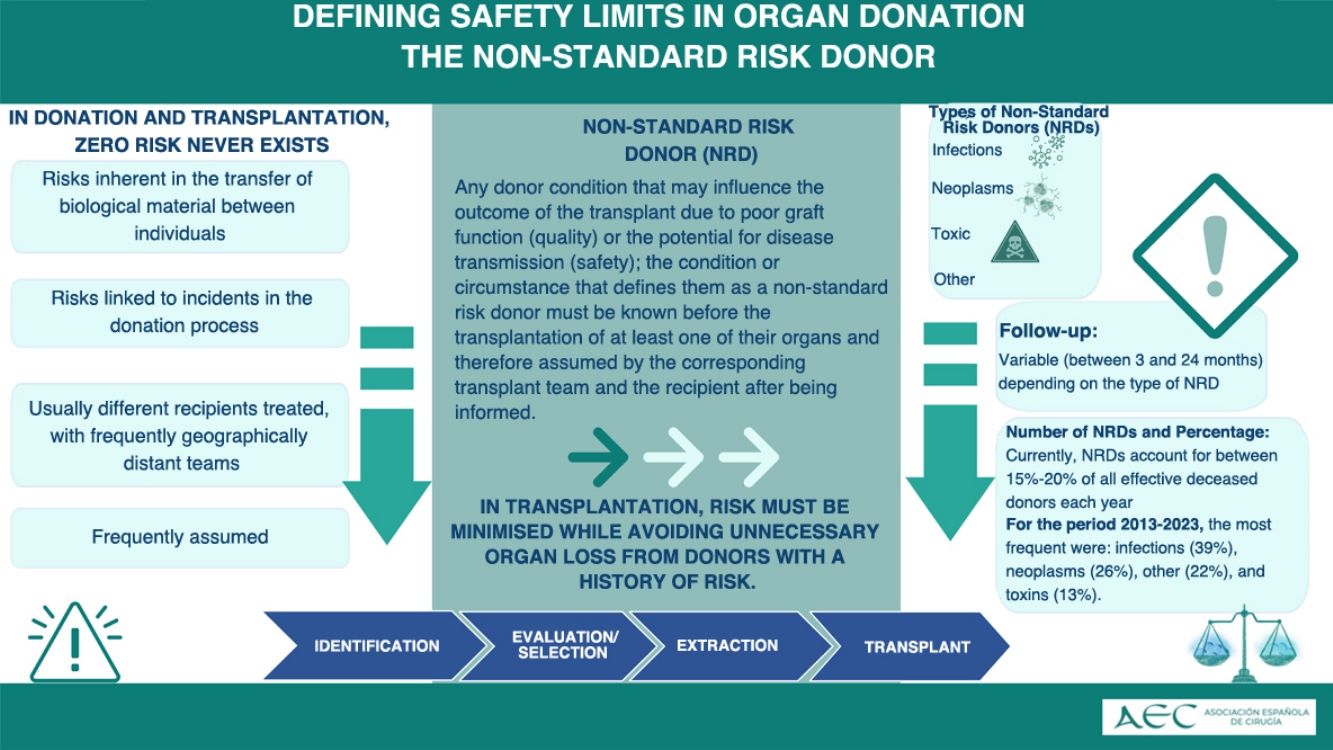
The transmission of diseases through organ transplantation is an inherent risk to the transfer of biological material between individuals. This risk must be minimised, while also avoiding the unnecessary loss of organs suitable for transplantation obtained from donors with a history of a condition that may affect organ function or may be transmitted to the recipient—such donors are referred to as non-standard risk donors. The final decision to transplant organs from these donors must be made following a thorough risk/benefit assessment.

To this end, the approach in Spain has been based on the provision of targeted support to transplant teams through the development and adoption of reference documents, a second-opinion system, and the generation of evidence through the prospective follow-up of recipients of organs transplanted from this type of donors.

Keywords:
Organ donation
Non-standard risk donor
Organ transplant
Infection
Neoplasms
Poisoning
Neurodegenerative diseases
Low prevalence diseases
Resumen

La transmisión de enfermedades a través del trasplante de órganos es un riesgo inherente a la transferencia de material biológico entre individuos. Tal riesgo ha de minimizarse, al tiempo que se debe evitar la pérdida innecesaria de órganos para trasplante a partir de donantes con el antecedente de una condición que puede afectar al funcionamiento del órgano o transmitirse al receptor. A este tipo de donante se le denomina donante de riesgo no estándar. La decisión final de trasplantar los órganos de estos donantes ha de ser tomada tras una pormenorizada evaluación del riesgo/beneficio.

Para ello, el abordaje en España se ha basado en el apoyo a los profesionales de los equipos trasplantadores, mediante la elaboración y adopción de documentos de referencia, un sistema de segunda opinión y la generación de evidencia mediante el seguimiento prospectivo de los receptores de órganos que se trasplantan a partir de este tipo de donantes.

Palabras clave:
Donación de órganos
Donante de riesgo no estándar
Trasplante de Órganos
Infección
Neoplasias
Intoxicaciones
Enfermedades neurodegenerativas
Enfermedades de baja prevalencia
Graphical abstract

Article

These are the options to access the full texts of the publication Cirugía Española (English Edition)
Subscriber
Subscriber

If you already have your login data, please click here .

If you have forgotten your password you can you can recover it by clicking here and selecting the option “I have forgotten my password”
Purchase
Purchase article

Purchasing article the PDF version will be downloaded

Purchase now
Contact
Phone for subscriptions and reporting of errors
From Monday to Friday from 9 a.m. to 6 p.m. (GMT + 1) except for the months of July and August which will be from 9 a.m. to 3 p.m.
Calls from Spain
932 415 960
Calls from outside Spain
+34 932 415 960
E-mail
References
[1]
A. Ríos.
El proceso de donación y trasplante de órganos. Desde la Sociedad hasta la Clínica,
[2]
D.R. Kaul, G. Vece, E. Blumberg, et al.
Ten years of donor-derived disease: a report of the disease transmission advisory committee.
Am J Transplant, 21 (2021), pp. 689-702
[3]
B. Domínguez-Gil, K. Moench, C. Watson, et al.
Prevention and management of donor-transmitted cancer after liver transplantation: guidelines from the ILTS-SETH consensus Conference.
Transplantation, 106 (2022), pp. e12-e29
[4]
Documento de Consenso sobre la Evaluación del Donante de Órganos para prevenir la Transmisión de Enfermedades Neoplásicas. Organización Nacional de Trasplantes. http://www.ont.es/infesp/Paginas/DocumentosdeConsenso.aspx (Latest consultation 4 March 2025).
[5]
B. Mahíllo, S. Martín, E. Molano, et al.
Malignancies in deceased organ donors: the Spanish experience.
Transplantation, 106 (2022), pp. 1814-1823
[6]
Guía del Consejo de Europa sobre la Calidad y la Seguridad de los Órganos para Trasplante. https://www.edqm.eu/en/guide-quality-and-safety-of-organs-for-transplantation (Latest consultation 4 April 2025).
[7]
Biovigilancia. Sistema Nacional de Notificación y Gestión de Reacciones y Eventos Adversos en la Donación y el Trasplante de Organos: https://www.ont.es/wp-content/uploads/2023/06/5.-2.-Sistema-nacional-de-notificacion-y-gestion-de-reacciones-y-eventos-adversos-en-donacion-y-trasplante-de-organos.pdf (Latest consultation 4 April 2025).
[8]
Documento de Consenso para la valoración de donantes con serología positiva para el virus de la hepatitis C. Organización Nacional de Trasplantes. http://www.ont.es/infesp/Paginas/DocumentosdeConsenso.aspx (Latest consultation 4 March 2025).
[9]
O. Len, I. Los-Arcos, J.M. Aguado, et al.
Executive summary of the Consensus Statement of the Transplant Infection Study Group (GESITRA) of the Spanish Society of Infectious Diseases and Clinical Microbiology (SEIMC) and the National Transplant Organization (ONT) on the selection criteria of donors of solid organs in relation to infectious diseases.
Enferm Infecc Microbiol Clin (Engl Ed), 38 (2020), pp. 379-389
[10]
O. Len, I. Los-Arcos, J.M. Aguado, et al.
Grupo de Estudio de la Infección en el Trasplante (GESITRA) of the Sociedad Española de Enfermedades Infecciosas y Microbiología Clínica (SEIMC) and the Organización Nacional de Trasplantes (ONT). Selection criteria of solid organ donors in relation to infectious diseases: a Spanish consensus.
Transplant Rev (Orlando), 34 (2020),
[11]
Documento de Consenso del Grupo de Estudio de la Infección en el Trasplante (GESITRA) perteneciente a la Sociedad Española de Enfermedades Infecciosas y Microbiología Clínica (SEIMC) y la Organización Nacional de Trasplantes (ONT) sobre los Criterios de Selección del Donante de Órganos Sólidos en Relación a las Enfermedades Infecciosas. https://www.ont.es/wp-content/uploads/2023/06/CRITER2.pdf (Latest consultation 4 April 2025).
[12]
E. Levesque, C. Paugam-Burtz, F. Saliba, et al.
Fungal complications after Candida preservation fluid contamination in liver transplant recipients.
Transpl Int, 28 (2015), pp. 1308-1316
[13]
I. Oriol, N. Sabe, J. Càmara, et al.
The impact of culturing the organ preservation fluid on solid organ transplantation: a prospective multicenter cohort study.
Open Forum Infect Dis, 6 (2019),
[14]
Documento de Consenso sobre Valoración de los Donantes con Virus de la Hepatitis C. https://www.ont.es/wp-content/uploads/2023/06/Documento-Consenso-Valoracion-Donantes-Virus-C.-Abril-2019.pdf (Latest consultation 4 April 2025).
[15]
C.M. Durand, A. Massie, S. Florman, et al.
Safety of kidney transplantation from donors with HIV.
N Engl J Med, 391 (2024), pp. 1390-1401
[16]
M. Sabra, O. Ilonze, R.A. Rao, K. Saleem, M.E. Guglin.
Donor substance abuse and heart transplantation outcomes.
Heart Fail Rev, 28 (2023), pp. 207-215
[17]
G. MacGowan, J.H. Dark, P.A. Corris, A.R. Nair.
Effects of drug abuse, smoking and alcohol on donor hearts and lungs.
Transplant Int, 32 (2019), pp. 1019-1027
[18]
D.J. Arenas, S. Beltran, S. Zhou, L.R. Goldberg.
Cocaine, cardiomyopathy, and heart failure: a systematic review and meta-analysis.
[19]
M.J. Bentley, J.C. Mullen, S.R. Lopushinsky, D.L. Modry.
Successful cardiac transplantation with methanol or carbon monoxide-poisoned donors.
Ann Thorac Surg, 71 (2001), pp. 1194
[20]
Z. Jaff, W.F. McIntyre, P. Yazdan-Ashoori, A. Baranchuk.
Impact of methanol intoxication on the human electrocardiogram.
Cardiol J, 21 (2014), pp. 170-175
[21]
Documento de Consenso sobre Recomendaciones Nacionales sobre Donación en Asistolia Controlada en Pacientes con Enfermedades Neurodegenerativas. Organización Nacional de Trasplantes. http://www.ont.es/infesp/Paginas/DocumentosdeConsenso.aspx (Ultima consulta 4 de Marzo del 2025).
asdasdasd
Article options
Tools
