
Bacterial infections are among the main determinants of morbidity and mortality in patients with cirrhosis. Infections caused by multidrug-resistant organisms (MDROs) are a growing threat to this vulnerable population, causing significantly higher in-hospital mortality [1].
Given that resistance patterns vary substantially across regions and over time, comparing local data from high-risk groups with established general-population surveillance systems may help to contextualise the magnitude of the problem. Therefore, this study describes antimicrobial resistance (AMR) rates among pre-specified pathogens isolated from invasive infections in patients with cirrhosis within a multicentre Latin American registry and compares them with AMR estimates from Latin American and European general-population surveillance reports.
2Materials and methods2.1Study design and populationThis was a cross-sectional study using the database of the Latin American Registry of Bacterial Infections in Patients with Cirrhosis (ClinicalTrials.gov: NCT03919032). This prospective registry includes adults ≥ 18 years with cirrhosis who are admitted with or develop a bacterial infection during hospitalization in four countries (Argentina, Uruguay, Brazil, and Peru). For the present analysis, we included all cases recorded between 1 December 2020 and 31 May 2025 with microbiological confirmation of invasive infection exclusively from one of the following sterile sites: blood, ascitic, or pleural fluid.
2.2VariablesThe bacterial isolate was the primary unit of analysis. Patient- and episode-related variables were described as attributes of the source patient or the infectious episode corresponding to each isolate. Data were collected on antimicrobial susceptibility patterns of key pathogens of clinical and epidemiological interest: Escherichia coli, Klebsiella pneumoniae, Pseudomonas aeruginosa, Acinetobacter spp., Staphylococcus aureus, and Enterococcus faecium. Resistance was assessed for key antibiotics using pre-specified, organism-specific panels.
Two AMR surveillance reports were used as comparators: (1) the 2025 Argentine annual AMR surveillance report issued by the National Antimicrobial Resistance Surveillance Network (WHONET-Argentina) [2]; and (2) the 2025 annual report of the European Antimicrobial Resistance Surveillance Network (EARS-Net) [3]. These reports do not specifically describe patients with cirrhosis; rather, they provide population-level AMR estimates from routine surveillance systems and were used as external epidemiological benchmarks rather than matched comparator cohorts.
Further details on registry procedures, data collection, quality assurance, definition of study variables and further details on the comparator surveillance reports are provided in the Supplementary Material.
2.3Statistical analysisResistance proportions were estimated with 95% confidence intervals (95% CI) using cluster-robust variance estimates at the patient level to account for the non-independence of bacterial isolates nested within the same patient. Comparisons with external surveillance sources were conducted as descriptive benchmarking, without formal hypothesis testing between non-comparable populations.
2.4Ethical statementThis study was performed in line with the principles of the Declaration of Helsinki. Approval was granted by the Ethics Committee of the Hospital Italiano de Buenos Aires, Argentina (October 2020, Protocol No. 5821).
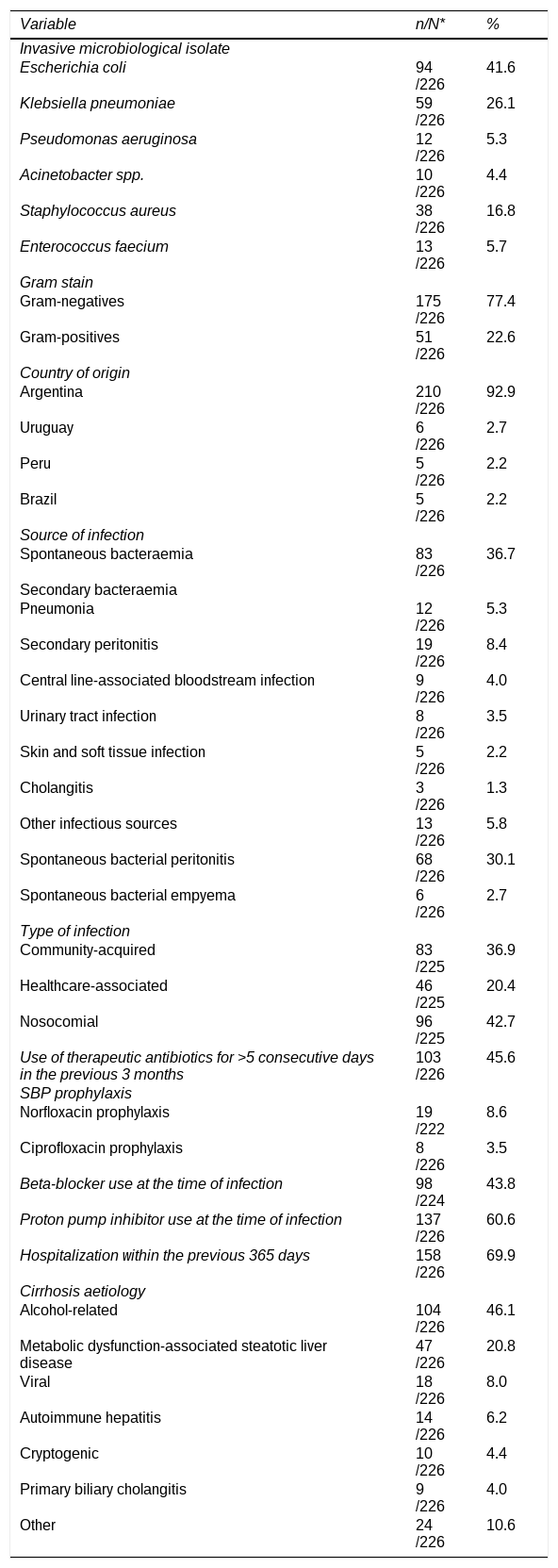
3ResultsDuring the study period, the registry collected 908 bacterial isolates. Of these, 226 invasive isolates, corresponding to 215 infectious episodes in 197 patients, met the inclusion criteria and were included in the present analysis. Their characteristics, together with those of the corresponding patients and infectious episodes, are summarised in Table 1.
Characteristics of the invasive microbiological isolates and of the corresponding patients/infectious episodes (n=226).
*n/N: data are presented as the number of observations over the total number of isolates with available information for each variable. Differences in the denominator relative to the total of 226 isolates reflect missing data.
The bacterial isolate was the primary unit of analysis. Therefore, all variables are presented at the isolate level. Patient- and episode-related variables reflect the characteristics of the source patient or the infectious episode corresponding to each isolate; a given patient could contribute more than one isolate.
Most isolates were Gram-negative organisms (77.4%). The most frequent pathogens were E. coli (41.6%), K. pneumoniae (26.1%), and S. aureus (16.8%).
Among invasive isolates, the most frequent underlying sources of infection were spontaneous bacteraemia (36.7%) and spontaneous bacterial peritonitis (SBP, 30.1%). Nosocomial infections accounted for 42.7% of isolates.
The median age of the source patients was 62.3 years (IQR 54.9–69.1), and 74.3% of isolates corresponded to male patients. The median Child–Pugh and MELD-Na scores of the corresponding patients were 11 (IQR 9–12) and 24.1 (IQR 18.4–30.2), respectively. Overall, 45.6% of isolates were obtained from patients who had received therapeutic antibiotics for more than 5 consecutive days in the previous 3 months, and 69.9% from patients with a hospital admission within the previous year.
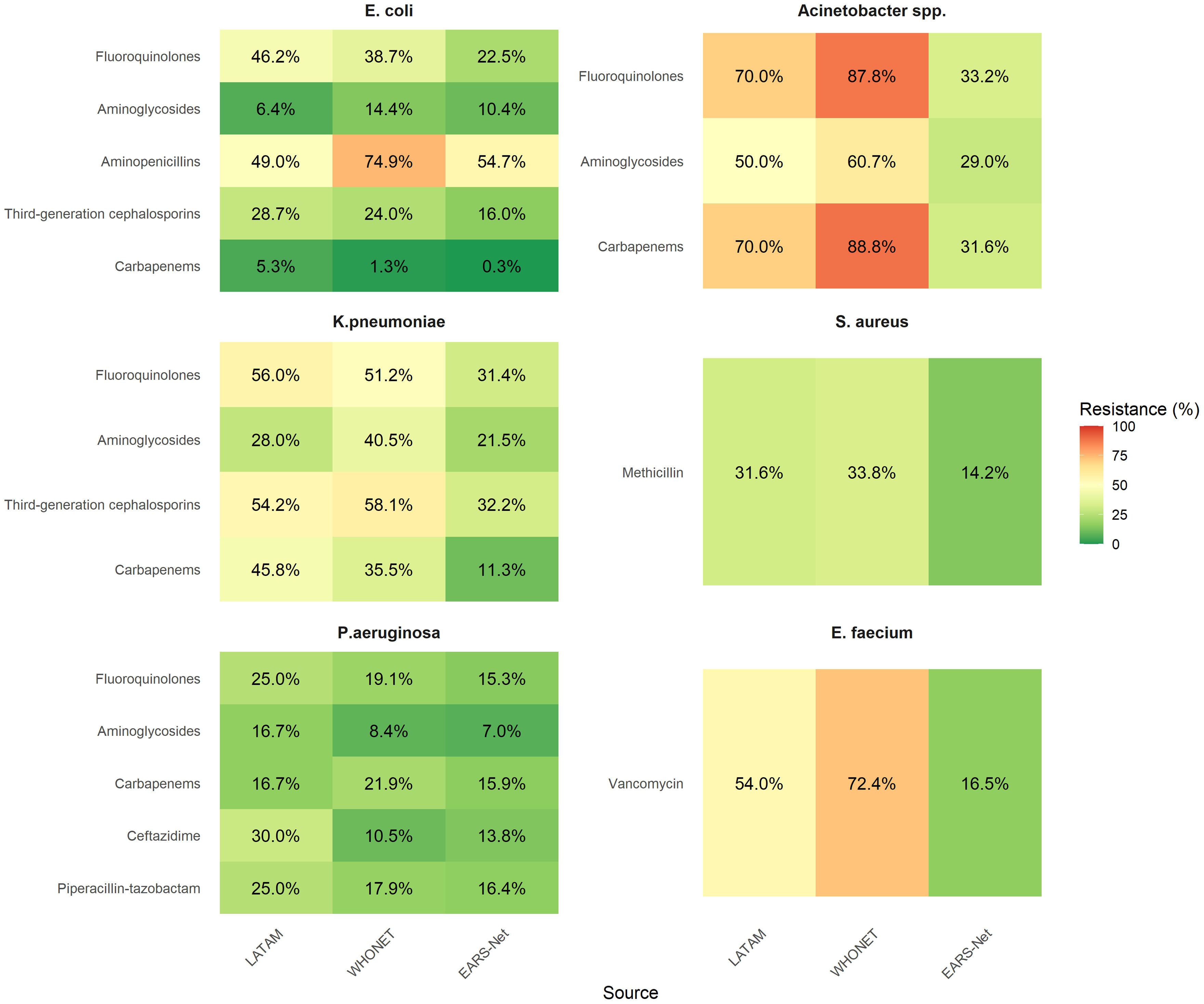
3.1Antimicrobial resistance profileThe proportion of resistant organisms according to pathogen–antibiotic class combinations is summarised in Fig. 1 and Table S1. E. coli showed high resistance to aminopenicillins (49%, 95% CI 38.5–59.4) and fluoroquinolones (46.2%, 95% CI 35.9–56.9); K. pneumoniae to third-generation cephalosporins (54.2%, 95% CI 41.1–66.8) and carbapenems (45.8%, 95% CI 33.3–58.8); and E. faecium to vancomycin (54%, 95% CI 24.8–80.5).
Antibiotic resistance heatmaps across surveillance sources. Heatmaps show the percentage of resistant invasive isolates for selected organism–antibiotic class combinations in three data sources: The Latin American cirrhosis registry cohort, WHONET-Argentina11 Informe anual de la vigilancia de la resistencia a antimicrobianos 2024 - Red WHONET Argentina. Annual Epidemiological Report on Communicable Diseases in Europe 2024. European Centre for Disease Prevention and Control.
Fig. 1 and Table S1 summarise resistance percentages for the microbiological isolates of interest in the study cohort and compare them with WHONET Network and EARS-Net data. Overall, resistance exceeded European reference values for several pathogen–antibiotic combinations, particularly for E. coli, K. pneumoniae, and P. aeruginosa. By contrast, resistance in Acinetobacter spp., methicillin-resistant S. aureus, and vancomycin-resistant E. faecium was broadly comparable to WHONET data, although still higher than that reported in the European surveillance report.
4DiscussionWe observed a substantial burden of AMR in invasive isolates of epidemiologically important pathogens recovered from patients with cirrhosis in Latin America. Resistance was particularly high in E. coli to aminopenicillins (49%) and fluoroquinolones (46.2%), in K. pneumoniae to third-generation cephalosporins (54.2%) and carbapenems (45.8%), and in E. faecium to vancomycin (54%). Across several pathogen–antibiotic combinations, resistance was consistently higher than that observed in European reference data, although overall it was comparable to regional data from the WHONET-Argentina network.
Comparison with external surveillance systems helps place these findings within a broader epidemiological context. First, the overall similarity to WHONET-Argentina data suggests that the high resistance pressure documented at the general population level in the region is also reflected in invasive infections among patients with cirrhosis. Secondly, the differences relative to EARS-Net reinforce the marked geographical heterogeneity in resistance profiles. This observation is consistent with the available regional evidence, which shows that the burden of multidrug-resistant organisms in Latin America is high and sustained [4].
The magnitude of resistance observed in our cohort probably reflects the convergence of several clinical and epidemiological factors, including a high proportion of nosocomial infections (42.7%), recent antibiotic exposure (45.6%), prior hospitalization (69.9%), and advanced liver disease (median Child–Pugh score of 11 and a median MELD-Na score of 24.1). Together, these features suggest a population with substantial exposure to healthcare settings and antimicrobial treatment, which may favour the selection and persistence of multidrug-resistant organisms. However, this interpretation should be approached with caution, as the study design does not permit causal inference.
5ConclusionsIn conclusion, antimicrobial resistance in invasive bacterial infections among patients with cirrhosis in Latin America was substantial, particularly among clinically relevant Gram-negative pathogens and E. faecium. These findings provide region-specific evidence to support empirical treatment decisions, reinforce the need for local microbiological data, and highlight the importance of sustained AMR surveillance and stewardship strategies tailored to this high-risk population.
FundingThe John C. Martin Foundation and Sociedad Argentina de Hepatologia.
Author contributionsAll authors contributed to the study conception and design. Material preparation and data collection were performed by A.S., G.G.P., and S.M. Statistical analysis was performed by S.M. The first draft of the manuscript was written by E.D.D.L., and all authors commented on previous versions of the manuscript. All authors read and approved the final manuscript.
Data availabilityThe datasets generated during and/or analysed during the current study are not publicly available due to institutional privacy policies but are available from the corresponding author on reasonable request.
Declaration of generative AI and AI-assisted technologies in the writing processDuring the preparation of this work, the authors used ChatGPT 4.0 to refine language, facilitating the creation of clear, concise, and coherent content. After using these tools, the authors reviewed and edited the content as needed and take full responsibility for the publication's content.
Ethics declarationWritten informed consent to take part in the study and to publish the article has been obtained from all participants or their legal representatives. The privacy rights of participants have been observed.
This study was performed in compliance with relevant laws, regulatory frameworks and guidelines where the research took place. This study was approved by the Ethics Committee of the Hospital Italiano de Buenos Aires, Argentina. (Approval No. 5821)
The authors have no relevant financial or non-financial interests to disclose.
We thank the Argentine Society of Hepatology (SAHE), the Latin American Association for the Study of the Liver (ALEH), Hospital Italiano de Buenos Aires, and the JC Martin Foundation for their valuable institutional support and for their assistance in disseminating this work.


articles