

metricas
Actas Urológicas Españolas (English Edition) Impact of surgical waiting list on oncological outcomes of radical prostatectomy...
Journal Information
Cite
Cite
Share
Download PDF
More article options
Visits
1175
Original article

Impact of surgical waiting list on oncological outcomes of radical prostatectomy in patients with intermediate- and high-risk prostate cancer

Impacto de la lista de espera quirúrgica en los resultados oncológicos de la prostatectomía radical en pacientes con cáncer de próstata de riesgo intermedio y alto
Visits
1175
P. de Pablos-Rodrígueza,
Corresponding author
pablos.rodriguez92@gmail.com

Corresponding author.
, P. Guedes Olivab, Á. Gómez Ferrera, M. Beamud Cortésa, A. Wong Gutiérreza, C. Gutiérrez Castañéa, A. Calatrava Fonsc, J. Aliaga Patiñoc, Á. García Cortésa, J. Agustín Lópeza, A. Collado Serraa, V. Rodríguez Parta, J.L. Casanova Ramón Borjaa
a Departamento de Urología, Fundación Instituto Valenciano de Oncología, Valencia, Spain
b Departamento de Urología, Hospital Universitario Dr. Negrín, Las Palmas de Gran Canaria, Spain
c Departamento de Anatomía Patológica, Fundación Instituto Valenciano de Oncología, Valencia, Spain
This item has received
Article information
Abstract
Full Text
Bibliography
Download PDF
Statistics
Abstract
Introduction

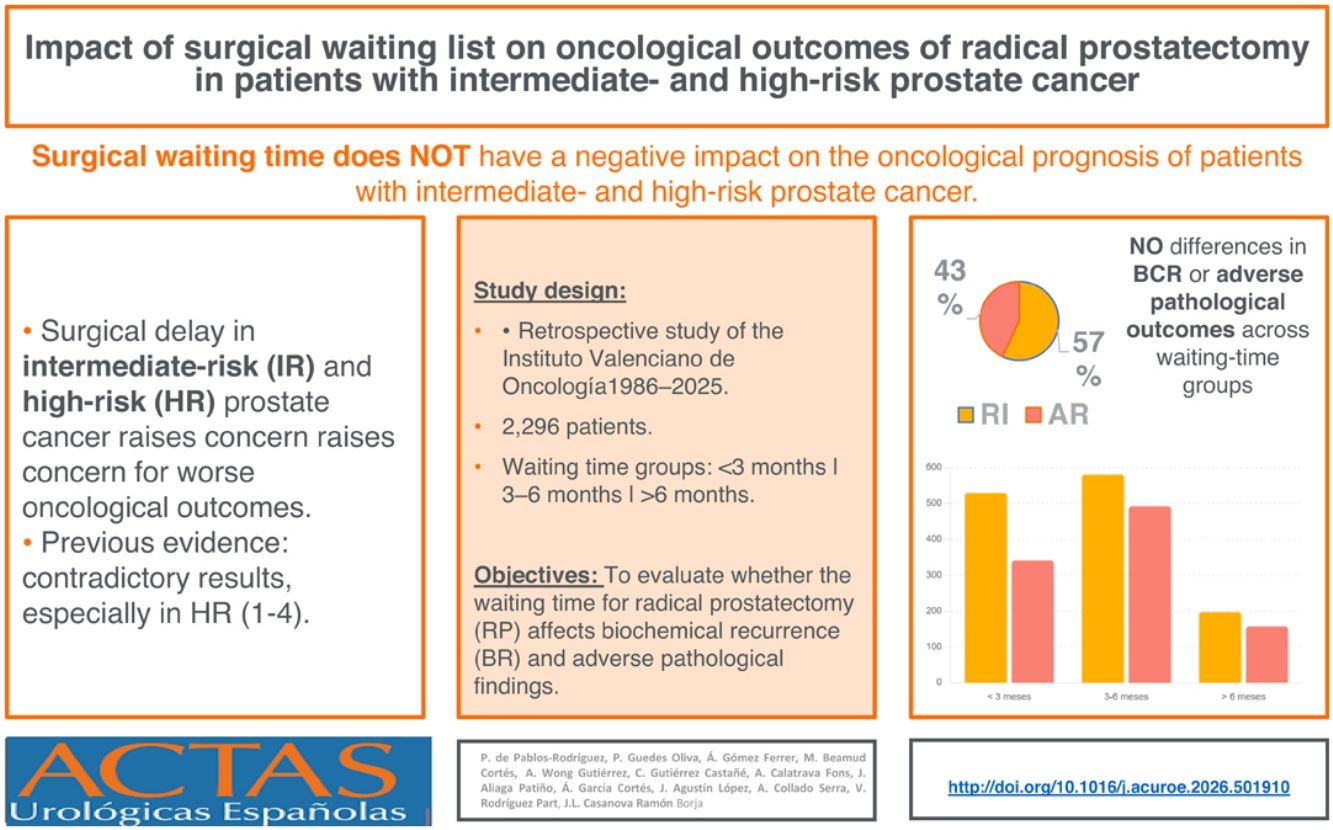
The prognosis of localized prostate cancer (PCa) following radical treatment is generally favorable, although up to 46% of patients may still experience adverse outcomes. The impact of delayed surgery in intermediate-risk (IR) or high-risk (HR) patients remains under discussion. This study evaluates its association with oncological outcomes.

Materials and methods

Retrospective study of 2296 patients with IR and HR PCa who underwent radical prostatectomy (RP) between 1986 and 2025. Upgrading, upstaging, positive margins, PSA persistence, and lymph node involvement were analyzed. Waiting time was grouped into <3, 3–6, and >6 months.

Results

The median waiting time was 3.5 months. Eighty-five percent of patients were operated on within 6 months. At 5 years, no difference was detected between waiting time and time to biochemical recurrence (BCR) when comparing the <3-month group with the 3–6-month group (HR 0.93; 95% CI 0.76–1.13) and the >6 months group (HR 0.74; 95% CI 0.53–1.04) among IR patients. In HR patients, no differences were observed either: 3–6 months (HR 0.85; 95% CI 0.71–1.01) and >6 months (HR 0.79; 95% CI 0.61–1.03). No increased risk of adverse pathological outcomes was found with longer delays.

Conclusions

A waiting time of ≤6 months was not associated with worse oncological prognosis, supporting its safety in IR or HR PCa.

Keywords:
Prostate cancer
Biochemical recurrence
Prostatectomy
Waiting time
Resumen
Introducción

El cáncer de próstata (CaP) localizado suele tener buen pronóstico tras tratamiento radical, aunque hasta un 46% puede evolucionar negativamente. El impacto del retraso quirúrgico en pacientes de riesgo intermedio (RI) o alto (AR) continúa en discusión. Este estudio evalúa su asociación con los resultados oncológicos.

Material y métodos

Estudio retrospectivo de 2.296 pacientes con CaP de RI y AR sometidos a prostatectomía radical (PR) entre 1986 y 2025. Se analizaron upgrading, upstaging, márgenes positivos, persistencia de PSA y afectación ganglionar. El tiempo de espera se agrupó en <3, 3–6 y >6 meses.

Resultados

La mediana de espera fue 3,5 meses. El 85% de los pacientes fue intervenido antes de los 6 meses. A 5 años, no se detectó ninguna diferencia entre el tiempo de espera y el tiempo hasta la RB al comparar el grupo de <3 meses, con el grupo de 3–6 meses (HR 0.93; IC95% 0.76–1.13) y el de >6 meses (HR 0.74; IC95% 0.53–1.04) de RI. En AR tampoco se observaron diferencias: 3–6 meses (HR 0.85; IC95% 0.71–1.01) y >6 meses (HR 0.79; IC95% 0.61–1.03). No se evidenció mayor riesgo de resultados patológicos adversos con mayor demora.

Conclusiones

Una espera ≤6 meses no se asoció a peor pronóstico oncológico, apoyando su seguridad en CaP de RI o AR.

Palabras clave:
Cáncer de próstata
Recidiva bioquímica
Prostatectomía
Tiempo de espera
Graphical abstract

Article

These are the options to access the full texts of the publication Actas Urológicas Españolas (English Edition)
Subscriber
Subscriber

If you already have your login data, please click here .

If you have forgotten your password you can you can recover it by clicking here and selecting the option “I have forgotten my password”
Purchase
Purchase article

Purchasing article the PDF version will be downloaded

Purchase now
Contact
Phone for subscriptions and reporting of errors
From Monday to Friday from 9 a.m. to 6 p.m. (GMT + 1) except for the months of July and August which will be from 9 a.m. to 3 p.m.
Calls from Spain
932 415 960
Calls from outside Spain
+34 932 415 960
E-mail
References
[1]
U.G. Falagario, A. Abbadi, S. Remmers, L. Björnebo, D. Bogdanovic, A. Martini, et al.
Biochemical recurrence and risk of mortality following radiotherapy or radical prostatectomy.
JAMA Netw Open, 6 (2023),
[2]
D.D. Nguyen, L. Haeuser, M. Paciotti, C. Reitblat, J. Cellini, S.R. Lipsitz, et al.
Systematic review of time to definitive treatment for intermediate risk and high risk prostate cancer: are delays associated with worse outcomes?.
J Urol, 205 (2021), pp. 1263-1274
[3]
E. Laukhtina, R. Sari Motlagh, K. Mori, F. Quhal, V.M. Schuettfort, H. Mostafaei, et al.
Oncologic impact of delaying radical prostatectomy in men with intermediate- and high-risk prostate cancer: a systematic review.
World J Urol, 39 (2021), pp. 4085-4099
[4]
J. Luu, R.M. Antar, C. Farag, S. Simmens, M.J. Whalen.
Delaying surgery in favorable-risk prostate cancer patients: an NCDB analysis of oncologic outcomes.
Clin Genitourin Cancer [Internet], 22 (2024),
[5]
European Association of Urology.
EAU guidelines on prostate cancer, Arnhem, The Netherlands, (2024),
[6]
M. Pattou, Y. Neuzillet, T. Ghoneim, P.O. Bosset, V. Vanalderverelt, D. Bohin, et al.
Evaluating the safety of delaying surgery beyond 9 months in localized prostate cancer patients: results from a prospective study with propensity score matching.
Int J Urol, 39 (2025), pp. 1243-1249
[7]
A. Nathan, C. Gao, A. Light, C. Alexander, V. Chan, K. Gallagher, et al.
Early oncological outcomes of delayed radical prostatectomy: a prospective, international, follow-up analysis of the COVIDSurg-cancer study.
BJUI Compass, 5 (2024), pp. 1314-1323
[8]
Gobierno de Navarra. Decreto foral 21/2010 2010:15.
[9]
Gobierno de Aragón. Decreto 83/2003, de 29 de Abr. 20003. 10.
[10]
S. Narita, K. Mitsuzuka, N. Tsuchiya, T. Koie, S. Kawamura, C. Ohyama, et al.
Clinical investigation reassessment of the risk factors for biochemical recurrence in D’ Amico intermediate-risk prostate cancer treated using radical prostatectomy.
Int J Urol, 22 (2015), pp. 1029-1035
[11]
O. Yossepowitch, A. Briganti, J.A. Eastham, J. Epstein, M. Graefen, R. Montironi, et al.
Positive surgical margins after radical prostatectomy: a systematic review and contemporary update.
[12]
F. Preisser, M. Marchioni, S. Nazzani, M. Bandini, Z. Tian, R.S. Pompe, et al.
The impact of lymph node metastases burden at radical prostatectomy.
Eur Urol Focus, 5 (2017), pp. 399-406
[13]
Y. Wang, K. Liu, L. Li.
Predictive factors for Gleason score upgrading in patients with prostate cancer after radical prostatectomy: a systematic review and meta-analysis.
Urol Int, 107 (2023), pp. 460-479
[14]
F.C. Hamdy, J.L. Donovan, J.A. Lane, C. Metcalfe, M. Davis, E.L. Turner, et al.
Fifteen-year outcomes after monitoring, surgery, or radiotherapy for prostate cancer.
N Engl J Med, 388 (2023), pp. 1547-1558
[15]
M.C. Lee, T.R. Erickson, S. Stock, L.E. Howard, A.M. De Hoedt, C.L. Amling, et al.
Association between delay to radical prostatectomy and clinically meaningful outcomes among patients with intermediate and High-risk localized prostate cancer.
[16]
N. Fossati, M.S. Rossi, V. Cucchiara, G. Gandaglia, P. Dell’Oglio, M. Moschini, et al.
Evaluating the effect of time from prostate cancer diagnosis to radical prostatectomy on cancer control: can surgery be postponed safely?.
Urol Oncol Semin Orig Invest, 35 (2017), pp. 150.e9-150.e15
[17]
R. Diamand, G. Ploussard, M. Roumiguié, M. Oderda, D. Benamran, G. Fiard, et al.
Timing and delay of radical prostatectomy do not lead to adverse oncologic outcomes: results from a large European cohort at the times of COVID-19 pandemic.
World J Urol, 39 (2020), pp. 1789-1796
[18]
L. Xia, R. Talwar, R.R. Chelluri, T.J. Guzzo, D.J. Lee.
Surgical delay and pathological outcomes for clinically localized High-risk prostate cancer.
JAMA Netw Open, 3 (2020),
[19]
R. Korets, C.M. Seager, M.S. Pitman, G.W. Hruby, M.C. Benson, J.M. McKiernan.
Effect of delaying surgery on radical prostatectomy outcomes: a contemporary analysis.
[20]
N. Gupta, T.J. Bivalacqua, M. Han, M.A. Gorin, B.J. Challacombe, A.W. Partin, et al.
Evaluating the impact of length of time from diagnosis to surgery in patients with unfavourable intermediate-risk to very-high-risk clinically localised prostate cancer.
BJU Int, 124 (2019), pp. 268-274
[21]
M. Zanaty, M. Alnazari, K. Ajib, K. Lawson, M. Azizi, E. Rajih, et al.
Does surgical delay for radical prostatectomy affect biochemical recurrence? A retrospective analysis from a Canadian cohort.
World J Urol, 36 (2018), pp. 1-6
[22]
M.A. Morini, R.L. Muller, P.C.B. de Castro Junior, R.J. de Souza, E.F. Faria.
Time between diagnosis and surgical treatment on pathological and clinical outcomes in prostate cancer: does it matter?.
World J Urol, 36 (2018), pp. 1225-1231
[23]
M.R. Abern, W.J. Aronson, M.K. Terris, C.J. Kane Jr., J.C.P.C.L. Amling, et al.
Delayed radical prostatectomy for intermediate-risk prostate cancer is associated with biochemical recurrence: possible implications for active surveillance from the search database.
Prostate, 73 (2013), pp. 409-417
[24]
F. Di Maida, A.A. Grosso, L. Lambertini, D. Paganelli, A. Marzocco, V. Salamone, et al.
Is it safe to defer prostate cancer treatment? Assessing the impact of surgical delay on the risk of pathological upstaging after robot-assisted radical prostatectomy.
[25]
K.B. Ginsburg, G.L. Curtis, R.E. Timar, A.K. George, M.L. Cher.
Delayed radical prostatectomy is not associated with adverse oncologic outcomes: implications for men experiencing surgical delay due to the COVID-19 pandemic.
J Urol, 204 (2020), pp. 720-724
[26]
S. Occhipinti, N. Dunglison, L. Zajdlewicz, G.D. Coughlin, J.W. Yaxley, R.A. Gardiner, et al.
A prospective study of psychological distress after prostate cancer surgery.
Psychooncology, 28 (2019), pp. 2389-2395
asdasdasd
Article options
Tools
